
1. Background
Chronic liver disease (CLD) and viral hepatitis remain major global health concerns, accounting for substantial morbidity and mortality worldwide. An estimated 304 million people live with chronic hepatitis B or C, and these infections were responsible for approximately 1.3 million deaths in 2022, primarily due to cirrhosis and hepatocellular carcinoma (1). Hepatitis B virus (HBV) and hepatitis C virus (HCV) are particularly pervasive; together, they represent a leading cause of chronic liver injury that progresses over many years, often silently, until advanced liver failure develops (1, 2). The World Health Organization reports that 254 million people live with chronic HBV infection and approximately 50 million live with chronic HCV infection globally, underscoring the magnitude of the disease burden (1, 3).
Patients awaiting liver transplantation for chronic viral hepatitis or other etiologies often experience declining health, marked physical symptoms, and reduced quality of life, which may culminate in the need for liver transplantation as the only definitive therapeutic option to prolong survival (4, 5). The number of patients awaiting liver transplantation continues to exceed the supply of available donor organs, resulting in prolonged waiting times, psychological stress, and an increased mortality risk among those on waiting lists (6). Studies of transplant candidates indicate that individuals awaiting liver transplantation experience significantly impaired quality of life and elevated levels of anxiety and emotional distress, highlighting the psychosocial burden during the waiting period (6, 7).
In Pakistan, CLD represents a substantial public health challenge. The country has one of the highest burdens of chronic viral hepatitis worldwide, with studies reporting that HBV and HCV infections remain endemic, particularly among high-risk and vulnerable groups, contributing to the development of cirrhosis and other serious liver conditions (8, 9). Research indicates that HCV prevalence is often higher than HBV prevalence across various populations in Pakistan, and both infections contribute substantially to the burden of liver disease that may eventually necessitate transplantation (9). Moreover, access to liver transplantation services in Pakistan is constrained by limited infrastructure, a shortage of donor organs, and socioeconomic barriers, which together result in long waiting lists and unmet clinical needs.
Although quantitative studies have described the epidemiology of liver disease and clinical eligibility for transplantation in Pakistani patients, a substantial gap remains in understanding the lived experiences of patients awaiting liver transplantation. Qualitative insights into how these patients perceive their illness, cope with uncertainty, navigate social and familial roles, and manage psychological stress during the waiting period are critical for developing patient-centered care models, improving psychosocial support services, and informing policies that address the unique challenges faced by transplant candidates in resource-limited settings. Understanding these lived experiences, particularly within the sociocultural context of Pakistan, can help healthcare providers and policymakers strengthen supportive care, improve communication strategies, and optimize outcomes for patients undergoing this complex and life-altering process.
2. Objectives
To our knowledge, few studies have examined this topic among patients in Pakistan. Given the complexity of human experiences, a key focus in health research, quantitative methods alone are insufficient to capture their depth. Moreover, because living conditions, beliefs, and cultural contexts vary among Pakistani people, this study was undertaken to explore the experiences of patients awaiting liver transplantation.
3. Methods
3.1. Study Design and Participants
This qualitative study used a content analysis approach and was conducted in 2026 at the PKLI & RC liver transplant clinic in Lahore, Pakistan. Twenty patients on the liver transplantation waiting list were recruited through purposive sampling with maximum variation. Variation was sought in terms of age, gender, marital status, educational level, and duration on the waiting list. Of these participants, 12 were female and 8 were male.
3.2. Inclusion and Exclusion Criteria
The inclusion criteria were having an indication for liver transplantation, being clinically stable, being able to understand and communicate adequately in Urdu, and being willing to participate in the study. Eligible participants were individually informed about the study objectives and procedures, and written informed consent was obtained before data collection. Interviews were conducted at PKLI & RC because the facility provided private rooms that ensured confidentiality, privacy, and a comfortable environment for the participants.
3.3. Data Collection Instruments
Semi-structured, face-to-face interviews were conducted in Urdu with participants' permission, and all interviews were audio-recorded. The interviews were conducted by the second author, a female PhD-qualified nurse researcher with prior training and experience in qualitative interviewing. The interviewer had previous experience working with patients with chronic illnesses, which informed her sensitivity to participants' emotional and clinical experiences. She had no prior personal or clinical relationship with any participant before recruitment. Participants were informed that the interviewer was a researcher independent of the transplant treatment team and had no role in their clinical care. This approach was intended to reduce perceived pressure and encourage open discussion.
Before data collection, the researcher reflected on her professional assumptions regarding liver transplantation and patient experiences. The interviewer maintained a neutral, empathetic, and nonjudgmental stance throughout the interviews. To minimize researcher influence, she used open-ended, neutral questioning, active listening, and probing based on participants' responses. Reflective field notes were recorded after each interview, and coding decisions were regularly discussed among the research team to enhance confirmability and reduce interpretive bias.
Eligible patients awaiting liver transplantation were identified through the transplant clinic and approached purposively to ensure variation in age, gender, and disease duration. Twenty-four eligible patients were invited to participate; 20 agreed, while 4 declined because of fatigue or lack of interest.
Sampling and data collection continued until thematic saturation was achieved. Saturation was operationalized as the point at which no substantially new codes, categories, or dimensions of participants' experiences were identified in consecutive interviews and additional interviews mainly reinforced previously developed concepts. Preliminary analysis was conducted alongside data collection. After each interview, transcripts were reviewed and initially coded to monitor emerging issues during recruitment. Saturation was discussed regularly within the research team throughout the ongoing analysis rather than being assessed only after all interviews were completed. By the eighteenth interview, no major new categories were emerging and code repetition had become evident. Two additional interviews were conducted to confirm thematic sufficiency and ensure variation across participant characteristics. Therefore, the final sample consisted of 20 participants.
Each interview began with an open-ended question: "What was your experience after being informed that you need liver transplantation?" During the interviews, the researcher asked additional probing questions as needed to maintain focus, meet the study objectives, and obtain more in-depth and detailed data. Examples included the following: "How were you placed on the waiting list?", "What is the concept of waiting for a liver transplant for you?", "After being added to the organ transplantation waiting list, what changes occurred in your lifestyle?", "What sort of problems have you experienced since you were placed on the waiting list?", and "What changes have occurred in your diet and physical activity compared with the past?" Each interview lasted between 45 and 60 minutes and continued until sufficient data richness and saturation were achieved. At the end of each session, the recordings were carefully reviewed and transcribed verbatim.
3.4. Data Analysis
Data were analyzed using the conventional content analysis approach described by Landman and Grantham. Analysis began concurrently with data collection to allow emerging insights to inform subsequent interviews. Immediately after each interview, audio recordings were transcribed verbatim in Urdu and checked against the recordings for accuracy. The transcripts were read repeatedly by the first author to achieve immersion and gain an overall understanding of participants' experiences. Meaning units relevant to the study aim were identified, condensed, and labeled with initial codes. Coding was conducted manually by the first author.
To enhance dependability, a second member of the research team independently reviewed a sample of transcripts, codes, and code labels. The preliminary codes were then compared and discussed within the research team. Differences in interpretation were resolved through discussion, re-examination of the original transcripts, and consensus. As analysis progressed, similar codes were grouped, compared across transcripts, and refined iteratively through constant movement between the data and emerging interpretations. Overlapping or repetitive codes were merged, unclear codes were redefined, and conceptually related codes were clustered into subcategories. Subcategories with shared underlying meanings were then abstracted into broader categories and final themes. Approximately 500 initial codes were generated across all interviews before reduction and refinement. No qualitative data analysis software was used; all coding, categorization, and thematic development were managed manually using organized matrices and analytic memos. Throughout the process, regular meetings were held among the authors to review coding decisions, discuss theme development, and ensure that the findings remained grounded in participants' narratives.
An audit trail was maintained throughout the analytic process. For example, the participant statement "Every day I wait for the call and feel my life is on hold" was initially coded as "constant uncertainty" and "life suspended while waiting," which were later grouped under the subcategory "psychological burden of waiting" and contributed to the broader theme "living with uncertainty."
To ensure rigor in this qualitative study, the criteria proposed by Guba and Lincoln, including credibility, transferability, dependability, and confirmability, were applied. Credibility was enhanced through maximum variation sampling, prolonged engagement with participants and data, persistent observation, effective communication with participants, and member checking to verify findings. Dependability was ensured through peer review and systematic re-examination of the data. Confirmability was achieved by maintaining researcher neutrality, documenting reflective notes throughout data collection, minimizing bias during interviews, and verifying codes and themes through faculty member review. Transferability was supported by providing a detailed description of participants and their contextual backgrounds.
3.5. Ethical Considerations
Regarding ethical considerations, an introductory permission letter was first obtained from the University of Lahore to facilitate access to participants. All patients were fully informed about the study objectives, and written informed consent was obtained before the interviews. Participants were assured that their information would remain confidential and were informed that audio recordings would be deleted after the study; however, they could request a copy of their interview recordings and the study findings if desired. They were also informed of their right to withdraw from the study at any time, although no participants chose to do so.
4. Results
4.1. Participant Characteristics
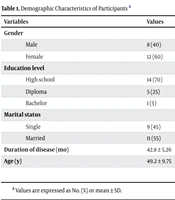
The study included 20 patients (12 women and 8 men), with a mean age of 49.2 years. The mean time spent on the liver transplantation waiting list was 42.8 months. Participants’ demographic characteristics are summarized in Table 1.
Table 1.
Demographic Characteristics of Participants a
| Variables | Values |
|---|---|
| Gender | |
| Male | 8 (40) |
| Female | 12 (60) |
| Education level | |
| High school | 14 (70) |
| Diploma | 5 (25) |
| Bachelor | 1 (5) |
| Marital status | |
| Single | 9 (45) |
| Married | 11 (55) |
| Duration of disease (mo) | 42.8 ± 5.26 |
| Age (y) | 49.2 ± 9.75 |
a Values are expressed as No. (%) or mean ± SD.
4.2. Main Themes and Subthemes
Overall, four main themes and eight subthemes emerged from the interview data, as presented in Table 2. The main themes and subthemes included life upheaval (perceived burden on the family and enduring daily hardships), information seeking (constant search for information and seeking alternative treatment options), spiritual coping (trust and faith in God and religious practices and rituals), and living with uncertainty (life dissatisfaction and struggling with the wait). Although four overarching themes were identified, participants’ experiences were not uniform. Considerable variation was observed according to illness severity, family support, waiting time, financial circumstances, and prior knowledge of transplantation. These differences are reflected within each theme.
Table 2.
Main Themes and Subthemes Identified From Data Analysis
| Main Themes and Subthemes | Participants' Quotations |
|---|---|
| Life upheaval | |
| Perceived burden on the family | "I always feel that my illness has become a burden for my family. They worry about me all the time and sometimes I feel guilty because of that." (Participant 3) |
| Enduring daily hardships | "Every day is a challenge for me. Even simple daily activities have become difficult and exhausting." (Participant 7) |
| Information seeking | |
| Constant search for information | "After the diagnosis, I started searching everywhere for information on the internet, from doctors, and from other families who had similar experiences." (Participant 5) |
| Seeking alternative treatment options | "We tried to find different treatment options because we hoped there might be something that could improve the situation." (Participant 9) |
| Spiritual coping | |
| Trust and faith in God | "I believe that everything happens by God's will. This belief helps me stay calm and accept the situation." (Participant 2) |
| Religious practices and rituals | "Praying and reading holy texts give me peace. Whenever I feel overwhelmed, I turn to my faith." (Participant 6) |
| Living with uncertainty | |
| Life dissatisfaction | "Sometimes I feel that my life is not the same anymore. Many of my plans and dreams have changed." (Participant 4) |
| Struggling with the wait | "Waiting for results or improvement is the hardest part. The uncertainty makes me anxious all the time." (Participant 8) |
4.2.1. Life Upheaval
Participants described profound disruption to their daily lives due to chronic liver disease and anticipation of transplantation. This disruption extended beyond physical limitations, affecting emotional well-being, family roles, and financial stability.
A dominant aspect of this experience was the perceived burden on the family. Participants frequently expressed guilt and emotional distress related to their dependence on family members, particularly when they observed the impact of their illness on caregivers.
"I constantly think that my family has to adjust everything around my condition; I feel like I am causing them trouble." (P4)
In addition, participants emphasized enduring daily hardships, including fatigue, treatment demands, and reduced functional capacity, which collectively diminished independence and quality of life.
"Managing my medications, diet, and hospital appointments takes so much energy every single day." (P11)
4.2.2. Information Seeking
Participants actively engaged in information-seeking behaviors to reduce uncertainty and regain a sense of control over their condition. These behaviors included consulting healthcare professionals, searching online resources, and communicating with other patients.
For many participants, continuous information seeking became a coping strategy to manage anxiety related to disease progression and transplantation outcomes.
"Whenever I get a chance, I ask the doctors questions; knowledge helps me feel less anxious." (P15)
Some participants also explored alternative or complementary approaches alongside medical care, reflecting hope for additional ways to improve their condition during the waiting period.
"I sometimes try different diets or supplements, hoping they can make a difference until the transplant comes." (P18)
4.2.3. Spiritual Coping
Spirituality emerged as a central coping resource that helped participants manage fear, uncertainty, and emotional distress. Faith in God provided meaning, acceptance, and emotional stability throughout the illness trajectory.
Participants described trust in the divine will as a source of strength that helped them endure difficult circumstances.
"I trust that God has a plan for me; this gives me strength even when I feel weak." (P2)
Religious practices, such as prayer, recitation of holy texts, and participation in religious activities, further supported emotional regulation and psychological comfort.
"Reciting verses and praying every morning calms my mind and lifts my spirits." (P12)
4.2.4. Living With Uncertainty
Living with uncertainty was pervasive among participants and was characterized by ambiguity regarding transplant timing, disease progression, and future outcomes. This uncertainty significantly affected emotional well-being.
Participants expressed dissatisfaction with illness-related life changes, including loss of previous roles, reduced autonomy, and emotional distress.
"Sometimes I feel hopeless and frustrated; my life doesn't feel like my own anymore." (P3)
The waiting period for transplantation was particularly distressing, generating ongoing anxiety and emotional exhaustion as participants remained uncertain about their future.
"The uncertainty is unbearable; I feel trapped between hope and fear." (P20)
5. Discussion
This study found that patients awaiting liver transplantation face multidimensional physical, psychological, and social challenges that place considerable stress on their families. These findings are consistent with previous studies reporting that patients awaiting liver or other organ transplants commonly experience psychological disturbances, including anxiety, depression, and dissatisfaction with life, while their families also bear substantial psychosocial burdens (10, 11).
In our study, information seeking and exploration of alternative treatment options emerged as active coping strategies to reduce anxiety and regain a sense of control. This finding aligns with previous research on patients with chronic illnesses, highlighting the crucial role of knowledge and awareness in resilience and self-management (12). However, some studies have reported that certain patients prefer to rely solely on physicians' advice and avoid actively seeking information. These differences may reflect variations in health literacy, access to resources, and cultural context (13).
Spiritual coping was another key strategy identified in this study. Reliance on God and engagement in religious practices helped participants manage stress and uncertainty. This finding is consistent with research in Islamic and Asian contexts, demonstrating the protective and resilience-enhancing effects of faith among patients with chronic illnesses (14, 15). Conversely, in some Western studies, spiritual coping did not appear as a prominent mechanism, likely reflecting cultural and religious differences.
Living with uncertainty and prolonged waiting was highlighted as a major source of psychological distress and dissatisfaction with life. This finding resonates with studies of patients awaiting heart or kidney transplantation (16). Some minor discrepancies exist; previous research suggests that social support can mitigate the negative effects of prolonged waiting, whereas in our study, family burden and limitations in daily life appeared to reduce the protective effect of available support.
Overall, the findings emphasize the importance of comprehensive, multidimensional support, including psychological, informational, and spiritual care for patients and their families. Comparisons with previous studies suggest that care programs should be culturally and socially tailored to maximize their impact on patient well-being and resilience.
The findings suggest that waiting for liver transplantation is not only a medical condition but also a prolonged state of disrupted identity, suspended life planning, and emotional ambiguity. Participants' accounts indicate that uncertainty was shaped not merely by a lack of information but also by limited control over transplant timing and disease progression. Differences in coping responses further suggest that psychological adjustment was influenced by access to family support, economic stability, and personal belief systems. Information seeking was not universally beneficial; while some participants experienced reassurance through knowledge, others experienced increased distress. This highlights the need for individualized communication strategies rather than standardized information delivery alone. Spiritual coping functioned as both a resilience resource and, at times, a source of struggle, indicating the complex role of faith during chronic illness. These findings underscore the importance of holistic pretransplant care that addresses emotional, informational, social, and existential needs.
The findings of this study have important implications for nursing practice and supportive care for patients awaiting liver transplantation. Participants' experiences showed that care needs extend beyond symptom management and include psychosocial, educational, family-centered, and spiritual support. Nurses should conduct routine assessments of emotional distress, functional limitations, caregiver burden, and financial difficulties, with timely referral to appropriate support services when needed. Patient education should be individualized according to health literacy, information preferences, and readiness to learn, and should cover the transplant process, medication management, warning signs, nutrition, and lifestyle adjustments. Providing information in an understandable local language and offering opportunities for questions may reduce anxiety and improve preparedness. Because many participants relied on spirituality, respectful spiritual assessment and referral to appropriate faith-based or counseling resources may strengthen coping. Persistent uncertainty also highlights the need for continuity-based psychological support, including regular follow-up, coping-focused communication, and screening for anxiety or depression. At the service level, the findings support multidisciplinary chronic-care models involving nurses, physicians, psychologists, nutritionists, and social workers. Nurse-led follow-up clinics or telehealth services may be valuable for maintaining education, monitoring well-being, and providing ongoing support during prolonged waiting periods.
5.1. Study Limitations
This study has several limitations that should be considered when interpreting the findings. First, the relatively small sample of patients awaiting liver transplantation in Pakistan may restrict the transferability of the results to other populations or settings. Second, because data were collected through semi-structured interviews, the findings may be influenced by recall bias or social desirability bias. Third, the results related to spiritual coping and family support may be shaped by the specific cultural and religious context of the participants and may not be directly applicable to other cultural environments. Finally, the study explored patients' experiences at a single point in time and therefore did not capture possible changes in their experiences over time.
5.2. Future Research
Based on the findings of this study, several directions for future research are suggested. First, similar studies in other regions and countries with larger populations could enhance the generalizability of the findings and explore cultural and social differences. Second, longitudinal studies could examine patients' experiences over time, capturing changes in lived experiences, stress, and coping strategies during the waiting period for transplantation. Third, future research could investigate the role of family and social support in reducing psychological burden and enhancing patient resilience. Fourth, evaluating the impact of spiritual, psychological, and educational interventions on anxiety reduction and quality of life among patients awaiting liver transplantation could provide practical insights. Finally, comparative studies across different cultural and religious contexts could clarify the influence of culture, religion, and spiritual beliefs on coping mechanisms and experiences during prolonged waiting for transplantation.
5.3. Conclusion
Patients awaiting liver transplantation experience physical, psychological, and social challenges, as well as strain on their families. To reduce anxiety, they actively seek information and alternative treatment options and use spiritual coping, faith, and religious practices to enhance resilience. Moreover, living with uncertainty contributes to dissatisfaction and psychological distress. The findings indicate that comprehensive psychological, informational, and spiritual support is essential for these patients and their families. Nursing responses should therefore extend beyond routine clinical monitoring to include individualized education, psychosocial screening, family-centered support, and culturally sensitive spiritual care. Integrating these elements into chronic care services may improve patient well-being while they await transplantation.