
1. Context
Population ageing is reshaping the organization of chronic care. This issue is particularly relevant to chronic disease care because chronic conditions in later life are rarely addressed through biomedical treatment alone. They are accompanied by functional decline, social isolation, caregiver strain, difficulties in navigating services, and the need for sustained support in the home and community. The Organisation for Economic Co-operation and Development has emphasized that long-term care systems must address not only disability and dependency but also sustainability, access, quality, and coordination across health and social care sectors (1).
For nursing and public health, these definitions underscore that chronic care in later life is both clinical and social. Older adults living with multimorbidity may require medication review, symptom monitoring, and professional nursing care, but they also need transportation to appointments, assistance with household tasks, companionship, peer encouragement, reminders, practical problem-solving, and support for self-management. These needs are often too frequent, relational, and context-dependent to be met by clinic visits alone. At the same time, family-based care is being weakened by migration, smaller household size, women's employment, urbanization, and caregiver exhaustion. In a recent chronic care study, a structured social support program improved health-promoting lifestyles among family caregivers of older adults with cancer, supporting the broader argument that chronic care outcomes are shaped by social support around both patients and caregivers (2).
Time banking has gained attention as a complementary model. In this manuscript, time banking refers to the reciprocal exchange approach, whereas time bank refers to a specific organization or platform; alternate spellings such as timebanking and time-credit systems were retained only in the search strategy. Time banking is a reciprocal exchange system in which participants provide services, earn time credits, and later exchange those credits for services from others. A recent nursing-focused publication also framed reciprocal time banking as a community-based innovation for elderly care and nursing practice (3). The basic principle is egalitarian: one hour of service equals one time credit, regardless of the market value of the task. Cahn's theory of time banking framed this approach as a form of co-production that recognizes capacities often ignored by the market and formal welfare systems (4). Subsequent work has described time banks as community exchange systems capable of mobilizing social capital, mutual aid, and local participation (5, 6, 7). This is highly relevant to active ageing because time banking reframes older adults not only as recipients of care but also as contributors whose time, knowledge, caregiving experience, and social support have social value.
Despite growing interest, the relevance of time banking to chronic care remains under-theorized. Existing evidence has examined health promotion, social capital, volunteering, willingness to participate, and implementation barriers, but fewer studies have connected time banking to chronic disease care, nursing referral, social prescribing, digital health infrastructure, or long-term care policy. A rigorous structured narrative review is therefore needed to move beyond descriptive enthusiasm and examine how, under what conditions, and through which mechanisms time banking may contribute to sustainable community-based chronic care. This review synthesizes the evidence on time banking for active ageing and mutual support, focusing on mechanisms, digital transformation, and policy pathways. It also proposes a conceptual framework for integrating time banking into community-based chronic care systems.
2. Evidence Acquisition
This article is a structured narrative review informed by transparent search and synthesis procedures. It is not presented as a systematic review, scoping review, or meta-analysis. PRISMA 2020 was used only as a reporting guide to improve the transparency of sources, eligibility decisions, and synthesis logic, and not to imply that all PRISMA items for systematic reviews were applicable (8). No protocol was registered, no formal risk-of-bias assessment was undertaken, and the purpose was conceptual integration rather than exhaustive effect estimation.
A targeted search was conducted across PubMed, Scopus, Web of Science, Google Scholar, ScienceDirect, SpringerLink, Frontiers, Oxford Academic, and PLOS ONE. The search was supplemented by full-text articles uploaded by the researcher, manual screening of reference lists, and recent web searches for relevant literature published in the last five years. The final search update was completed on 14 May 2026. Search terms were combined using Boolean logic: ("time bank" OR "time banking" OR "timebanking" OR "time credit" OR "time currency" OR "mutual support") AND ("older adults" OR ageing OR aging OR elderly OR "active ageing" OR "healthy ageing" OR "long-term care" OR "chronic care" OR "community-based care" OR volunteering OR "digital platform" OR blockchain OR policy). Searches prioritized studies published between 2010 and 2026, including early-online and recently indexed publications for which bibliographic information was available. Older theoretical works were retained only when they provided essential conceptual grounding rather than current empirical evidence.
Studies and sources were included if they addressed time banking, time-credit exchange, reciprocal volunteering, community-based support, older-adult care, long-term care, digital time-bank platforms, or implementation barriers relevant to ageing and chronic care. Empirical studies, qualitative research, quasi-experimental evaluations, cross-sectional surveys, case studies, scoping reviews, policy sources, and conceptual papers were eligible. Studies were excluded if they focused on unrelated barter systems, corporate exchange, financial banking, or time-use economics without relevance to care, ageing, or community support. Grey literature was used cautiously and only when it provided policy context or when peer-reviewed evidence was limited.
A structured narrative account of source selection was maintained. Database and publisher-site searching identified 168 records, while uploaded full-text articles, manual reference-list screening, and targeted web searching identified 42 additional records or sources. After the removal of duplicates, superseded versions, and clearly irrelevant records, 116 records were screened. Sixty-two records were excluded at the title, abstract, or source-description level because they did not address time banking, ageing, chronic care, community support, volunteering, or digital implementation. Fifty-four full texts or detailed source records were assessed for relevance. Eighteen were excluded because they lacked relevance to ageing or chronic care (n = 8), provided insufficient methodological or conceptual detail (n = 5), were duplicate or superseded versions (n = 3), or lacked adequate full-text or source information (n = 2). Thirty-six sources were retained in the final synthesis. The principal empirical, implementation, and conceptual sources are summarized in Table 1; seminal theoretical and policy sources are retained in the reference list but are not all summarized in the table.
Table 1.
Summary of Included Studies and Sources
| Author (y) | Country/Region | Study Design/Source Type | Population/Setting | Key Findings | Relevance to Review Theme |
|---|---|---|---|---|---|
| Raji et al. (2025) (2) | Iran | Quasi-experimental study | Family caregivers of older adults with cancer | Social support improved overall health-promoting lifestyle and selected subscales. | Social support in chronic care |
| Salar et al. (2025) (3) | Iran | Nursing-focused conceptual article | Elderly care and nursing practice | Discussed reciprocal time banking as a community-based innovation for elderly care and nursing practice. | Nursing relevance of time banking |
| Lu et al. (2024) (9) | Hong Kong | Quasi-experimental mixed-methods study | Adults aged 50 years and above | Time banking increased late-life volunteering and sustained engagement. | Active ageing; intervention evidence |
| Lu et al. (2025) (10) | Hong Kong | Quasi-experimental longitudinal mediation study | Adults aged 50 years and above | Time banking increased volunteering hours; the quality-of-life effect operated through volunteering-related self-efficacy. | Mechanisms; empowerment pathway |
| Lu et al. (2025) (11) | Hong Kong | Quasi-experimental study | Older adults | Time banking promoted equitable volunteering without crowding out other volunteering. | Equity and sustainability |
| Lu et al. (2024) (12) | Hong Kong | Qualitative case study | Older volunteers and advisory members | Cross-sector collaboration, meaningful work, and co-production facilitated engagement. | Implementation model |
| Wu et al. (2023) (13) | China | Secondary data analysis | 8459 older adults | Volunteering was associated with fewer depressive symptoms; frequency and diversity mattered. | Indirect psychosocial evidence |
| Jiao et al. (2024) (14) | China | Platform-data analysis | Web-based Nansha Timebank projects | Intrinsic and extrinsic narrative cues shaped participation decisions. | Digital platform behavior |
| Li et al. (2023) (15) | China/Mongolia | UTAUT-based survey | Wellness tourism users | Attitude, trust, and anxiety mediated time-banking adoption intention. | Technology acceptance |
| Cheng et al. (2019) (16) | China | Blockchain prototype/system design | Volunteer mutual pension system | Blockchain was proposed for transparent, portable, and auditable time-credit records. | Digital transformation |
| Azizan et al. (2026) (17) | Global | Scoping review | 30 studies | Willingness, motivators, and barriers included social influence, institutional support, trust, and usability. | Evidence mapping |
| Zhang et al. (2025) (18) | China | Community case study | Dongying YL Community | More than 500 activities were reported; benefits included social bonds, while challenges involved standardization and sustainability. | Governance and community care |
| Qin (2023) (19) | China | Community case study | Nanning X Community | Problems included low initiative, time-currency measurement, credit portability, and service supply level. | Local implementation challenges |
| Wu et al. (2024) (20) | China | Cross-sectional survey; factor and logistic analysis | University students | 82.67% were willing to participate; value judgment and social influence were key determinants. | Youth engagement; intergenerational support |
| Wu et al. (2021) (21) | China | Cross-sectional survey; logit model | Youth and older adults | Health status, free time, and volunteer experience influenced participation in online time-bank nursing. | Online care participation |
| Verma et al. (2024) (22) | India | Qualitative interviews | Young adults | Participants identified potential for diverse services, but barriers included stigma, trust, privacy, safety, and discomfort with help-seeking. | Cultural implementation barriers |
| Naughton-Doe et al. (2021) (23) | England | Qualitative/scoping implementation analysis | Adult social care timebanks | Safeguarding, matching, and sustainability were major implementation challenges. | Preventive social care lessons |
| Farmer and Nimegeer (2014) (34) | Scotland | Participatory action research | Remote rural communities | Community participation shaped locally relevant primary care models and volunteering schemes. | Co-production; community care |
The synthesis followed an interpretive thematic approach. Two authors independently extracted key information on study context, design, population, mechanisms, outcomes, barriers, digital features, and policy relevance. A mixed deductive-inductive coding strategy was used. Initial deductive categories were informed by the review aim, including mechanisms, chronic care relevance, digital transformation, implementation, ethics, and policy, and inductive codes were added when recurring concepts emerged from the literature. Disagreements in extraction, coding, or interpretation were resolved through discussion and, when needed, by review by a third author. Final themes were agreed upon by consensus.
Sources were weighted according to relevance and evidentiary contribution. Direct empirical time-banking studies, quasi-experimental evaluations, platform-data studies, and implementation case studies were given the greatest interpretive weight for time-banking claims. Indirect evidence from volunteering, social support, community participation, social prescribing, and chronic care was used to contextualize potential chronic-care applications, rather than to infer direct clinical effectiveness. Policy documents and conceptual papers were used mainly for framing, model development, and interpretation. This distinction was maintained throughout the synthesis to avoid overinterpretation of heterogeneous evidence.
3. Results
The synthesis is organized around analytical themes rather than study-by-study summaries. Table 1 provides an overview of the main empirical, implementation, and conceptual sources that informed the themes.
3.1. Mechanisms of Time Banking: Reciprocity, Recognition, Empowerment, and Social Capital
The central mechanism of time banking is reciprocal exchange. Unlike traditional volunteering, which may reproduce a distinction between benefactor and beneficiary, time banking assumes that individuals can both give and receive. This is particularly important for older adults with chronic conditions, who are often positioned as dependent recipients of care. Time banking challenges this deficit framing by recognizing that older adults may continue to contribute knowledge, companionship, practical skills, and emotional support even when they also require assistance.
The literature suggests that time banking may operate through six interrelated mechanisms: reciprocity, recognition, empowerment, trust, belonging, and social capital. Seyfang argued that time banks can contribute to the social economy by valuing unpaid labor and strengthening mutual aid (5). Lasker and colleagues reported that participation in a community currency organization may enhance well-being by fostering social relationships, perceived usefulness, and access to support (6). Collom and colleagues further described time banking as a system in which equal time value can mobilize groups often marginalized in conventional labor markets (7). These mechanisms are not merely abstract; they are directly relevant to chronic care because many supportive activities in chronic illness are non-market tasks, such as accompanying someone to a clinic, helping with shopping, explaining services, or checking on a socially isolated neighbor.
Recent quasi-experimental evidence from Hong Kong strengthens the causal plausibility of these mechanisms. In a time-banking intervention for adults aged 50 years and above, participants in the time-bank group showed a faster increase in weekly volunteering hours than the comparison group, and time banking indirectly improved quality of life through increased volunteering and volunteering-related self-efficacy (9, 10). This finding suggests that the health relevance of time banking may not arise solely from social contact, but rather from a chain process in which recognized contribution increases engagement and engagement enhances self-efficacy. Another Hong Kong study found that time banking promoted equitable volunteering among older adults without crowding out other volunteering activities (11). A related case study identified cross-sector collaboration, meaningful voluntary work, and a co-production environment as conditions that facilitated volunteer engagement (12).
3.2. Impact on Ageing and Chronic Care
Direct evidence on time banking should be distinguished from indirect evidence on volunteering and social support. Evidence on volunteering and ageing provides important context for the chronic care relevance of time banking, but it is not equivalent to direct evidence that time banking improves chronic disease outcomes. The Chinese CLASS 2018 study found that volunteering among older adults was associated with lower depressive symptoms, and that professional volunteering, frequency, and variety of participation were associated with more favorable mental health outcomes (13). This supports the broader premise that structured social participation may protect psychological well-being in later life. In chronic disease care, such psychosocial pathways are clinically important because depression, loneliness, and low self-efficacy can undermine self-management, medication adherence, and quality of life.
However, the evidence should be interpreted cautiously. The Hong Kong chain-mediation study did not identify a direct intervention effect on quality of life, and the belonging pathway was less robust than the self-efficacy pathway (10). This challenges the common assumption that time banking improves well-being simply by increasing social connectedness. It may be more accurate to state that time banking becomes relevant to chronic care when it generates meaningful roles, repeated participation, recognition, and confidence. Therefore, time banks need to be designed as structured supportive-care systems rather than passive databases of offers and requests.
The proposed chronic care applications of time banking are strongest in areas where professional care and informal care intersect. Examples include social prescribing, home-based companionship, transport to appointments, support after hospital discharge, caregiver respite, peer support for self-management, walking groups, community navigation, and early identification of social risk. Caregiver respite refers to temporary relief for family or informal caregivers. These activities do not replace clinical assessment or nursing intervention, but they may strengthen the environment in which chronic care occurs. In this sense, time banking should be viewed as a hypothesized adjunctive social infrastructure for chronic care rather than an established disease-specific intervention.
3.3. Digital Transformation: Platforms, Data, and Blockchain
Digitalization is changing how time banks are organized. Early time banks relied on paper records, coordinators, and local ledgers. Contemporary systems increasingly use mobile applications, web-based platforms, digital identity verification, service matching, feedback systems, and time-credit databases. Digital tools may improve scalability, transparency, monitoring, and credit portability. They may also generate data on unmet needs, service matching, and patterns of participation.
The Nansha web-based time-banking study illustrates this potential. Jiao and colleagues analyzed service-requirement narratives and found that intrinsic and extrinsic cues in online service descriptions shaped participation decisions (14). This type of platform-based evidence moves beyond willingness surveys by examining actual participation behavior in digital systems. Similarly, the UTAUT-based study of time-banking adoption intentions in wellness tourism destinations found that attitude, trust, and anxiety mediated behavioral intention, highlighting that adoption depends not only on technical availability but also on psychological perceptions (15).
Blockchain has been proposed as another response to trust and portability problems. Cheng and colleagues presented VOLTimebank, a blockchain-based volunteer system for mutual pension, designed to store service records transparently and support exchange across locations (16). The rationale is clear: if participants doubt that time credits will be accurately recorded, transferable, or redeemable in the future, they may be reluctant to contribute. However, blockchain should not be treated as a universal solution. It may improve record integrity, but it does not resolve issues of service quality, safeguarding, informed consent, data minimization, or digital exclusion.
Digital transformation also creates risks. Older adults with limited literacy, low income, sensory impairment, cognitive impairment, or limited access to smartphones may be excluded from digital time banks. The scoping review of willingness, motivators, and barriers identified technological usability and trust as major determinants of participation (17). Therefore, accessible design is not optional. Time-bank platforms intended for chronic care should include assisted registration, large-font interfaces, telephone-based options, caregiver proxy access where appropriate, multilingual support, offline alternatives, and human coordinators.
3.4. Implementation Models Across Countries
Time banking is not a single model but a family of models shaped by welfare regimes, community structures, and policy goals. In China, time banks are often positioned within social governance and active ageing strategies. The Dongying YL Community Time Bank organized more than 500 mutual-aid activities, mobilized local volunteers, and offered services such as health checks, companionship, meal delivery, and emergency support (18). The Nanning X Community case similarly described a local model supported by government, community structures, social organizations, and information technology, but also identified problems of low initiative among older adults, a lack of standardized time-currency measurement, limited cross-regional exchange, and low levels of service supply (19). These cases show the importance of state-community collaboration, but they also demonstrate that local enthusiasm is insufficient without standardization and sustainable operational systems.
University-community models represent another pathway. The Nanjing study of university students found that 82.67% were willing to participate in time-banking volunteer services for older adults, and that willingness was influenced by value judgment, social support, social influence, and socioeconomic conditions (20). The Beijing online time-bank nursing study similarly identified determinants of willingness among youth and older adults, suggesting that health status, prior experience, and available time matter (21). Such models may be particularly relevant for nursing and health sciences education because they allow students to participate in supervised community support while developing ethical awareness, communication skills, and an understanding of ageing.
The Indian qualitative study provides a necessary corrective. Participants saw potential in time banking and were willing to provide services ranging from household support to professional assistance, but they also expressed concerns about awareness, stigma, safety, privacy, service evaluation, and hesitancy to ask for help (22). This evidence challenges the assumption that reciprocity is automatically accepted. In some cultural contexts, receiving help may be associated with vulnerability, shame, or indebtedness. For chronic care, this means that program design must normalize receiving support as a legitimate form of participation, not as dependency.
3.5. Barriers and Enablers
Barriers across studies cluster around awareness, trust, safety, operational capacity, digital usability, service standardization, and policy legitimacy. Awareness is basic but persistent. Many potential participants do not distinguish time banking from conventional volunteering or monetary banking. Trust is more complex. Participants must trust other members, coordinators, credit records, service valuation, and the future redeemability of credits. Chronic care adds another layer because recipients may be frail, cognitively impaired, socially isolated, or medically vulnerable.
Service standardization is particularly important. Chronic care support includes activities of varying complexity and risk. Companionship and grocery shopping differ from dementia support, medication reminders, post-discharge assistance, or caregiver respite. Equal valuation of time does not eliminate differences in skill, risk, and responsibility. Therefore, time banks linked to chronic care need task classification, training, supervision, referral pathways, and clear boundaries between volunteer support and professional care. Evidence from English timebanking in preventive social care has shown that person-to-person timebanks face substantial challenges related to safeguarding, matching, and sustainability (23). These lessons are directly relevant to chronic care, where safety cannot be delegated to goodwill alone.
Enablers include institutional support, meaningful roles, cross-sector collaboration, trained coordinators, accessible digital systems, recognition, feedback, and integration with existing care pathways. Time credits may motivate participation, but they are unlikely to sustain engagement by themselves. Participants need visible impact, social recognition, opportunities to use credits, and confidence that the system is fair and safe. The Hong Kong case study suggests that co-production and meaningful work are especially important (12).
3.6. Ethical and Equity Considerations
The principle that one hour equals one time credit is ethically appealing because it resists market hierarchies. It recognizes undervalued work and may empower people whose contributions are often invisible. Levitas's critique of conventional economic thinking is relevant here because it reminds us that unpaid care and the everyday work that sustains families and communities are often excluded from formal concepts of economic value (24). Time banking can therefore be understood as a practical attempt to value care beyond the market.
Nevertheless, equality of time does not necessarily mean equality of burden. One hour of companionship may not be equivalent, in emotional difficulty or risk, to one hour of supporting a person with advanced dementia. Time banks must distinguish equality of dignity from equivalence of task complexity. Ethical implementation requires informed consent, privacy protection, complaint mechanisms, background checks where needed, insurance arrangements, and safeguards for vulnerable adults. It also requires equity monitoring. If time banks mainly recruit individuals who are already active, educated, and digitally connected, they may reproduce inequalities rather than reduce them.
Another ethical concern is substitution. Policymakers may be tempted to use time banking as a low-cost substitute for underfunded professional care. This would be inappropriate. Time banking may complement professional chronic care, but it cannot replace nursing, rehabilitation, social work, home care, or medical management. Its appropriate role is supportive, preventive, and relational: reducing isolation, helping people navigate services, reinforcing self-management, and extending the community reach of formal care.
3.7. Critical Analysis of the Evidence Base
The evidence base on time banking is promising but uneven. Its strengths include conceptual coherence, cross-cultural relevance, growing empirical diversity, and emerging quasi-experimental evidence. However, several limitations constrain strong conclusions. First, many studies measure willingness rather than sustained behavior. Willingness surveys are useful for feasibility assessment but do not establish whether participants will remain active, exchange credits, accept help, or provide reliable support over time. The high willingness reported among Nanjing university students is encouraging (20), but it cannot be treated as evidence of implementation success.
Second, outcomes are heterogeneous. Studies measure volunteering hours, willingness, platform adoption, depression, quality of life, belonging, self-efficacy, social capital, and governance outcomes. Few directly measure chronic care indicators such as functional status, self-management, medication adherence, caregiver burden, hospital readmission, emergency department use, delay of institutionalization, or cost-effectiveness. This makes it difficult to claim that time banking improves chronic care outcomes, even when evidence suggests psychosocial benefit.
Third, many studies are context-specific. Chinese community cases reflect policy, governance, and demographic conditions that may not generalize to countries with different welfare regimes. Hong Kong quasi-experimental studies provide stronger evidence but remain linked to particular community organizations, cultural expectations, and program designs. Indian qualitative findings emphasize cultural barriers that may be less visible in East Asian policy-driven models. The appropriate conclusion is therefore conditional: time banking may contribute to community-based chronic care when institutional design, cultural acceptability, digital accessibility, and safeguarding conditions are present.
Fourth, publication bias and innovation bias are likely. Successful pilots and enthusiastic case studies are more likely to be published than failed programs. The literature often reports benefits but less often reports inactive members, unsuccessful matches, unused credits, conflict, administrative costs, safeguarding incidents, or program closure. High-quality research should address these limitations by reporting implementation failures as well as successes.
Finally, the literature sometimes treats social capital as inherently positive. Yet strong community ties can also exclude outsiders, reinforce stigma, or place informal obligations on women and older volunteers. Time banking should be studied not only as a mechanism of care, but also as a form of governance that distributes responsibility, risk, and recognition across communities.
3.8. Limitations of This Review
This review has limitations that should be considered when interpreting its conclusions. First, it is a structured narrative review rather than a systematic review; therefore, the source-selection process was designed for conceptual integration and relevance rather than exhaustive identification of every eligible study. Second, no formal risk-of-bias assessment or meta-analysis was conducted. Third, the evidence base includes heterogeneous empirical studies, conceptual papers, policy sources, and case studies, which differ substantially in design and evidentiary strength. Fourth, most included time-banking studies did not directly test chronic disease-specific outcomes. Consequently, the proposed links between time banking and community-based chronic care should be interpreted as a conceptual and implementation hypothesis that requires prospective evaluation rather than established clinical effectiveness.
3.9. Conceptual Integration: The Time-Banking-Enabled Community-Based Chronic Care Ecosystem
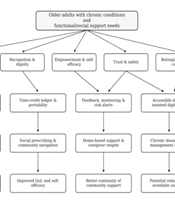
On the basis of the reviewed evidence, this article proposes the Time-Banking-Enabled Community-Based Chronic Care Ecosystem model (Figure 1). The model conceptualizes time banking as a complementary infrastructure that connects older adults' chronic and functional support needs with reciprocal community resources. It includes five interacting components.

Figure 1.
Time-banking-enabled community-based chronic care ecosystem. The figure separates population need, mechanisms, implementation inputs, care-integration pathways, outcomes, and governance moderators. Evidence-supported pathways include time banking to volunteering engagement and volunteering-related self-efficacy. Proposed pathways requiring future testing include effects on chronic disease self-management, caregiver burden, functional outcomes, and avoidable health service use. The model conceptualizes time banking as complementary community infrastructure, not as a substitute for professional chronic care. Time banking is conceptualized as a complementary community infrastructure, not a substitute for professional chronic care.
The first component is population need: older adults living with chronic conditions, multimorbidity, functional limitations, and social support gaps. The second component is the mechanism layer, which includes reciprocity, recognition, empowerment, trust, and belonging. These mechanisms are grounded in social exchange theory, self-efficacy theory, planned behavior, ecological models of volunteering, and technology acceptance frameworks (25, 26, 27, 28, 29, 30, 31, 32, 33). The third component is digital and operational infrastructure, including registration, service matching, time-credit ledgers, feedback, monitoring, accessibility support, and data protection. The fourth component is care integration: primary care and nursing referral, social prescribing, home-based support, caregiver respite, and chronic disease self-management. Social prescribing refers to referral to non-clinical community resources to support health and well-being. The fifth component is governance, including legal standards, volunteer training, safeguarding, equity monitoring, and sustainable funding.
The model distinguishes mechanisms, implementation inputs, and outcomes. Mechanisms are the processes through which time banking may influence participants, such as reciprocity, recognition, empowerment, and trust. Implementation inputs are the conditions that make these mechanisms operational, such as digital platforms, trained coordinators, service-matching systems, safeguarding protocols, and nursing or primary-care referral pathways. Outcomes are measurable changes that may occur if the system functions effectively.
The model's core proposition is that time banking improves chronic care relevance not by replacing clinical services, but by strengthening the social conditions in which chronic care occurs. Proximal outcomes may include increased volunteering hours, credit exchanges, participation frequency, self-efficacy scores, and perceived social support. Intermediate outcomes may include reduced loneliness, improved self-management confidence, caregiver relief, service navigation, and continuity of community support. Distal outcomes may include improved quality of life and, if confirmed in future evaluations, reduced avoidable use of acute care. At present, the pathways from time banking to volunteering and self-efficacy are supported by emerging empirical evidence (9, 10), whereas pathways to chronic disease outcomes, service utilization, and cost-effectiveness remain proposed for future testing.
This model also clarifies why some time banks may fail. If time-credit systems are introduced without trust, training, accessibility, or connection to care pathways, they may remain symbolic. If digital infrastructure is introduced without human coordination, vulnerable older adults may be excluded. If policy support is absent, credits may lack credibility and portability. If safeguards are weak, chronic care recipients may be placed at risk. Successful implementation therefore requires alignment among mechanisms, digital tools, care integration, and governance.
3.10. Research Gaps and Future Directions
The next generation of research should move from feasibility and willingness toward intervention evaluation and implementation science. First, studies should test time banking among older adults with specific chronic conditions such as diabetes, heart failure, chronic obstructive pulmonary disease, stroke, dementia, and multimorbidity. These populations would allow researchers to examine whether time banking contributes to clinically meaningful outcomes.
Second, pragmatic trial designs are needed. Cluster randomized trials, stepped-wedge designs, or controlled quasi-experimental studies could compare usual community care with time-bank-enhanced care in primary care centers, nursing clinics, or community health organizations. Third, outcome measures should include not only volunteering and quality of life, but also loneliness, depression, self-management, medication adherence, caregiver burden, functional status, service utilization, and cost-effectiveness.
Fourth, digital equity must be examined directly. Future studies should investigate whether digital time banks include or exclude older adults with limited literacy, disability, cognitive impairment, poverty, or rural residence. Fifth, research should use implementation frameworks to examine reach, adoption, fidelity, maintenance, and scale-up. Time banking is a complex intervention, and its effects depend on context, program design, and governance.
Specific research questions include: Does integration of time banking into primary care improve self-management among older adults with multimorbidity? Which component of time banking--time credits, recognition, reciprocity, social contact, or skill-building--drives outcomes? What tasks can safely be delegated to trained volunteers in chronic care? How can nurses supervise time-bank volunteers without medicalizing community exchange? What digital design features improve accessibility for older adults with low digital literacy? What governance model best balances community ownership, safety, and accountability?
3.11. Policy and Practice Implications
For policymakers, time banking should be positioned as a candidate component of healthy ageing, long-term care, and community-based chronic care policy rather than as a proven chronic disease intervention. It requires stable funding, legal recognition, service standards, data protection rules, volunteer training, safeguarding protocols, and integration with local health and social care systems. Governments should not use time banking as a justification for reducing formal chronic care services. Instead, if adopted, it should be evaluated as preventive and supportive community infrastructure.
For healthcare managers, time banking could be tested as part of social prescribing and community navigation. Primary care teams and nurses could identify older adults who need companionship, transport, walking support, practical assistance, or community connection and refer them to supervised time-bank networks. Conversely, time-bank coordinators could identify social or functional decline and refer participants back to formal services. This bidirectional referral process is a plausible implementation model, but it requires prospective testing before being recommended as routine care.
For nursing practice, time banking offers a potential opportunity to extend person-centered chronic care beyond the clinic. Nurses can help define safe volunteer roles, provide training on communication and confidentiality, teach recognition of warning signs, support referral pathways, and contribute to evaluation. Nurses should not be expected to manage time banks alone, but their expertise is essential for safety and integration when participants have chronic conditions.
For community organizations, sustainability depends on meaningful roles, visible recognition, and reliable opportunities to both give and receive help. Time credits are only one part of motivation. Programs should also cultivate belonging, feedback, trust, and dignity. For digital platform designers, accessibility must be built into the system from the beginning. Platforms should support low-literacy users, older adults with disabilities, offline participation, caregiver-assisted accounts, and human help desks.
4. Conclusions
Time banking is a promising social innovation for ageing societies; however, its contribution to chronic care should be interpreted with caution. Available evidence suggests that time banking may mobilize community assets, recognize non-market care work, increase volunteering, and enhance empowerment, self-efficacy, and social support. These mechanisms are relevant to chronic care because many needs of older adults with chronic conditions are social, functional, and relational rather than exclusively biomedical.
However, time banking is not a substitute for professional health and social care. Its value lies in complementing formal systems, extending community support, and creating reciprocal infrastructures that help older adults remain supported and socially valued. The most credible future for time banking in chronic care is therefore not as a stand-alone volunteer program but as a governed, digitally supported, and equity-oriented community care ecosystem linked to primary care, nursing, social prescribing, and long-term care policy. If carefully designed, ethically governed, and integrated with formal care systems, time banking may become a practical pathway for sustainable community-based chronic care in ageing societies; however, this pathway requires rigorous empirical evaluation before it can be adopted as routine chronic care policy.
Ethics Approval and Consent to Participate: Not applicable. This article is a narrative review of previously published literature and does not involve human participants or identifiable personal data.