


1. Background
The lifetime prevalence of bipolar I disorder has been estimated at around 1% (1). A series of recent studies in 11 different European, American, and Asian countries demonstrated the prevalence of bipolar I disorder as about 0.6% (2). A challenging problem is that the acute episode of mania arises a psychiatric emergency condition and might require in-patient treatment to control symptoms like agitation, irritability, mood-related issues, and high-risk behaviors (3). Considering the prevalence of bipolar I disorder and its negative impacts on the function and quality of life of patients, demonstrating investigations are necessary to validate the kinds of optimal combinations of faster and more effective pharmaceuticals that can be used in the management of this disorder. There are growing appeals for various medications effective in controlling the acute episode of mania.
Current widely accepted drugs to eliminate the acute episode of mania consist of a mood stabilizer (lithium, sodium valproate, carbamazepine) combined with one typical or atypical kind of antipsychotic. Studies have shown that such a clinical approach triggers more curative effects and better responses to treatment (60 - 80%), compared to prescribing a mood stabilizer alone (50%) or antipsychotics alone (50%). However, the rate of effectiveness of each of the above-mentioned drugs remains unknown. Sodium valproate is classified as an anticonvulsant drug and is still considered the first-line treatment for mania episodes and/or mixed feature of bipolar I disorder, but not all patients respond well to single pharmacotherapy with sodium valproate (4). Thus, further studies are necessary to address a more effective combination of medications to control this disorder.
Prior research substantiates the belief that the combined therapy of mood stabilizers and antipsychotics could have a major role in controlling patients’ symptoms during mania episodes. Nonetheless, they have observed that drug tolerance has reduced in combined pharmacotherapy (5, 6). On the other hand, the efficacy of conventional treatments for people with acute mania is still less than the optimal rate (7). In 2013, Bourin and Thibaut stated that we are still lacking accurate investigations to plan the most appropriate treatment for mania and hypomania episodes. The main problem is with the comparison between anticonvulsants, antipsychotics, and mood stabilizers, as there is no global consensus in using them for the treatment of acute mania (8).
A study by Cipriani examined the effect of haloperidol on the treatment of mania, compared to placebo and other single-drug or combined treatments. For this reason, 15 individual studies were conducted on 2,022 subjects, and haloperidol had a statistically significant effect on reducing the symptoms of mania, compared to placebo, both in single prescription or as an add-on therapy. Also, no significant difference was seen between Haloperidol and risperidone, olanzapine, carbamazepine, and sodium valproate (9). Another study by Plosker in the UK reported that quetiapine was more effective than haloperidol in controlling acutely manic patients (10).
The literature review shows that only have a few studies done comparative investigations regarding the effectiveness of antipsychotics combined with sodium valproate in the treatment of mania episodes of bipolar disorder. Therefore, considering the importance of resolving symptoms of the acute episode of mania rapidly, the present study made the individual comparison of the therapeutic effects of sodium valproate combined with quetiapine or haloperidol among patients with bipolar I disorder experiencing an episode of mania or mixed feature admitted to Razi Psychiatric Center of Tehran.
2. Objectives
The present study explored individual comparison of the therapeutic effects of sodium valproate combined with quetiapine or haloperidol as an add-on, among patients with bipolar I disorder experiencing an episode of mania or mixed feature admitted to a psychiatric center in Tehran.
3. Methods
The present study was a double-blind clinical randomized trial conducted from March to September 2014 in Tehran. The statistical population consisted of patients of 18 years or above who were diagnosed with bipolar I disorder experiencing an episode of acute mania or mixed feature. The patients were selected randomly and enrolled in the research setting as per the inclusion criteria. The study inclusion criteria included being in-patients hospitalized in the acute ward admitted to the hospital following the aggravation of symptoms induced by discontinuing pharmacotherapy since at least four weeks before hospitalization, as well as the lack of medical history or undergoing pharmacotherapy for physical conditions. Considering the results of previous research, we randomly placed all 36 study participants in two groups receiving quetiapine or haloperidol. The number of patients in each group was 18. The patients were randomly placed in groups. Moreover, the researcher was blinded to the groups. All patients were evaluated at week three and six, after reaching the maximum dosage of medications. Patients were aged between 20 and 57 years, and both groups had equal gender disparities.
All patients were visited weekly by a psychiatric resident. They were also interviewed at the time of referral and then at weeks three and six of their treatment plan. This was experimentally investigated by the Young Mania Rating Scale (YMRS). This scale consisted of 11 questions, and its scores could range between 0 and 60. The higher the score, the more severe the mania. The validity and reliability of this tool were examined in Iran in 2003, and the sensitivity of 98.4% and specificity of 98.4% were reported for it. As a result, YMRS was approved as a reliable and valid instrument and applicable in both clinical and research settings (11). The study duration was six weeks in total (after raising drug dosage to the maximum level). This period was calculated according to the study by Sussman et al. that documented most therapeutic effects were gained at weeks three and six of the experiment (12).
Considering the results of the previous research and concerning the dosage specified in the psychiatric handbooks for treatment of acute mania or episodes of mixed feature, we prescribed sodium valproate 15 mg/kg plus quetiapine 500 mg daily in one group and sodium valproate 15 mg/kg plus haloperidol 10 mg daily in the other group (5, 9, 12). Also, respecting psychiatric reference texts, as per the above-mentioned, an equivalent dosage of quetiapine and haloperidol was prescribed (1). This study used different data analysis methods such as Paired t test, ANOVA, and chi-square test. Eventually, the collected data were analyzed applying SPSS version 16 software.
4. Results
Table 1 presents the results of patients’ demographic data. According to our findings from the independent t test, the mean age of the studied subjects was higher in the group of haloperidol receivers, but this difference was not statistically significant. Our data also addressed a comparison between the two groups of study in terms of marital status. Based on the results of the chi-square test, most patients were single, and no statistically significant difference was determined between the groups on this variable. The chi-square test was also applied to analyze the participants’ occupational status that revealed no significant difference between the groups of quetiapine and haloperidol receivers in terms of employment status. We also realized that most participants were unemployed. Descriptive statistics were calculated for the histories of in-patient treatment using the chi-square test, and no explicit difference was observed between the two groups in terms of the numbers of hospitalization in a psychiatric center.
Table 1.Demographic Data of Groups of Quetiapine and Haloperidol Receivers a
| Variables | Quetiapine Receivers | Haloperidol Receivers | P |
|---|---|---|---|
| Age | 35.94 ± 11.61 | 39.89 ± 10.74 | 0.97 |
| Marital status | 0.25 | ||
| Single | 9 (50) | 4 (22.22) | |
| Married | 3 (33.33) | 5 (27.77) | |
| Divorced | 5 (27.77) | 4 (22.22) | |
| Separated | 1 (5.55) | 4 (22.22) | |
| Widowed | 0 (0) | 1 (5.55) | |
| Employment status | 0.38 | ||
| Employed | 1 (5.55) | 0 (0) | |
| Retired | 0 (0) | 2 (11.11) | |
| Housewife | 6 (33.33) | 6 (33.33) | |
| Unemployed | 11 (61.11) | 10 (55.55) | |
| In-patient treatment | 0.55 | ||
| First Time | 4 (22.22) | 6 (33.33) | |
| Few Times | 14 (77.77) | 12 (66.66) |
a Values are expressed as mean ± SD or No. (%) unless otherwise indicated.
The main goal of the experiments was to calculate the effectiveness of adding quetiapine or haloperidol to the conventional treatment of patients with bipolar I disorder. For this aim, we used YMRS to assess their responses to the above-mentioned medications. In the following step, an Independent t test was applied to analyze the scores obtained from this tool. As shown in Table 2, the mean score of YMRS was not higher in the group of quetiapine receivers than in the haloperidol group and also did not increase in quetiapine receivers after three weeks of the initiation of the study. However, such a difference between the two groups was not statistically significant. In addition, the mean score of the YMRS remained unchanged in the group of quetiapine receivers, compared to the haloperidol receivers after the completion of the intervention program (week six), but this difference was not recognized to be statistically significant either.
Table 2.Comparison of Mean Scores of Patients in Quetiapine and Haloperidol Treatment Groups at Different Study Intervals a
| Intervals | Quetiapine Group | Haloperidol Group | P |
|---|---|---|---|
| Pretest | 35.38 ± 6.38 | 34.38 ± 3.58 | 0.01 |
| At week 3 | 11 ± 6.83 | 13.11 ± 6.10 | 0.18 |
| At week 6 (posttest) | 6.27 ± 4.14 | 9.22 ± 6.05 | 0.34 |
a Values are expressed as mean ± SD unless otherwise indicated.
The evaluation of the data through the ANOVA test regarding the effectiveness of prescribing additional drugs including quetiapine or haloperidol, in decreasing the patients’ YMRS score is shown in Figure 1.
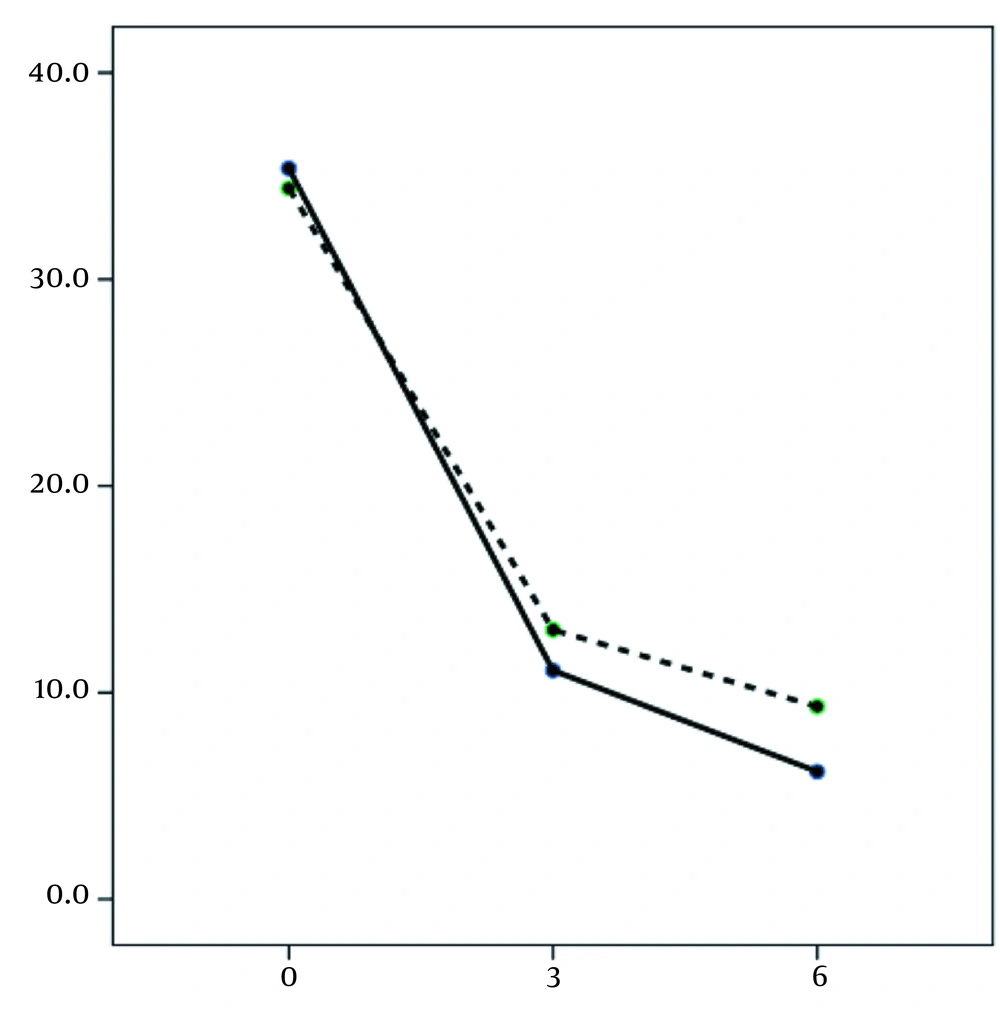
Figure 1.
Comparing decreasing trends of YMRS score of quetiapine and haloperidol groups in different evaluation periods
The trend values were then subjected to decrease in the YMRS score among the members of quetiapine receiving group. In other words, these scores were in them, higher than the group of haloperidol receivers. although such a difference was not significant in both groups at weeks three and six of the treatment period (P-value > 0.05).
It is worth noting that there was no statistically significant difference between the number of patients with “bipolar I disorder” with a mixed feature in the two classified groups; the same was true for patients with “bipolar I disorder” experiencing episodes of mania. Moreover, no subjects of the haloperidol group experienced any kind of extrapyramidal symptoms or depression in the sixth week.
5. Discussion
An acute episode of mania often calls for immediate clinical attention and deserves patient admission to a psychiatric center (3). There is presently a tendency towards prescribing two or even a few drugs concurrently, but it is yet unknown which combination of pharmacologic therapy is best to reduce an acute bipolar state in a particular patient. Another issue that may complicate the treatment of an acute mood episode is the patient’s resistance to commonly used medications. There is no consensus among the experts for the optimal emergency treatment of the acute manic or mixed state of bipolar I disorder (4, 5).
Considering the proven side effects of the second-generation antipsychotics (7), along with trends in prescribing the first-generation antipsychotics added to mood stabilizers (8, 13) in the management of acute or mixed bipolar episodes, it was of our special interest to compare the impact of first and second-generation antipsychotics (quetiapine and haloperidol) on the rapid relief of acute symptoms in patients with bipolar I disorder. The present study emerged the key findings that the reduction in the score of YMRS at weeks three and six of the treatment plan among the group of quetiapine receivers was not statistically significant. Such effectiveness was also unrelated to demographic characteristics including age, gender, etc.
When comparing our results with those of previous studies, it must be pointed out that we obtained higher scores for YMRS in weeks three and six of the intervention program when compared to the study of Intyre et al. in 2005, who reported more reductions in the same scores (14). This difference might be due to the altered prescribed dosages of quetiapine and haloperidol in our research, or such difference may have simply occurred by the sample size of each investigation. It is important to highlight the fact of single drug prescription in the study by Intyre et al., versus combined pharmacological therapy of sodium valproate added to a first or second-generation antipsychotic in our research. However, in both studies, the efficacy of quetiapine and haloperidol was not statistically significant (14).
Contrary to our results, a prior case-control study showed that quetiapine was less effective than haloperidol in the urgent relief of acute mania; however, the difference was not statistically significant (15).
Goikolea et al. reviewed seven prior studies that explored the effectiveness of haloperidol on 2,073 subjects suffering from acute manic episodes and realized that Haloperidol was more effective in decreasing the symptoms of mania during the initial week of treatment; this finding is not consistent with our data in which the reduction in YMRS scores was observed in the third week of intervention and mostly in the group of quetiapine receivers rather than the ones on haloperidol treatment (15). Such diversity might be explained by differences in the sample size of the two studies.
The main limitation of the study is the lack of a placebo group; thus, the effectiveness of treatment may be attributed to sodium valproate alone. Another limitation of the present study naturally includes the short-term follow-up process (six weeks). Future studies may compare the results of combination therapy of quetiapine and haloperidol with other anticonvulsants.
5.1. Conclusion
In summary, this paper argued that a combination of sodium valproate with either quetiapine or haloperidol could be effective in the management of acute mania or mixed bipolar I disorder to reduce the severity and duration of symptoms although there was no statistically significant difference between the efficacy of these two pharmacological therapies.


