
1. Background
Breast cancer remains one of the leading global health challenges affecting women. Global estimates for 2022 indicate that female breast cancer accounted for approximately 2.3 million new cases worldwide, placing it among the most common malignancies globally (1). Improvements in diagnosis and treatment have increased survival; however, many women continue to experience persistent physical, psychological, and social consequences during active treatment and survivorship. Among these symptoms, cancer-related fatigue is one of the most prevalent, distressing, and undertreated problems.
Cancer-related fatigue is commonly defined as a distressing, persistent, subjective sense of physical, emotional, or cognitive tiredness or exhaustion related to cancer or cancer treatment that is disproportionate to recent activity and interferes with usual functioning. It differs from ordinary tiredness in that it is not fully relieved by rest, may persist despite adequate sleep, and requires multidimensional assessment and management (2). Fatigue can limit daily activities, household and social roles, employment, adherence to self-care recommendations, and participation in treatment. Recent systematic evidence indicates that cancer-related fatigue affects a large proportion of patients and varies by cancer type, treatment modality, disease stage, psychological status, sleep disturbance, and physical activity (3).
In women with breast cancer, chemotherapy, hormonal changes, pain, nausea, sleep disturbance, health anxiety, and reduced physical activity may interact to create a self-perpetuating cycle of fatigue. Severe fatigue can reduce motivation for self-care, light physical activity, adequate nutrition, social interaction, and regular follow-up. Therefore, fatigue management in breast cancer should not rely solely on general advice. It requires a structured, patient-centered, feasible, follow-up-based intervention that can be implemented in real-world clinical settings.
Contemporary guidelines for cancer-related fatigue emphasize regular screening, patient education, individualized physical activity, cognitive-behavioral approaches, mindfulness-based interventions, and multicomponent supportive programs (4). Recent studies published in the target journal also support feasible nonpharmacological and supportive approaches for fatigue management: mindful yoga reduced physical, affective, and cognitive fatigue in women with breast cancer (5), and the combined use of low-intensity exercise and slow stroke back massage improved fatigue severity among patients undergoing chemotherapy (6). Nevertheless, complex or resource-intensive interventions may be difficult to implement consistently in routine oncology units, particularly in settings with limited staff and time. In this context, culturally acceptable, low-cost, nurse-led models that combine education with active follow-up may help translate evidence into routine care.
The Continuous Care Model is a structured nursing model implemented through 4 stages: Orientation, sensitization, control, and evaluation. Its core elements include an active therapeutic relationship with the patient and family, identification of patient needs, increased awareness and sensitivity to health problems, support for self-care behaviors, and maintaining contact after the initial educational sessions. Previous studies suggest that this model may improve outcomes in patients with cancer. Elahi and Imanian reported that the Continuous Care Model improved sleep quality and reduced pain, fatigue, and nausea among women with breast cancer receiving chemotherapy (7). Ning et al. also found that continuous nursing based on the Omaha System reduced cancer-related fatigue among patients with lung cancer undergoing chemotherapy (8). In a recent study from Zahedan, structured self-care education improved self-efficacy among women with breast cancer undergoing chemotherapy, further supporting the relevance of nurse-led education and self-management support in this population (9).
2. Objectives
Despite these findings, focused evidence on fatigue among women with breast cancer in the Iranian oncology nursing context remains limited, particularly regarding low-cost, nurse-led, follow-up-based care models implemented during chemotherapy. This study aimed to determine the effect of the Continuous Care Model on cancer-related fatigue among women with breast cancer undergoing chemotherapy.
3. Methods
3.1. Design and Setting
This two-group quasi-experimental study used a pretest-posttest control-group design. The study was conducted in 2023 in the chemotherapy units of Khatam al-Anbia and Imam Ali hospitals, affiliated with Zahedan University of Medical Sciences, Zahedan, Iran.
3.2. Participants and Eligibility Criteria
The study population comprised all patients with breast cancer who were referred to the chemotherapy units of Khatam al-Anbia and Imam Ali hospitals in 2023 and met the eligibility criteria. The inclusion criteria were a definitive diagnosis of breast cancer, age 25 to 65 years, stage II or III breast cancer, no known psychiatric disease, and a baseline Cancer Fatigue Scale score of at least 35. The exclusion criteria were unwillingness to continue participation and cancer metastasis during the study.
3.3. Sample Size and Allocation
The sample size was calculated based on the study by Elahi and colleagues (7), using σ1 = 4.5, σ2 = 4.32, μ1 = 16.8, μ2 = 7.81, α = 0.05, and Z1−β = 0.85 in the formula for comparing 2 means.
The calculated minimum sample size was fewer than 10 participants per group; however, to increase test power and based on similar studies, 40 participants were included in the intervention group and 40 in the control group (total, 80 patients). Convenience sampling was performed based on the inclusion criteria, followed by group assignment using A/B cards. A packet containing A and B cards equal to the total sample size was prepared. After each eligible patient presented, the patient randomly selected 1 card; patients who selected card A were assigned to the control group, and those who selected card B were assigned to the intervention group.
3.4. Measurement
Demographic and clinical characteristics included age, marital status, occupation, educational level, duration of breast cancer, and disease stage. Cancer-related fatigue was measured using the Cancer Fatigue Scale (CFS), developed by Okuyama et al. (10). The CFS contains 15 items and assesses physical fatigue (7 items), affective fatigue (4 items), and cognitive fatigue (4 items). Each item is scored on a 5-point scale ranging from 1 (not at all) to 5 (very much). The total score ranges from 15 to 75, with higher scores indicating greater fatigue. Scores of 15 - 35, 35 - 55, and 55 - 75 indicate mild, moderate, and severe fatigue, respectively. The Persian psychometric study reported acceptable validity and reliability; Cronbach alpha coefficients for the physical, affective, and cognitive subscales and the total scale were 0.87, 0.74, 0.75, and 0.82, respectively, and the corresponding test-retest intraclass correlation coefficients were 0.960, 0.903, 0.945, and 0.843.
3.5. Intervention
Participants in the intervention group received the Continuous Care Model in 4 stages. In the orientation stage, conducted in the first week in 1 face-to-face session lasting 10 to 15 minutes, the researcher established communication with the patient and explained the objectives of the program. In the sensitization stage, 3 educational sessions lasting 30 to 45 minutes were held over 3 consecutive weeks. Fatigue-related educational content included cancer-related fatigue and its consequences, activity-rest planning, energy conservation, gradual activity, nutrition and hydration, sleep management, and follow-up of self-care recommendations. During the control stage, patients were followed for 2 months to monitor implementation of the recommendations, answer questions, and provide guidance. During the evaluation stage, posttest fatigue assessment was completed. Participants in the control group received routine chemotherapy-unit care. The fidelity of intervention delivery was monitored by another member of the research team.
3.6. Treatment Context and Follow-Up
All participants were nonmetastatic, histologic grade II, hormone receptor-positive, and human epidermal growth factor receptor 2-negative. All patients received Adriamycin (doxorubicin) plus cyclophosphamide chemotherapy in 4 planned cycles at 21-day intervals. The orientation and sensitization sessions lasted 4 weeks in total, and the 2-month follow-up was conducted during this chemotherapy phase.
3.7. Statistical Analysis
Data were analyzed using SPSS version 26. Continuous variables were summarized as means and standard deviations, and categorical variables as frequencies and percentages. Independent t tests were used to compare quantitative variables between the 2 groups. Chi-square tests were used to compare qualitative variables between the 2 groups. Paired t tests were used to compare pretest and posttest fatigue scores within each group. Independent t tests were used to compare fatigue scores and changes in fatigue scores between the intervention and control groups. Analysis of covariance was used to compare posttest fatigue between groups while controlling for baseline fatigue. Statistical significance was set at P < 0.05. There were no missing data for the fatigue outcome, and no imputation was performed.
3.8. Ethical Considerations
The study was approved by the Ethics Committee of Zahedan University of Medical Sciences (IR.ZAUMS.REC.1402.347). Written informed consent was obtained from all participants. Confidentiality was maintained, and participants were assured that withdrawal from the study would not affect their routine treatment.
4. Results
A total of 80 women with breast cancer completed the fatigue outcome assessment: 40 in the intervention group and 40 in the control group. The 2 groups were comparable with respect to their main demographic and clinical characteristics. As shown in Table 1, the mean age was 41.30 ± 8.21 years in the intervention group and 43.63 ± 8.66 years in the control group. Disease stage, occupational status, educational level, and duration of disease did not differ significantly between the groups.
Table 1.
Baseline Characteristics of Women with Breast Cancer by Study Group a
| Variables | Intervention (n = 40) | Control (n = 40) | P-Value |
|---|---|---|---|
| Age (y) | 41.30 ± 8.21 | 43.63 ± 8.66 | 0.222 |
| Duration of disease (mo) | 6.05 ± 1.41 | 6.30 ± 1.08 | 0.367 |
| Marital status | 0.218 | ||
| Single | 2 (5.0) | 0 (0.0) | |
| Married | 34 (85.0) | 31 (77.5) | |
| Widowed | 3 (7.5) | 5 (12.5) | |
| Divorced | 1 (2.5) | 4 (10.0) | |
| Education | 0.555 | ||
| Illiterate | 18 (45.0) | 16 (40.0) | |
| Below diploma | 11 (27.5) | 15 (37.5) | |
| Diploma | 6 (15.0) | 7 (17.5) | |
| Academic education | 5 (12.5) | 2 (5.0) | |
| Occupation | 0.494 | ||
| Employed | 2 (5.0) | 0 (0.0) | |
| Unemployed/housewife | 38 (95.0) | 40 (100) | |
| Disease stage | 0.371 | ||
| Stage II | 18 (45.0) | 22 (55.0) | |
| Stage III | 22 (55.0) | 18 (45.0) |
a Values are expressed as No. (%) or mean ± SD. Independent t-tests were used for age and duration of disease. Chi-square tests were used for marital status, education, occupation, and disease stage.
Table 2 presents the pretest and posttest fatigue scores. At baseline, the mean fatigue was 43.92 ± 5.57 in the intervention group and 45.42 ± 5.31 in the control group, with no statistically significant between-group difference (P = 0.222). After implementation of the Continuous Care Model, mean fatigue in the intervention group decreased to 12.95 ± 5.84. The within-group reduction was statistically significant (P < 0.001). In contrast, fatigue in the control group increased from 45.42 ± 5.31 to 53.95 ± 4.41, also showing a significant within-group change (P < 0.001).
Table 2.
Comparison of Cancer-Related Fatigue Before and After the Intervention a
| Total Outcomes | Group | Pre-test | Post-test | Change (post-pre) | Within-Group Test | P-Value |
|---|---|---|---|---|---|---|
| Total fatigue score | Intervention | 43.92 ± 5.57 | 12.95 ± 5.84 | -30.97 ± 7.24 | -27.06 | < 0.001 |
| Total fatigue score | Control | 45.42 ± 5.31 | 53.95 ± 4.41 | +8.52 ± 3.02 | 17.84 | < 0.001 |
| Between-group comparison | P value | 0.222 | < 0.001 | < 0.001 | -31.85 for change | < 0.001 |
a Values are expressed as mean ± SD. Higher scores indicate greater fatigue; a lower score after the intervention indicates improvement. Paired t-tests were used for the within-group pretest-posttest comparisons in the intervention and control rows. Independent t-tests were used for the between-group comparisons of pretest, posttest, and change scores.
The mean change in fatigue was -30.97 ± 7.24 in the intervention group and +8.52 ± 3.02 in the control group. The between-group comparison of change scores was statistically significant (t = -31.85; P < 0.001). An analysis of covariance was performed to adjust for baseline fatigue. As shown in Table 3, after controlling for baseline fatigue, the intervention remained associated with lower posttest fatigue (P < 0.001).
Table 3.
Main Model for the Effect of the Intervention on Cancer-Related Fatigue a
| ANCOVA/Effects | Coefficient or Mean Difference | 95% CI | F-Value | P-Value |
|---|---|---|---|---|
| Baseline fatigue | 0.41 | 0.23 to 0.60 | 19.03 | < 0.001 |
| Intervention group effect | -40.38 | -42.43 to -38.33 | 1534.38 | < 0.001 |
a Analysis of covariance was used for both model rows, with posttest fatigue as the dependent variable and baseline fatigue as the covariate.
The trajectory shown in Figure 1 visually summarizes the divergence between the groups: fatigue decreased substantially in the intervention group, whereas it increased in the control group over the same follow-up period.
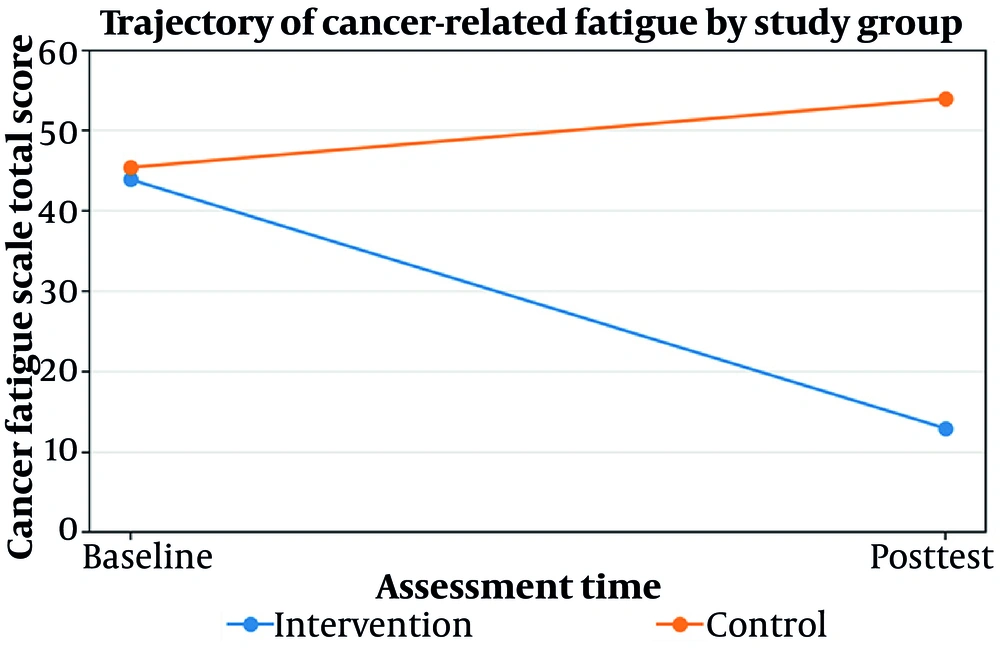
Figure 1.
Mean cancer-related fatigue scores at baseline and posttest by study group; lower scores indicate less fatigue.
5. Discussion
The main finding of this study was that the Continuous Care Model substantially reduced cancer-related fatigue in women with breast cancer undergoing chemotherapy. The intervention and control groups had comparable fatigue levels at baseline; however, after 2 months of follow-up, fatigue markedly decreased in the intervention group and increased in the control group. This pattern suggests that the intervention not only reduced fatigue but may also have protected patients against worsening fatigue during chemotherapy.
From a clinical perspective, the magnitude of improvement was notable and should be interpreted cautiously. Fatigue was measured using a self-report instrument, blinding was not feasible, and the study was conducted in a limited clinical setting. These factors may increase the risk of performance bias, detection bias, social desirability bias, selection bias, and the Hawthorne effect. Therefore, the findings should be interpreted as evidence from a quasi-experimental study rather than as definitive randomized-trial evidence.
The present findings are consistent with studies showing that structured, supportive, and follow-up-oriented interventions can reduce cancer-related fatigue during cancer treatment. Elahi and Imanian reported that the Continuous Care Model improved sleep quality and reduced pain, fatigue, and nausea among women with breast cancer receiving chemotherapy (7). This agreement is clinically important because both studies used a nursing care model based on patient education, continuous contact, and follow-up during chemotherapy. The findings are also consistent with those of Ning et al., who reported that continuous nursing based on the Omaha System reduced cancer-related fatigue among patients with lung cancer undergoing chemotherapy (8). Although the cancer type differed, both interventions emphasized needs assessment, patient education, symptom monitoring, and continued nurse-patient communication.
The results are also supported by more recent evidence on nonpharmacological and supportive care for cancer-related fatigue. Azimi et al. showed that mindful yoga reduced physical, affective, and cognitive fatigue in women with breast cancer (5), and Fazeli et al. reported that low-intensity exercise combined with slow stroke back massage reduced fatigue severity among patients undergoing chemotherapy (6). At the synthesis level, an overview of systematic reviews reported favorable effects of exercise interventions on cancer-related fatigue in breast cancer while noting that methodological quality and intervention characteristics should be considered when interpreting the findings (11). In a related study of women with breast cancer undergoing chemotherapy, an educational-supportive intervention improved perceived stress and nutritional status (12). Although fatigue was not the primary outcome of that study, its findings support the broader role of structured education and support in managing chemotherapy-related problems.
However, the literature is not completely uniform. Jacot et al. found that a brief hospital-supervised exercise and diet education program did not significantly improve general cancer-related fatigue compared with usual care in women receiving adjuvant treatment for early breast cancer (13). This nonconcordant finding may be related to differences in intervention intensity, continuity of follow-up, adherence, and the degree of individualized support. In contrast, a recent meta-analysis of randomized trials reported that mindfulness-based stress reduction significantly reduced cancer-related fatigue in patients with breast cancer (14). Taken together, concordant and nonconcordant findings suggest that fatigue reduction depends not only on the type of intervention but also on sustained follow-up, patient engagement, timing during treatment, and patients’ practical ability to implement the recommendations.
The mechanisms by which the Continuous Care Model may reduce fatigue are probably multifactorial and are consistent with the logic of the model itself. The model emphasizes an ongoing relationship between the care provider and patient, sensitization to health problems, patient participation, self-care behaviors, follow-up, and evaluation. In this study, these elements may have helped patients better recognize fatigue, follow the educational recommendations, maintain communication with the care provider, and receive support during chemotherapy.
These findings are also compatible with current cancer-related fatigue guidelines. The ASCO-Society for Integrative Oncology guideline emphasizes nonpharmacological approaches such as exercise, cognitive-behavioral interventions, mindfulness-based programs, and psychoeducation for fatigue reduction (4). Although the Continuous Care Model is a nursing model developed and applied in the Iranian care context, it is conceptually aligned with these recommendations because it integrates education, monitoring, behavioral support, and follow-up. Moreover, systematic evidence in breast cancer suggests that appropriately tailored physical activity and supportive behavioral interventions can help reduce fatigue (11). In the present intervention, the educational content included balanced activity and rest, gradual light activity, and energy conservation.
This study has several strengths. It focused on a clinically important and measurable outcome, used a standardized fatigue instrument, included a control group and pretest-posttest measurements, and implemented the intervention in a real chemotherapy-care setting. However, limitations should be acknowledged. The study was conducted in hospitals affiliated with 1 university in 1 city; thus, generalizability to other regions should be interpreted cautiously. The study used convenience sampling followed by A/B card-based group assignment rather than a full randomized controlled trial procedure with computer-generated random sequence generation and formal allocation concealment. Fatigue was measured by self-report, and blinding of participants, intervention providers, and outcome assessment was not documented. Although all participants presented with complete blood count sheets and had hemoglobin levels above 10 g/dL at entry, exact hemoglobin values were not recorded in the research dataset and therefore could not be entered into the tables or controlled in the analysis. Cronbach alpha for the current sample, chemotherapy dose modifications, cycle-by-cycle symptom burden, nutritional status, pain, depression, sleep quality, and physical activity were not available in the research dataset and therefore could not be controlled in the present analysis. Follow-up lasted 2 months; therefore, the durability of the effect is unknown.
For clinical practice, the findings suggest that oncology nurses can play an important role in fatigue management by implementing a structured, low-cost, follow-up-based care plan. Practical implementation may include nurse training, use of the educational program developed for the Continuous Care Model, scheduled follow-up contacts, and patient education during chemotherapy. This implementation logic is congruent with recent evidence from Rezvaniamin and colleagues, in which a nurse-led behavioral intervention supported by home practice and telephone follow-up improved a patient-reported outcome in another chronic disease population (15). Research on educational-supportive interventions in women with breast cancer undergoing chemotherapy also supports the practical relevance of structured education and support in this population (12). The 5-EPIFAT trial protocol further highlights the ongoing need to develop and evaluate strategies for cancer-related fatigue during active cancer treatment (16). Future studies should test the Continuous Care Model in multicenter trials with longer follow-up and should assess quality of life, sleep, anxiety, treatment adherence, physical activity, and clinical indicators such as hemoglobin.
5.1. Conclusions
The Continuous Care Model significantly reduced cancer-related fatigue in women with breast cancer undergoing chemotherapy. Given its simplicity, nurse-led structure, and feasibility for clinical follow-up, this model can be considered part of routine supportive care for women with breast cancer.