1. Background
Multiple sclerosis (MS) is a chronic, progressive neurological condition characterized by patches of demyelization of nerves in areas of the brain and spinal cord, resulting in distorted or interrupted transmission of nerve impulses to and from the brain. In a study designed to understand how people with MS experience engagement in occupations, the participants reported decreased engagement in meaningful occupations, which led to a belief that they are different as people and are now living more differently than they did before (1). Research shows that 85% of people with multiple sclerosis lose their jobs during the first 5 years after diagnosis. This not only has serious effects on their work performance areas but also means that it forces them to have extra spare time in their life. The importance of leisure is therefore increased in people with multiple sclerosis (2). According to the literature, leisure can be simply defined as activities in which people participate willingly and eagerly after release from their job, family, and social obligations and duties, in order to relax, to have fun, to develop their knowledge and self-actualization, and to connect with the community (3).
Previous research on adults with disabilities reveals that satisfaction with leisure is an important factor in predicting satisfaction with life (2). It has also been shown that there is a relationship between quality of life and 4 important factors in relation to multiple sclerosis, including the ability to have outdoor recreation and social activities, to work or be involved with activities without emotional and physical problems, to overcome fatigue, and finally to have intimate and supportive friendships (4). Koopman mentioned that people with MS stated daily meaningful recreational activities as very important in their life, along with their health, their physical, psychological, economical, and occupational conditions, and access to social facilities (5). It should therefore be emphasized that attention to rehabilitation according to recreational activities has great importance, and increases the levels of satisfaction with life and well-being. Johnson showed that MS can have profound effects on daily life activities, such as leisure. Decreases in physical function can result in decreased participation in recreation and leisure activities. Impairments caused by MS can limit participation in leisure activities, or people with MS are forced to adapt activities according to their needs (4). As studied a population in Norway with neurological problems, mainly MS and Parkinson’s disease, who were referred to occupational therapy social communities, and showed that common problems are related to occupation (93-94%) and leisure (94%) (6). Lexell studied 44 people with MS from both genders with a mean age of 49.4. He reported that they have problems in all 3 areas of daily performance, including leisure, and that leisure problems affect the two sexes equally (7).
Unfortunately, leisure and recreation are not considered often enough in rehabilitation programs for people with MS. Johnson has shown that rehabilitation in multiple sclerosis mainly focuses on physical function, ignoring recreational activities related to social and mental function (4). Motl and colleagues mentioned that although both physical activity and self-efficacy might be important targets of behavioral and self-management interventions for improving the health related quality of life of people with MS, self-efficacy is seemingly more important than physical activity (8) and is a very important predictor of leisure time and physical activity participation (9). Common psychiatric disorders in people with MS, such as depression, also interfere with performance areas such as leisure perspectives and experiences (10, 11).
As leisure perspective, which directs leisure exploration and experience, is a subjective matter based on the clients’ contexts, qualitative studies can help to gain deeper insights in these cases. Many researchers believe that qualitative research patterns can help more in the exploration of hidden aspects of human concepts, such as culture, perception, perspectives, attitudes, and ideas (12-16). Regarding the holistic perspective of occupational therapy, the accurate recognition of needs regarding leisure in people with multiple sclerosis is not limited to purely physical problems, but also requires special attention to psychosocial aspects, including points of view, experiences, and personal, cultural, social, physical, and spiritual contexts.
2. Objectives
Given the importance of precise reviews about leisure in people with MS and individual special perspectives and experiences in different occupational contexts, the present study was conducted to determine the perspectives and experiences of people with MS regarding leisure and related activities.
3. Patients and Methods
This qualitative research studied the perspectives and experiences of people with MS regarding leisure using the descriptive phenomenological method. Participants were selected through purposeful sampling among people of both sexes of the MS Society in Khuzestan province of Iran, who had previously been seen at the Physiotherapy and Occupational Therapy clinics of the Rehabilitation School of Ahvaz Jundishapur University of Medical Sciences (AJUMS), in 2012.
In order to observe ethical points before starting the interview, the participants were accurately informed about the project. An interview was performed and recorded after obtaining written consent. In this way, the following ethical issues were noted and the participants were informed about them. A) Data obtained in the interviews were anonymized. B) The participants were assured that their data would remain confidential. C) The participants’ data in the interviews were used as an accurate report of what the person said, without any manipulation. D) Insulting remarks to natural and legal persons, if any, were removed from the statements of the participants. This study was approved by ethics committee in Ahvaz Jundishapur University of Medical Sciences with the code of ETH-119.
All participants had enough verbal ability to participate in the interview. Some of them were physically independent but others used a cane, crutch, walker, or wheelchair. Interviews were conducted in a special room in the office of the researcher or in the physiotherapy clinic affiliated to the rehabilitation school.
Data were collected by in-depth interviews as well as observation and note taking during interviews. Face-to-face interviews were conducted by the researcher, with at least 20 to 60 minutes in a single session. Statements and opinions of the interviewees were recorded by Dictaphone. Questions were raised during the non-structured interview. The first question raised in this section included a general question, i.e. "What are your views and experiences of leisure experiences?" The other questions were asked according to the participants’ opinions. To maintain the integrity and strength of the obtained data, the research questions were asked in a variety of ways in order to reduce or eliminate the possibility of incorrect information being provided by the participants. Since the data collection methods were in-depth interviews, the interviews were conducted accurately and without bias so as to gain enough information about the subject of the questions. This means that if in the same situation or a similar condition another investigator repeats the process, then he/she can achieve the same or similar responses. After the interview, a verbatim transcript was obtained in order to investigate the principles, phrases and sentences of the participants in the interviews. In order to interpret and analyze the gathered information after verbatim transcription of each interview, the manuscripts with original codes were presented to each interviewee to ensure that they could correct any errors in interpretation, to boost the clarity and reliability of the research. The correction was based on the participants' opinion; recorded information was analyzed before the next interview with others as guidance for the next session, and finally all interviews were read line by line, repeatedly reviewed, and eventually coded. In order to interpret and analyze the obtained data, Colaizzi’s method was used. Data was broken into its components and also compared in terms of similarities and differences, and then the main concepts were coded in each line or paragraph. Next, the previous primary codes and classifications were checked to integrate conceptually similar codes, and ultimately the sub-themes were formed. Above all, these continued to form the themes. Moreover, to ensure the reliability of data analysis, the researcher referred to all participants and asked their opinions about whether the findings could reflect a comprehensive description of their experience or not (Member Check). If something was added or removed by the participants, this data was incorporated into the final text. In summary, this process included: A) describing the desired phenomenon; b) collecting the participants’ descriptions of the phenomenon; c) describing all expressed interests in the phenomenon; d) referring to the main entries and extracting important phrases; e) determining the meaning of each significant phrase; f) organizing meanings formulated in clusters of themes; g) forming a comprehensive and perfect description; h) referring to the participants to validate the descriptions; and i) adding these data to comprehensive descriptions in the case of access to new data during validation.
Data gathering continued until data saturation was achieved. To confirm the validity and prolong engagement with the participants, peer review was used. The final data were reviewed by three professionals in quantitative research. It is worth noting that according to the principle of confidentiality, the names of the individuals participating in this study were replaced with numbers. Moreover, according to the language spoken, the author tried to use phrases such as "people with multiple sclerosis" instead of negative words such as handicapped, disabled, and patients; but these words have been used in direct quotations from participants during interviews to maintain accuracy.
4. Results
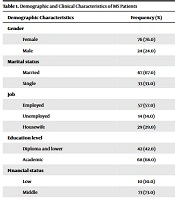
Eleven interviews were conducted with eight women and three men with MS. The ages of these subjects ranged from 20 to 47 years. Six participants were single and the others were married. In terms of educational level, five subjects had a diploma, three were students at university, and three had Bachelor of Science degrees. Demographical information is shown in Table 1.
Table 1.
Demographic Information of Participants
| Participant Number | Gender | Age | Marital Status | Education |
|---|---|---|---|---|
| 1 | F | 21 | Single | Student |
| 2 | M | 27 | Single | Diploma |
| 3 | F | 40 | Married | Diploma |
| 4 | F | 47 | Married | Diploma |
| 5 | M | 29 | Married | Diploma |
| 6 | M | 33 | Married | Bachelor |
| 7 | F | 30 | Single | Bachelor |
| 8 | F | 22 | Married | Student |
| 9 | F | 26 | Single | Diploma |
| 10 | F | 20 | Single | Student |
| 11 | F | 37 | Single | Bachelor |
By repeatedly studying verbatim transcribed texts, 734 important sentences were initially selected. These were analyzed using Colaizzi’s analytical method. These phrases were reduced to 164 during the next examination. Finally, after reviewing the phrases and their meanings, 9 key phrases were selected as the main sub-themes. In a subsequent study, sub-themes were classified into 4 main themes of research, and finally were classified into a general theme. Obviously, due to the large volume of data from interviews, only a limited number of phrases were selected and used in the text of the article. The general theme, main themes, subthemes, and some phrases used by participants are displayed in Table 2.
Table 2.
Themes, Subthemes and Some Statements of Participants
| Themes and Sub-Themes | Some Phrases of Participants |
|---|---|
| Importance and aim of leisure | |
| Improve physical performance | Participant 7 stated: "We get renewed physically." |
| Improve mental performance | Participant 8 stated: "When I do what I like, this can be great spiritually." |
| Style of spending leisure | |
| Personal spending | Participant 1 stated: "I sit and close my eyes and think by myself." |
| Group spending | Participant 4 stated: "Most of my time is spent with my wife and children at home." |
| Leisure obstacles | |
| Individual barriers | Participant 6 stated: "Leisure time increases for me when I have an attack of MS because I have no way to rest." |
| Social barriers | Participant 6 stated: "There is a bad meaning for MS in society. They don’t know what MS is and as they don’t have enough information, they say every bad thing to people with MS." |
| Environmental barriers | Participant 10 stated: "Most of the time in the year, there is hot and dusty weather in Ahvaz so I prefer to stay at home and watch these groundless TV programs. As you know hot weather is not good for MS." |
| Leisure suggestions | |
| The role of person | Participant 5 stated: "If a person has a good relationship with relatives and friends, then it is ok and life is not boring." |
| The role of society | Participant 11 stated: "If they consider us as a citizen with a wheelchair, they don’t dig the ground and make holes which are difficult for us to pass by in a wheelchair through alleys and streets." |
4.1. Importance and Aim of Leisure
The main themes in this study were the importance and purposes of leisure, which were obtained from sub-themes of improving both physical and mental performance. Participants mentioned the importance of the effects of leisure, such as keeping the body healthier and reducing mental and physical fatigue; human needs for leisure for better productivity, job affairs and self-care outputs; improving access to enable more future success; to keep and improve knowledge and spirit power; to relieve mental monotony, especially those caused by MS; and to be with people and to be loved by them.
Participant 1 stated: "Leisure time is helpful. It can solve some human problems, including work and life disturbances. Most of the time, I am preoccupied with different thoughts because of having this problem, which you know. Some thoughts bother me. I am trying to forget these bothering thoughts during leisure time and be comfortable. There were times that I could have better output in my studying after that. I feel better spiritually and my mind works better after leisure activities. I think leisure has the same importance as my university work."
Participant 2 stated: "(I) just want to pass time. Time must pass."
Participant 3 stated: "Leisure is important because the body can be kept healthier. It is a need for human beings."
Participant 6 stated: "We should use our leisure in the best condition, so we do not regret this in future. We should make our future more clearly and the best it could be. We should learn something from life."
Participant 9 stated: "Leisure is very much important. Good leisure makes thorough changes to me. I think I am healthy mentally. I can do my work in the best way."
Participant 5 stated: "When I play with my grandchildren in my spare time, I have a good feeling. They like me more due to me playing with them. Time passes better by playing with them." She added that: "When I read books, journals or something like that, I repeat those things I have learned before, so I do not forget them. If I do not repeat, then I forget them rapidly."
4.2. Style of Spending Leisure
The other main theme in this study was how to spend leisure time, obtained from the sub-themes of personal and group activities. Individual leisure time priorities included watching TV, doing home maintenance, reading books and magazines and various newspapers, thinking, exercising, using computers and related programs, praying and reading the holy Koran (both at home and the mosque), sleeping and resting, listening to music, walking, and participating in various classes such as art and psychology classes. A priority for group spending was the company of others, especially spouses, children, and friends, with activities such as going to the park.
Participant 1 stated: "I often try to read general rather than school books. It sometimes happens that I sit and close my eyes and think. I categorize my thoughts. I sit and think if I cannot remember a certain thing or if I learned better before; it is not because of the MS. It is because I am distracted. So I would like to justify myself. I concentrate on the point that I am not patient. When I feel tired of the dormitory, I go and walk around. I listen to music when I cook it sometimes happens that I talk with my friends till 1am and this is a kind of leisure activity."
Participant 4 stated: "Most of my time is spent with my wife and children at home. I play with my grandchildren. Sometimes I go to the park. Sometimes I have guests and with my sister in law welcome them."
Participant 5 stated: "I preferably sleep during free time."
Participant 6 stated: "I allocate about 2 out of 18 hours of my free time weekly to thinking, positive thinking about what I can do to get better than now. I spend at least 7 to 8 hours of my spare time working in the field of software designing. I learn more from computer sciences. I set aside another 1 or 2 hours to be with family, children, parents, and my wife. We go out with my wife, and I enjoy it. I don’t go to the cinema since I don’t like it. I watch TV just for social programs. If it is ok, medical programs on TV. For example, a wise doctor talking about life planning. I read good books and use great people’s knowledge, especially sociological books. Sometimes I go to the mosque and pray or go out with one of my friends."
Participant 8 stated: "I read books in my spare time. To tell you the truth, I sleep a lot in free time. Maybe it is more than usual. I can do light activities like decoration at home or sewing, painting. But I do sleep more."
Participant 9 stated: "I memorize the holy Koran in my spare time. Now I have memorized 10 parts of it. I watch nice programs on TV too and no other activity."
4.3. Leisure Obstacles
Among the main themes of this research, barriers to leisure were defined from the sub-themes of personal, social, and environmental barriers. Participants in the study stated that depression and lack of motivation, negative thoughts, lack of enough physical ability, lack of proper individual planning, fatigue and the need to rest instead of spending energy on suitable activities, giving priority to other daily issues rather than addressing recreational activities, personal financial constraints, health problems, concerns about the future in this case especially for marriage and job, lack of familiarity with various recreational facilities in urban areas, lack of familiarity with the rights of the individual to engage in leisure activities, and satisfaction with minimal facilities are the personal factors inhibiting proper leisure. For social barriers, they cited economic problems in society (leisure being expensive); cultural barriers to entertainment in society, especially for women; family members having other commitments; lack of knowledge about MS in society; and lack of social help for people with MS. Furthermore, they mentioned the inappropriate climate and weather in Ahvaz (extreme heat and high humidity throughout the year and the existence of extreme dust), the lack of adequate urban facilities for the population with special needs (inappropriate urban architecture) and lack of appropriate facilities to enable the mobility of people with MS. For this reason, many participants expressed dissatisfaction with their own leisure.
Participant 1 stated: "Really I don’t have any plans for leisure time. So I am always preoccupied with what I didn’t do in spare time. I never learn from it. If I have good plans for my leisure time, I can pass spend at least 4 days a week with good leisure activities." He also added: "Sometimes I am very busy so that I don’t have free time at all. You see, sometimes I don’t know where and how I can spend my spare time. Most of the time, there is nothing to fill my free time with." He continued: "Sometimes when I want to rest, I get involved with my MS and disability. I have seen MS patients who just sit in a wheelchair; it is really a difficult condition."
Participant 2 stated: "I am depressed. I don’t have enough physical and mental ability. I just do my job and no more at all. Depression is related to my illness. When MS attacks occur, depression is going to increase."
As a man, participant 6 stated: "I know most of the MS patients here in the MS society. To me, MS patients, especially women, waste their spare time. It is exactly because they are pessimistic about life and the future. They think they have nothing as they have MS. They say I am sad because I have MS. I think I don’t have a good future. Then I ask them what your future is. They say marriage, job. I see their deep feeling. Maybe they are right in some instances but it is a right for every person to be hopeful and not allow it to disturb his life. They say: "If I want to do this new work or every activity, it is possible that MS doesn’t permit me to do it, or maybe I get paralyzed. You see, it is just a possibility and not more. I don’t know why they think pessimistically. It may be that MS doesn’t do what they say. They don’t want to be optimistic. Most of the MS Patients are hopeless and think negatively. It is possible that they won’t have problems in keeping themselves fresh and happy in future. Is it true that I don’t have any plans for the future just because of MS and its possible future symptoms? Why I must be sad because of MS? I don’t want to be like them. I don’t want to waste my time in life." He also added, "In the severe points of MS attacks, my leisure time is going to increase. I am obliged to be in a resting position. I get bored soon and have no way to rest. I can't go out with my friends. My family feels more compassionate for me in this phase." Also, he stated: " As in society people don’t have enough accurate information about MS, they say everything to MS patients. For example, they say it is a contagious disease. No solution for it. They don’t know MS patients. They don’t know that most MS patients are talented and educated. I wanted to go to the doctor’s office. Unfortunately I fell down. I told a man to help me to get in a car. He didn’t do it for me. I was sad and asked my friend why he didn’t help me. My friend told he is right. Unfortunately, society has been changed so that if you help someone in this condition, you can claim that he made me fall. So nobody helps others in this case. Or when an MS patient goes to the pool, people don’t know how they can help. If they help, it may cause inconvenience, and if not, it is not humane. So, it is confusing for them. You see, if an MS patient wants to go to cinema, as it is difficult for him to wait in a line for long time, others say that’s what your problem is. You are young. Youths are lazy. They don’t know the problems. So, it is annoying. When an MS patient wants to get in a car for a short distance as he gets tired very soon, the taxi driver wants to take more money for this distance. You see, these are our problems. There is something against someone who knows what MS is. Then, he persists to help the MS patient incorrectly. You see, being over compassionate is not ok at all. Of course, there are people who think truly."
Participant 8 stated: "Honestly I sleep. I feel sad if I stay awake longer and think negatively more. For example, I think to what I did last week; then I get sad more." He also added: "I think I can't go to public places because of my illness. I can't progress like my friends in sport classes physically. I like to have more physical leisure time activities. I think I have become more sensitive these past 2 years. My spouse may not get me everywhere for recreation or other classes because he has limited time. He goes to his work. I like to go outside of the home to do things like shopping."
Participant 9 stated: "I have some friends who like me to go with them. But there is no way. Because of my physical problems, I can't walk. I don’t have a good health condition. I like to go to the park but my dad should come with me and take a ride. He can bring me where I like and he knows himself, but he says he is busy with his job and his fieldwork. He can't have a companion."
Participant 10 stated: "Most of the time in a year, there is a hot and dusty weather in Ahvaz so I prefer to stay at home and watch these mindless TV programs. As you know hot weather is not good for MS. It increases our problems. You see, there is no special enough place to go there. Just Saheli park (name of a park in Ahvaz) which is very crowded, and there are many types of people there. Some of the leisure activities are expensive, too. People must spend a lot for them, which is more than they are worth."
Participant 11 stated: "If I want to go anywhere in the city, I need to go where there are wheelchair ramps, but there are not enough ramps in the city. It is even very difficult to pass by wheelchair in bazaars or streets."
4.4. Leisure Suggestions
Among the main themes in this study, suggestions for improving recreation were obtained from the sub-themes of both the individual and society’s role in improving leisure time. Participants’ suggestions for the individual’s role included praying and having a good connection with God, having positive thoughts and hope about the future, proper planning, participating in interesting classes addressing the arts and sport, participating in psychological classes with the aim of gaining more knowledge about MS problem solving, traveling to places of pilgrimage and tourism, improving family relations, and communicating with friends. Among society’s roles for improving leisure time, we can mention improving the levels of people’s knowledge about MS; providing appropriate facilities for people with MS to have access to parks, social and cultural locations for leisure time; holding special psychological classes for people with counseling; sessions and conferences for gathering people with MS together regularly; special sport and art classes focusing on MS needs; the promotion of public transportation systems suitable for people with MS; raising the level of their income; and improving the quality of the media’s programs especially television.
Participant 1 stated: "You see, if an MS patient has a good planning, he can use leisure better. He can use sport and art classes."
Participant 3 stated: "It would be great to have special sport and art classes or psychological ones."
Participant 4 stated: "It would be better if we have good relationships with other humans, relatives or families. In this case, there is no exhaustion in life."
Participant 6 stated: "If we have a good connection to God, it would be great. In my mind, this is very important: better connection, better life, better spirit and also being positive in all cases. You see, this holy Koran has very interesting things resulting in positive thinking, a happy life. Why should we be hopeless? It would be nice to be with other MS patients together in a special location and talk to each other with no physician. It is good to have a psychologist there, once or twice monthly at least. You see, it happened before but not now. It is great to be with each other and visit. We can talk and make each other hopeful. Hope will be more in these sessions. You see two people who have been successful can affect each other. It will be never unsuccessful. Problems increase when people are alone. In this case, there are negative thoughts more, too. I have a suggestion that the MS society should specify a mini bus to take MS patients here in the MS society together. Everyone can do what he needs here; then, the minibus can take them back. The goal is being together. You see they don’t have enough attention to these suggestions".
Participant 8 stated: "If TV had better programs, then I would watch it more enthusiastically".
Participant 11 stated: "If they consider us as citizens with wheelchairs, they won’t dig the ground and make holes so that it is difficult for us to pass by in a wheelchair through alleys and streets".
5. Discussion
Participants in this study expressed the importance of leisure from different aspects. It was shown that these people were spending their leisure time in the form of individual and group activities; however, they are faced with various barriers including personal, social, and environmental ones. They require more attention to be given to their leisure, and to emphasize the role of the individual and the community in improving their leisure. A summary of their statements was collected and categorized into 9 subthemes and 4 main themes under the umbrella phrase of the perspectives and experiences of people with MS about leisure.
The population in this study mentioned the importance of leisure for their mental and physical functions. Hunt and his colleagues (2013) pointed out those handicraft activities, as leisure-based visual activities, contributed to a more satisfying way of life, filling occupational voids and using time well. They also offered deep immersion respite from worry about illness. Creative classes offer social camaraderie and opportunities for learning and development. Art-making processes and products are highly affirmative, increasing emotional well-being and promoting self-worth. They also feel that they express valued aspects of self through their art. Art has appeared to assist with identity maintenance, accommodating functional losses associated with MS whilst opening new doors (17). Some other studies showed the positive effects of leisure and leisure activities on people with MS. Kleiber showed that leisure could have 4 effects on adjustment to disability. First, leisure is a barrier for negative events in life because it provides a diversion from disability concerns and anxieties; second, it results in a positive perspective for the future; thirdly, it results in keeping positive aspects of the past and rebuilding life; and fourth, it is as a tool for managing individual upheaval during negative events in life (2). Reynolds in his qualitative article mentioned that participation in art activities is a suitable source for individual identity and positive attitudes for people with chronic diseases like MS even if they have not participated in art programs regularly before (18).
Participants pointed that there were some limitations to participation in leisure activities, including individual, social, and environmental limitations and barriers. According to a previous study, Nortvedt (2005) compared people with MS with the normal population and people with diabetes, asthma, and angina in relation to the quality of life, especially related to health and job conditions and lifestyle factors. It was revealed that people with MS smoke more than others and have less physical activities related to leisure (19). Plow et al. (2014) also, expressed that fatigue, pain, and lack of time were commonly cited barriers to engagement in physical activities related to performance areas such as leisure (20). Vanner et al. (2008) mentioned that in people with MS, there is a relationship between high levels of activity and recreation with lower levels of apathy and depression, and also with higher levels of cognitive skills, self-efficacy, and quality of life, thereby, increasing leisure activities (21). Hakim et al. (2000) studied 411 people with MS and mentioned that MS has a profound effect on social roles and the welfare of relatives. Severe disability and cognitive impairments are predictive factors for drop outs, decreasing standards of life and leisure activity and also increasing social withdrawal in these people (22). Therefore, it seems that leisure activities could affect people with MS through not only physical limitations but also psychological ones. Ben Ari et al. (2014) mentioned that increasing the participation of people with MS in different performance areas including activities of daily living, leisure, and work is an important outcome of rehabilitation. The results of his study suggest a multi-factorial approach to intervention that considers physical, mental, and emotional components to maximize participation among patients with MS. He mentioned that rehabilitation for people living with multiple sclerosis (MS) should incorporate careful evaluation of physical disability, cognitive impairment, and depression, and also their impact on participation. Signs of depression may also have a greater impact on participation in outdoor and leisure activities than on other activities (23).
Participants in this study also experienced exclusion from different facilities. They asked for governmental and non-governmental organizations to participate in solving their problems more actively. They stated their exclusion from being unable to reach some locations and the lack of having a well-organized community transportation system. They believed that the physical structure of public spaces and also urban transportation systems sometimes must be adjusted to solve their physical problems. The architecture was one of the most important obstacles to integration of people with disabilities in the society. They also mentioned the lack of support systems, especially for the planning of sport and art classes. They emphasized lack of holding regular meetings and having counseling classes for people with MS as barriers for leisure that can be solved with good planning. In Article 24 of the Universal Declaration of Human Rights, the right for rest and leisure for those with disability is mentioned. Also, the protection of individuals with disabilities in recreation, sport, and culture is mentioned in the fourth article of the law (24).
One of the problems raised by the participants was the lack of sufficient knowledge in the community about MS and people with MS. It can be concluded that it is essential to promote public education about the symptoms and needs of these people due to the increased incidence of this disease in the community, in order to provide proper support for these people with opportunities to improve accessibility to community facilities.
The findings showed that leisure was affected by limitations in physical and mental performance in people with MS. It also appeared that improvement in the quality of leisure for people with MS needs governmental and non-governmental cooperation to promote life satisfaction and quality of life in these people.
Rehabilitation clinicians must take the importance of leisure participation into account; they should not ignore leisure in evaluations and interventions, as it has effects on the quality of life of people with MS. This is more important area because many people with MS are unemployed in Ahvaz city (38.9%), so, they have more spare time than others (25).
Clinicians must pay attention to the effects of some important problems in MS, such as physical limitations, fatigue, pain, cognitive changes, emotional and psychological disorders (especially depression) (23, 26), behavioral problems, and social isolation, which can all have an effect on leisure participation. It is also suggested that clinicians should try hard to facilitate and make suggestions for easier transport in urban and rural areas by adaptations in the environment to increase participation in leisure activities by people with MS. Above all, attention to these suggestions by a person who has a disability can improve the quality of rehabilitation programs according to the main paradigm of rehabilitation disciplines, to develop and deliver client-centered programs.
Moreover, the government and public media must provide more information to increase people's knowledge about MS, especially about the signs and symptoms and the needs of people with MS as human beings. They must also act to facilitate participation in leisure activities by people with disabilities.
There were some limitations in this study. In some cases when their speech was to be recorded, the participants were discouraged from participating in this research. The researcher waited for a long time in the MS society or clinic for the presence of participants to obtain final approval for their participation. Moreover, the cognitive skills of participants were not considered in this research.