
1. Background
Anxiety disorders are among the most common mental disorders in the general population (1). Text of the fifth edition of diagnostic and statistical manual of mental disorders (DSM-5) introduces generalized anxiety disorder (GAD) as a disorder mainly characterized by extreme anxiety, which lasts for at least 3 months and is related to 2 or more fields of activity or events, such as professional or educational problems (2). The characteristic of this disorder is intense anxiety and worry about several events and activities for at least 6 months (1). In generalized anxiety disorder, a person permanently worries about future events and is afraid of them (3).
Epidemiologic studies show that around 30 million people in the United States have these disorders. Among them, one-year generalized anxiety disorder has a prevalence of 3% to 8%. Female to male proportion of this disorder is 2 to 1, but this rate is around 1 to 1 for women and men being embedded for treating the disorder. Lifetime prevalence of this disorder is near 5% (4). Presence of autonomic excitement, muscular tension, and alertness has been mentioned and, where anxiety must accompany 3 or more of the 6 key symptoms of impatience, fatigue, distorted concentration, emotionality, muscular tension, and distorted sleep. Generalized anxiety disorder accompanies increased risk of morbidity to medical diseases and is also considered as a risk factor in the etiology of a range of psychiatric disorders, especially depression and alcohol abuse, such that their timely diagnosis and treatment is one of the considerable worries among clinical circles. As time passes, patients with generalized anxiety disorder realize that their worries are overwhelming and cause them mental distraction (5).
The thinking model of individuals with emotional disorder has a repetitive and ruminative nature, which focuses on relevant subjects that are difficult to control.
This condition is a sign of cognitive attentional syndrome with increased characteristic of self-attention. Cognitive-attentional syndrome includes extreme conceptual process that manifests itself as thought worriedness and rumination. These processes include long chains of thoughts that are more verbal, through which a person tries to answer to “what if …” question or questions about the meaning of events (Why do I feel like this?). In addition to these conceptual elements, cognitive-attentional syndrome includes directed attention in the form of focused attention to stimulants related to threats; this state is called threat monitoring (6). Salmani et al. (7), in their study, found that metacognitive therapy of cognitive-attentional syndrome and cognitive incompatible regulatory strategies reduce emotion. Low cognitive trust refers to individuals’ mistrust to their memory and attention as cognitive procedures, which is considered as metacognitive incompatible elements and strategies (8, 9). Cognitive-emotional self-regulatory model explains that individuals with emotional disorder are trapped in a closed circle of self-incompatible process. This process leads to lack of resources and rigid control during the process. In this process, emotional disorder must be related to meta-measurements of low cognitive trust. This state must be more intense in disorders involving deeper layers of information process in cognitive-emotional self-regulatory model.
Based on this prediction, low trust for cognitive abilities is related to emotional distraction (9).
Spada et al. (10) consider metacognitive dimensions including positive metacognitive beliefs
about anxiety and low cognitive trust among motives causing anxiety (11). They found that patients with generalized anxiety disorder have lower cognitive trust compared to healthy groups (12). They further showed that metacognitive therapy reduces generalized anxiety disorder among students. Metacognitive therapy is among therapeutic methods with effectiveness on generalized anxiety, which has been approved in numerous studies (13-16). In another study, it was found that metacognitive therapy reduces generalized anxiety syndrome as well as metacognitive beliefs (17), which showed a significant difference between the metacognitive therapy and control groups. They also found that metacognitive therapy reduces significance of generalized anxiety and depression among patients with grade 2 diabetes. In another study, it was revealed that metacognitive therapy technics are used to treat generalized anxiety based on Wells manual (18). Metacognitive therapy is a new approach that has emerged as a result of systematic modeling and testing, leading to various technics with effectiveness approved by scientific studies. This approach has been highly effective in understanding and treating disorders, such as generalized anxiety disorder (19), posttraumatic stress (19, 20), mental and practical obsession disorder (21), social anxiety (22, 23), and depression (21). Due to its specific characteristics (having a regular structure; limited number of therapeutic sessions; emphasis on cognition process instead of its content; designing specific technics, such as detached mindfulness and attention training technic (6); and providing special models for each disorder and their empirical evaluation), this therapy has gained an extensive worldwide acceptance (9). Metacognitive therapy helps understand the causes of mental health problems and their treatment. This approach is based on the fundamental theory of executive function and is self-regulated. Metacognitive therapy has been first offered to treat generalized anxiety disorder and has proved to be effective in the rate of recovery and treatment progress in different studies (13-15). This therapy includes technics and strategies that challenge the patients’ process and way of thinking instead of targeting the contents of their cognitions and changing their way of responding to cognitive processes, such as anxiety. The meta-cognitive model has been validated in a number of individual studies (12, 14); however, the research conducted to determine the effectiveness of therapy derived from this model, was not adequate. This study aimed at evaluating the effect of implementing metacognitive therapy on cognitive-attentional syndrome and cognitive trust among female students with generalized anxiety disorder.
2. Methods
2.1. Study Design
This was a quasi-experimental study with pretest, posttest, and control group.
In this study, metacognitive therapy was considered as the independent variable and cognitive- attentional symptoms and cognitive confidence as the dependent variable.
The graphic design of the study is as follow:
Table 1.
Graphic Design of the Study
| Graphic Design of the Study | |||||
|---|---|---|---|---|---|
| R | E | O1 | X | O2 | O3 |
| R | C | O1 | - | O2 | O3 |
Abbreviations: C, control group; E, experimental group; R, random assignment of the participants in experimental and control groups; O1, Pretest; O2, Posttest; O3, Follow-up; X, Intervention.
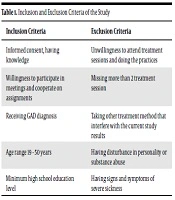
The statistical population included all female students of Shahid Chamran university of Ahvaz during 2015 and 2016, who had generalized anxiety disorder, and had been invited to participate in this study by a phone call. A total of 120 individuals filled in the generalized anxiety scale (24) for initial diagnosis. From among those with a high score (cut-off point: 10 and above), 32 had generalized anxiety; they underwent structured clinical interview and 28 individuals with generalized anxiety criteria were selected. The inclusion criteria for the study were the diagnosis of generalized anxiety disorder and not taking any psychiatric medications. In the next step, 28 students were divided into experimental and control groups. The experimental and control groups completed the questionnaires again after 6 weeks. The Inclusion criteria for in the intervention group were as follow: not using any psychiatric medication and lack of exposure to acute psychiatric disorders. Exclusion criterion was absence of more than 2 sessions. The experimental and control groups were selected from the following departments: Faculty of science, engineering, humanities, agriculture, physical education, science, education and psychology, theology, economics, social sciences, and geosciences. SPSS 22 was used for data analysis.
2.2. Ethical Considerations
At first, the students were explained about the research and they were asked to provide an informed consent to participate in the study. Participation in this study was voluntary.
2.3. Study Tools
2.3.1. Generalized Anxiety Scale (GAD)
The short version of generalized anxiety scale (GAD-7) has been developed by Spears et al. (24). This scale includes 7 main questions and 1 extra question that measure the intensity of the disorder in individual, social, family, and professional functions. In the study by Spears et al. (24), Cronbach’s Alpha coefficient of this scale has been found to be 0.92. The correlation obtained between generalized anxiety scale and Spielberg’s state-trait anxiety questionnaire was 0.71 and 0.52 for trait anxiety. Moreover, the correlation between generalized anxiety and the subscale of 12-clause anxiety from clinical syndrome check-list was 0.63 (25). Cronbach’s Alpha of generalized anxiety scale in this study was calculated to be 0.69.
2.3.2. Diagnostic Interview Based on SCID-IV
This tool has been developed by Spitzer, Gibbon, and Williams (26). It includes an interview that has been designed based on diagnostic criteria (the fourth statistical and diagnostic classification of mental disorders by American assembly of psychiatry (DSM-IV)) in a structured way to diagnose mental disorders, by which diagnosis of generalized anxiety is approved through asking questions about syndrome of generalized anxiety. After translating this interview to Persian, Sharifi et al. (27) implemented it on a sample of 299 individuals. Diagnosis agreement was average or good (stability over 0.60) for special and general diagnoses. General agreement (total kappa of 52% for examining all current diagnoses and 55% for life time diagnoses) obtained has also been reported to be desirable. Results of the study revealed that stability and possibility of conducting the Persian version of SCID is acceptable. Diagnostic interview was used in screening to identify syndrome of generalized anxiety.
2.3.3. Cognitive-Attentional Syndrome Scale
Cognitive-attentional syndrome scale is a 16-clause scale, developed to assess activation of cognitive-attentional syndrome (9). Its first 2 questions are about the abundance of patients’ anxiety and the extent of their attention to threatening factors. The next 6 clauses are related to the abundance of strategies individuals use when encounter negative emotions and thoughts. These 8 clauses were answered based on an 8-point Likert’s scale from 0 to 8. The next 8 clauses grade the extent of individuals’ belief to every one of metacognitive beliefs about cognitive-attentional syndrome based on a 0 to 100 scale. The total score of cognitive-attentional syndrome is finally obtained out of the total of all 16 clauses. This scale is the only known tool developed, to date, to simultaneously assess all elements of cognitive-attentional syndrome. In this scale, obtaining higher scores shows more activation of cognitive-attentional syndrome. The value of Cronbach’s Alpha in this scale was calculated to be 0.86, and the validity of this tool has been reported as desirable (28). Cronbach’s Alpha value of this scale in the present study was calculated to be 0.82.
2.3.4. Metacognitions Questionnaire
Metacognitions questionnaire developed by Cart-Right Hatten and Wells (11) was used to measure positive and negative metacognition beliefs and cognitive trust. This questionnaire contains 65 questions and 5 subscales: (1) positive beliefs about anxiety; (2) negative beliefs about anxiety; (3) low cognitive confidence; (4) negative beliefs about thoughts; and (5) cognitive self-awareness (6). The subscale of low cognitive trust was used in this study.
Scoring was done based on a 4-point Likert scale from “I don’t agree” to “I totally agree”. Regarding the stability of this questionnaire, the range of Cronbach’s Alpha coefficient was reported to be from 0.72 to 0.93; its stability was 0.75 for a total score after a period of 22 to 118 days through retest method; and it was 0.59 to 0.87 for subscales (29). Cronbach’s Alpha for the subscales of this study was calculated between 0.75 and 0.90.
Table 2.
A Brief Content of Metacognitive Therapy Sessions for Generalized Anxiety Disorder
| Session | Session Contents |
|---|---|
| First | Case compilation and formulation, introduction of the model and preparation, implementing thought suppression test, starting challenge or belief related to uncontrollability of anxiety, detached mindfulness exercise, introduction of postponement of anxiety, homework: detached mindfulness exercise and postponement of anxiety. |
| Second | Review of homework, especially beliefs regarding uncontrollability, continuation of preparation if needed, fresh verbal and behavioral attribution of uncontrollability, homework: continuation of postponement of anxiety and introduction of losing control test. |
| Third | Review of homework, especially beliefs regarding uncontrollability, continuation of uncontrollability challenge or belief (providing different evidences), performing losing control test during therapy sessions, examining and stopping nonadaptive control and avoidance behaviors, homework: continuation of postponement of anxiety and performing losing control test. |
| Fourth | Review of homework, especially uncontrollability and avoidance behaviors, continuation of uncontrollability challenge or belief if needed, starting challenges or beliefs related to risk, trying to lose control or self-harm through anxiety test, homework: inspiration of anxiety to test possible risks. |
| Fifth | Review of homework, especially beliefs about danger of anxiety, continuation of challenge or belief about danger of anxiety, performing the tests or belief related to the risk during the therapy sessions, homework: behavioral tests for danger- related challenge or belief. |
| Sixth | Review of homework, beliefs about danger of anxiety and remaining incompatible strategies, continuation of danger- related challenge or belief, emphasis on reversing any remaining incompatible strategy, homework: behavioral tests for danger related challenge or belief. |
| Seventh | Review of homework, especially beliefs about danger, starting positive challenges or beliefs in case of negative beliefs reaching 0, homework: performance of noncompliance strategy and other behavioral tests for positive challenges or beliefs. |
| Eighth | Review of homework and positive beliefs, continuation of positive challenges or beliefs, performance of non-compliance strategy during therapy session, homework: behavioral tests, such as anxiety level decrease or increase test. |
| Ninth | Review of homework, review of non-compatible encounter and remaining avoidance behaviors, work on reversing remaining syndrome, performance of non-compliance strategy during therapy sessions, continuation of positive challenge or beliefs, working on a new program: homework: asking the patient to write a report of therapy summary. |
| Tenth | Review of homework, work on therapy general plan (preventing relapse), enforcement of alternative program and its clear description through examples, timetable of complementary sessions, and working on compiling a new program (plan), homework: identifying the continuous application of therapy. The control group was initially explained that 3 class sessions were held to relieve anxiety. |
After examining the default assumption of homogeneity of the slope of the regression analysis of covariance, it was found that the equality in the use of analysis of covariance condition was not fulfilled. The pretest and posttest analysis was performed to find the difference between the control and experimental groups. Covariance analysis could not be used because of regression gradients assumption violation; therefore, multivariate variance analysis for difference of scores was used. Levin test was used to examine the homogeneity of variance between variants. Levin test results for cognitive attentional syndrome variant (F = 0.001 and P = 0.970) and for low cognitive confidence variance (F = 0.012 and P = 0.913) were not significant.
3. Results
3.1. A - Descriptive Findings of the Study
The mean value and standard deviation of cognitive-attentional syndrome and low cognitive confidence variants during pretest and posttest stages for the test and control groups are presented in Table 3.
Table 3.
Descriptive Indices of the Study Variants for the 2 Groups During Pretest and Posttest Stages
| Variance | Group | Pretest | Posttest | ||
|---|---|---|---|---|---|
| Mean | Standard Deviation | Mean | Standard Deviation | ||
| Cognitive-attential syndrome | Test | 568.07 | 141.89 | 335.14 | 143.91 |
| Control | 522.42 | 123.53 | 543.00 | 128.97 | |
| Low cognitive confidence | Test | 22.64 | 6.47 | 17.35 | 6.44 |
| Control | 22.58 | 6.26 | 21.71 | 5.96 | |
Table 4.
Results of Multivariate Variance Analysis Showing the Difference Between the Scores of Cognitive-Attentional Syndrome and Low Cognitive Confidence Variance in the Test and Control Groups
| Test | Value | F | Df Hypothesis | Df Error | Significance Level | Effect Size |
|---|---|---|---|---|---|---|
| Pillais trace | 0.435 | 6.63 | 2.000 | 25.000 | 0.001 | 0.435 |
| Wilks lambda | 0.539 | 9.84 | 2.000 | 23.000 | 0.001 | 0.435 |
| Hotelling Strace | 0.771 | 9.63 | 2.000 | 25.000 | 0.001 | 0.435 |
| Royslargest | 0.771 | 9.63 | 2.000 | 25.000 | 0.001 | 0.435 |
Table 4 demonstrates a significant difference between the test and control groups in at least 1 dependent variant (cognitive-attentional syndrome and low cognitive confidence) (P = 0.001). Therefore, single variant variance analysis was done to learn what variant causes a difference between the 2 groups. Results are presented in Table 5.
Table 5.
Results of Single Variance Analysis on the Difference Between the Scores of Cognitive-Attentional Syndrome and Low Cognitive Confidence in the Test and Control Groups
| Source of Changes | Sum of Squares | Degree of Freedom | Mean Value Squares | F | Level of Significance | Effect Size |
|---|---|---|---|---|---|---|
| Cognitive attentional syndrome | 449835.750 | 1 | 449835.750 | 18.06 | P < 0.000 | 0.410 |
| Low cognitive confidence | 120.143 | 1 | 120.143 | 6.500 | P < 0.017 | 0.200 |
Contents of Table 5 reveal a significant difference between the test and control group students in cognitive-attentional syndrome (P < 0.000 and F = 18.06) and low cognitive confidence (P < 0.017 and F = 6.500).
4. Discussion
The present study was conducted to examine the effectiveness of metacognitive therapy on cognitive-attentional syndrome and low cognitive confidence among female students of Shahid Chamran university of Ahvaz who had anxiety disorder. Women constitute half of the population of the country and their social functions and economic status have a significant impact on the well-being of the family and the community. Moreover, physical and social living conditions of women, compared to men, leads to valuable sources of stress caused by inequality of women in the family, division of labor, gender, and power relations within the family and community. Results of this study showed a significant difference between the test and control groups in cognitive-attentional syndrome. In other words, cognitive therapy reduced cognitive-attentional syndrome in the test group compared to the control group. Findings are in line with the result of the study conducted by salmani and Hasani (30), Salmani, Hasani, Karami, and Mohammad Khani (7). Cognitive- attentional symptoms of the underlying mechanism have been considered a concern. Reduction of cognitive-attentional syndrome is highly important in metacognitive therapy, which is related to vulnerability due to emotional disorders (31, 32), as mental rumination escalates the intensity of negative mood and acceptance. In the present study, therapy has led to a significant decline in the level of mental rumination, threat monitoring, non-compliant encounters, and avoidance behavior among patients. Therefore, it may be stated that metacognitive therapy is effective in reducing activities of cognitive-attentional syndrome due to reducing self-attention, mental rumination, threat monitoring, non-compliant encounter, and avoidance behaviors through training the method of attention and increasing activities. Most of the technics used in metacognitive therapy (detached mindfulness, postponement of anxiety, losing control, and nullifying encounter strategies) of this syndrome involves individuals in long- lasting emotional experience, and so leads to increased anxiety and continuation of the disorder. Cognitive-attentional syndrome manifests itself in generalized anxiety disorder in the form of extreme anxiety, focused attention to threat related stimulants, thought oppression, and incompatible emotion regulating strategies (28, 33). In general, a person is feeling threatened by continued cognitive-attentional symptoms (34),but metacognitive therapy positively affects the extent of involvement in anxiety, threat monitoring, and non-compliance encountering behaviors as the elements forming the cognitive-attentional syndrome and on the strategy for cognitive regulation of emotion. Thus, it would be reasonable to assume that by implementing this treatment on patients with generalized anxiety disorder, using compatible and incompatible strategies on these patients, the activity of the syndrome would be reduced (13-15).
The other finding of this study was that metacognitive therapy reduces the scores of cognitive confidence for the test group compared to the control group. This finding is in line with those of Shafi’ee Sang Atash, Rafi’ee Nia, and Najafi (35), Wells And cartwright-Hotton (28), Cartwright- Hatton and Wells (29), Salmani, Hasani, Karami, and Mohammad Khani (36), Hosseini, Fathi Ashtiani, Rabi’ee, Nouhi and Fajrak (37), and Atapour and Alivandi Vafa (38). By low cognitive trust, we mean lack of individual’s trust in his/her memory and attention, as cognitive processes are considered as incompatible metacognitive elements and strategies (8, 9). The self-regulating cognitive emotional model states that individuals with emotional disorder are trapped in a closed noncompliant circle. This way of processing leads to lack of resources and rigid control during the process. In this process, emotional disorder must be related to meta- measurements on low cognitive confidence. This state should be more severe in disorders that involve deeper layers of information process in self-regulating cognitive-emotional model. According to this anticipation, low trust in cognitive ability is related to emotional disorder. According to previous studies, emotional disorders are related to metacognitive and cognitive experiences with low efficiency. Metacognitive model (cognitive-emotional self-regulation) states that individuals with emotional disorder are trapped in a closed circle of self-incompatible process. This way of processing leads to lack of resources and rigid control during the process. In this process, emotional disorder must be related with meta-measurements on low cognitive trust. This state should be more severe in disorders that involve deeper layers of information process in self-regulating cognitive-emotional model. According to this anticipation, low trust in cognitive ability is related to emotional disorder (39). Studies have shown that 3 dimensions of metacognition are related to psychological dysfunction, which include negative beliefs about anxiety tending for uncontrollability and risk, beliefs related to the need for controlling the thoughts, and cognitive confidence. Metacognitive therapy improves these beliefs by using different solutions (35).
4.1. Conclusions
The present study revealed that metacognitive therapy is an effective intervention for cognitive-attentional syndrome and cognitive confidence among female students with generalized anxiety. Therefore, this therapy can be used to treat anxiety. The results of this study can be used by and helpful to students with generalized anxiety disorder, women working in other organizations and clinics, clinical centers, counseling centers, and universities.
4.2. Limitations of the Study
The limitations of this study included uncooperativeness of the students in classes, novelty of some of the variables, difficult access to books and articles, and inability to control unwanted variables. Ethical code: 63499.