1. Background
Having a child is a divine gift that is influenced by cultural and religious values of every society. Having a child strengthens the family bonds and is seen as a sign of commitment to cultural values in most societies. In fact, child-bearing is the most important goal of life in most communities, and if fertility attempt fails, it can become a destructive emotional experience (1). Infertility is defined as a disability in pregnancy after one year of intercourse, without the use of contraceptive methods and disability in pregnancy (2). According to the Iranian culture, the parental role is recognized as the basis of common life and identity in couples. Also, having a child leads to a rise in social status, marital security, social and economic protection, care at old age, performing religious duties, fertility, and reproduction (1). Therefore, the fertility phenomenon is a physiological process in living organisms. This phenomenon also has social and psychological dimensions (3). Pregnancy is considered a unique and exceptional period for females and their families and an exciting time in women’s lives (4). Disability in getting pregnant means pressure and suffering for many couples. Infertility is more than just a medical diagnosis, and is considered a social stigma (5). According to studies, about 11 to 51 million people have a type of infertility worldwide in such way that one out of six couples has this problem in reproductive ages (6). About a quarter of Iranian couples experience primary infertility during their life, and 3.4% of couples have a primary infertility problem at any time. The infertility rate in Iran is estimated at 10% to 15%. Based on the last conducted study in 2012, the reported prevalence of infertility was 201.2% in Iran (7). This figure is an indicator of the fact that a large population of people have infertility problems (8). Infertility is a crisis that leads to stress and extreme psychological problems in people’s lives (9). Infertility causes many problems in couples’ mental health, general well-being, self-esteem, and relationships (10). After the death of parents, infertility is the most stressful event in life (9). Infertility-related mental stress is comparable to the stress of heart disease, cancer, or Human Immunodeficiency Virus (HIV) (11). Infertility is in fact a complex crisis in life that is psychologically threatening, and for this reason, many authors have referred to the psychological outcomes of infertility as public grief reactions (12). Despite numerous studies on the importance of the relationship between body and mind in the infertility phenomenon, its psychosocial aspects have not been adequately discussed (13). However, considerable attention has been paid to the role of psychological factors in infertility, and medical science has suggested a relationship between infertility and psychological factors in the recent years (12). Infertility-related psychological problems can be an intensifying factor for infertility, since people, who are relaxed and have a good mental health, experience less mental pressure and the chances of fertility increases in these cases. Infertility treatments, ranging from medical and hormonal monitoring to fertilization methods, impose severe physical and psychological burden on females and their husbands (13). Patients undergoing infertility treatment have distressing experiences in their lives (11). Many infertile couples face painful, failed therapies without reaching the intended outcome, which makes them feel weak in reaching their goals (9). Although both couples experience this crisis, studies show that females experience more negative psychological effects compared to infertile males. The maternal role is one of the major causes of stress for infertile females; as a result, infertile women are more stressed. Many infertility tests and treatments are also carried out on females, which further increase psychological pressures. The same factors have led infertile females to be more responsible for infertility problems (14). The inability to conceive and the common social reactions in the society to this group of people are the source of many psychological pressures for this group (3). Therefore, depression is one of the psychological disorders that may affect infertile couples. Psychological researches have shown that infertility, leads to the development of depression and an increase in symptoms (15). In general, infertility treatment is very difficult and is associated with increased risk of psychological symptoms (9). Most studies have reported that the negative response to pregnancy tests exacerbates depression symptoms in most females undergoing infertility treatment (16). The results of research on infertile patients in some societies have shown that 20% to 50%, 20%, and 15% to 56% of patients have symptoms of mild-moderate, and severe depression, and anxiety, respectively (16, 17). The results of a study on 55 infertile females showed that anxiety and depression were present in infertile females, and the most important cause was the attitude of individuals towards control of life and social acceptance (18). Matsubashi et al. conducted a study in Japan that compared depression and anxiety among 101 infertile and 81 fertile females. They found that depression was more prevalent among infertile females (19). Depression, as a consequence of infertility, can influence relationships and quality of life of infertile couples (20). The results of a previous study at Tehran University, showed that depression in infertile females was related to infertility cause, infertility duration, educational level, and occupation (21). Meller showed that depression was associated with impairment in the regulation of LH secretion, resulting in disruption of ovulation cycles and fertility process (22). Failure to pay attention to emotional disorders of infertile couples, especially depression, creates a defective cycle that reduces the likelihood of infertility treatment success (5). Considering the special cultural, demographic, and different outcomes of methods of assisted reproduction at different times and regions, as well as emotional problems of infertile women is of great importance, however little attention has been devoted to related studies concerning psychological dimensions, particularly infertile women’s depression, although many families encounter such challenges. Although, there are several theories in this regard, the practical dimensions have been ignored, accordingly, the significance and novelty of the study are justifiable.Therefore, the present research aimed at determining the prevalence and severity of depression and its related factors among infertile females.
2. Methods
The present study was an analytical and cross-sectional study. The present study with code of ethics IR.GMU.REC.1395.13. was confirmed by the university ethics committee. The research population included all infertile females that had referred to the Milad Khorasan Razavi infertility center.
The ethical points, including the participants’ right to choose as well as to withdraw, keeping the patients’ secrets, obtaining patients’ informed consent, and the number of existing medical records (N = 5000) were taken into account. Based on the Cochran formula 385 medical records were randomly selected.
The inclusion criteria included: Women with a clear diagnosis of infertility with female or male cause, or both, who referred to the research setting for treatment, having Iranian nationality, lack of a history of mental disorders, along with depression and other medical diseases, and willingness to participate in the project.
The exclusion criteria included: pregnancy throughout the study, treatment continuation at other places, or withdrawal from the study.
Data collection instruments included two questionnaires. The first questionnaire was related to demographic information of the individual, including age, education, occupation, type of infertility, cause of infertility, duration of infertility and duration of treatment, and main treatment. The second questionnaire included the Beck depression inventory. This questionnaire contains 21 self-evaluation questions and each of them has four statements. The minimum and the maximum score are 0 and 63 in this test, respectively. By adding individual scores in each of the females, a person’s score is obtained directly. The following scores can be used to indicate the overall level of depression: normal (one to nine), mild depression (10 to 19), moderate depression (20 to 29), and severe depression (30 <) (23). The validity and reliability of this questionnaire was confirmed in Talaei et al.’s study entitled “Investigating of the effect of group cognitive-behavioral therapy on depression in infertile women”, and various studies have also been conducted in the country that measure the psychometric properties of this instrument. One of these studies include a study conducted by Tashakori and Mehryar, who reported a reliability coefficient of one. In other studies, including Chegini’s study, the validity of the Beck’s questionnaire was variable and varied from 0 0.70 to 0.90 (6). Data analysis was carried out using SPSS Version 20, frequency charts and tables, and Pearson and Spearman tests. Results of statistical tests were considered significant at P < 0.5.
3. Results
Normality of the data distribution was confirmed by the Kolmogorov-Smirnov test. The mean age of patients was reported as 31 ± 9.3 years. Most of these people had diploma degrees and the least were illiterate and 80.8% of them were housewives. The mean, maximum, and minimum duration of infertility in these individuals was (7 ± 4.7) 25 and one year, respectively. The mean and maximum duration of treatment was 4 ± 3.3 and 20 years, respectively. Individuals used assisted reproductive techniques as a primary treatment (Table 1).
Table 1.
Frequency Distribution of Demographic Characteristics of Infertile Females
| Variable | No. (%) |
|---|---|
| Level of education | |
| Illiterate | 24 (6.2) |
| Cycle | 107 (27.8) |
| Diploma | 137 (35.6) |
| Academic | 117 (30.4) |
| Total | 385 (100) |
| Job | |
| Housewife | 311 (80.8) |
| Employed | 74 (19.2) |
| Total | 385 (100) |
| Infertility Type | |
| Primary | 297 (77.1) |
| Secondary | 88 (22.9) |
| Total | 385 (100) |
| Cause of infertility | |
| Female | 151 (39.2) |
| Male | 85 (22.1) |
| Both | 86 (22.3) |
| Idiopathic | 63 (16.4) |
| Total | 385 (100) |
| Main treatment | |
| Drug | 159 (41.3) |
| Assisted reproductive techniques | 226 (58.7) |
| Total | 385 (100) |
Of the 385 females participating in this study, 93 (24.2) had no evidence of depression, and the remaining 292 (75.8) had some degree of depression, with 39% showing mild depression (Beck score between 10 and 19) and others showing moderate to severe depression (scores above 20 and 30) (Figure 1).
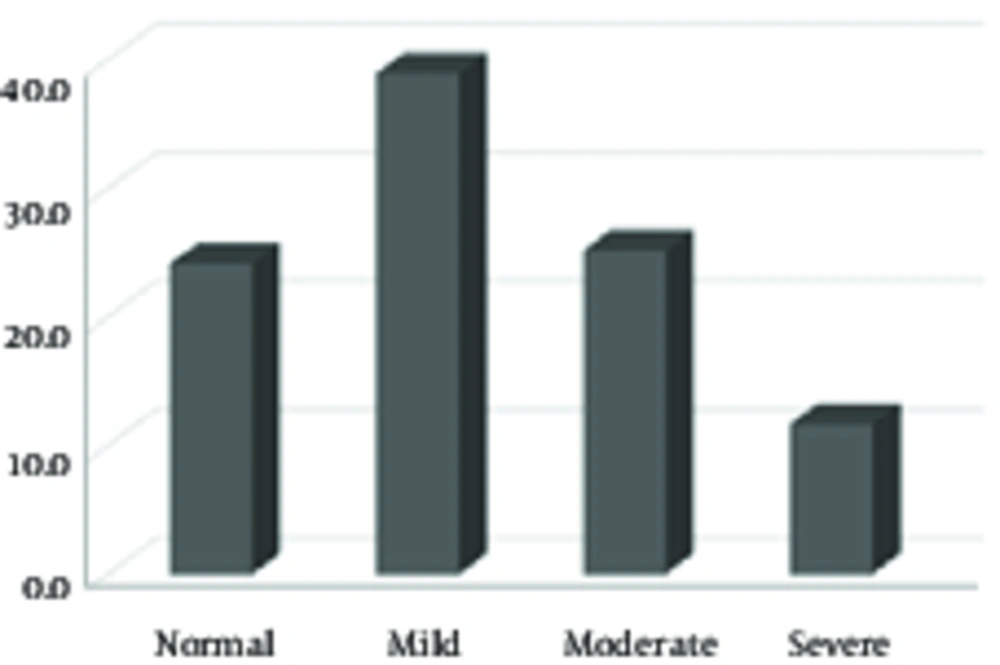
Figure 1.
Percentage frequency of depression severity
The age of the individuals ranged from 19 to 55. In fact, the minimum and maximum age was 19 and 55, respectively, which was more than that of the embryo donation or gestational surrogacy. After examining depression based on the patients’ age, it was found that there was a significant relationship between these two variables. The prevalence and severity of depression decreased with increasing age. There was a statistically significant relationship between level of education and depression in a way that prevalence and severity of depression were higher in patients with lower levels of education, than those with higher levels of education. The mean, maximum, and minimum duration of infertility was 6.8, 1, and 25 years in the studied females, respectively. Also, mean, maximum, and minimum duration of treatment was 3.9, 20, and 0 years in these females, respectively (females who attended at the start of treatment). According to statistical tests, there was no significant difference between the duration of infertility and the duration of treatment with depression (Table 2).
Table 2.
The Relationship of Variables Such as Age, Education, Duration of Infertility, and Treatment with Depression
| Variable | Average | Test Result | |
|---|---|---|---|
| P Value | r | ||
| Age | 31.21 | < 0.001 | -0.203 |
| Level of education | 2.90 | < 0.001 | -0.165 |
| Duration of infertility | 6.81 | 0.864 | 0.009 |
| Duration of treatment | 3.96 | 0.56 | 0.029 |
Depression was evaluated based on the occupational status of patients and the results showed a significant relationship between the two variables (Table 3). The prevalence and severity of depression in housewifes was higher than employed females.
Table 3.
The Relationship of Variables Such as Job, Infertility Type, Treatment Method and Cause of Infertility with Depression
| Variable | Number | Depression Score and Standard Deviation | Test Result |
|---|---|---|---|
| Job | < 0.001 | ||
| Housewife | 311 | 18 ± 9.425 | |
| Employed | 74 | 13.99 ± 8.209 | |
| Infertility Type | 0.082 | ||
| Primary | 297 | 17.68 ± 9.685 | |
| Secondary | 88 | 15.70 ± 7.871 | |
| Treatment method | 0.423 | ||
| Drug | 158 | 16.75 ± 8.968 | |
| Assisted reproduction techniques | 226 | 17.51 ± 9.573 | |
| Cause of infertility | 0.035 | ||
| Male | 85 | 14.86 ± 8.08 | |
| Female | 151 | 17.74 ± 9.23 | |
| Both | 86 | 17.26 ± 10.42 | |
| Idiopathic | 63 | 19.14 ± 9.11 |
The investigation showed no significant relationship between infertility type (primary and secondary) and prevalence and severity of depression (Table 3). In fact, there was no statistically significant difference between depression of females with primary infertility and those with secondary infertility.
Infertility treatment is performed in two ways, including drug therapy and the use of assisted reproductive techniques such as IVF and surrogacy, ovum donation, donated fetus, and so on. The most commonly used method among the studied females includes the use of assisted reproductive techniques (n = 226) and 158 of these females used the drug therapy method. The results of the statistical tests showed no significant difference between the two groups (Table 3).
The causes of infertility based on female, male factors, or both and idiopathic factors were studied. After assessing its relationship with depression score, it was observed that there was a significant difference between the two groups in terms of depression and cause of infertility in both cases. The results of Duncan’s test showed a significant difference between depression in male infertility and infertility with unknown cause, and women who had infertility with unknown cause had higher depression scores.
4. Discussion
This study was conducted to determine the prevalence and severity of depression and its related factors in infertile females. According to the society’s norms and culture, having a child is an important issue in marital life, and inability to do so can create problems for infertile couples, particularly infertile females, because they are deprived of their important maternal role, and are ultimately threatened by psychological disorders. The results of various studies on this particular group have shown that depression is common among infertile females. The results of the present study showed that 75.8% of studied infertile females experienced depression at varying degrees. This finding indicates the prevalence of depression among infertile females. Also, many other studies have come to this conclusion. Behdani reported in his study that 57% of infertile females had some degree of depression (23). Al Hassan also reported in his study in Ghana that 62% of infertile females had depression (20). The results of another study in Hungary showed that 58% of infertile females had some degree of depression (24). These statistics suggest that the prevalence of depression is an important phenomenon among infertile females of different countries and nationalities.
Results of a study on the relationship between the couples’ mental health and their marital satisfaction showed that 52.5% of females had mental disorders (25). Montazeri’s study showed that depression rate in Iran ranged from 5.69% to 73%, and women developed depression 1.7 times more than males (26). Monazeri’s review study reported that prevalence of depression was 4.1% and females were more susceptible to this disorder (27). The present findings showed that the prevalence of depression was higher among infertile females since they are more susceptible to depression, which is intensified by infertility.
The prevalence of depression among this group of females can be due to factors such community’s view of them, deprivation from having a child, and fear of separation and divorce.
The present findings showed that little attention has been devoted to psychological dimensions of the group under discussion and few related studies have been performed, and there is a lack of specific psychological plans at infertility centers. High levels of depression among these females and its effect on life quality and the couples’ treatment cycles show the importance of the present study. Concerning the present findings, it is suggested that in addition to medical treatments associated with organic and physical problems, to consider psychological aspects of infertile females more seriously, because in the case of better mental health, medical and physical treatment will yield better outcomes. This can be materialized with psychological counseling of females undergoing treatment at the onset of the treatment process, investigating their depression status and performing relevant interventions. Other results of this study showed that the rate of depression in females decreased with age. In fact, there was a reverse relationship between the age of studied females and prevalence and severity of depression among them. This finding can be due to a change in people’s attitudes over time. Based on an incidental theory, such as the inability to have children, which is of greater importance and sensitivity at an early age, as time passes and other things happen, it becomes less important and thus its psychological effects are reduced. However, this cannot be generalized, therefore, it is necessary to predict and pay close attention to even severe degrees of depression in older ages and throughout the infertility period in general. Also, some similar studies showed that there was a direct relationship between degree of depression with age in infertile females (20, 24, 28), which is not consistent with the findings of the present study. This difference may be due to the cultural differences, as well as the difference in the age of marriage and exposure to infertility. The results of this study on job status and educational level in infertile females showed a decrease in the severity of depression in females with higher level of education and current employment. Behdani and Haririan also found in their studies that there was a reverse relationship between depression and level of education in infertile females, and also lower level of depression was observed in females, who had been employed (23, 29). Similarly, Alhassan et al. in Ghana reported that there was an inverse relationship between depression and level of education of females (20), which is consistent with the current findings. Higher education seems to increase the chance of a person to have a good and stable job and it may have a calming effect psychologically. On the other hand, working females have less social isolation and are likely to experience less loneliness. Females, who have higher social function may experience less depression in response to stress because of their financial independence, less isolation, and greater skills. Also, Behdani and Haririan showed that there was a correlation between the depression of females under study and the education level of their husbands. It was later determined that a higher level of education of husbands was associated with lower level of depression in the females. It seems that since husbands with higher levels of education are more aware of the issue of infertility, they thus show more appropriate treatment, and support and adaptive mechanisms against stress (23, 29). Similarly, Abedini and Ramezanzadeh also showed a reverse relationship between infertile female’s depression and their educational and job status (21, 30). Given these results, counseling and planning for treatment, encouraging and counseling patients, who are not employed, to participate in social affairs or classes of interest at the beginning of treatment can have a positive effect on the treatment process and reducing their depression. There was no relationship between the duration of infertility, duration of treatment, and the type of infertility with depression in the studied females. In fact, there was a statistically significant difference between depression of females with primary infertility and those with secondary infertility, as well as years of infertility or treatment. However, Ramazanzadeh and Haririan showed in their studies on infertile females of Tehran that there was a direct relationship between depression and the duration of infertility (21, 29), which is consistent with the results of previous studies in Ghana and Iraq’s Basra. The results of Al-Assadi’s study in Basra indicated a direct correlation between type of infertility and duration of treatment with depression in infertile females (31). The results of Al-Hasan’s research in Ghana also revealed that there was a relationship between infertility and depression in infertile females, and depressive symptoms were found to be more severe in females with primary infertility. In fact, it can be said that the relationship between depression and duration of infertility can be due to the fact that in the early diagnosis of infertility, there is a great deal of hope for the success of treatment procedures; however, the resulting frustration along with the existing stress causes depression in this group of females over time, considering the failure to conceive despite the therapeutic methods. Also, inability to have maternal experience and having a child and losing a female identity can increase the prevalence of depression in this group of infertile females in primary infertility (20, 32). However, these results are not consistent with those of the present study, which may be due to the time difference between the current study and Haririan and Ramazanzadeh’s studies. The development of infertility treatments as well as modern assisted reproductive techniques raises hope in patients over time and despite the long duration for treatment, they still hope for therapeutic success and it has a psychologically positive effect. There was a relationship between depression and the cause of idiopathic infertility. Furthermore, the prevalence and severity of depression were greater in females with an unknown cause of infertility; the cause of infertility was unknown in these couples and although no problem was specified, they still had trouble getting pregnant, therefore, this confusion could have increased the prevalence and severity of depression in these females. However, Ajawi showed in a similar study in Tokyo that depression is more apparent in infertile females with male infertility factor (28). The present study showed no relationship between the prevalence and severity of depression and treatment methods, i.e. drug therapy and assisted reproductive techniques.
One of the strong points of the present study was its performance in the most specialized medical center of the University of Medical Sciences, which had many clients and could cover the females sponsored by the university.However, due to the existence of similar centers in other cities, patients could refer to these places, and this was one of the study limitations.
4.1. Conclusions
In general, it can be concluded that a high percentage of infertile females (more than three-quarters of them) experience some degree of depression with varying degrees of severity. Considering the complications and known effects of depression on the various aspects of couples’ health and quality of life dimensions, it is necessary to provide care and specialist management for this phenomenon. It is recommended to monitor and pay attention to this complication with regards to the cause of infertility and various age groups, education levels, and occupations in infertile females. Lack of awareness about different aspects of infertility and its consequences and impact on the health status of affected couples can exacerbate the psychological aspects. Failure to pay attention to the psychological aspects of infertility can affect the survival of couples’ marriage and prolong the course of treatment, and it is important to take measures, such as increasing public awareness of the different aspects of infertility using public education, helping infertile couples in coping with stress, holding counseling sessions to choose the right treatment method, and helping couples deal with family problems caused by infertility, which require sufficient attention to the psychological aspects of this issue and the simultaneous provision of psychological and psychiatric services at infertility treatment centers.