
1. Background
Hepatitis G virus was firstly reported by Abbott laboratory researchers in West Africa. This agent was isolated from non-A-E hepatitis patients. They showed that genome sequence of this virus was similar to GBV-A and GBV-B isolated from primates. Hence, they called it GBV-C (1). This virus was also found by Genelabs technologies group when analyzing the samples from hepatitis patients, and was named hepatitis G virus (1). Recently, it was found that this virus was a new genus called Pegivirus from the Flaviviridae family. Therefore, it was named human Pegivirus (HPgV) (1).
This virus is an enveloped RNA virus with a single chain RNA structure of positive polarity with a size of 9.4 kb, belonging to the Flaviviridae family (1, 2). The viral genome comprised of a single open reading frame (ORF), encoding ~3000 amino acids, which included some structural (E1 - E2) and non-structural (NS2 - NS5B) proteins (3, 4). By comparing the HGV and HCV genomes (both are in the same family), it seems that HGV is a hazardous agent and can cause hepatic diseases (5, 6). Surprisingly, some researches asserted that HGV was isolated from persistent and fulminant hepatitis samples, while the other hepatitis agents were not detected (7).
It was illustrated that HGV is transmitted via person-to-person, mainly by the parenteral routes, especially individuals with multi-blood transfusion. Among these patients, those on hemodialysis (HDs) are at high risk of infection with HGV (8, 9). In addition, another high-risk population acquiring HGV infection is individuals infected with hepatitis B virus (HBV) (10, 11) or hepatitis C virus (HCV) (12). Some studies showed that co-infection of HBV and HCV with HGV causes acceleration of chronic illness and an increase in the severity of the disease (7).
Several studies have displayed that HGV is an infectious agent. It has been estimated that roughly 1% of healthy blood donors are infected with HGV (6, 10, 13). Low (3.1%) and high (57.5%) prevalence of HGV outbreaks have been reported in patients with HD in Japan and France, respectively (14, 15). Generally, the prevalence of HGV varies from 11% to 24%, among HCV-infected individuals (16-18). The prevalence of HGV infection varies in different regions of Iran and ranges from 3.14% to 10.73% (19, 20).
Due to sharing of dialysis machines among patients with HD, the transmission risk of hepatitis viruses to these people is at a high level. Hence, for more cautious use of these devices, detecting HD patients infected with hepatic diseases seems to be necessary to determine the risk of transmission of these viruses to the uninfected patients. In this regard, evaluating the prevalence of the hepatitis viruses in patients with HD is also essential. Furthermore, testing the sterility of HD devices after use for these patients should be carried out under strict laws.
With this purpose in mind, an epidemiological study was conducted to determine the prevalence of HGV and its co-infection with HCV and HBV infections in HD patients at dialysis units of Ahvaz hospitals, affiliated to the Ahvaz Jundishapur University of Medical Sciences, Ahvaz, Iran. Ahvaz is the capital city of Khuzestan Province with roughly two million individuals and a tropical climate. It merits attention that Ahvaz is a touristic city located in the south-west region of Iran.
2. Objectives
The aim of this study was to determine the prevalence of HGV among hemodialysis patients in Ahvaz and its co-infection with HCV and HBV patients.
3. Methods
This epidemiological study project was approved by the ethics committee of Ahvaz Jundishapur University of Medical Sciences (Ethic code: IRAJUMS.REC.1394.569). The ethic consent was obtained from each HD patient.
3.1. Detection of Hepatitis G Virus Genome Using the Molecular Method
The RNA was extracted from all plasma samples by high pure viral RNA Kit (Roche, Germany), according to the manufacturer’s protocol. Finally, 50 µL of RNA samples were employed for synthesizing cDNAs. The cDNAs were prepared using the Thermo Fisher Scientific kit, according to the manufacturer’s protocol and maintained at -20°C until use.
3.2. Nested Polymerase Chain Reaction
The nested PCR was carried out using 4 primers conserved in the 5’ un-translated region of genomic HGV (21). The reaction mixture contained 2.5 µL of PCR buffer (Roche), 0.3 mmol of dNTP, 0.125 µL of enzyme (taq DNA polymerase 5 unit, Roche), 1.5 mmol of MgCl2, and 1.5 pmol/µL of primers (nucleotides 102 to 121 as Fhg1 contained GCCAAAAGGTGGTGGATGGG as the forward primer, and nucleotides 457 to 477 as Rhg1 contained CGGAGCTGGGTGGCCCCATGC as the reverse primer) and water up to 25 µL. For the second round, 1 µL of PCR products of the first step of PCR, was utilized for the second step of PCR as the template. For the second round, the reaction mixture and PCR thermal condition were carried out the same as the first round PCR and the following primers were used: Forward primer: Fhg2 TGGTAGGTCGTAAATCCCGG, and reverse primer: Rhg2 TGGTCCTTGTCAACTCGCCG. Polymerase chain reaction reactions were performed using a thermocycler (Bio-Rad, Hercules, CA, USA). Durations and temperatures used in both steps of PCR are shown in Table 1.
Table 1.
Durations and Temperatures Used in Both Polymerase Chain Reaction Steps
| Step | Temperature, °C | Duration, Min | Repeat | |
|---|---|---|---|---|
| 1 | First denaturation | 95 | 5 | 1 |
| 2 | Denaturation | 94 | 1 | 36 |
| Annealing | 45 | 1 | ||
| Extension | 72 | 1 | ||
| 3 | Final extension | 72 | 10 | 1 |
The PCR products from the second step of PCR were run on 2% agarose gel, using 1X TAE buffer, stained with safe stain, and observed under UV trans illuminator (Bio-Rad, Hercules, CA, USA). The final PCR product of 261 bp was indicated as a positive sample. The PCR products were purified using Nucleo Spin Gel and PCR Clean-up Kit (Duren, Germany), according to the manufacturer’s protocol. The purified PCR products were sequenced (ABI Company, USA) to determine HGV genotypes.
This project, registration number 94111, was approved by the ethics committee of the Ahvaz Jundishapur University of Medical Sciences. Ethical consent was obtained from each HD patient.
3.3. Serological Test
The sera samples were collected via the venoject method from 100 randomly selected HD patients, who were registered for dialysis at Golestan and Razi hospitals of Ahvaz city, Iran, during February to December 2016. Sampling was carried out before dialysis. The sera of all the patients were tested for HBsAg and anti-HCV antibody, using enzyme linked immunosorbent assay (ELISA) kits (Dia. Pro Kit, Italy), based on the manufacturer’s manual.
3.4. Statistical Analysis
Number of samples (100) was estimated, according to Morgan’s table. The effects of three factors, including gender, age, and duration of hemodialysis (DHD) on HGV were analyzed using the GLM procedure of the SAS software (version 9.1).
Analysis was followed as:
Hijk = Si + Aj + Dk + eijk
Hijk: the phenotype of the HD patients for HGV disease (infected/non-infected)
Si: Gender (male/female)
Aj: Age as a covariate factor
Dk: Duration of Hemodialysis (DHD) as a covariate factor
4. Results
As illustrated in Figure 1, the outbreak of the HGV infection was 10% in the patients on HD, which was determined by the nested PCR. All the detected HGVs were dominant with genotype 2a. In addition, as showed in Table 2, 2% of the HD patients were co-infected with HCV and HGV, while 1% of the HD patients were co-infected with HBV.
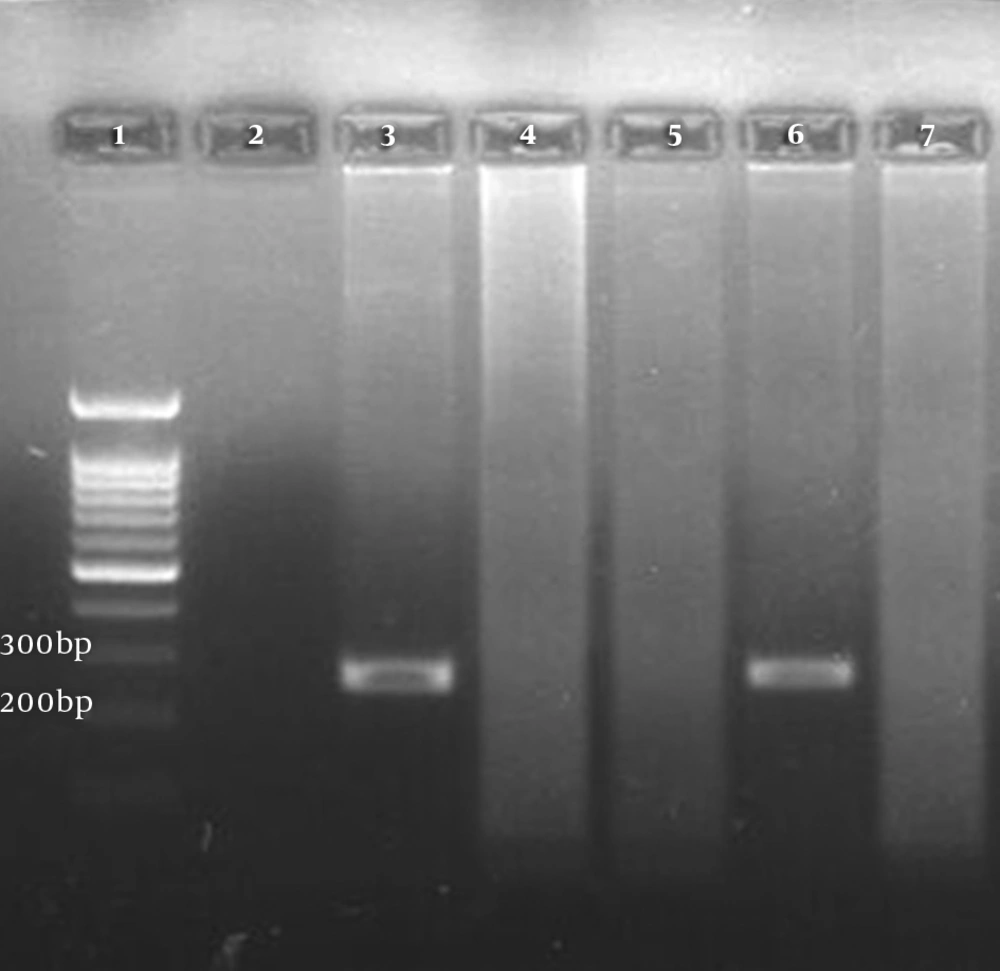
Figure 1.
The Figure shows the polymerase chain reaction analysis of patients on hemodialysis in Ahvaz. 1, Marker; 2, Negative control; 3, Positive control; 4, 5, and 7, Negative samples; 6, positive sample.
Table 2.
The Characteristics of Hemodialysis Patients Infected with GBV-Ca
| Patients | Gender | Age | Duration of HD, Mo | HBV | HCV |
|---|---|---|---|---|---|
| 1 | M | 55 | 30 | - | - |
| 2 | M | 56 | 17 | - | + |
| 3 | M | 33 | 20 | - | - |
| 4 | M | 50 | 18 | - | - |
| 5 | M | 54 | 24 | + | - |
| 6 | M | 58 | 24 | - | - |
| 7 | M | 53 | 48 | - | + |
| 8 | F | 50 | 21 | - | - |
| 9 | M | 62 | 24 | - | - |
| 10 | F | 61 | 24 | - | - |
Abbreviations: F, Female; M, Male.
a-, Negative; +, Positive.
Based on the statistical analysis, the average age of the total patients was 47 ± 14.5 (mean ± SD) years, 70% of whom were male and 30% were female. The average age of the positive patients for HGV RNA was 47 ± 14.5 (mean ± SD) years. The average HD period in HGV RNA positive cases was 25 ± 8.5 months, which was longer than that of the HGV RNA negative cases.
The relationship between HGV and three factors of gender, age, and duration of HD was investigated in the HD patients. The results demonstrated that there was a significant correlation between HGV and duration of HD (P < 0.01). However, gender and age had no significant effects on HGV in the HD patients (Table 3).
Table 3.
Demographic Characteristics of the Patients on Hemodialysis
| Variables | HGV Exposed | HGV Non Exposed | P Value |
|---|---|---|---|
| Number of patients | 10 | 90 | - |
| Age | 47 ± 14.5 | 47 ± 14.5 | NS |
| Gender (F: M) | 2:8 | 26:64 | NS |
| Duration of dialysis, mo | 25 ± 8.5 | 16.26 ± 4.8 | P < 0.01 |
Due to the sharing of dialysis machines among patients on HD, the transmission risk of the hepatitis viruses to these people is at a high level. Hence, for more cautious use of these devices, detecting patients on HD infected with hepatic diseases seems necessary to determine the risk of transmission of these viruses to uninfected HD patients. In this regard, evaluating the prevalence of hepatitis viruses in HD patients is essential. Furthermore, testing the sterility of HD devices after use for these patients should be carried out under strict laws.
With this purpose in mind, an epidemiological study was conducted to determine the prevalence of HGV and its co-infection with HCV and HBV infections in patients on HD at dialysis units of Ahvaz hospitals, affiliated to the Ahvaz Jundishapur University of Medical Sciences, Ahvaz, Iran. Ahvaz is the capital city of Khuzestan province with an approximate population of two million and a tropical climate. It merits attention that Ahvaz is a touristic city, located in the south west region of Iran.
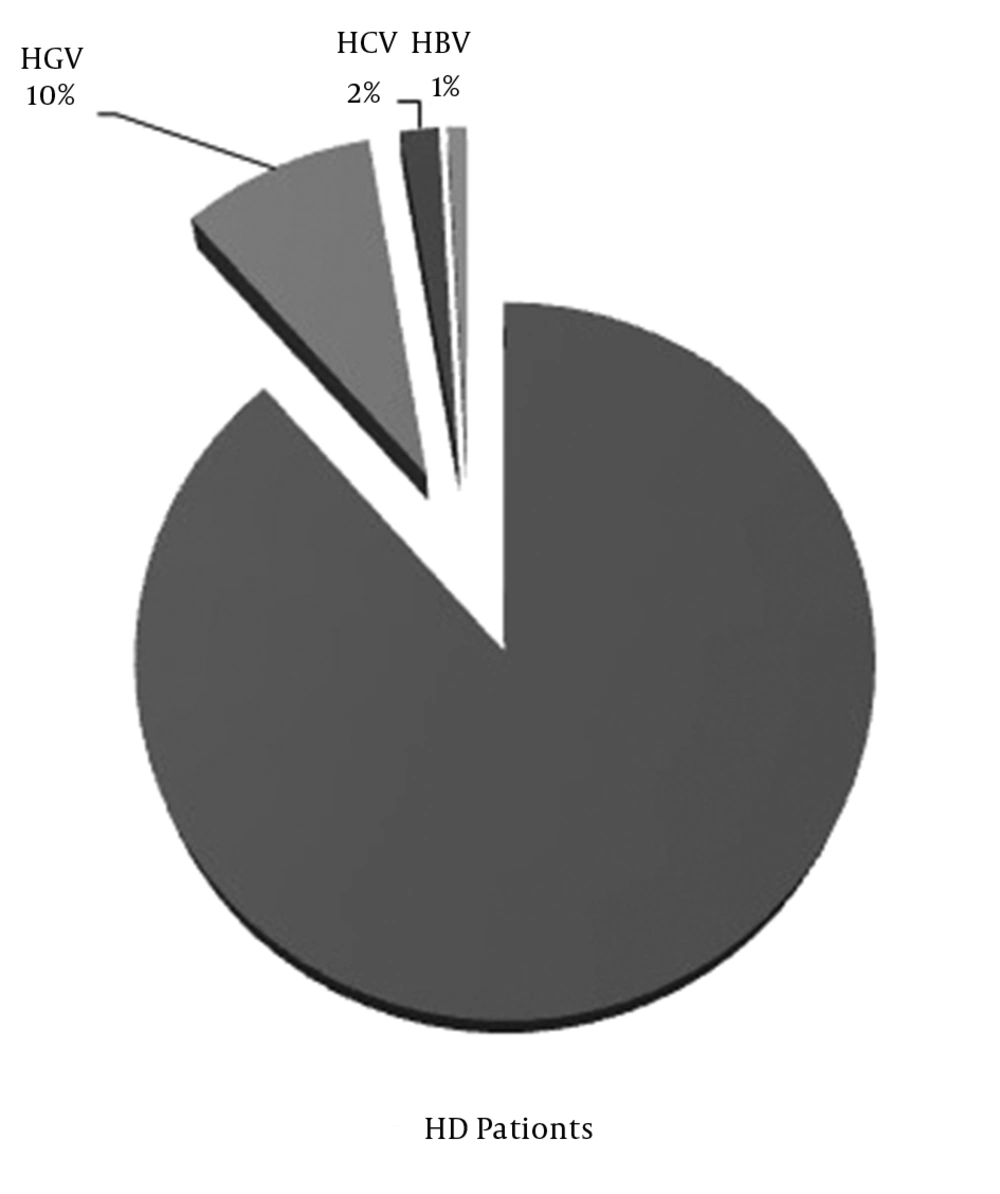
Figure 2.
The diagram illustrates the prevalence of hepatitis G virus, hepatitis C virus and hepatitis B virus infection among hemodialysis patients of hospitals in the Center of Ahvaz.
5. Discussion
Transmission of hepatitis viruses to HD patients is a worrying problem. In this regard, identifying patients on HD infected with hepatic diseases is an essential measure. The present study was carried out to determine the prevalence of hepatitis (G, C, B) infections among patients on HD in Ahvaz city of Iran. The results showed that a number of patients on HD were infected with HGV in the statistical population analyzed in this research. As a matter of fact, when comparing HGV prevalence between Ahvaz city and other cities of Iran and different regions around the world, it was observed that HGV outbreak was moderate. For instance, the prevalence of HGV in patients undergoing kidney transplantation was 24% in Italy (22). The frequency of HGV in patients undergoing HD was 50% in Germany (23), 12.8% in Brazil (24), and 4.5% in Japan (25). The prevalence of HGV among HD patients varied from 3.15% to 57% in different regions of the world, 3.1% to 15% in Japan, 11.5% to 20% in USA, and 6% to 57.5% in Europe, and 55% in Indonesia (11). The results were in agreement with findings reported by Watanabe MA in Brazil (24).
The co-infection of HGV was observed in HCV and HBV carriers (26). In the present study, two cases on HD with HGV infection were found to be co-infected with HCV. The prevalence of HGV among the HD patients has been reported in different regions of Iran. Hossini-Moghaddam et al. (2008) (southern Khorasan, Iran) described the prevalence of HGV RNA as 13.6% while the co-infection of HGV and HCV was 2% in patients on HD. In addition, Hossini-Moghaddam et al. reported that the HGV genotypes 1a, 1b, 3a, and 3b were observed in patients on HD (27). However, in the current study, HGV genotype 2a was prominent in the patients on HD. Ziaii et al. (2007) reported the outbreak of HGV infection as 5% among patients on HD in Birjand, Iran. The HGV dominant genotypes were reported as 1a, 2a, and 3a in Birjand city, Iran. All the detected HGV cases were shown to be co-infected with HCV infection (28). Khafi-Abad et al. (2009) in Tehran described the prevalence of HGV as 32.6% in patients on HD, which was higher than that obtained in the current study (29). Dadmanesh et al. (2015) found that 4.3% of patients on HD were infected with HGV RNA in Tehran, which was lower than that obtained by the current study (30). Samarbaf-zadeh et al. (2015) described that 3.14% of HD and kidney transplant patients had positive results for HGV RNA, which was lower than that obtained in the current study (19). Kargar Khaierabad et al. (2016) conducted a research on HGV and HCV in patients on HD in Hormozgan Province and found no co-infection of HGV and HCV among the patients (31). Samadi et al. (2008) reported the prevalence of HGV infection as 12.6% in patients on HD of Tehran, which is in agreement with the current results (32). Mohsenzadeh et al. (2012) outlined the prevalence of HGV as 11% among chronic renal failure individuals in Shiraz, which is in accordance with the current findings (33). Monica V Alvarado-Mora et al. (2011) conducted a research on detection of HGV- in HCV- and HBV-infected population. The results revealed the prevalence of HGV among the population groups as 3.2% and 5.06%, respectively. The co-infection of HGV with HBV or HCV infection was 7.7% among patients on HD. Moreover, the HGV dominant genotypes were found to be 1, 2a, and 2b (5). Hanggoro Tri Rinonce et al. (2017) observed the diversity distribution of HGV genotype among individuals on HD in Indonesia. The HGV dominant genotypes were 6 (85%), 4 (6%), and 3 (1%), respectively (34). Imen Ben Dhifallah et al. (2016) described the prevalence of HGV among multi-transfused individuals and the HCV-positive population. It was found that the HGV positive prevalence was 14.9% and 7.2%, respectively, in Tunisian patients. The dominant genotype of HGV was 2a, as in the current investigation (35).
5.1. Conclusion
The present study revealed that the prevalence of HGV infection was moderate among the HD patients of Ahvaz city in comparison with other regions of Iran. In addition, some HGV-positive patients were co-infected with HBV and HCV in this region. Meanwhile, the duration of the HD period had a significant correlation with infectivity. Hence, managing the decontamination of the HD devices after use for these positive hepatitis patients should be carried out under strict laws to prevent cross-contamination among HD patients in this city.