
1. Context
One of the most prominent achievements of the 20th century is the phenomenon of aging. Therefore, for the first time in human history, most residents of low-income and less developed societies can hope to reach old age (1).
Based on the definition provided by the World Health Organization (WHO), anyone above the age of 60 years is deemed to be elderly. People in this life cycle are prone to various diseases and disabilities due to reduced physiological capacity. Today, the importance of aging and elderly medicine is remarkable due to the improvement in the world’s health conditions and an increase in life expectancy. At present, there are seven billion people living in the world, 893 million of whom are the elderly. It is estimated that this figure increases in the coming years, and a significant part of this population live in the developing countries such as Iran (2-4). Over the past five years, the ratio of the elderly to the total population of Iran almost doubled; therefore, now 7.27% of the population is 60 years old and above (5).
Among the psychiatric diseases, associated with increasing age, are cognitive impairments that include dementia, delirium, and amnestic disorders. Dementia is a clinical syndrome with a set of symptoms and signs manifested in the form of disorders in memory, language disorder, psychological and psychiatric changes, and impaired daily activities (6-8).
In dementia, patients encounter a type of generalized acquired impairment that is progressive and irreversible. Typically, dementia is a significant symptom that leads to the referral of the individual to the doctor, and in addition there are deficiencies in a number of cognitive areas such as the power of thought, speech, judgment, reasoning, and perception (9). About 12 million people in the world have dementia, and the number is expected to reach 25 million in 2040. Estimates of dementia in England suggest that about 637000 people have dementia syndrome. The annual cost of care is £17 billion, more than cardiovascular disease, stroke, and cancer. In terms of the global burden of the disease, dementia is responsible for 2.11% of all years of life associated with disability, which this proportion is higher than those of stroke, musculoskeletal disorders, heart diseases, and cancer. The worldwide evident dementia problem and the inadequate response to it led governments to review their policies (10).
In dementia cognitive impairments, attention, emotion, language, orientation, actions, performance, judgment, and problem - solving skills are problematic and the main causes of them are brain memory damage. The normal functioning of the various brain systems is the correct cognitive function, and cognitive impairment is also associated with increasing age and the analysis of the components of these systems. It is observed that patients with more advanced cognitive diseases such as dementia have many clinically cognitive problems. In other words, there is a high probability of the development of dementia in people with cognitive problems in the coming years (2, 11). Studies in high income countries show that only one-fifth to one-half of dementia cases are typically recognized and documented in primary care (12-16). This treatment gap is much greater in low and middle income countries; one study in India showed that 90% remain unidentified (17).
The National Dementia Strategy in England highlights three factors that lead to inactivity in seeking and providing help: the stigma of dementia preventing open discussion, the false belief that changes are a normal part of ageing, and the wrong belief that nothing can be done (18, 19). Early diagnosis of dementia can provide timely information, counseling and practical support for people with dementia and their families. Only through receiving a diagnosis can they access available drug and non-drug therapies that may improve their cognition and enhance their quality of life (20). Early detection of dementia provides an opportunity for the individual to adjust to the diagnosis and to participate actively in planning for the future (21), which can reduce the heavy societal costs associated with institutionalization (22). In addition, some causes of cognitive decline are not reversible, but might be treatable. Appropriate treatment can stop or slow the rate of further decline (23).
Timely identification of the elderly at risk for dementia and other advanced cognitive impairments and considering the necessary preventive and therapeutic measures to prevent the progression of the course of the disease appear to be necessary. Therefore, the current review study aimed at predicting premature dementia as a step towards improving community health.
2. Evidence Acquisition
The current systematic review was conducted to review articles related to the title of early anticipation of dementia as a step towards the promotion of community health. In order to access relevant resources in domestic and international databases (Magiran, SID, PubMed, Web of Science, Scopus) and the Google Scholar search engine, the main Persian and English search term was dementia. Other terms included diagnostic tests, elderly, early diagnosis by subject searching using AND/OR operators from 1996 to 2016 (Table 1). A shortlist of early diagnostic tests was made based on previous studies investigating early diagnostic tests.
The titles of articles were reviewed by two experienced researchers, and in the next step, a summary of the articles with related topics was reviewed and at the end, if there was discordance in selecting the study, a third skilled reviewer was consulted. The eligibility of the extracted articles was screened based on the title and abstract. The quality of entries was checked by a checklist including the reliability and validity of data collection instruments, the participants’ profile, study design, and the results.
The original search provided 128 articles out of which 25 articles that met the inclusion criteria (Table 2) were enrolled in the study.
Table 1.
Review of Reliable Databases and Sites
| Number | Search Keyword | PubMed | Google Scholar | ScienceDirect | SID |
|---|---|---|---|---|---|
| 1 | Elderly | 298 | 502 | 97 | 54 |
| 2 | Types of dementia | 158 | 470 | 302 | 197 |
| 3 | 1 + 2 | 84 | 328 | 46 | 18 |
| 4 | Early diagnostic tests | 58 | 63 | 34 | 6 |
| 5 | 3 + 4 | 38 | 66 | 13 | 11 |
| Total | - | 2 | 15 | 3 | 5 |
Table 2.
Inclusion and Exclusion Criteria of the Study
| Inclusion Criteria | Exclusion Criteria |
|---|---|
| Investigating the early diagnostic tests of various types of dementia | Lack of access to the full-text |
| Investigating only the elderly group | Not published from 1996 to 2016 |
| Investigating the developing risk factors of dementia | Failure for giving priority to the early detection of dementia |
| Published in the English or Persian languages |
3. Results
Using the keywords in the final stage, 128 articles were obtained. Out of which, after reading the titles, 40 articles were excluded. Out of the remaining 88 articles, after reading their abstracts, 55 articles were excluded and out of the 33 remaining articles, after reading their entire text, eight articles were excluded. Finally, 25 articles were enrolled in the current study (Figure 1).
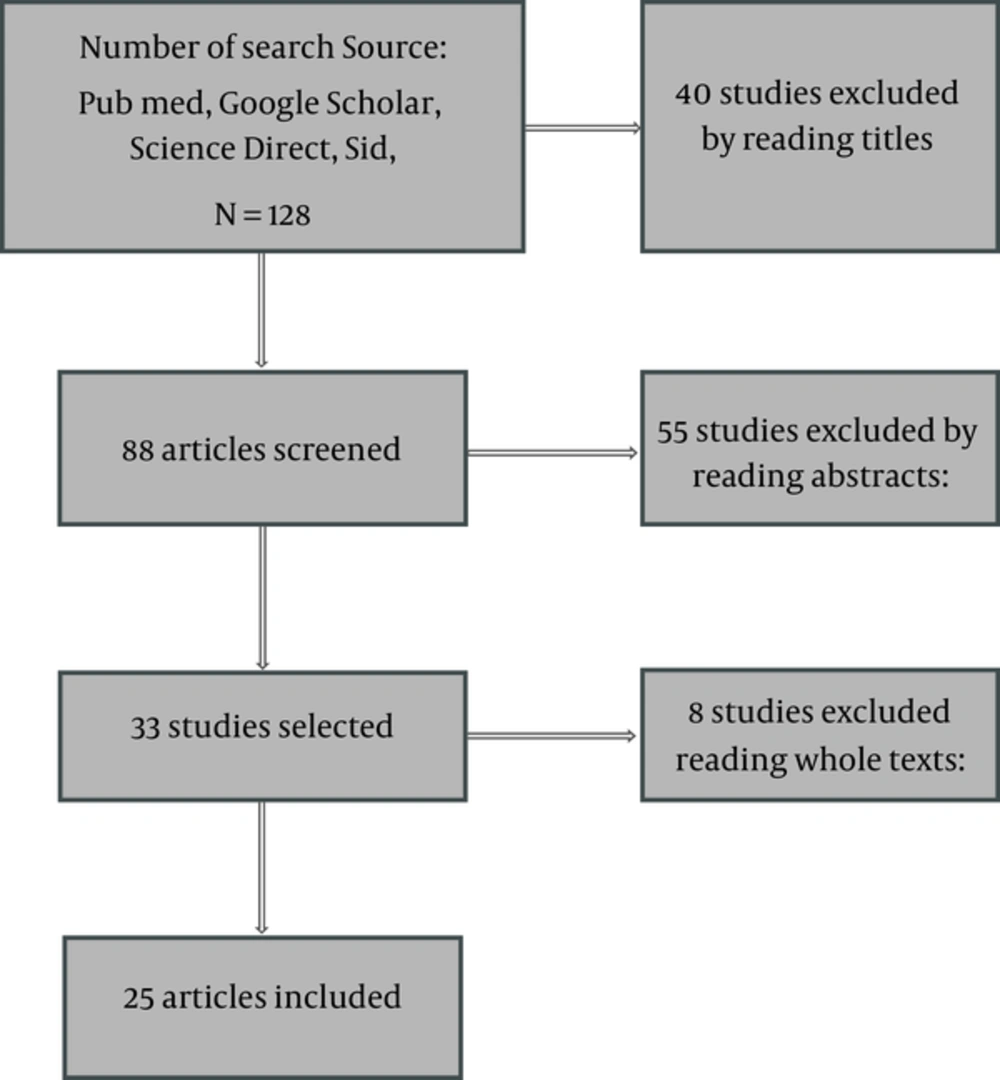
Figure 1.
PRISMA flow diagram of the review
A summary of the findings of the 20 papers evaluating early detection tests of dementia is briefly presented in Table 3. Of these, eight articles evaluated verbal fluency tests; three evaluated the cognitive-risk motor syndrome as a type of screening test; two other studies measured the potential cognitive indicators of dementia during the pre-disease period; two studies also used olfactory testing as an indicator of early diagnosis; and in five studies, the visual tests, mini-mental state examination (MMSE), digit span (direct - inverse), and the tracing test (section A-B) were used in the elderly population.
Table 3.
Studies Evaluating Diagnostic Tests for Dementia
| Author (Year of Publication) | Type of Article | Number and Type of the Study Subjects | The Study Objective | Conclusion |
|---|---|---|---|---|
| Nejati (2008) | Cross sectional study | 150 Iranian elderly | Determining the effectiveness of psychological vocal, semantic verbal, and semantic tasks in the elderly, and comparing the tasks | Since dementia caused by aging more involves the frontal lobe of the brain, poor function of the elderly in the verbal phonological test can be attributed to this structural change (24). |
| Barekatian (2012) | Review | Elderly people | A review of the value of neuropsychological investigations in determining the prevalence of dementia | Defective episodic memory is the first cognitive change before dementia, but asymmetry in cognitive abilities may also occur in the pre-clinical stage and predict early dementia (25). |
| Jacobson (2002) | Review | Elderly people | Determining the potential cognitive indicators of dementia during the pre-disease period | Lack of coordination in cognitive function can be an indicator for the pre-clinical stage of dementia (26). |
| Jafari (2010) | Cross sectional study | 350 Iranian elderly people | Feasibility of the Persian version of Rey auditory verbal learning test | The Persian version of the test has good reliability and validity, and can be used to evaluate and comment on short-term memory and learning performance in the elderly, and identify people with dementia (27). |
| Andersson (2006) | Cross sectional study | 224 elderly people | Application of Rey auditory verbal test to identify people at higher risk for dementia | The test is quite capable of detecting suspected people (28). |
| Schoenberg (2006) | Cross sectional study | 158 people suspected of dementia | Application of Rey auditory verbal testing to identify people at risk of dementia | The auditory verbal test can accurately identify people suspected of dementia (29). |
| Saxton(2004) | Cross sectional study | 193 elderly people | Psychological, verbal, phonetic, and semantic comparison of the elderly | The semantic part of the test is a good predictor of dementia 1-5 years before the disease manifestation (30). |
| Maseda (2014) | Cross sectional study | 82 elderly people | Creating the possibility of linking the three components of language (psycho - verbal, naming and understanding) to predicting cognitive impairment, as well as determining the efficacy of the language assessment test to predict or monitor the development of cognitive impairment | Language evaluation, especially mastery and understanding, is a good indicator of cognitive impairment. Using these assessments as predictors of cognitive impairment such as dementia is recommended (31). |
| Gomez (2006) | Cross sectional study | 153 elderly people | Use of the psycho-verbal test as a predictor of Alzheimer-type dementia | The use of this test can identify healthy individuals at risk of developing a mild impairment of Alzheimer-type dementia (32). |
| Zhu (2016)/ Devanand (2000) | Cross sectional study | 534 elderly people | Use of the olfactory test for the early detection of Alzheimer-type dementia | Olfactory performance test serves as a marker to predict Alzheimer’s risk and is a very important tool to screen populations at high risk for Alzheimer’s disease (33, 34). |
| Verghese (2002) | Cross sectional study | 422 elderly people | Evaluation of abnormal motor status as an early marker for the diagnosis of dementia | Motion disturbances are an indicator for identifying elderly people with cognitive impairment such as dementia/ Alzheimer’s disease (35). |
| Ayers (2014) | Review | Elderly people | An overview of the diagnosis of motoric cognitive risk syndrome to predict the progression of dementia | Motor disorders such as walking and slowing down of movements are more and more increased with the development of age, and are identified as a risk factor for the development of cognitive impairment syndrome of dementia (36). |
| Doi (2015) | Cross sectional study | 9683 Japanese elderly people | Outbreak of cognitive-motor cognitive risk syndrome in the elderly | Motoric cognitive risk is the newly described predementia syndrome, which is characterized by cognitive complaint and slow walking, and associated with an increased risk of dementia (37). |
| Shao (2014) | Cross sectional study | 82 elderly people | Use a psychological-verbal test to identify cognitive impairments | The speech fluency test has the ability to identify patients with mild cognitive impairment, and the results can be abnormal clinically from five years before the dementia. Since the results of this test may be abnormal before all other cognitive tests, in all perfect cognitive assessments, the test of speech fluency must be done (38). |
| Chehrehnegar (2016) | Cross sectional study | 74 elderly people | A review of the cognitive vision assessment test | Visual impairment is a useful predictor for patients with cognitive impairment including Alzheimer's disease and dementia (39). |
| Foreman (1996) | Cross sectional study | 33 elderly people | Validation of the brief test of the MMSE cognitive status in the elderly | This test is suitable to evaluate general cognitive health in the elderly (40). |
| Awh (1996) | Cross sectional study | 11 elderly people | Examination of digit span (direct - inverse) test in the elderly | This test evaluates working memory and can predict a cognitive impairment such as dementia (41). |
| Lezak (2005)/ Stuss (2001) | Cross sectional study | Elderly people | Assessment of the tracing test (Part A - B) | This test is widely used to measure visual-motor tracking, divided attention cognitive flexibility, and executive-cognitive functions in the elderly population (42, 43). |
The findings of five other studies that investigated the risk factors to develop dementia are presented in Table 4. In these studies, stress, age, diet, blood lipids, serum parameters, mental illnesses such as depression, cardiovascular disease, and diabetes were identified as factors involved in the onset of dementia.
Table 4.
Risk Factors for Dementia
| Author (Year of Publication) | Type of Article | Number and Type of Study Subjects | The Study Objective | Conclusion |
|---|---|---|---|---|
| Kuck (2014) | Review | Elderly people | An overview of the relationship between stress and dementia | There is a relationship between stress and dementia. Chronic stress leads to excessive cortisol release, and excessive cortisol release, in turn, causes brain damage that can lead to dementia (44). |
| Cooper (2015) | Systematic review and meta-analysis | Elderly people | A review of modifiable predictors of dementia to detect mild cognitive impairment | Age, depression, diabetes, metabolic syndrome, low folate diet, and neural signs are modifiable and predictive risk factors for dementia (10). |
| Samieri (2008) | Cohort | 1214 elderly people | Determining plasma PUFA and blood lipids as risk factors to predict dementia | By increasing the concentration of plasma PUFA and lipids, the risk of dementia increases (45). |
| Potter (2013) | Cross sectional study | 179 elderly people | Study of the role of major depressive disorder, as a risk factor, in the onset of dementia | Older people with cognitive impairment in memory and executive impairment in functioning during depression are at increased risk for dementia (46). |
| Batty (2014) | Retrospective | 103764 elderly people | The role of cardiovascular diseases as a modifiable and forecasting factor for dementia | There is a relationship between the risk factors for heart disease and death due to dementia (47). |
4. Conclusions
The current study was the only systematic review found in the field of early prediction of dementia as a step to promote community health. Therefore, the current study aimed at conducting a systematic review of past studies that examined early diagnostic tests and the risk factors for dementia development. The current study was not limited to clinical trials, but included various types of research methodologies including reviews, descriptions, prospective, retrospective, etc.
In reviewing the articles studied in the current study, it was observed that most researchers emphasized on the identification of common risk factors for cognitive impairment such as dementia and the implementation of diagnostic tests as a preventive strategy to help reduce the burden of dementia and its impact on the quality of life worldwide.
Advantages of early diagnosis are: identification of physical and psychological causes, treatment of associated illnesses, initiation of psycho - social support and symptomatic drug therapy; however, early diagnosis due to the slow and variable onset of a syndrome comes out of personality and is not easy to disassociate naturally from time to time for a long time since the onset of the disease process (48). Due to age increase and its associated lower ability and vulnerability, prompt action should be performed toward the elderly and they should be supported physically, socially, and psychologically. It is important to pay attention to the all aspects of human beings, especially the elderly, as a vulnerable social stratum in order to improve their quality of life. The onset of dementia in the elderly makes them susceptible to tension and mood disorders. On the other hand, it limits the activities and has side effects on the lifestyle of the patients (9). The dementia is progressive; therefore, the patients eventually need care since they gradually become incapacitated for care, to the extent that they should be protected and sheltered round the clock. Dementia usually changes the context of the relationship between caregivers and patient. For instance, caring for patients with dementia puts caregivers at the risk for adverse psychological outcomes including anxiety and depression (48, 49)
In addition, the overwhelming burden of controlling and treating dementia on society is striking. Hence, for a new drug, a patient should pay about $US 12.20 per month. On the other hand, the emotional damage of the imposed cost to the family is unthinkable as well (3).
Based on the current study findings, the studies that evaluated the verbal fluency test as a valid indicator of the prediction of individuals with dementia-risk reported the effect of this method in early detection of positive dementia. In fact, language is the main mode of communication and an essential human resource. Language skills are cognitive abilities that change with aging and involve the integration of multiple processes and cognitive regions of the brain that may be related to cognitive impairment conditions (50, 51). Accordingly, the semantic components of language are more vulnerable to aging than other focal aspects such as syntax and phonology. For this reason, verbal psychology and tasks of coping with naming are particularly affected by Alzheimer’s disease. It is also shown that semantic noise begins in patients with mild Alzheimer’s disease with the loss of conceptual communication. In fact, language skills are cognitive abilities that vary with age. The psycho - verbal function involves two cognitive processes, the ability to generate words, and the ability to change words. Therefore, the psycho - verbal test is considered as an appropriate indicator to identify cognitive impairments in such individuals. The sensitivity and specificity of this test are some of the high-grade neuropsychological tests that are commonly used for such individuals. Psychological verbal evaluation is always an important part of the neuropsychological evaluation and is implemented both in phonemic and semantic environments. In the phonological type, subject should present words that start with a specific letter and in the semantic type, subject should present words semantically related to a particular category at a given time interval. The psycho - verbal test is a useful test to evaluate cognitive executive functions and linguistic functions (52).
A review of the studies also showed that motor disorders such as walking and slowing down of movements are increasingly associated with the development of age, and is identified as a risk factor to develop dementia. Cognitive processes are related to motor function and clinical evaluation of walking can be useful to provide early diagnostic evidence of dementia. Subjective cognitive complaints, slow walking, and mobility confirm the cognitive motion syndrome in an individual. Motoric cognitive risk (MCR) is a clinical approach to identify people at risk (53). In addition, MCR is a reliable indicator to predict dementia; since slow walking and development of the MCR may take place several years before cognitive impairment begins (54). In the studies, the effect of this test to recognize positive dementia is reported.
Visual impairment is a useful predictor for patients with cognitive impairment including Alzheimer’s disease and dementia. Reduced visual acuity due to the lack of awareness by the individual with defected vision defect is an indication of the progression of the disease. According to the current study inclusion criteria, studies showed that patients with mild cognitive impairment and Alzheimer’s disease had some flaws in spatial vision functions. Operational and visual functions have a role in routine activities, driving, and leisure activities. Demographic degradation in executive functions also affects day-to-day activities, and severe cognitive problems can lead to malfunctioning in everyday life. Thus, the defect in doing daily activities is due to a reduction in the visibility of symptoms of dementia in the elderly (55). It was observed that visual impairment is associated with the implementation of activities and the visual changes show distorted information, which affects motor control and understanding of the depth (56). Visual impairment reduces the visual perception ability and increases the chances of cognitive impairment; therefore, early detection before the progression of cognitive impairment and reduction in functional impairment seems essential (57).
The olfactory test is another relatively new diagnostic technique and is a non-invasive method. the Sniffin’ Sticks test is the test for odor identification. In this test, the patient is asked to identify 16 different variants. The inability to distinguish Bo demonstrates cognitive impairment such as dementia in a person (41). Age-related olfactory disorders are caused due to damage to the olfactory receptor cells caused by a decline in brain activity associated with age during a person’s life. The current study observed that olfactory performance tests serve as a marker to predict Alzheimer’s risk, and are an essential tool to screen populations at higher risk for Alzheimer’s disease (42). People with olfactory disorder are at risk for the development of cognitive impairments such as Alzheimer’s disease (58); therefore, in order to improve the accuracy of Alzheimer’s diagnosis, and the easy and early identification of populations at risk, olfactory test is required.
The current study results showed that defective episodic memory is the first cognitive change before dementia, but asymmetry in cognitive abilities may also occur in the pre-clinical stage and predict early dementia. Today, it is known well that with increasing age, the efficiency of working memory is reduced, which is due to the analysis of the back-exterior of the pre-frontal spinal cord (59). This finding is consistent with the results of the studies that showed the efficacy of this test was high in the early diagnosis of cognitive impairment (60, 61).
In the other searched studies, dementia - inducing risk factors were identified as factors that can contribute to the development of dementia and its predictive value in the elderly. Dementia is a multifactorial disorder, and genetic and environmental factors, as well as their interactions affect its onset. Age is a major determinant of this disease, and gene mutation also contributes to a small percentage of all patients. The strong association of dementia with age increase somewhat to reflect the cumulative effects of different risk factors and different protective factors during lifetime including the complex effects of complex interactions of genetic talents, psychological factors, and biological and environmental factors that a person experiences during his life-cycle. Epidemiological interventions, imaging, and neuropathological research support the role of genetic, vascular, and other psychological factors to develop the disease, while evidence suggests that the etiologic role of diet or nutritional factors, occupational exposure, and inflammation are less evident (5, 6, 10, 47). Karlamangla stated that risk factors for dementia are multiple and include gender, cardiovascular disease, hypertension, stress, etc. But, age is the most powerful risk factor for dementia (61). The results of previous studies were consistent with the results of Hutton’s research stating that more than half of the elderly in the developing countries are in a disadvantaged financial situation and have financial stress, and stress is the cause of the drop of cognitive status (62).
Due to their age and reduced ability and social vulnerability, appropriate attention should be paid to the elderly and their physical, social and psychological needs should be evaluated. It is important to pay attention to all aspects of human beings, especially in the elderly as a vulnerable social stratum in order to improve their life quality. The onset of dementia in the elderly makes them susceptible to tension and mood disorders. On the one hand, it limits the activities and affects patients’ lifestyle (9). In fact, health promoting behaviors are one of the main determinants of health known to be the underlying cause of not having many diseases, and improving health and preventing diseases are directly related to such behaviors. Health - promoting behaviors in the elderly have a potential impact on the promotion of their health and also reduce health care costs (63, 64).
The current systematic review observed that motor and language function tests were the most frequently applied test for dementia screening. However, many other screening tests had comparable diagnostic performances. Cognitive tests had better performance than the other dementia screening tests. Olfactory test is an easy test to detect other types of dementia. Since mild cognitive impairment has adverse effects on the quality of life and performance, risk reduction is important. Early diagnosis and intervention, and modifying the modifiable factors can delay or prevent the onset of dementia during a mild cognitive phase.