
1. Background
In today’s life, we are witnessing the occurrence of stress and its complications more than ever. Psychologically, people who suffer from repeated, prolonged stress in life are more likely to experience loneliness, social isolation, sense of difference with peers, poor education, and limited community participation (1). However, recent studies have addressed new concepts in this matter using the Seligman positive psychology approach and argued that the opposite side of people who give disappointing answers to severe crises are those who have more effective responses and choose unique and creative ways to manage their position; they not only adapt to crises and changes caused by them and accept them as a stage of life, but also often go beyond their previous position and experience great profoundness and evolution in various aspects of life (2).
In fact, the results of studies conducted using this approach since 1996 have shown that a great number of people who have survived after stressful events experience positive psychological changes. These positive changes can be caused by stressful events or they might be a type of education that a person learns when tries to adapt to stressful events (3-5). An interesting point is that the review of the literature over the past decade in this matter suggests that, contrary to expectations, the evidence of growth experiences is much greater than the evidence of posttraumatic stress disorder (PTSD) at different levels (6). This positive change, which is recognized as posttraumatic growth (PTG), is the experience or mental perception of positive psychological changes that result from the struggle with a stressful event and includes the growth and excellence in five categories: (1) new possibilities, (2) relating to others, (3) personal strength, (4) spiritual change, and (5) appreciation of life. Special attention to the term “struggle” in the literature is related to the reason that growth is not necessarily the result of an event, but the individual’s efforts to cope with new realities are crucial in determining the extent of growth experience (4, 7, 8).
In several studies, the concept of PTG has been studied with other terms such as “benefit finding”, “stress-related growth”, and “flourishing”. However, most researchers in this field tend to use the term “posttraumatic growth” to describe such positive changes (5, 9). A review of the literature shows that most studies examined posttraumatic growth and its association with various factors in non-clinical samples. This is despite the fact that posttraumatic growth can be the subject of research in patients experiencing chronic diseases or medical conditions (4, 8).
The high rates of chronic diseases are one of the new challenges that the healthcare system is facing; the coronary artery disease, and at the top of it, myocardial infarction, places in this category (10, 11). In the United States, 1.5 million people are affected by myocardial infarction each year, leading to 400,000 deaths. In Iran, of all the 700 to 800 deaths per day, 317 are due to cardiovascular diseases and 166 of them are because of myocardial infarction. The direct and indirect costs of cardiovascular diseases in the United States are estimated to be 4753 billion dollars a year. In Iran, 15 billion dollars a year are spent on treatment besides 50 million dollars on the purchase of related medical equipment (10).
Myocardial infarction is one of the most stressful events that can cause serious physical, psychological, and social problems for patients. Patients with myocardial infarction face multiple sequelae such as congestive heart failure, cardiac arrhythmias, unemployment, physical disabilities, and mental disorders such as anxiety and depression. These problems can affect patients’ well-being and quality of life. On the other hand, the Seligman’s positive psychological approach can stimulate the development of positive attitudes and modify the individuals’ perception and the philosophy of life, creating the ground for making positive changes in people who experience life-threatening illnesses such as myocardial infarction that suddenly and unexpectedly claim the patients’ lives (12, 13). The results of several studies investigating the concept of posttraumatic growth in post-myocardial infarction patients suggest that people first affected by infarction and then experiencing posttraumatic growth during the course of disease are less likely to have recurrent heart attack than other patients are; moreover, the occurrence of related unpleasant side effects is also lower due to the presence of several and different support systems along with the improvement of the patients’ ability to adapt better to new stressors (4, 5, 7).
Meaning in life refers to a sense of connection with the creator of the universe, having a goal in life, pursuing and achieving valuable goals, and ultimately achieving evolution. One of the most famous definitions of meaning in life was presented by Emil Frankl (1982). He believes that when a person feels that his being is linked to a perfect source and sees himself reliant on extensive and reliable frameworks such as the religion and philosophy that he chose to live in, he finds the meaning and feels it (14, 15). These people show resilience and tolerance against stressful events of life (9, 16).
In general, the perception of the meaning of life (MOL) is one of the strong predictors of well-being and life satisfaction. The results of studies also show that having a meaningful life has a significant positive correlation with hope, happiness, life satisfaction, and quality of life and a significant negative association with depression, anxiety, and mental disorders. All of these verify that a meaningful life is a valuable indicator for assessing mental health in individuals (17).
The results of some studies indicate that meaning in life is one of the variables associated with posttraumatic growth (18). However, some other studies have not shown a clear relationship between the two mentioned concepts (3, 19, 20). In a study by Rahimi and Heidarzadeh on patients with myocardial infarction experiencing a traumatic event, the mean total score of posttraumatic growth was moderate to high (13). In another study, Mousavi and Vatankhah stated that meaningful life was a positive predictor of posttraumatic growth in women with breast cancer (21).
Since myocardial infarction is the most common and a major cause of death in the world and its consequences can affect the lives of individuals and the community, the understanding of different dimensions of the concept of posttraumatic growth and the meaning of life, and more importantly, examining the type and the relationship between these concepts based on different components can provide valuable information for patients and healthcare providers. Applying these concepts to plan daily care and interactions leads to a more effective compromise of patients with stressful situations and better care provided by their caregivers.
2. Objectives
Considering the relationship between posttraumatic growth and social, cultural, and supporting systems of the target population (22) and the lack of sufficient studies on the relationship between these two variables in patients with myocardial infarction in Iran, the aim of this study was to investigate the relationship between posttraumatic growth and meaning in life in myocardial infarction patients.
3. Methods
3.1. Study Design and Population
The present descriptive-correlational study was performed on a sample of 191 patients referring to the largest cardiology center (Bu-Ali Sina) in Qazvin, Iran. Patients were selected through a convenience sampling method based on the inclusion criteria. The inclusion criteria included the age of 18 years or older, the definitive diagnosis of myocardial infarction (for the first time) by a cardiologist, the ability to read and write, the experience of at least three months from the onset of myocardial infarction (23), and performing PCI process in all samples (24, 25). The exclusion criteria were unwillingness to participate in the study, experience of severe stress during the past month based on the patient’s self-report, having mental disorders during data collection based on the information recorded in the patient’s file, and inappropriate physical condition at the time of data collection if prevented the patient from responding appropriately to questions (Figure 1). After explaining the research objectives and how to participate in the study, written consent was obtained from the patients.
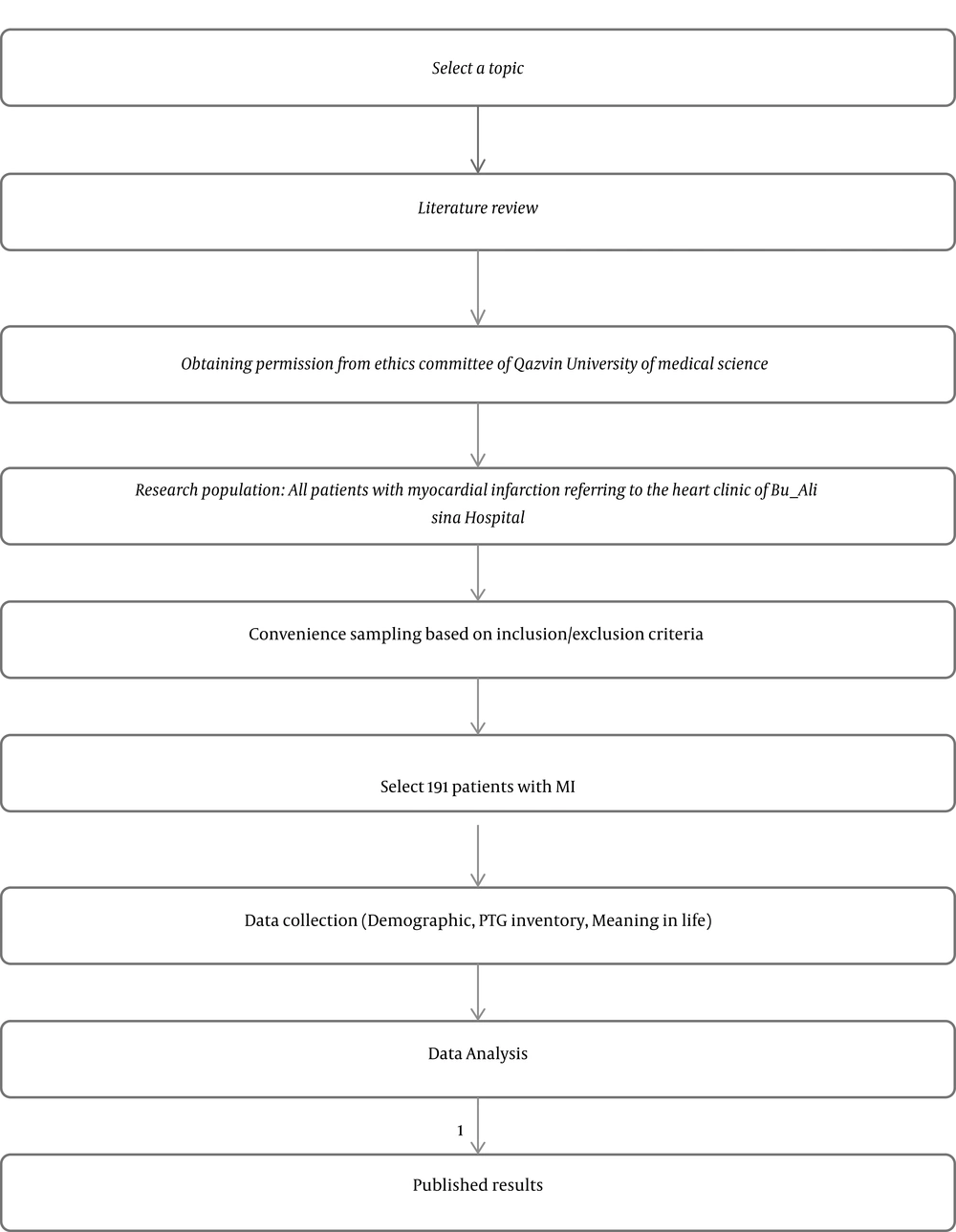
Figure 1.
The study flow chart
3.2. Sample Size
The sample size was calculated using the relevant statistical formula considering the significance level of 0.05, the power of 80%, and the effect size of d = 0.2 obtained according to the coefficient of determination (0.04) using G*power 3.1.7 software.
● Analysis: A priori: Computing required sample size
● Input: Tail(s) = Two
Effect size |ρ| = 0.2000000
α err prob = 0.05
Power (1 - β err prob) = 0.8
● Output: Noncentrality parameter δ = 2.8210518
Critical t = 1.9725951
Df = 189
Total sample size = 191
3.3. Instruments
The instruments used in the present study included a demographic characteristics questionnaire, the posttraumatic growth inventory (PTGI), and the meaning in life questionnaire (MLQ).
The demographic characteristics consisted of data about patients’ age, gender, marital status, level of education, and occupation.
3.4. Posttraumatic Growth Inventory (PTGI)
The posttraumatic growth inventory (PTGI; Tedeschi and Calhoun, 1996) was used to assess growth-related changes experienced by traumatic individuals (26). This 21-item scale evaluates five domains of PTG consisting of (1) new possibilities, (2) relating to others, (3) personal strength, (4) spiritual change, and (5) appreciation of life. The items are rated from 0 (I did not experience this situation as a consequence of my crisis) to 5 (I fully experienced this change to a very great degree). The total score ranges from 0 to 105 with a higher score indicating a greater experience of posttraumatic growth (4). The reliability and validity of the scale were evaluated in a sample of patients with cardiac disorders in the United States by Sheikh and Marotta. The obtained Cronbach α for the total scale was 0.96 (27).
Triplett et al. reported that the internal reliability of the scale was 0.90 and the test-retest consistency with a two-month interval was 0.71 (18, 28). The PTGI was translated into Persian by Mahmoudi (2008) and then revised and adapted by Mahmoudi et al. According to the results of PTGI construct analysis, three factors were confirmed including changes in the relationship with others (α = 0.86), philosophy of life (α = 0.87) and self-perception (α = 0.88) in an Iranian population (29, 30).
3.5. The Meaning in Life Questionnaire (MLQ)
This instrument was designed by Steger et al. to assess the presence of meaning in life and search for it. The validity, reliability, and factor structure were studied in various studies with different samples. The researchers found two factors, the presence of meaning in life and search for meaning in life, with a total number of 17 items using exploratory factor analysis. Then, in confirmatory factor analysis, seven items were removed and a suitable structure of two factors with 10 items was achieved. According to Steger et al., the validity of the subscale “the presence of meaning” was 0.86 and that of the subscale “search for meaning” was 0.87. Moreover, the reliability coefficients of the subscales “the presence of meaning” and “search for meaning” were 0.70 and 73.1, respectively (31). Jamali obtained its reliability coefficient as 0.9 using Cronbach’s alpha (32). In addition, the reliability coefficient of the MLQ was determined to be 0.89 in Peymanfar and Akbari study using Cronbach’s alpha (33). The scale for scoring the items of the questionnaire included absolutely untrue (1), mostly untrue (2), somewhat untrue (3), cannot say true or false (4), somewhat true (5), mostly true (6), and absolutely true (7). The scores of items 2, 3, 7, 8, and 10 are summed up to obtain the subscale score of “search for meaning” and the scores of items 1, 4, 5, 6, and 9 are summed up to calculate the subscale score of “the presence of meaning”. The total score of the scale ranges from 10 to 70. A higher score indicates a greater meaning in one’s life and a lower score indicates a lower meaning.
3.6. Ethical Consideration
This study was approved by the Ethics Committee of Qazvin University of Medical Sciences (IR.QUMS.REC.1397.022). Before signing informed consent forms, all the participants were informed about the study objectives and procedures. They were also assured that participation in the study would be voluntary and would not affect their medical care. Permission was obtained from the PTGI and MLQ developers (Tedeschi and Calhoun (5) and Steger et al. (31) respectively).
3.7. Statistical Analysis
Data were analyzed using SPSS (version 24). Descriptive analysis, frequency, mean, and standard deviation (SD) were used to describe the participants’ demographic variables. Inferential statistics (Pearson’s test) were used to evaluate the relationship between PTG and MOL. The significance level was set at P < 0.05.
4. Results
4.1. Socio-Demographic Characteristics of Patients with Myocardial Infarction
Based on the results of the study (Table 1), the mean age of the patients was 59.6 ± 1.2 years. Of the 191 participants, 49 (25.7%) were female and 142 (74.3%) were male. Moreover, 5 (2.6%) patients were single and 186 (97.4%) were married. In terms of education level, 36 (18.8%) were illiterate, 117 (61.3%) were under diploma, 30 (15.7%) had diploma degrees, and 8 (4.2%) had university degrees. Regarding the occupation status, 133 (69.6%) were employed, 51 (26.7%) were retired, and 7 (3.6%) were unemployed.
Table 1.
Sociodemographic Characteristics of Patients with Myocardial Infarctiona
| Variable | Values |
|---|---|
| Age, mean ± SD | 12.1 ± 59.6 |
| Gender | |
| Female | 49 (25.7) |
| Male | 142 (73.3) |
| Total | 191 (100) |
| Marital status | |
| Single | 5 (2.6) |
| Married | 186 (97.4) |
| Total | 191 (100) |
| Education level | |
| Illiterate | 36 (18.8) |
| Under diploma | 11 (61.3) |
| Diploma | 30 (15.7) |
| Academic | 8 (4.2) |
| Total | 191 (100) |
| Occupation status | |
| Employed | 133 (69.6) |
| Retired | 51 (26.8) |
| Unemployed | 7 (3.6) |
| Total | 191 (100) |
aValues are expressed as No. (%) unless otherwise indicated.
4.2. Posttraumatic Growth and Its Dimensions
Based on the results (Table 2), the mean total score of posttraumatic growth in patients was 64.6 ± 11.5. In terms of the domains of posttraumatic growth, the mean scores of appreciation of life, new possibilities, relating to others, personal strength, and spiritual change were 9.4, 15.8, 21.2, 12.4, and 5.7, respectively. Given the unequal number of items in each domain, the weighted mean scores of domains (based on the number of items of each domain) were estimated to be 3.13, 3.16, 3.02, 3.1, and 2.8, respectively. Accordingly, the subscale “new possibilities” scored the highest and “spiritual change” scored the lowest.
Table 2.
Posttraumatic Growth and Its Dimensions Scores
| Variable | Mean ± SD | Min | Max | Number of Items | Weighted Average |
|---|---|---|---|---|---|
| Appreciation for life | 9.4 ± 1.9 | 3 | 15 | 3 | 3.13 |
| New possibilities | 15.8 ± 3.4 | 4 | 23 | 5 | 3.16 |
| Relating to others | 21.2 ± 4.1 | 7 | 30 | 7 | 3.02 |
| Personal strength | 12.4 ± 2.5 | 4 | 18 | 4 | 3.1 |
| Spiritual change | 5.7 ± 1.07 | 1 | 8 | 2 | 2.8 |
| Posttraumatic growth | 64.6 ± 11.5 | 21 | 92 | 21 | 3.07 |
4.3. Meaning in Life and its Dimensions
Based on the results (Table 3), the mean total score of meaning in life in patients was 49 ± 6.04. The mean scores of subscales “presence of meaning” and “search for meaning” were 26.03 and 23, respectively.
Table 3.
Meaning of Life and its Dimension Scores
| Variable | Min | Max | Mean ± SD |
|---|---|---|---|
| The existence of meaning in life | 15 | 34 | 26.03 ± 3.9 |
| Search for meaning in life | 16 | 29 | 23 ± 2.4 |
| Meaning of life | 32 | 63 | 49 ± 6.04 |
4.4. Relationship Between MOL and PTG
Based on the results (Tables 4 and 5), there was a significant positive correlation between posttraumatic growth and meaning in life (r = 0.71, P < 0.001). Thus, the mean score of posttraumatic growth increases by an increase in the score of the meaning in patients’ lives. Pearson correlation coefficient showed significant positive correlations between meaning in life and all the domains of posttraumatic growth (P < 0.05).
Table 4.
Correlation Matrix of Posttraumatic Growth and Meaning of Life in Patients
| Variable | Meaning of Life | Posttraumatic Growth |
|---|---|---|
| Posttraumatic growth | ||
| r | 0.71 | 1 |
| P value | < 0.001 | - |
| Meaning of life | ||
| r | 1 | |
| P value | - |
Table 5.
Relationship Between the Components of Posttraumatic Growth and Meaning of Life in Patients
| Posttraumatic Growth | Appreciation for Life | New Possibilities | Relating to Others | Personal Strength | Spiritual Change | Total |
|---|---|---|---|---|---|---|
| Meaning of life | ||||||
| r | 0.61 | 0.67 | 0.66 | 0.62 | 0.62 | 0.71 |
| P value | < 0.001 | < 0.001 | < 0.001 | < 0.001 | < 0.001 | < 0.001 |
5. Discussion
This study aimed to investigate the relationship between posttraumatic growth and meaning in life among patients with myocardial infarction. The results indicated that the mean total score of posttraumatic growth was moderate to high among the participants (64.6 ± 11.5), which demonstrated a degree of growth experience in patients. Consistent with the results of this study, the mean total score of posttraumatic growth was reported high by Zarin et al. (27) in patients with spinal cord injury and Rahimi and Heidarzadeh (13) in patients with myocardial infarction. Heidarzadeh et al. (34) and Jansen et al. (35) stated that the mean total score of posttraumatic growth was moderate to high in cancer patients. Meanwhile, the results of Morris et al. (22) and Bellizzi et al. (36) showed that the mean total score of posttraumatic growth was low in patients with cancer. Regardless of the cultural differences between participants in the above studies, the results of the present study confirmed the theoretical framework of the concept of posttraumatic growth, which believes that exposure to stressful events, such as myocardial infarction, could be associated with the experience of growth in various areas.
Based on the results of the present study, the domain of “new possibilities” scored the highest and the domain of “spiritual change” scored the lowest among the five domains of posttraumatic growth. It means that participants in the study experienced the most growth in the domain of “new possibilities” and the least growth in “spiritual change”. Consistent with the results of the present study, the results of studies by Brix et al. (37), Morris et al. (22), and Bellizzi et al. (36) showed that the domain of spiritual change had the least growth in patients with cancer. Hooper et al. found that the highest growth was in terms of new possibilities and the least growth was in the domain of spiritual change (38). Contrary to the present study, Rahimi and Heidarzadeh (13) study in patients with myocardial infarction and Heidarzadeh et al. (34) study in cancer patients reported the highest growth in the domain of spiritual change and the least growth in the domain of new possibilities. On the other hand, Aflakseir et al. (39) in women with breast cancer and Teodorescu et al. (40) in Norwegian immigrants concluded that the lowest posttraumatic growth was in the domain of new possibilities. The contradictory results of studies concerning the scores of different domains of posttraumatic growth in different events and societies can be reasonably expected due to differences in the type and quality of the experienced stress, cultural differences, religious teaching, and values of each society that requires further in deep examination using a qualitative approach.
In terms of meaning in life, the results of the study showed that the mean total score of meaning in life was 49 ± 6.04 among the participants. The mean scores of “presence of meaning” and “search for meaning” subscales were 26.03 ± 3.9 and 23 ± 2.4, respectively. Consistent with the current study, Abedi et al. stated that elderly people achieved a higher score on meaning in life (41). Thompson also reported that breast cancer patients had a high meaning in life (42). Reza Zadeh and Rahmani Asl (9) and Park and Baumeister (16) believe that individuals are more resistant and patient in facing stressful events if they have a meaning in life. Several studies have shown meaning in life had a direct and meaningful relationship with quality of life, satisfaction, and optimism while it was inversely related to anxiety, depression, and psychological distress (43). Nasiri showed a significant positive correlation between meaning in life and life expectancy, happiness, and life satisfaction and a significant negative correlation between meaning in life and depression (17). All of these results indicate that patients participating in the present study had a valuable indicator for assessing mental health by having a high mean score of meaning in life.
Contrary to the results of the present study, Kord and Rahbari reported that the mean score of “search for meaning” was high in patients with cardiovascular diseases (44). Hassankhani et al. (45) and Eric (46) reported low meaning in life in cancer patients. After experiencing severe stress, the person who searches for the meaning needs some times to achieve a fixed and definite meaning. Therefore, one of the reasons for the contradictory results of the above studies can be the different times of the studies.
In terms of the relationship between the domains of posttraumatic growth and meaning in life, the results of the study showed a significant positive relationship between the scores of posttraumatic growth and meaning in life (P < 0.05). Patients achieved higher scores on different domains of posttraumatic growth by an increase in the scores of meaning in life. Consistent with the results of this study, Mousavi and Vatankhah stated that meaning in life was a predictor of posttraumatic growth in women with breast cancer (21). Dursun et al. showed a significant positive relationship between posttraumatic growth and meaning in life in university students (47). Garcini et al. concluded that students whose lives were more meaningful could cope better with the anxiety and challenges of life (48). Shafiee et al. stated that the mean score of meaning in life was lower in the injured women than in other women (49). According to the researchers, experiencing posttraumatic growth can facilitate the process of recognizing the stressful events in patients, create a positive view in patients and their relatives, and change their lifestyles; this concept creates meaningful positive changes in the emotional and cognitive lives of individuals, which positively affect their behaviors and functions (4, 5, 50). Healthcare providers can apply the concepts to plan the daily care and interactions, which may lead to an effective compromise of patients with stressful events and better care provided by caregivers.
5.1. Conclusions
The understanding of variables related to posttraumatic growth can help clinicians change this process in a useful way. We believe that clinicians are the facilitators of this process because posttraumatic growth is likely inhibited by heavy-handed attempts to move trauma survivors toward the understanding they have not yet directly experienced.
5.2. Limitations and Suggestions
The use of self-report tools was one of the limitations of this study. Patients might not have a clear understanding of the concepts of this study to answer the related questions. Thus, it is suggested that extensive studies concentrate on qualitative factors and open interviews.
It is also suggested that the predictors of posttraumatic growth be evaluated in Iranian society in future studies to effectively plan and provide a context for improving traumatic patients’ adaptability, development, and quality of life.