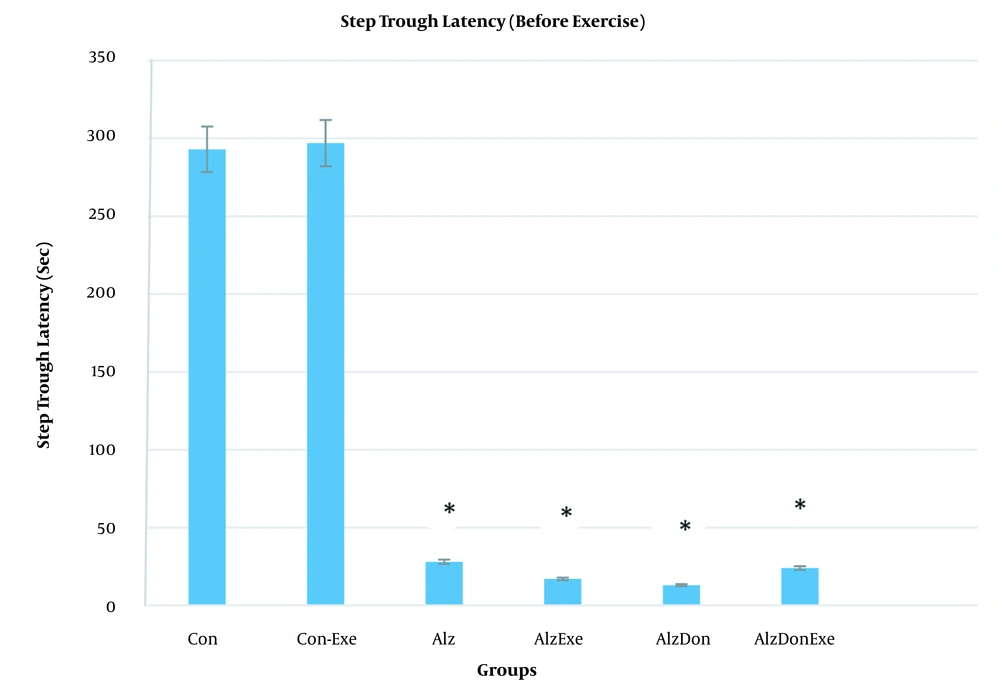
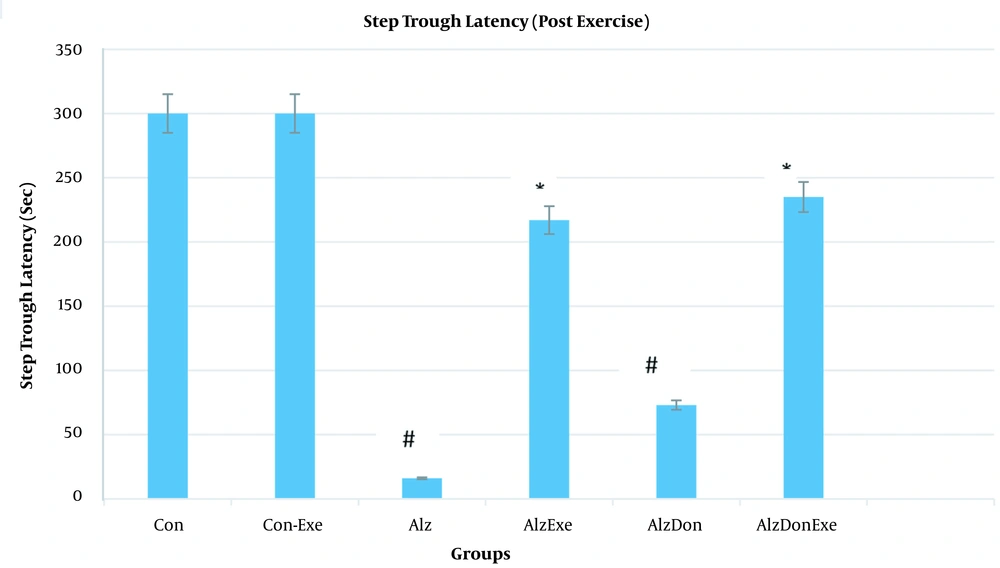
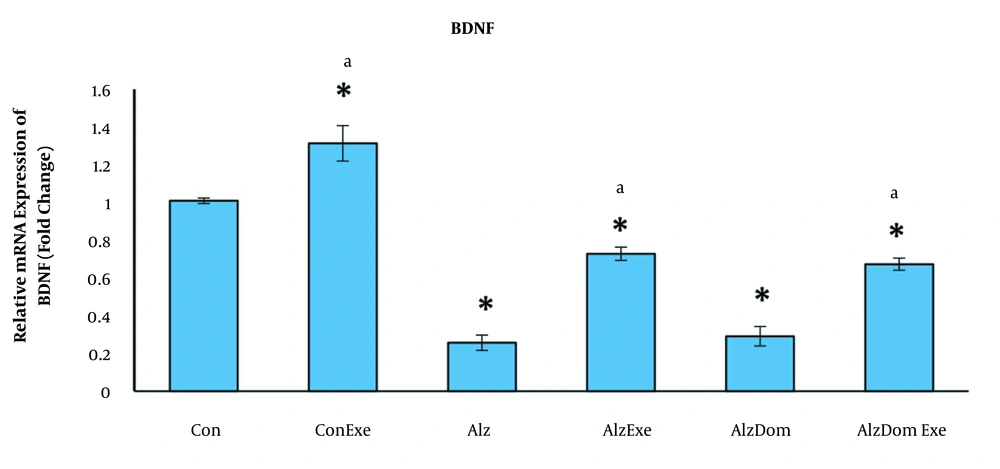
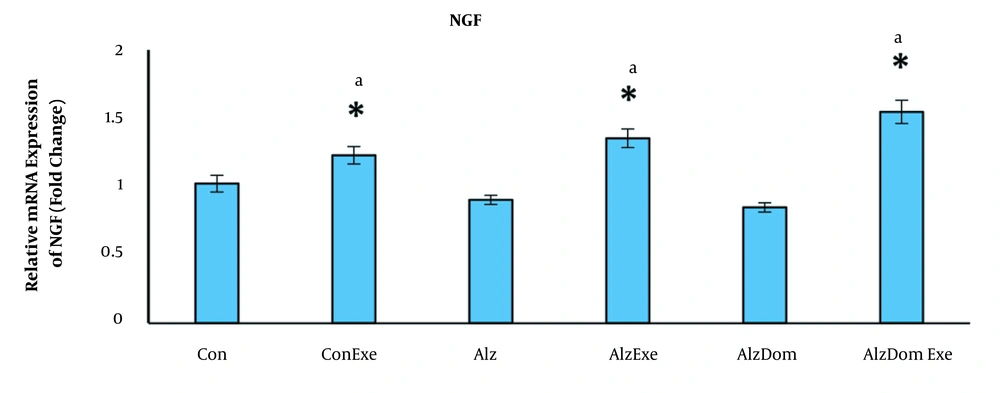
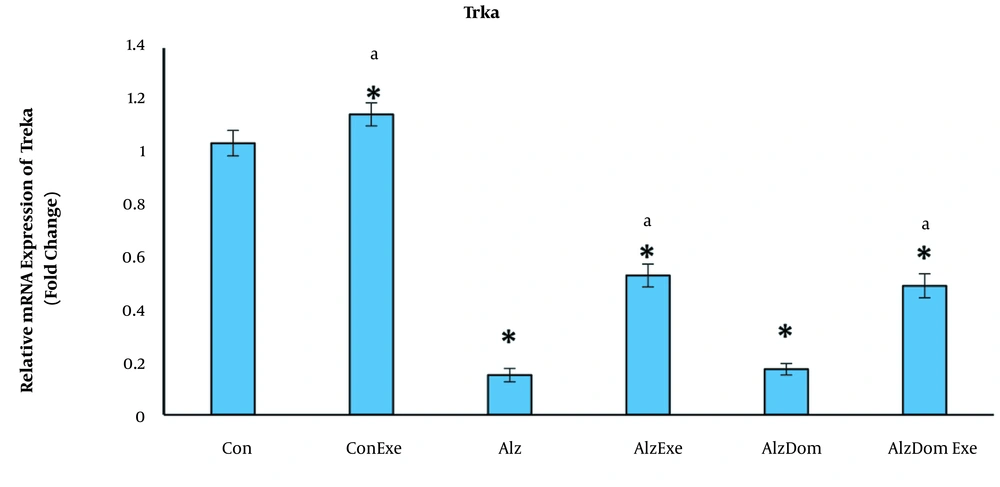
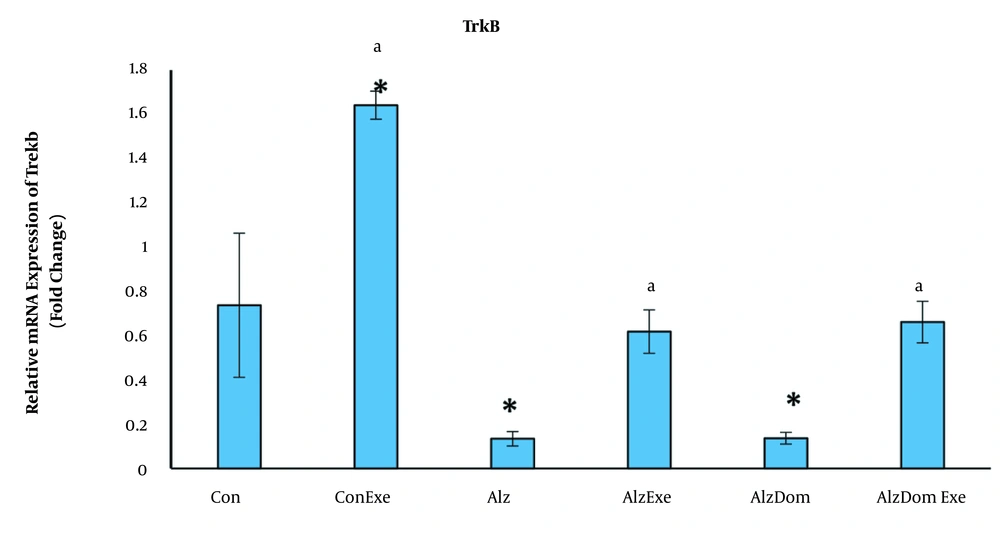
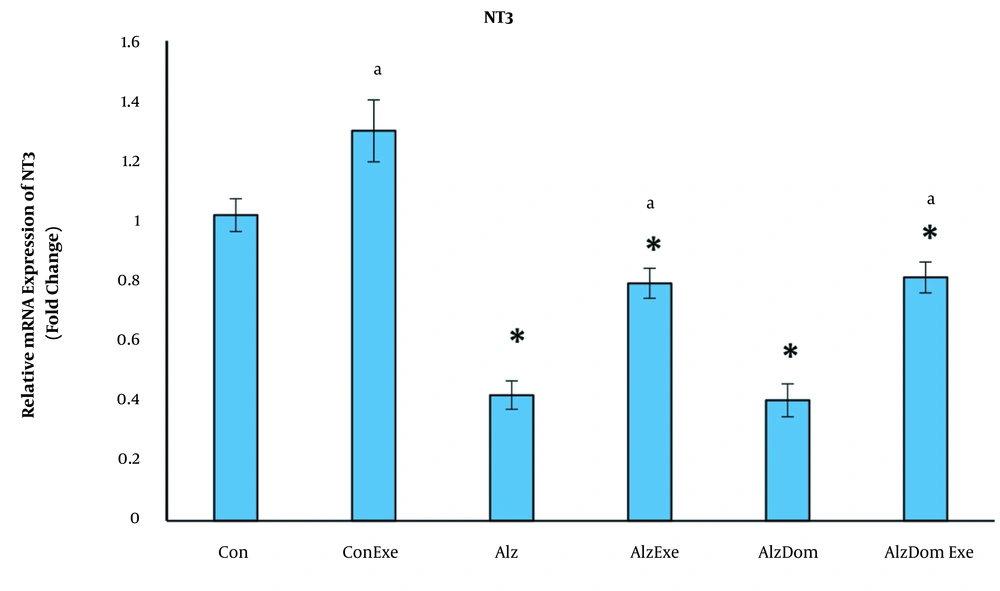
The results of present study showed that the expression of all the genes studied in all groups except the Donpezil group was significantly different from the Alzheimer's group. While the results of the present study regarding the effect of exercise, especially resistance training on neurotrophins gene and their receptors expression, are consistent with those reported by Cullen (
3), Wang and Holsinger (
15), and Lippi et al. (
5), they are inconsistent with the results of Dinoff et al. (
16), Walsh et al. (
17), and Dinoff et al. (
18). The difference in results can be due to the environmental measurement of the research variables; in our research, the variables were measured directly in the hippocampus.
The results of our research indicated that the use of donepezil alone for eight weeks did not have a significant effect on the expression of the studied genes. These results are inconsistent with those reported by Leyhe et al. (
6) and Jelic and Darreh-Shori (
7) possibly due to different doses of the drug and the duration of use. In the above-mentioned research, donepezil was used at a dose of 10 mg/kg for 1.5 to 2 years, while in the present study the dosage was 1.5 mg/kg for eight weeks.
The results of the study showed that resistance training and taking donepezil at the same time significantly increased the expression of the studied genes. No study was found on the effect of exercise, especially resistance training, and concomitant use of donepezil on the expression of neurotrophins gene in the hippocampus.
Our results showed that donepezil consumption with the dose used in this study did not significantly increase the expression of the genes studied, but the use of donepezil with eight weeks of resistance training significantly increased the genes studied. This mismatch is possibly due to the effect of exercise on increasing cerebral circulation, neurogenesis, and increasing brain signaling in terms of gene expression.
Regarding the effect of resistance training and donepezil consumption on learning, our results also showed that performing eight weeks of resistance training and concomitant use of donepezil significantly increased learning. These results are consistent with the results of Jiangbo and Liyun (
19). Accordingly, it can be said that resistance training and donepezil use can increase learning by increasing neurogenesis, increasing the expression of neurotrophins and their receptors, increasing cerebral blood flow, reducing the activity of acetylcholinesterase, and reducing the neuronal apoptosis.
Physical exercise can increase cognitive ability. Among different mechanisms involved in the interdependence between physical activity and brain health, much attention is recently given to neurotrophins receptor signaling pathway, which supports the growth and differentiation of new synapses, axons and dendrites and increases the synaptic plasticity and the survival of neurons. The present study showed that physical exercise and circulating brain-derived neurotrophic factor levels are positively interconnected. Besides, the change in this molecule after exercises is accompanied by the betterment of neurocognitive functioning. More definite results are still needed for other neurotrophins, like nerve growth factor, neurotrophin-3, and neurotrophin-4 (
5).
It is evident that AD results in the attenuation of neurotrophic and growth factors (BDNF, IGF-1, VEGF, and NGF). Thus, up-regulation of neurotrophic and growth factors can form a viable exercise strategy for brain protection against AD. According to clinical and basic studies, BDNF mRNA and proteins (e.g., proBDNF) are negatively affected by AD, particularly in hippocampus. It is also reported that reduced levels of BDNF and NGF in the brain result in AD pathology. Besides, lentiviral vectors administration for constitutive expression of BDNF in hippocampus is able to inhibit cellular death, reverse neuronal atrophy, and improve behavioral deficits, thus AD development is postponed. In addition to increasing neurotrophic factors generation, exercise as a physiologic mechanism can induce BDNF expression in hippocampus to minimize the AD-induced functional impairments of hippocampus. The improved BDNF signaling through exercise can mitigate learning and memory impairments in AD by increasing neurogenesis and LTP expression, modulating dendrites shape, and reversing Aβ-caused neurotoxicity (
2).
BDNF concentrations are more heavily and robustly influenced by aerobic exercise rather than resistance exercise. A meta-analysis of 12 trials of randomized control through resistance intervention showed that the level of BDNF in blood did not change significantly after exercise protocols that varied in type, duration, frequency, and time (
18). Walsh et al. (2016) observed that resistance exercise did not change basal BDNF concentrations (
17). Blood samples were taken in 20 min increments for a total of 2 h, with time 0 at the start of exercise and under resting condition. The BDNF blood concentrations increased transiently through exercise, but receded within 2 h; and the rising and falling responses of BDNF concentrations to the exercise before and after the 8-week exercise protocol were similar (
3).
Considering the time and cost limitations, we could not use more drug doses in a longer time period to increase the results efficiency. While increasing neurotrophic factors generation, exercise as a physiologic mechanism can also induce BDNF expression in hippocampus to minimize the AD-induced functional impairments of hippocampus. The improved BDNF signaling through exercise can mitigate learning and memory impairments in AD by increasing neurogenesis and LTP expression, modulating dendrites shape, and reversing Aβ-caused neurotoxicity.