The emergence of high-throughput RNA sequencing (RNAseq) has led to the identification of thousands of unknown lncRNAs, whose improper expression is closely associated with cancer development and initiation. Dysregulation of lncRNAs is closely related to tumorigenesis, metastasis, diagnosis, or prognosis of GC. Recently, several lncRNA-associated GCs have been detected. Nonetheless, the underlying mechanisms regulating GC progression remain largely unknown. In the study by Wang et al., it was shown that LINC00659 levels were significantly elevated in GC. SP1 activated the up-regulation of LINC00659 in GC. There was an association between higher levels of LINC00659 and TNM stage, lymphatic metastasis, and poorer prognosis. Overexpression of LINC00659 also resulted in a reduction of AQP3, which was suppressed by miR-370 mimics. LINC00659 appears to act as a molecular sponge for miR-370, modulating AQP3 expression as a tumor promoter in GC. In an m6A-YTHDF2-dependent manner, LINC00659 upregulated JAK1 mRNA by facilitating ALKBH5 binding. The JAK1 axis was disrupted when ALKBH5 or LINC00659 were silenced. As JAK1 was up-regulated in GC, the JAK1/STAT3 pathway was activated (
19).
In the study by Wang et al., it was shown that LINC00659 levels were clearly elevated in GC. SP1 activated the up-regulation of LINC00659 in GC. There was an association between higher levels of LINC00659 and TNM stage, lymphatic metastasis, and poorer prognosis. Overexpression of LINC00659 also resulted in a reduction of AQP3, which was suppressed by miR-370 mimics. LINC00659 appears to act as a molecular sponge for miR-370, modulating AQP3 expression as a tumor promoter in GC (
19). In an m6A-YTHDF2-dependent manner, LINC00659 upregulated JAK1 mRNA by facilitating ALKBH5 binding. The JAK1 axis was disrupted when ALKBH5 or LINC00659 were silenced. As JAK1 was up-regulated in GC, the JAK1/STAT3 pathway was activated (
20). LINC00659 derived from cancer-associated fibroblasts (CAFs) promotes CRC cell proliferation, invasion, and migration via the miR-342-3p/ANXA2 axis (
21). Zhang et al. revealed that LINC00659 binds directly to the polypyrimidine tract-binding protein (PTBP1). By knocking down LINC00659 expression, PTBP1 binding was inhibited under
H. pylori infection. LINC00659 knockdown reduced gastric epithelial cell senescence induced by
H. pylori infection. It also suppressed interleukin-6 and IL-8 secretion through NF-κB p65 phosphorylation reduction (
22). Sheng et al. indicated that LINC00659 expression levels were markedly up-regulated in GC patients. Elevated levels of LINC00659 were associated with advanced tumor stage and unfavorable prognosis for GC patients. Also, up-regulated LINC00659 expression could promote GC cell invasion. Bioinformatics studies indicated IQ motif containing GTPase activating protein 3 and matrix metalloproteinase 15 as possible downstream targets of LINC00659 associated with tumor metastasis. However, the exact underlying mechanism needs further exploration (
23). Sheng et al. reported an expression level of LINC00659 in GC, which can be due to the promotion of cell invasion and regulation of cell proliferation. SUZ12 is a transcription factor and regulates LINC00659. Also, LINC00659 regulates cell cycle and GC invasion through an increase in SUZ12 expression (
23). LINC00659 up-regulation was linked with poor survival in CRC patients. LINC00659 was found to have a significant co-expression with cycle-related genes in CRC. Silencing of LINC00659 expression caused cell growth inhibition and induced apoptosis, probably through suppression of AKT-PI3K signaling in colon cancer (
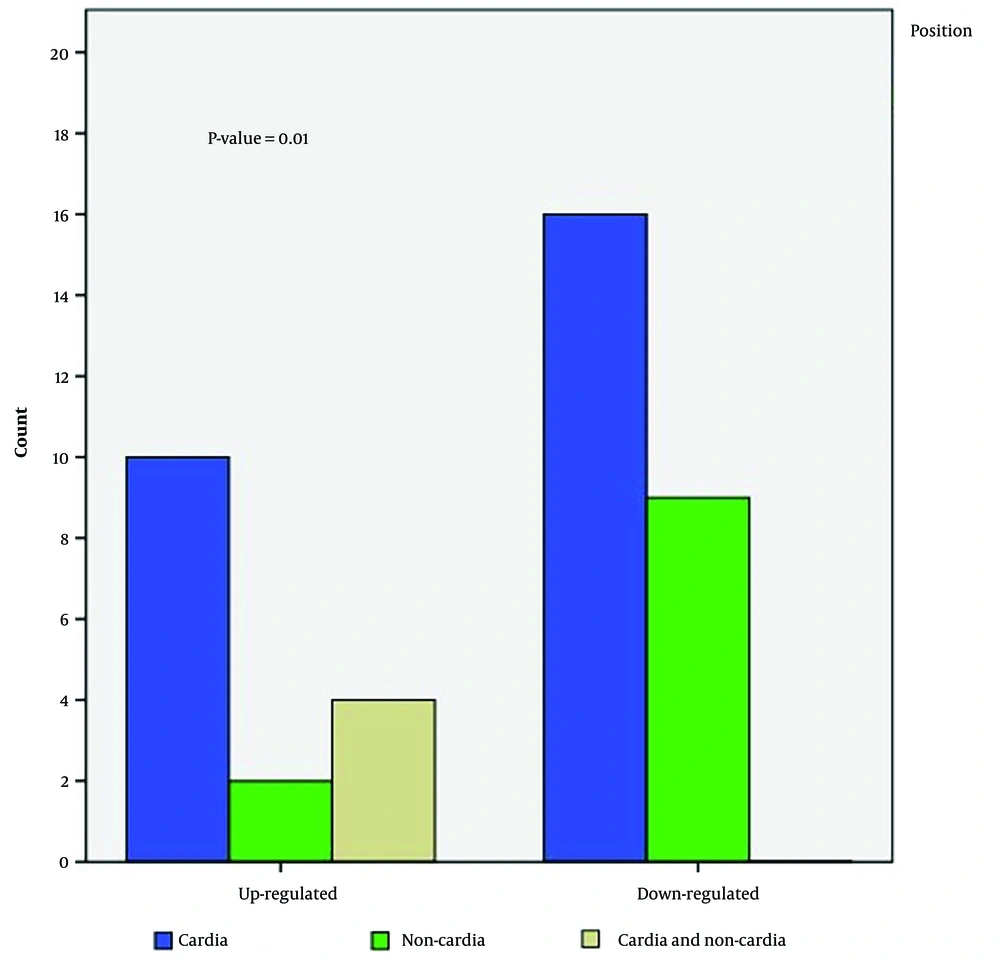
16). On the contrary, in our study, although LINC00659 was down-regulated in more GC samples than controls (expression ratio = 0.57), the difference did not reach statistical significance. After classifying patients into up- or down-regulation groups, a significant association was found between LINC00659 expression levels and tumor site (P < 0.05). No significant association between LINC00659 expression levels and GC risk is probably due to the sample size, which might not have been sufficient for the assessment. The differences between our findings and two recent studies can be due to the fact that many lncRNAs display both tumor suppressive and oncogenic functions (
24). Human populations are also genetically diverse, and SNPs in lncRNAs largely influence expression (
11). In addition, most samples originated from the cardia subsite (63.4%), which are largely different from non-cardia samples based on tumor features, distinct etiologies, and biological behaviors (
25). Thus, it can be expected that the mechanisms of lncRNA function in the process of carcinogenesis will be different. Further research involving a larger sample size that encompasses diverse geographic and ethnic groups within Iran is essential to enhance the validity of the findings. This will facilitate a deeper understanding of the functional mechanisms of LINC00659 in GC and elucidate its impact on cellular pathways and tumorigenesis.


![A and B, calculations of fold change (mean ± SE) in expression levels between the normal and tumor paired samples for all samples and for anatomical sites and histopathological types of the tumors. P-values for total, cardia gastric cancer (GC), non-cardia GC, cardia/non-cardia GC, intestinal- and diffuse-type GC [vs. adjacent non-cancerous tissue (ANCTs)] were 0.33, 0.43, 0.36, 0.74, 0.41, and 0.58, respectively.](https://brieflands.com/journals/jjcmb/articles/153640/figures/jjcmb-16-2-153640-i001-preview.webp "A and B, calculations of fold change (mean ± SE) in expression levels between the normal and tumor paired samples for all samples and for anatomical sites and histopathological types of the tumors. P-values for total, cardia gastric cancer (GC), non-cardia GC, cardia/non-cardia GC, intestinal- and diffuse-type GC [vs. adjacent non-cancerous tissue (ANCTs)] were 0.33, 0.43, 0.36, 0.74, 0.41, and 0.58, respectively.")