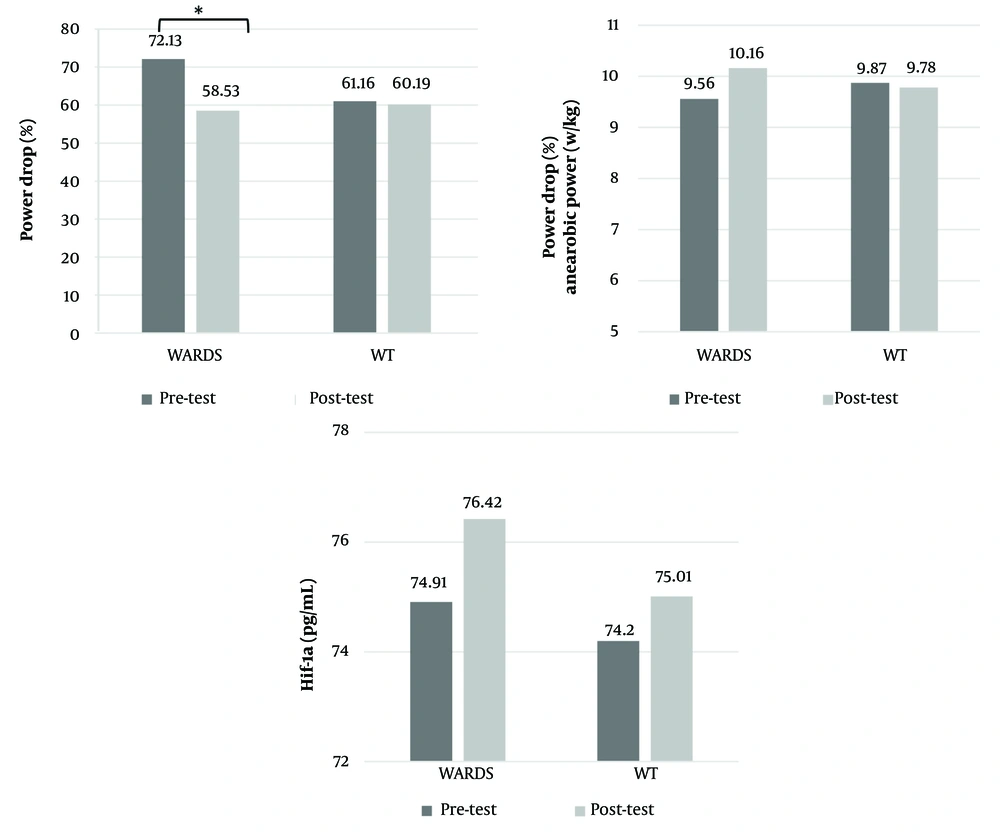
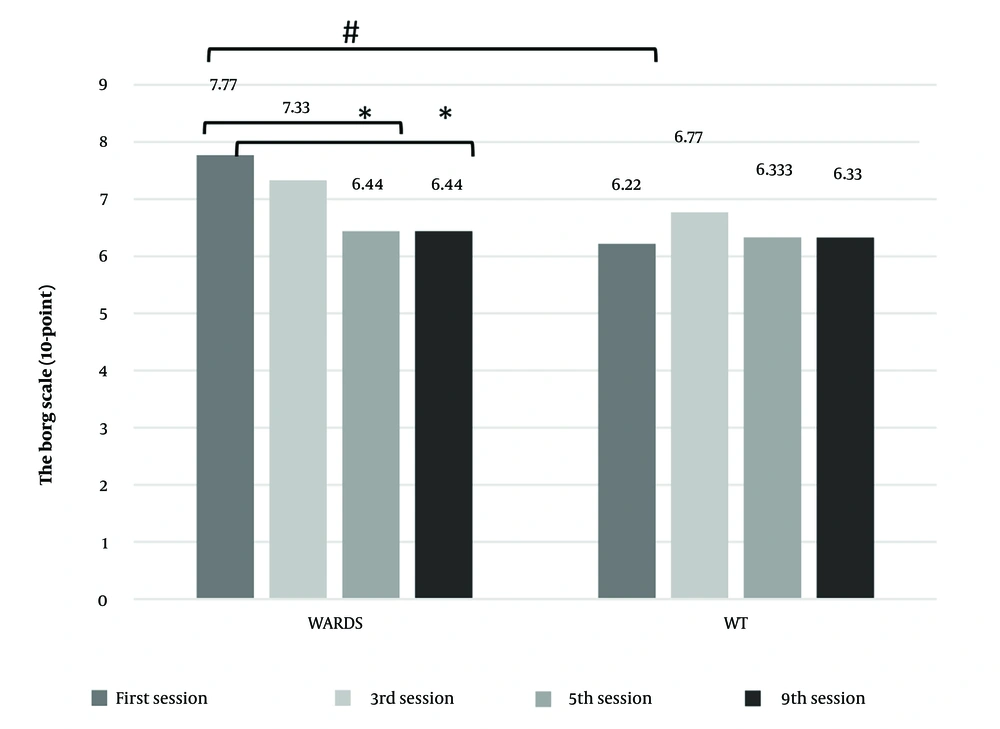
The aim of this study was to investigate the effect of weightlifting exercises with ARDS on buffering capacity, HIF-1α, anaerobic power, FI, and RPE in weightlifters. The results indicated that using added dead space in weightlifting exercises enhanced buffering capacity, resulting in a 1.97% increase in HIF-1α levels, a 5.9% increase in anaerobic power, and a 23.2% reduction in FI in the WARDS group. Additionally, the RPE Index during training sessions decreased in the WARDS group, showing no significant difference between the two training groups on the final training day. Athletes and coaches can adopt this low-cost and efficient training method to improve buffering capacity, enhance anaerobic power, and reduce fatigue.
The adaptations resulting from increased mean partial pressure of CO
2 during ARDS training and the elevated HCO
3⁻ concentration from the carbonic anhydrase reaction (
15-
17) contribute to delayed acidosis and improved buffering capacity (
18), which can further promote anaerobic metabolism (
10). La⁻, a potent signaling molecule, induces an increase in the HIF-1α factor (
13). In line with our study’s findings, implementing the ARDS training method caused a significant rise in La⁻ levels in the WARDS group, consistent with the 1.97% increase in HIF-1α levels in this group. Factors such as acute exercise, acidosis, oxidative stress, and heat have been shown to activate HIF-1α expression independently of hypoxia (
19). Additionally, La⁻ can increase HIF-1α levels even in the presence of oxygen (
13).
However, the results of our study contrast with those of Selfridge et al., who reported that increased CO
2 responses reduce HIF transcription activity and that low pH conditions facilitate the lysosomal degradation of HIF-α protein (
20).
The reason for this difference may lie in the fact that Selfridge et al. examined acute CO
2 exposure conditions, whereas in our study, participants trained under high CO
2 conditions for 10 weeks, and we measured the adaptations resulting from these conditions. Selfridge also suggested that the acidic pH conditions associated with high CO
2 exposure might deprive cells of nutrients, prompting a response in the form of lysosomal degradation of HIF-α protein (
20). However, with the observed increase in La⁻ and HCO
3⁻ levels in the WARDS group of our study, it seems that enhanced buffering capacity facilitated better H⁺ elimination, thereby preventing the reduction of HIF-1α.
Research has demonstrated that RPE is a valuable tool for prescribing exercise intensity (
21). Prescribing RPE-based training programs allows individuals to maintain exercise intensity within a predetermined RPE range, which is closely associated with objective physiological markers of intensity, such as heart rate, oxygen consumption, or blood La⁻ levels (
22). Numerous studies have reported a strong correlation between blood La⁻ and RPE during exercise (
23,
24). In our study, RPE levels showed significant differences between the two groups only in the initial training sessions, with no differences observed by the seventh and tenth weeks. This suggests that using a mask and tube during training was not perceived as more difficult by participants in the WARDS group. Furthermore, the WARDS group trained under higher CO
2 and La⁻ conditions with similar RPE levels and demonstrated superior results in buffering capacity, anaerobic power, and FI.
Our findings align with the results of studies by Danek et al. and López-Cabral et al. (
15,
25). In Danek et al.'s study, 11 active individuals performed six 10-second repetitions with four minutes of active recovery over four laboratory sessions. The work done in the mask group (4.4%) and the average HCO
3⁻ concentration (6.7%) were higher, with no difference in RPE between groups (
15). Similarly, López-Cabral’s study stated that reductions in RPE were associated with increases in La⁻ due to metabolic adaptations during resistance training (
25).
However, our results were inconsistent with findings by Miller et al. and Green et al. (
22,
26). Miller et al. reported that exogenous La⁻ intake during exercise did not affect RPE levels (
26). Additionally, Green et al.'s study found a negative correlation between La⁻ concentration and RPE during cycling exercise, where RPE levels were lower when La⁻ levels were highest (
22). In these studies, the exercise duration was much shorter than in our research, and the researchers focused on the immediate response of La⁻ to RPE. In contrast, our study examined the adaptations created over a prolonged training period, which are likely to influence the measured factors differently (
27). Players with higher anaerobic power and lower FI are capable of superior performance in high-intensity activities (
28). Researchers emphasize that elevated metabolic stress is a key factor in enhancing anaerobic power after training (
6). Improved buffering capacity, through increased bicarbonate and its role in compensating for the energy demands of the anaerobic system (
29), contributes to elevated La⁻ levels, as observed in this study. Alongside the rise in La⁻ levels, an increase in HIF-1α levels was also noted. Several studies have reported a specific relationship between HIF-1α levels and anaerobic power. It has been demonstrated that the distribution of HIF genotypes in strength and power athletes, such as weightlifters, sprinters, and short-distance swimmers, differs from the general population. Athletes with certain HIF alleles exhibit resistance to hypoxic conditions and possess enhanced glycolysis and angiogenesis capabilities, making them particularly adept at power sports (
12).
In studies conducted by Ahmetov et al. (
11) and Cieszczyk et al. (
12), a positive correlation was observed between the frequency of the HIF-1α allele in weightlifters and their level of success. The frequency of this allele was notably higher in athletes compared to the control group. In the present study, findings from the WARDS group compared to the WT group revealed that an increase in HIF-1α levels (1.97% vs. 1.07%) was accompanied by an increase in anaerobic power (5.9% vs. -0.9%) and a significant decrease in the FI (-23.2% vs. -1.6%).
Both the aforementioned studies involved a large number of athletes and non-athletes to address potential issues of population stratification and assessed HIF-1α distribution through DNA testing and biopsies. While the present study had a smaller sample size, it supports the findings of these larger studies, demonstrating similar trends and validating the relationship between HIF-1α levels, anaerobic power, and reduced fatigue.
5.1. Conclusions
Our study results demonstrated that employing the ARDS training strategy in weightlifting exercises enhanced buffering capacity and, through increased HIF-1α levels, improved anaerobic power while reducing FI, without elevating RPE. Trainers and athletes involved in anaerobic sports activities who aim to enhance performance efficiently and reduce fatigue can benefit from incorporating this training method.
However, our study had limitations. The small sample size introduces potential ambiguities, preventing a robust confirmation of the hypothesized relationship between a specific type of HIF-1α and anaerobic power. It is important to note that athletic performance is a multi-gene trait, and further exploration of other performance-related factors is warranted. Additionally, the findings of this study should be corroborated by future research involving longer durations, elite athletes, and female participants to provide a more comprehensive understanding of the impact of ARDS training on performance.