Multiple sclerosis (MS) is a chronic, inflammatory, autoimmune disease of the central nervous system (CNS) that impacts millions of people across the globe. The characteristic pathological hallmark of MS is the damage to the myelin sheath of nerve fibers in the brain and spinal cord (demyelination), which disrupts nerve signal transmission and causes a myriad of debilitating symptoms (
1). The pathogenesis of MS is a multifactorial, complex phenomenon resulting from the interaction between genetic predisposition and several environmental factors. Genetically, while MS is not a directly inherited condition, over 200 genetic variants, notably those in the human leukocyte antigen (HLA) region, have been found to be linked with a heightened risk of the disease. Nevertheless, scientific data confirm that these genetic factors are not adequate to trigger the disease, and that environmental factors have a fundamental role in its initiation and progression. Among the most incriminating of these factors are viral infections (notably the Epstein-Barr virus), low vitamin D levels resulting from lack of sun exposure, smoking, and obesity in adolescence (
2-
5). In this scenario, the gut microbiome has been recognized in recent years as an essential and significant environmental factor in the initiation and modulation of immune responses. The gut microbiome, which consists of trillions of microorganisms comprising bacteria, archaea, fungi, and viruses, plays a central role in the regulation of host immunity, metabolism, and communication with the CNS through the gut-brain axis (
6,
7).
Communication between the gut microbiome and the CNS occurs via a complex bidirectional network known as the gut–brain axis, which integrates neural, immune, and hormonal pathways (
8,
9). Dysbiosis, defined as an imbalance in microbial communities, has been identified as a common feature of numerous inflammatory and autoimmune disorders, including MS (
6,
10). Alterations in gut microbiota composition and function can transmit inflammatory and autoimmune signals to the CNS, potentially contributing to neuroinflammatory processes central to MS pathogenesis (
8,
11).
A key link between the gut microbiome and MS involves the activity of mucinolytic bacteria. Gut microbial communities can be categorized into distinct enterotypes based on dominant taxa. An enterotype represents a classification of human gut microbiota compositions based on the prevalent enrichment of specific bacterial genera within an individual's gut, largely independent of age, ethnicity, or geographical location. These stable microbial community structures, often dominated by bacterial groups such as
Bacteroides,
Prevotella, or
Ruminococcus (corresponding to Enterotypes 1, 2, and 3, respectively), dictate distinct metabolic activities and physiological impacts on the host. Enterotype 3, characterized by high abundances of mucin-degrading species such as
R.torques and
R. gnavus, exhibits a strong capacity to degrade mucin. By secreting glycosidase and sulfatase enzymes, these bacteria break down the intestinal mucus layer, which serves as the first physical barrier against luminal pathogens (
12-
15). Excessive mucin degradation results in thinning of the mucus layer, increased intestinal permeability, and translocation of inflammatory components into the bloodstream (
16). In contrast, species such as
Akkermansia muciniphila, while also mucin-degrading, exert protective effects by reinforcing the mucus barrier and reducing inflammation (
17,
18). This functional dichotomy underscores that both bacterial identity and mechanism of activity critically influence host outcomes (
19).
Damage to the mucin layer reduces the distance between luminal bacteria and intestinal epithelial cells, exposing epithelial cells to microbial-associated molecular patterns (MAMPs) such as lipopolysaccharide (LPS) (
20). This interaction activates inflammatory pathways via toll-like receptors (TLRs) and disrupts the integrity of epithelial tight junctions (
21-
23). The resulting increase in intestinal permeability enables microbial and inflammatory products to enter systemic circulation, thereby triggering immune activation and skewing the balance of regulatory (Treg) and pro-inflammatory (Th17) T cells toward inflammation. The dominance of Th17 cells enables their enhanced migration across the blood-brain barrier into the CNS. Once in the CNS, these Th17 cells secrete a repertoire of neurotoxic cytokines, including IL-17 and GM-CSF, directly fostering inflammation and inducing cytotoxic effects on oligodendrocytes. This sustained immune assault may lead to the destructive demyelination and axonal damage characteristic of MS pathogenesis. These events are directly implicated in the pathogenesis of MS (
24-
28).
The association between gut dysbiosis and MS is supported by multiple lines of human and preclinical evidence. Studies have demonstrated that MS patients exhibit higher abundances of mucinolytic bacteria, particularly Ruminococcus torques, and that these changes correlate with disease severity and progression (
29,
30). Elevated levels of biomarkers of intestinal permeability, such as zonulin and LPS, have been observed in MS patients. Furthermore, animal models—particularly experimental autoimmune encephalomyelitis (EAE)—have confirmed a causal role for the gut microbiome in initiating and modulating disease pathology (
27,
31-
34) .
If the central hypothesis regarding enterotype 3 and mucinolytic bacteria in MS pathogenesis is correct, it carries substantial diagnostic and therapeutic implications. From a diagnostic perspective, gut microbial profiling may serve as a predictive biomarker for identifying individuals at high risk (
35). Therapeutically, various interventions—including diets enriched with diverse prebiotic fibers, next-generation probiotics and postbiotics, fecal microbiota transplantation (FMT), and even the design of targeted drugs that inhibit key mucin-degrading enzymes—could restore gut barrier integrity and attenuate systemic inflammation (
36-
41).
Table 1 summarizes key research articles that provide the evidentiary basis for the proposed hypothesis. The selected studies build a sequential narrative, starting from the foundational concept of enterotypes, detailing the mechanism of mucin degradation by specific bacteria, providing human evidence for increased intestinal permeability in MS, and culminating in mechanistic studies that establish a causal link between the gut microbiome and neuroinflammation in animal models.
| Author (y) | Source Type | Population/Model | Key Findings Relevant to Hypothesis | Significance for the Proposed Hypothesis |
|---|
| Arumugam et al., 2011 (14) | Original research | Human microbiome data | Defined the concept of "enterotypes" as distinct clusters of gut microbial communities | Provides the foundational framework for categorizing gut microbiomes, including Enterotype 3 |
| Schaus et al., 2024 (12) | Original research | Biochemical and In vitro models | Identified Ruminococcus torques as a keystone degrader of intestinal mucin glycoproteins | Directly implicates the central bacterial actor of the hypothesis in its key destructive function |
| Desai et al., 2016 (19) | Original research | Gnotobiotic mouse models | Showed that a fiber-deprived microbiota switches to host-secreted mucus as a nutrient source, eroding the colonic mucus barrier | Provides a core mechanistic principle for how dysbiosis leads to mucus barrier degradation |
| Camara-Lemarroy et al., 2020 (33) | Original research | Human (MS patients) | Found that biomarkers of intestinal permeability (e.g., zonulin) were elevated in MS patients and associated with disease activity | Provides direct human evidence for the "leaky gut" component of the hypothesis in the context of MS |
| Mirza and Mao-Draayer, 2017 (32) | Review article | Synthesized MS literature | Summarized evidence for microbial translocation (passage of bacterial products like LPS) from the gut into systemic circulation in MS | Connects the breach in the gut barrier to the initiation of systemic inflammation |
| iMsms Consortium, 2022 (29) | Original research | Human (MS patients and paired controls) | Demonstrated significant alterations in the gut microbiome of MS patients, including changes in mucin-degrading bacteria, compared to healthy cohabiting controls | Offers powerful human evidence of gut dysbiosis in MS using a robust study design |
| Cekanaviciute et al., 2017 (27) | Original research | Human T-cells, mouse models (EAE) | Showed that gut bacteria from MS patients could modulate human T-cells in vitro and exacerbated disease when transplanted into germ-free mice | Provides the strongest evidence for a causal role of the MS-associated gut microbiome in disease pathogenesis |
| Lee et al., 2011 (34) | Original research | Mouse models (EAE) | Demonstrated that proinflammatory T-cell responses (Th1/Th17) directed against commensal gut microbiota are sufficient to promote EAE | Establishes the crucial immunological link between gut microbes and CNS-targeting autoimmune T-cell responses |
Abbreviations: MS, multiple sclerosis; LPS, lipopolysaccharide; EAE, experimental autoimmune encephalomyelitis.
The schematic diagram (
Figure 1) illustrates the sequential events linking gut dysbiosis, particularly associated with Enterotype 3, to the development of CNS demyelination in MS.
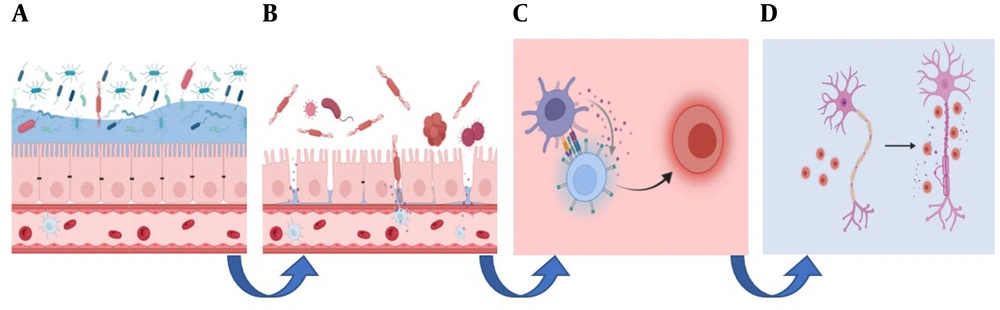
Proposed conceptual framework of gut dysbiosis-driven multiple sclerosis pathogenesis, with a focus on enterotype 3: A, healthy gut homeostasis and balanced microbiome: A depiction of a healthy intestinal lumen showing a diverse and balanced microbiota (represented by various green and blue bacterial species) predominantly residing within a thick, intact mucus layer (blue). Beneath the mucus, a monolayer of healthy intestinal epithelial cells (pink) with strong, intact tight junctions (black dots) forms a robust gut barrier. The lamina propria (red layer beneath epithelium) contains quiescent immune cells (light blue) and blood vessels (red); B, Enterotype 3-associated gut dysbiosis and compromised gut barrier: An altered gut environment characterized by a significant shift in microbial composition, with an overgrowth of pro-inflammatory bacteria (red and dark pink species), characteristic of Enterotype 3. This state leads to the degradation and thinning of the protective mucus layer, exposing the epithelial cells. Critically, the tight junctions between epithelial cells become compromised, allowing increased translocation of pathogenic bacteria and their byproducts (e.g., small blue dots representing bacterial components like LPS) into the lamina propria. Activated dendritic cells (star-shaped light blue cells) in the lamina propria take up these antigens, initiating an immune response; C, systemic immune activation and Th17 cell differentiation: Activated dendritic cells (dark purple, antigen-presenting cells) migrate to regional lymph nodes (not shown) where they present antigens to naive T cells (light blue). This interaction, along with co-stimulatory signals and inflammatory cytokines, drives the differentiation of naive T cells into activated pro-inflammatory T cells, notably Th17 cells (represented by the activated light blue cell releasing small purple inflammatory mediators); D, immune cell infiltration into the cns and demyelination: Activated pro-inflammatory T cells from the periphery migrate across the blood-brain barrier (emphasized in the accompanying text) into the CNS parenchyma. Within the CNS, these activated T cells (represented by the red-glowing cells) re-encounter cognate antigens presented by CNS resident cells (not shown) and launch an autoimmune attack against the myelin sheath (yellow/beige segments) of neurons (pink cells). This sustained immune assault results in demyelination, characterized by the destruction and loss of the myelin sheath around the axons (right neuron), leading to impaired neuronal function, a hallmark of MS pathogenesis.


