


1. Background
Cerebral palsy (CP) is the most widespread developmental movement disorder (1). Like all other children, children with CP need care. Due to mobility problems, developmental delays, and wide medical intervention, daily care of these children is more difficult than that of a normal child. Effective management of the child’s health problems and fulfilling the role of caregiver, which is more than daily life needs, is one of the main challenges that parent are encountering it (2). Most of these problems can lead to a considerable mental pressure on the children, their families, and caregivers. Mothers are usually the first caregivers of these children (3). Teaching the biomechanics to improve the correct posture and the safety of both caregiver and child is an important part of intervention in the care of child (4). The abovementioned problems and current deficiencies necessitate researching on teaching the correct methods of caring these children to help their mothers is felt. Up to this date, no experimental clinical research had been done in Iran.
2. Objectives
This study aimed to examine the effect of training correct methods in positioning and carrying the children with CP on the quality of life (QOL) of their mother.
3. Patients and Methods
In this randomized clinical trial, we recruited all the mothers of children with CP who were referred to the centers affiliated with Ahvaz Rehabilitation College. Samples were selected from available society and among people who were referred to this center. Having the least literacy level (fifth grade of the elementary school), certifying the diagnosis of the child’s CP by a specialist, and living in Ahvaz were the inclusion criteria. Mothers who did not attended at the training and evaluation sessions were excluded.
After the announcement of project’s purposes, 28 mothers entered the study. Eight of them did not met the eligibility criteria. Therefore, the final sample included 20 mothers. After the explanation of research goals and obtaining a written consent, they were randomly allocated to two groups of case and control. Each group included ten mothers. Before conducting the main evaluation, level of children’s gross motor function was evaluated by the Gross Motor Classification System (GMFCS).
A member of staff who was unaware of study protocol and intervention assigned to each group evaluated the participants. The case group was educated by means of slide projector and notebooks in two sessions with one-week interval. Slide projectors and notebooks consisted of pictures in various positions and were selected from books on the treatment of cerebral palsy and motor delay on Levitt (1), occupational therapy skills for physical dysfunction by Grangaard (5), early rehabilitation in people with CP by Dr. Yektamaram (6), and CP book by Bigham (7). The slides and the notebook taught mothers the correct biomechanical states while carrying and positioning these children in different environments, and mother and child’s correct positioning while the child was wearing clothes, eating, drinking, bathing, and resting. The validity of text and pictures were certified by the professors of Occupational Therapy Group of Rehabilitation College.
At the end of second training session, the forth author responded mother’s questions about presented text. Before the first training session, one week after second session, and four weeks after that, both groups were evaluated for QOL by means of a questionnaire consisting of 26 questions according to the QOL designed by world health organization that is named World Health Organization Quality Of Life - Brief (WHOQOL-BREF). This questionnaire was a summary of WHOQOL-100 one. The first and second questions concerned general QOL and public health; other questions concerned four fields of QOL: physical health, psychologic health, social communication, and environmental health. In each field, scores were between zero and 20, and the highest score showed the better QOL. This questionnaire was translated and validated in Iran, and its validity has been approved. Its reliability in intraclass correlation index was 0.77 in physical health, 0.77 in psychologic health, 0.75 in social communication, and 0.84 in environmental health fields. Cranach’s alpha test among these four fields was 0.77 for intervention group and 0.73 for control group. Distinctive validity of this questionnaire was shown with the score difference between healthy and sick people in various fields, which was confirmed by the significance of group index after removing the potential confounding factors by means of linear regression (8). GMFCS is a standard observational classification system, which classifies children with CP in five groups based on gross motor abilities, limitations on them, and need for assistive devices. It is profitable for children from birth to 12 years of age. Reliability and content validity of this instrument have been examined by Dehghan et al. Cochran test showed that the repetition of its Farsi text is not significant at the level of P < 0.05, which indicated the lack of distinction between testers (9).
Obtained data from this research were analyzed by means of SPSS 16 (SPSS Inc,. Chicago, IL, USA). In order to study the normal distribution of variables, we performed Kolmogorov-Smirnov test. For studying the mean difference of variables between case and control groups, an independent-samples t test was used. ANOVA was used for repetitive scales to study the mean difference of variable during three evaluation sessions. P value < 0.05 was considered as statistically significant level.
4. Results
The mean of mother’s age was 27.5 ± 6.4 years in the intervention group and 29.6 ± 5.5 years in the control group; mean of children’s age was 39.3 ± 25.1 and 45.9 ± 33.4 months in intervention and control groups, respectively. Children’ group consisted of nine males and 11 females. According to GMFCS scale, most of children in the intervention and control groups were classified as the level five and four, respectively. Mother’s demographic characteristics as well as children’s characteristics are presented in the Table 1. In both groups, no significant difference regarding basic characteristics of the mothers and children was found (P > 0.05). With respect to the mean difference between the first and third evaluation sessions, that there were significant differences between intervention and control groups in the fields of physical and psychologic health (P < 0.05); however, There was no significant difference between groups in fields of social communication and environmental health (Table 2). In the post hoc Tukey's test, differences between sessions as well as second and third ones were observed. Before the intervention, there was no significant difference between intervention and control groups in various fields of QOL (P > 0.05). After the intervention and in the follow-up evaluation, a significant difference was observed between two group in the fields of physical, psychologic, and environmental health (P < 0.05) (see Figures 1, 2, 4); however, in the field of social communication, no significant difference was observed between two groups (see Figure 3) (Table 3).
Table 1. Basic Characteristics of Mothers and Children with Cerebral Palsy in Study Groups
| Variable | Intervention Group | Control Group |
|---|---|---|
| Mother’s Age, y a | 27.5 ± 6.4 | 29.6 ± 5.5 |
| Educationa | ||
| Elementary | 4 ± 40 | 2 ± 20 |
| High School | 5 ± 50 | 2 ± 20 |
| Academic | 1 ± 10 | 0 ± 0 |
| Marital Status b | ||
| Good-Bad | 90-10 | 80-20 |
| Child’s Age, mo a | 39.3 ± 25.1 | 45.9 ± 33.4 |
| Child’s Gender | ||
| Female-Male | 40-60 | 50-50 |
| Cerebral Palsy Type c | ||
| Diplegia Spastic | 1 (10) | 3 (30) |
| Quadriplegia Spastic | 5 (50) | 3 (30) |
| Hypotonia | 2 (20) | 3 (30) |
| Athetosis | 2 (20) | 1 (10) |
| Child’s Weight, kg a | 9.6 ± 3 | 11.9 ± 6.4 |
| GMFCS c,d | ||
| II | 1 (10) | 1 (10) |
| III | 0 (0) | 2 (20) |
| IV | 3 (30) | 4 (40) |
| V | 6 (60) | 3 (30) |
a Data are presented as Mean ± SD.
b Data are presented as %.
c Data are presented as No. (%).
d Gross Motor Function Classification System.
Table 2. Scores of Different Fields of Quality of Life Scale and Significance Level of Scores' Difference Between First to Third Evaluation a
| Variable | Physical Health | Psychologic Health | Social Communication | Environmental Health | ||||
|---|---|---|---|---|---|---|---|---|
| Intervention | Control | Intervention | Control | Intervention | Control | Intervention | Control | |
| Before Training | 12.4 ± 1.6 | 12.5 ± 1.5 | 12.9 ± 1.3 | 13.3 ± 1 | 13.3 ± 6.7 | 13.1 ± 3.3 | 12.1 ± 1.8 | 11.1 ± 2.2 |
| After Training | 13.1 ± 1.8 | 11.4 ± 1.2 | 13.8 ± 1.4 | 12.1 ± 2.1 | 13.6 ± 2.8 | 11.7 ± 4.3 | 12.8 ± 1.9 | 10.5 ± 1.3 |
| Follow-up | 14.2 ± 2.2 | 11.3 ± 1.3 | 14 ± 1.5 | 11.7 ± 1.2 | 14.4 ± 2.9 | 11.5 ± 3.5 | 12.9 ± 2.4 | 10 ± 1.7 |
| P value | 0.002 | 0.033 | 0.044 | 0.009 | 0.560 | 0.375 | 0.271 | 0.206 |
a Data are presented as Mean ± SD.
Table 3. Scores of Different Fields of Quality of Life Scale in Study Groups a
| Variable | Before Training | After Training | Follow-Up |
|---|---|---|---|
| Physical Health | |||
| Intervention | 12.4 ± 1.6 | 13.1 ± 1.8 | 14.2 ± 2.2 |
| Control | 12.5 ± 1.5 | 11.4 ± 1.2 | 11.3 ± 1.3 |
| P value | 0.936 | 0.020 | 0.003 |
| Psychological Health | |||
| Case | 12.9 ± 1.3 | 13.8 ± 1.4 | 14 ± 1.5 |
| Control | 13.3 ± 1 | 12.1 ± 2.1 | 11.7 ± 1.2 |
| P value | 0.45 | 0.042 | 0.002 |
| Social Communication | |||
| Intervention | 13.6 ± 3.7 | 13.6 ± 2.8 | 14.4 ± 2.9 |
| Control | 13.1 ± 3.3 | 11.7 ± 4.3 | 11.5 ± 3.5 |
| P value | 0.802 | 0.261 | 0.056 |
| Environmental Health | |||
| Intervention | 12.1 ± 1.8 | 12.8 ± 1.9 | 12.9 ± 2.4 |
| Control | 11.1 ± 2.2 | 10.5 ± 1.3 | 10 ± 1.7 |
| P value | 0.276 | 0.005 | 0.007 |
a Data are presented as mean ± SD.
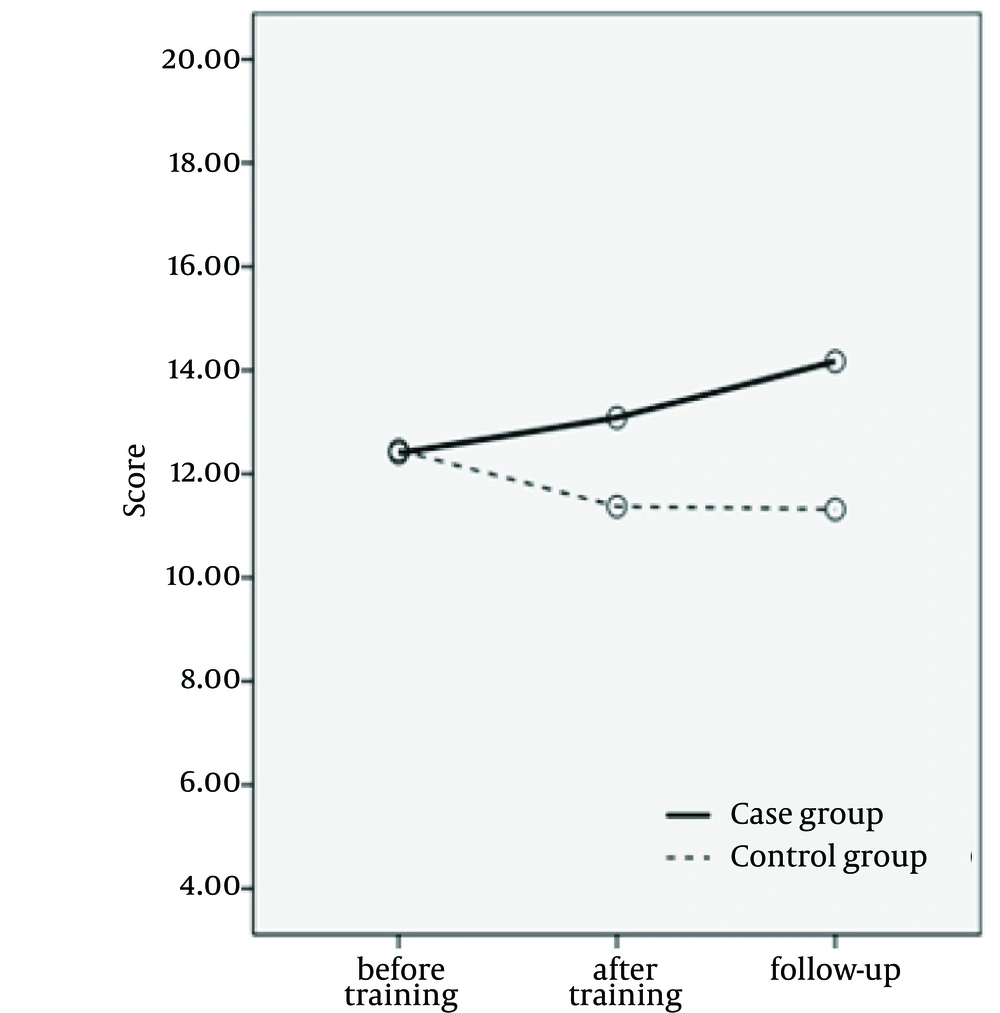
Figure 1.
Mean Score of Physical Health of Quality of Life Scale Between Intervention and Control Groups From First Through Third Evaluations
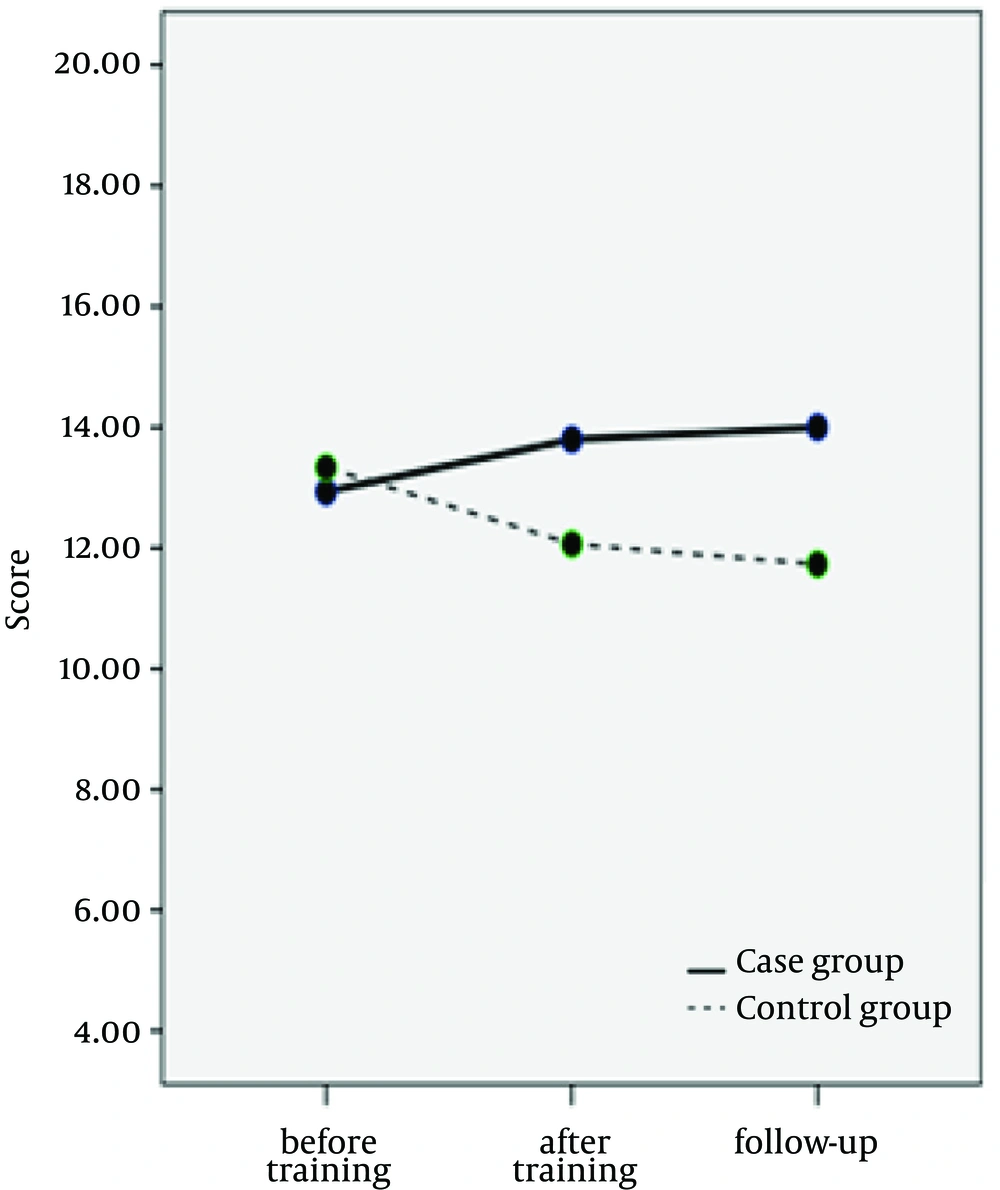
Figure 2.
Mean Score of Psychological Health of Quality of Life Scale Between Intervention and Control Groups From First Through Third Evaluations
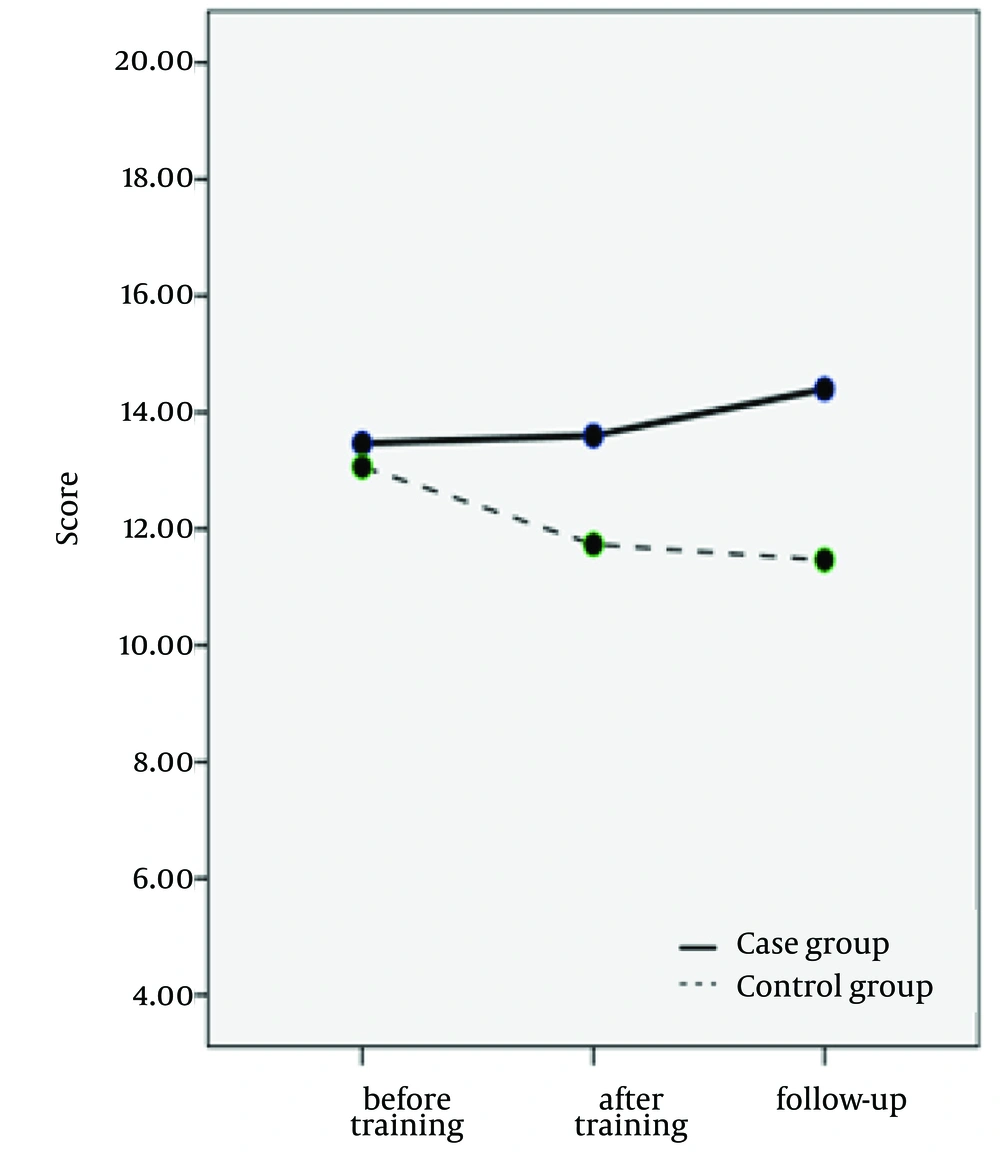
Figure 3.
Mean Score of Social Communication of Quality of Life Scale Between Intervention and Control Groups From First Through Third Evaluation
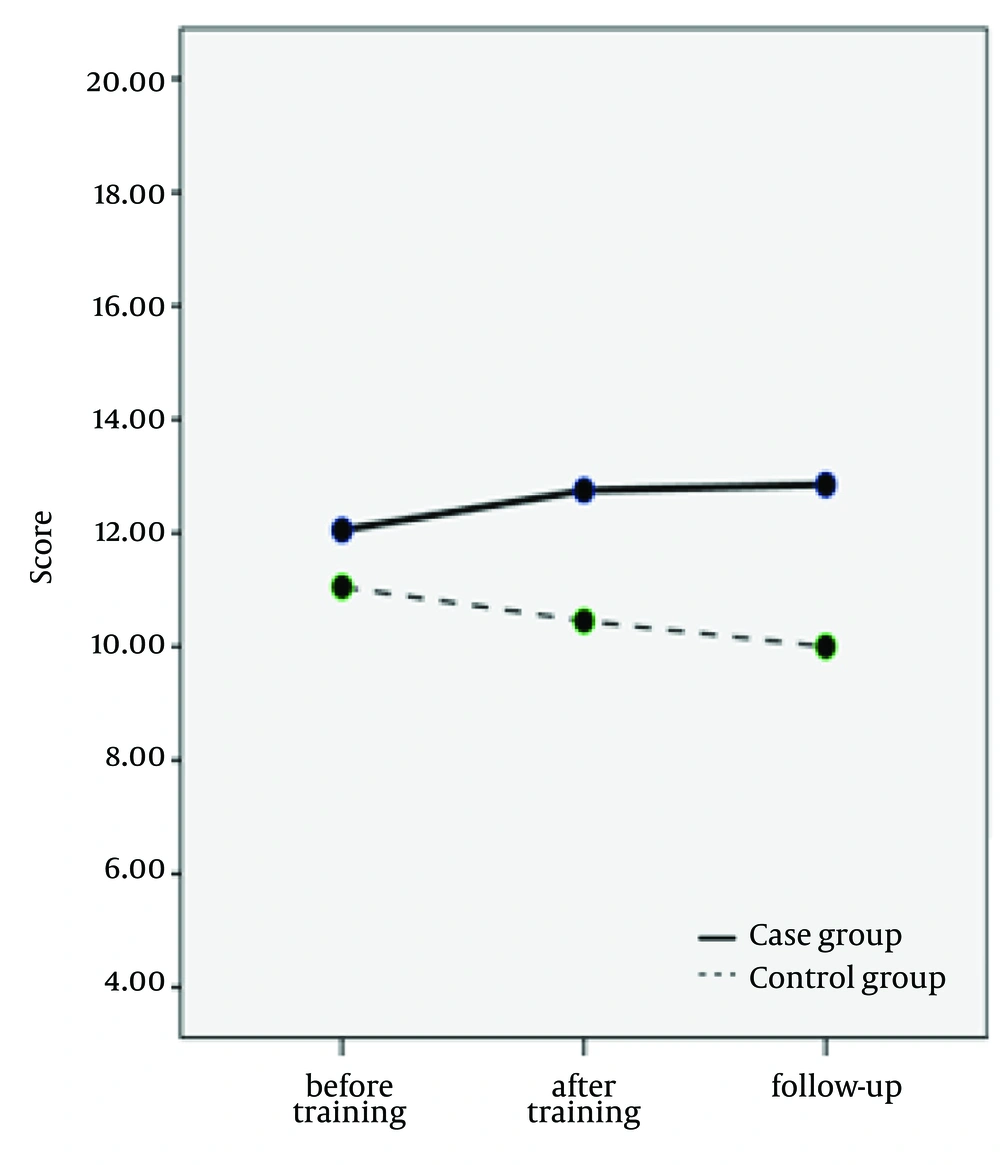
Figure 4.
Mean Score of Environmental Health of Quality of Life Scale Between Intervention and Control Groups From First Through Third Evaluation
5. Discussion
In the recent research, the significant difference in the fields of physical, psychologic, and environmental health was seen; however, social communication scale of QOL did not show any significant difference between study groups. We can conclude that the training of correct methods of child carrying and positioning can improve in the physical and mental health of mothers of children with CP. Although improvement of mothers’ physical performance was the purpose of provided education, we could see a significant improvement not only in both physical and mental health. The lack of observance of correct biomechanical principals in mothers might have resulted in musculoskeletal pains (10). On the other hand, these pains have affected mother’s psychologic performances due to the change of second link (musculoskeletal pains) after amendment to the first link (correct biomechanic) of series. In the field of child’s care, because this education had improved mothers’ self-confidence, we could expect a better psychologic health for mothers.
The effect of nutritional intervention on the caregiver’s QOL was examined in Sullivan et al. study. In the field of physical, psychologic, and environmental health, the effect of intervention was significant and in accordance with the results of current research (11). In another study, Prudent et al. examined the effect of using various types of rehabilitation interventions on the mothers’ QOL (12). Furthermore, in the Rodrigues Dos Santos et al. research, the effect of dental care on QOL of the caregivers looking after the children with CP (13). Results of these two studies were only similar to our results in the insignificant effects on social communication. In abovementioned researches, intervention in the children and results on caregivers were examined, but in our study, the intervention was directed toward mothers as the main child’s caregivers. This subject can be mentioned as one of the strong point of this research.
In a cohort study mothers of children with CP, Raina et al. observed that the adaptation of techniques with using the least energy for handling children could lead to a decrease in the level of mother’s depression (14). In the current research, training mothers in correct carrying and positioning methods had a significant effect on psychologic health. Although this training was only physical, it had positive effects on the care needs. The care factor is one of the effective factors on the health of the in capable children’s caregivers (15). Although this research was not directly about the environmental health, the interclass result showed a significant difference in that regard. Provided education to mothers not only affected mother’s physical health and increased mother’s knowledge of their child in this field, but also was based on principles of scientific books. Moreover, it could have a positive effect on the child’s health (8). This positive effect can partly increase the child’s independence and secondarily, increase the possibility of leisure activities for mothers. We might totally conclude the significant effect of training on this field. However, environmental health is a wide field and is connected to other factors such as sense of security, need for money, living conditions, and access to transportation facilities (8), any change of which can affect person’s understanding of environmental health.
Small numbers of educational sessions and failure of some families to present at these sessions at due time were the limitations of this research. Based on the obtained results, training mothers in correct ways of positioning and carrying the children with CP can affect most fields of their QOL. In the field of CP, the therapists and physician must pay more attention to educating and training families so that main caregivers of these children, who are mostly their mothers in our country, can experience a better QOL.
Finally, in future studies, researchers must consider some issues such as more educational sessions and holding a private practice session for each caregiver. Moreover, offering education for only one type of CP, presence or telephone follow-up, offering education to other members of family, and using the bigger samples or even in other disorders are suggested.


