


1. Context
Rheumatoid Arthritis (RA) is an autoimmune disease with unknown etiology, which involves the small joints of the hands and feet symmetrically (1). The exact cause of RA is unknown, but it is thought to be multi-factorial, with genetic predisposition and environmental factors. Symptoms of RA vary depending on the degree of inflammation and include: joint pain and stiffness, fatigue, anorexia, and low fever. RA can also manifest as a systemic autoimmune disease that affects the musculoskeletal, nervous, respiratory, cardiovascular, renal, and hematological systems (2). The prevalence of RA is 1% in the world and within 5-10 years of diagnosis, half of the patients with RA will be unable to work (3) and they may have difficulty to perform normal daily activities. Moreover, coincidence of the RA with physical disabilities and some other diseases leads to remarkable economic burden, reduced productivity, and deteriorated quality of life (QOL) (2). The QOL is defined as the perception of people about life, values, goals, standards, and interests (3, 4). The World Health Organization (WHO) also defines QOL as the way individuals perceive their own state within the framework of their culture and value systems that includes the objectives, expectations, standards and interests. In chronic diseases, increasing the QOL of the patient is as important as improving the medical status. Therefore, QOL measures are increasingly used for resource allocation and determination of treatment strategies (5). Also, studies indicated that QOL could be considered as one of the most important components of quality of medical and healthcare (6). According to the authors’ best knowledge, no systematic review studies are published in Iran on the importance of QOL in patients with RA.
2. Objectives
The current systematic review aimed to conclude and provide a general and clear view of the results obtained from previous studies to use in planning and interviewing the QOL improvement among patients with RA.
3. Data Sources
A systematic review was conducted on the published articles from 2000 to 2013 in three English and five Persian electronic databases: Science Direct, PubMed and Google scholar for English and Google scholar, IRAN DOC, SID, and MedLib in Persian. The combination of the following keywords was used as search strategy: QOL, RA, Iran and, their Persian equivalents.
4. Study Selection
The eligible criteria for selecting articles were quantitative or qualitative studies on the QOL of patients with RA in Iran. The articles published in English and Persian were included. Also, all articles published from 2000 to 2013 were included in this study to control and minimize the effect of time on the patients’ QOL due to the medical advancements, changes of patients’ knowledge and life styles. Articles that measured QOL only by qualitative methods without releasing conceptual framework to predict QOL, and the articles such as: letter to the editors, and articles presented in seminars and conferences without full text, or resulted from implemented interventions and animal studies were excluded. First, all articles were screened based on their titles and abstracts. Afterwards, retained articles were reviewed in depth. Then eligible references were identified by the mentioned criteria, and 10 articles were selected and evaluated.
5. Data Extraction
Finally, seven out of the ten articles had eligibility for quantitative analysis based on Forest plot (Figure 1). From each study, the author, year, location, number of participants, demographics, tools, and correlation/relationship of factors were extracted. The extracted data were analyzed quantitatively by Forest Plot Viewer and Microsoft Office Excel 2007. Summary results were presented as weighted mean with 95% confidence interval (CI). Forest Plot Viewer was used to create Forest plot, and the graphical display of individual study results. Data were collected from the reported means, standard deviations, and the number of patients in each study. Measures were provided as QOL index using 95% confidence intervals in Forest plot. Heterogeneity was assessed by I2 statistics by Excel 2007 software (7). To analyze qualitative factors affecting QOL, content analysis was done to code and combine main categories.
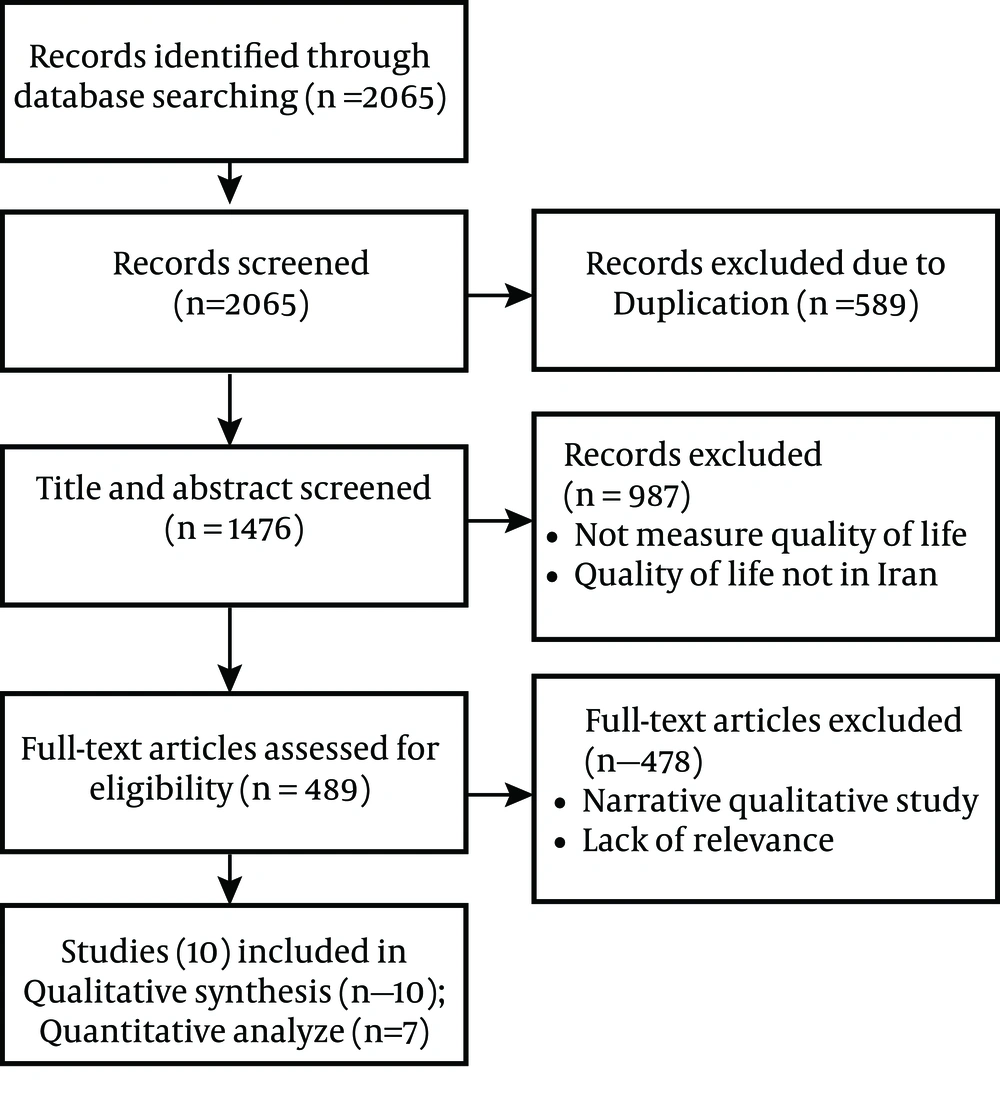
Figure 1.
Flowchart of the Literature Search
6. Results
Two thousand and sixty five articles were found in the searched references. After studying titles, abstracts, and full texts of articles, and excluding duplicated and irrelevant cases, 10 articles were selected and evaluated according to the objectives of the study, among which four had been published in English journals. Most of the studies (five cases) were conducted in Tehran. The Most of the studies had been conducted in 2009. In the 10 investigated articles, quality of life for 1812 subjects was evaluated; majority of the cases were female (69.84%). In the investigated articles, five different tools were used to evaluate the patients’ QOL in Iran. Short Form Health Survey (SF-36) questionnaire was often applied, with 5 times in this study.
6.1. Quality of Life Among Patients With Rheumatoid Arthritis
Six studies (8-13) that reported results of the QOL, met the inclusion criteria for assessment based on Forest plot. Total quality of life was 47.5. QOL score of three studies were lower than the mean. QOL score reported by Nadrian et al. (8) was 36.89 (95% CI; 34.18, 39.6), suggesting the improving aspect of Role Function in patients with RA; QOL score reported by Askary-Ashtiani et al. (10) was 36.63 (95% CI 35.7, 37.29), suggesting the improving aspect of Physical Role and General Health; and QOL score reported by Kalaly Jouneghani et al. (13) was 35.43 (95% CI 33.68, 37.16), suggesting the improving aspect of Function (Figure 2).
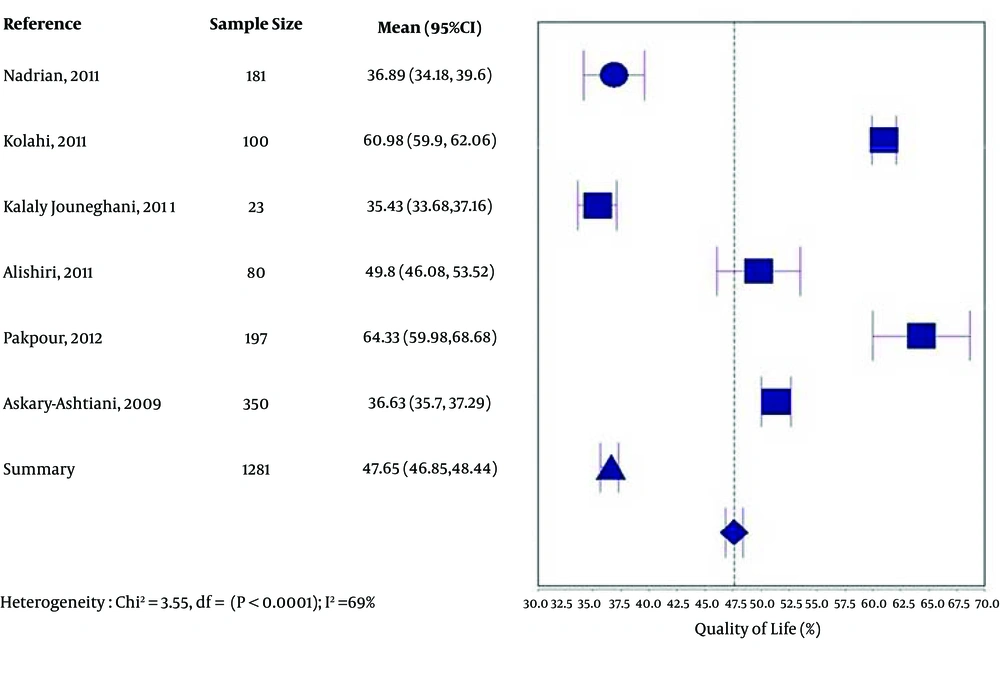
Figure 2.
Forest Plot for Studies Reporting Quality of Life Among Iranian Patients With Rheumatoid Arthritis
6.2. Factors Affecting Quality of Life
In the reviewed articles, different variables and factors were reported to affect QOL of the patients with RA (8-17). One of the most thoroughly studied factors is depression which appears to be a key factor affecting quality of life (14, 15, 17, 18). These studies consistently found that by increasing depression, significant decrease occurs in the patients’ QOL (Table 1). Demographic factors such as age, income, and occupational status are analyzed in most studies (14, 15, 17, 18) regarding their impacts on the QOL. For example, these studies indicated the existence of positive significant association between family income, educational status, and having an occupation with some aspects of QOL among patients with RA. No significant association was found between gender and QOL. Other Studies indicated that health status and enabling factors had a direct effect on QOL (8, 16). Self-care behaviors, predisposing, reinforcing and enabling factors had an indirect effect on QOL through health status. Health status, self-care behaviors, and enabling factors are more powerful predictors of QOL in patients with RA, respectively. In the current study, negative significant associations were found among complications of RA including: co-morbidity, pain, disease severity, body limitation, symptom, VAS (visual analogue scale) measures for pain, joint stiffness, and fatigue with QOL (P > 0.05) (9, 11, 12, 14, 15, 18).
Table 1. Effective Factors on Quality of Life Among Patients With Rheumatoid Arthritis
| Study | Year | Location | Sample Size | Demographics | QOL Assessment Tools | Correlation/ Relationship |
|---|---|---|---|---|---|---|
| Pakpour et al. (11) | 2013 | Qazvin | 197 | Mean ± SD of age:23.25 ± 4.98 years, Female: 79 % | SF-36 Questionnaire | Patients with at least one co-morbidity reported lower HR-QOL compared with those without any co-morbidity (P < 0.001) |
| Kolahi et al. (9) | 2011 | Tabriz | 100 | Mean ± SD of age: 45.6 ± 7.1 years, Female: 100% | SF-36 Questionnaire | Negative correlation between pain, mental, and physical health in subjects with RA (P < 0.001) |
| Kalaly Jouneghani et al. (13) | 2011 | Isfahan | 23 | Mean ± SD of age: 47.09 ± 6.1 years, Female: 100% | SF-36 Questionnaire | The relationship between aerobic exercises and QOL was significant (P < 0.001). The relationship between disease severity and QOL was insignificant |
| Alishiri et al. (12) | 2011 | Tehran | 80 | Mean ± SD of age: 43.20 ± 11.8 years, Female: 87.5% | SF-36 Questionnaire | Disease severity is associated with physical functioning scale, but not mental HR-QOL |
| Nadrian et al. (8) | 2011 | Yazd | 181 | Mean ± SD of age:45.54 ± 13.61 years, Female: 79 % | MOS-SF-20 AIMS2-SF Questionnaire | There is a significant relationship between QOL, health status and self-care behaviors in patients with RA (P < 0.01). Health status and self-care behaviors had75.8% of total QOL variance. Self-care behaviors had 31.1% of total health status variance, as well |
| Nadrian et al. (16) | 2009 | Yazd | 181 | Mean ± SD of age: 45.54 ± 13.61 years, Female : 79 % | MOS-SF-20 AIMS2-SF Questionnaire | There is a significant relationship between QOL and health status factors, enabling factors, self-care behaviors factors, predisposing factors and reinforcing factors (P < 0.001). |
| Askary-Ashtiani et al. (10) | 2009 | Tehran | 380 | Mean ± SD of age:57.8 ± 11.5 years, Female : 54.7% | SF-36 AIMS2-SF Questionnaire | Moderate to high relationship was found among body limitation, symptom, and VAS measures for pain, joint stiffness, and physician's global assessment (P < 0.01) |
| Monjamed and Razavian (14) | 2008 | Tehran | 190 | Range of age: 18< years, Female: 67.4% | QOL Questionnaire | Negative relationship was found between signs and symptoms such as pain severity, fatigue severity, anxiety, disability, depression severity and QoL. Age, marriage status, occupational status, number of children, family income, duration of disease, and physiotherapy are significantly associated with QOL (P < 0.001). No significant relationship was observed between gender, and physiotherapy and QOL (P > 0.05) |
| Razavian et al. (17) | 2009 | Tehran | 190 | Range of age: 18< years, Female: 67.4% | QoL Questionnaire | No significant relationship was observed between depression and QOL (P < 0.001). Significant relationship was found between age, marriage status, occupational status, number of children, family income, duration of disease, physiotherapy, and QOL (P < 0.001). Insignificant relationship was observed between gender, physical activity and QOL (P > 0.05) |
| Atapoor et al. (15) | 2002 | Kerman | 100 | Mean ± SD of age: 19-80 years, Female: 80% | HAQ questionnaire | Insignificant relationship was found between depression, age and complication (number of involved joints) of RA with disability (P < 0.001). Family income, educational status and occupation are associated with improving QOL aspects (P < 0.05). Insignificant relationship was observed between gender, duration of disease and residential status with disability |
7. Conclusions
It is important to note that, RA has a negative impact on QOL (19). In the current review, QOL score was relatively low for the Iranian patients. In the studies by Birtane et al. (20), Ranzolin et al. (21), and Tander et al. (5) QOL scores were 55.5, 54.4, and 55.5 respectively, which were compatible with that of the current study. Whereas, Lapsley et al. (22) in Brazil reported QOL score as 75.4; it seems that QOL had a little better situation in Brazil comparing the results of the other similar studies. QOL is a multidimensional concept which encompasses physical health, psychological status, level of independence, social relationships, and people’s relationships with salient features of their environment (11). The study by Kalaly Jouneghani et al. in Iran showed that aerobic exercises can improve the QOL (13). The studies by Razavian et al. in Iran (17) and Lee in South Korea (3) found that preventing the aggravation of functional disability is a crucial component to improve the health-related quality of life (HRQOL) of patients with RA. According to another study, depression and fatigue should be properly investigated and managed to improve HRQL (23). Prevalence of depression in patients with RA vary between 14% and 46%, and even in some studies the prevalence of depression is reported up to 65% (24). Some studies reported that depression is associated with reduced health status, as well as higher pain, fatigue, and reduced QOL (9, 21, 25). According to the present study, depression which appears to be a key factor affecting QOL should be prevented. Although controlling pain is an indication of successful treatment, despite the treatment, the majority of patients with RA have considerable amounts of pain (9). Severe pain could impede the individual’s work, daily activities and QOL (21). The studies by Ranzolin et al. (21), Kolahi et al. (9), and Monjamed et al. (18) indicated insignificant association between pain and QOL. The present study also confirms previous findings. Therefore, almost all of the drugs currently used to treat RA, such as anti-inflammatory drugs, disease-modifying anti-rheumatic drugs (DMARDs), and biological drugs, all target pain relief to a greater or lesser extent (9). In the Iranian studies, the age had a major influence on QOL. As expected, similar to the findings of other studies, older individuals had poorer health status than the younger ones (22, 26, 27). In the evaluated studies, some items such as high education, higher income, marriage, and occupation were reported as factors improving the patients’ QOL. The results of most studies in this field confirm these items (22). In the evaluated studies, there was insignificant association between gender and QOL among patients with RA. These findings were also supported by Bedi et al. (27) and Ranzolin et al. (21); whereas, the other studies (18, 22, 28) found the association between gender and QOL. It is important to note that, in all of these studies, female obtained lower scores than male in all domains of QOL (18). Many studies found fatigue as a major determinant for quality of life of patient with RA (9, 29). In the present study, fatigue, disease activity scores, and disease duration had negative significant association with QOL. Based on the other studies QOL among patients with RA is correlated with disease duration and disease activity scores (2, 18). Finally, the current study findings showed that health status and enabling factors had a direct effect on QOL. Self-care behaviors, predisposing, reinforcing and enabling factors had an indirect effect on QOL through health status. Health status, self-care behaviors, and enabling factors were more powerful predictors of QOL in patients with RA, respectively. Although self-care behaviors are weaker predictors of QOL than health status, but due to the strong association between self-care behaviors and health status it could be concluded that self-care behaviors indirectly and through health status affect QOL (17, 21, 27). The present study attempted to systematically summarize the findings of conducted studies on QOL among the patients with RA. The most important limitation of this study was different data collection and reporting methods used in the evaluated studies. Also, the evaluated studies may not reflect the QOL of all patients with RA in Iran, and further studies are needed. Despite these limitations, all of the articles were found through accurate and complete research. To improve the QOL, all health professionals should consider all dimensions of QOL, comprehensively. On the other hand, due to the interactive nature of these aspects, improving one aspect can lead to improvement in other aspects. Due to the chronic nature of RA, promoting QOL and adherence to therapies could be achieved through convincing the patients. Therefore, identification of the weak points and planning for them at all levels, individual to the community level, is suggested. Finally, it is important to note that improving QOL could be achieved through empowering patients by their participation in the service delivery process and decision making, and for this purpose, healthcare professionals should focus on self-care abilities of the patients and reinforcing them by training.
