1. Background
Menstruation in girls and women is accompanied by some symptoms and problems that are multidimensional that have diverse effects on physiological body systems (1). Premenstrual syndrome (PMS) is a group of physiologic and somatic symptoms related to the menstrual cycle (2). These symptoms occur during the luteal phase of the menstrual cycle when the plasma progesterone concentration is high (3) and resolved at the end of menstruation (2). The exact etiology of PMS remains unknown but there is some evidence that hormonal and neuroendocrine factors as possible causes of PMS symptoms (2).
According to epidemiological studies, the prevalence rate of PMS is high in Asia and low in Europe. France has the lowest prevalence of PMS among European countries and Iran has the highest prevalence among Asian countries (4).
The PMS treatments are divided into herbal (5), psychotropic (6, 7), hormonal, and surgical methods. Most women who suffer from severe PMS need psychotropic or hormonal treatments to control the symptoms (8). Some studies have shown that the fruit extract of vitex agnus castus is the only remedy to control irritability and mood disorders (9). Other studies that have used calcium, vitamin B6, and vitamin E also showed positive effects by controlling PMS symptoms (10-12). In a clinical trial study using high carbohydrate beverages in women suffering from PMS, anger and confusion symptoms were decreased after 90 - 180 minutes consumption (13). Additionally, a high starch diet and carbohydrate supplements showed a significant reduction of PMS symptoms (14, 15). In Zahedan (Iran), adolescent girls who suffer from PMS had low intakes of dairy products, fruits, and vegetables when compared with healthy girls (16).
An appropriate dietary pattern is necessary for a healthy lifestyle that could have positive effects on many aspects of life such as menstrual cycles in women. A study on dietary intakes could help nutritionist determine food patterns and their effect on some problems such as PMS symptoms in women. The Iranian food pyramid is an appropriate dietary pattern that was designed for Iranian adults (17) and by following the food pyramid guidance helps to improve overall health (18). No studies were found about the relationship between dietary patterns (according to food pyramid) and PMS emotional and physiological symptoms in Iranian women. An appropriate diet effects different aspects of life (19) such as a high prevalence of PMS in Iran, the effects of PMS on daily performance, economic and financial aspects of life. This study was designed to investigate the effects of food patterns on PMS symptoms female students at the Ahvaz Jundishapur University of Medical Sciences.
2. Objectives
This study evaluates food patterns among female university students who suffer from PMS and are healthy.
3. Materials and Methods
The Students Research Ethical Committee approved this cross-sectional study. The survey was performed on 100 students residing in dormitories at Ahvaz Jundishapur University of Medical Sciences in winter 2014 and an informed consent form was signed by all participants. Inclusion criteria were as follows: above 18 years of age, regular menstruation, and no genital diseases; and exclusion criteria were as follows: emotional or physical stress in past three months (such as a relative’s death or surgery), physical illness, any drug consumption (such as anti-depression, hormonal drugs, multivitamins, and mineral supplements), a history of mental disease, or using a special treatment for PMS. The diagnostic criteria of the American College of Obstetricians and Gynecologists were used to study the frequency and severity of PMS symptoms (20). Accordingly, a diagnosis of PMS may be made if symptoms include at least one of the somatic and affective symptoms. A questionnaire was used to evaluate five categorical models: mood and emotional symptoms; pain; fatigue and focus symptoms; gastrointestinal symptoms; and three other disorders acne, polyuria, and increased weight. Then each categorical model was scored separately. The score ranges (for each symptom model) were as follows: zero (never), 1 (mild), 2 (moderate), 3 (relatively severe), and 4 (severe). Additionally, the total score (all five categorical models) was determined for each participant. Three questions about age at menarche (the first menstruation), menstrual cycle period, and bleeding cycle days were asked from each student. In this survey, food patterns were evaluated by the food pyramid (designed by USDA food guide pyramid (18) and in accordance with the Iranian pyramid). The picture of the food pyramid was shown to female student and one serving of a different food groups was explained to them. Then they were asked to report their daily intake from each food group for the past three months. The food groups were as follows: milk and dairy products (yogurt, ice cream, and doogh); bread and grain products (rice and pasta); meat and beans; fruits; vegetables; and oils. At the end of the study, 86 participants filled all of the questionnaires completely, 14 students were eliminated from the study for incomplete questionnaires and poor corporation.
Data were analyzed by SPSS (ver 16). The quantitative variables were shown as mean ± standard deviation (SD). The Pearson correlation coefficient was used and a linear relationship was determined and shown by scatter plots to evaluate the relationship between the two variables. P values below 0.05 were considered significant.
4. Results
Fifty-six (65.1%) students who suffer from PMS and 30 (34.9%) healthy female students included 86 total participants for this study. The mean age ± SD of healthy students and those who suffer from PMS was 19.8 ± 1.4 and 19.5 ± 1.1, respectively. There were no significant differences between the PMS and the healthy groups for age. Table 1 shows the mean ± SD of score for each categorical model of symptoms (mood and emotional symptoms; pain; fatigue and focus; gastrointestinal symptoms; other disorders; and total symptoms). There were significant differences between students suffering from PMS and healthy students.
The mean (±SD) for age at menarche, menstrual cycle period, and bleeding cycle days was 13.3 ± 1.3 (years), 27.5 ± 3.5 (days), and 6.4 ± 1.5 (days), respectively. Figure 1 indicates age at menarche and menstrual cycle period relationship with scores of mood-emotional symptoms, pain, and gastrointestinal symptoms. The Pearson correlation test showed a significant negative relationship between mood-emotional symptoms and age at menarche (P = 0.034, r = -0.229; Figure 1A), which means the greater the age of first menstruation the less the mood-emotional score will be. A significant negative relationship between pain score and age at menarche showed a lower age for first menstruation which lead to more pain (P = 0.006, r = -0.297; Figure 1B). The Pearson correlation test showed negative relationship between menstruation cycle period and pain (P = 0.019, r = -0.252; Figure 1C). The statistical relationship between gastrointestinal disorders and age at menarche displayed a negative relationship (P = 0.013, r = -0.267; Figure 1D). The correlation test between total disorders and age at menarche showed negative relationship again (P = 0.007, r = -0.288; Figure 1E), which revealed more age of first menstruation that led to less total disorders.
The mean ± SD for serving intakes of different food groups were as follows: grain group: rice 4.8 ± 2.3, pasta 2 ± 2.05, bread 2.3 ± 1.5; dairy group: milk 0.5 ± 0.7, yogurt 0.6 ± 0.4, doogh 0.7 ± 0.3, ice cream 0.5 ± 0.8, cheese 0.6 ± 0.5; meat and beans group: meat 2.5 ± 0.9, beans 0.6 ± 0.5, egg 0.4 ± 0.5; fruit group: 1.1 ± 0.8, vegetable group: 0.6 ± 0.6; and oil group: 6.5 ± 3.4. Figure 2 displays the relationship between food intakes (according to the Iranian food pyramid) with the score of categorical models of symptoms. The negative relationship between milk servings intake and pain (P = 0.038, r = -0.224; Figure 2A) revealed that the more milk consumed led to less pain. A negative relationship was observed between total dairy products consumption and pain (P = 0.019, r = -0.253; Figure 2B). The score of other disorders revealed negative relationship with milk (P = 0.018, r= -0.254; Figure 2C), ice cream (P = 0.032, r = -0.231; Figure 2D), and total dairy products intake (P = 0.009, r = -0.281; Figure 2E). These results indicate that if intakes of milk, ice cream, or total dairy products were increased, then the other disorders (like acne or increased weight) were decreased. Total disorders displayed a negative relationship with total dairy products intake (P = 0.024, r = -0.243). Other food groups did not show any relationship with the categorical models of symptoms.
Table 1.
| Categorical Models of Symptoms | Scores | P Value c | |
|---|---|---|---|
| Healthy | PMS | ||
| Mood-emotional | 2.8 ± 2.7 | 6.8 ± 3.7 | < 0.001 |
| Pain | 2.9 ± 1.9 | 8.0 ± 4.0 | < 0.001 |
| Fatigue and focus | 2.7 ± 2.3 | 6.0 ± 3.2 | < 0.001 |
| Gastrointestinal | 0.6 ± 0.9 | 1.6 ± 1.5 | < 0.001 |
| Other disorders | 1.4 ± 1.5 | 3.2 ± 2.2 | < 0.001 |
| Total disorders | 10.4 ± 5.9 | 25.6 ± 10.7 | < 0.001 |
a Abbreviations: PMS, premenstrual syndrome.
b data are presented as mean ± SD.
c Independent t-test significance level < 0.05.
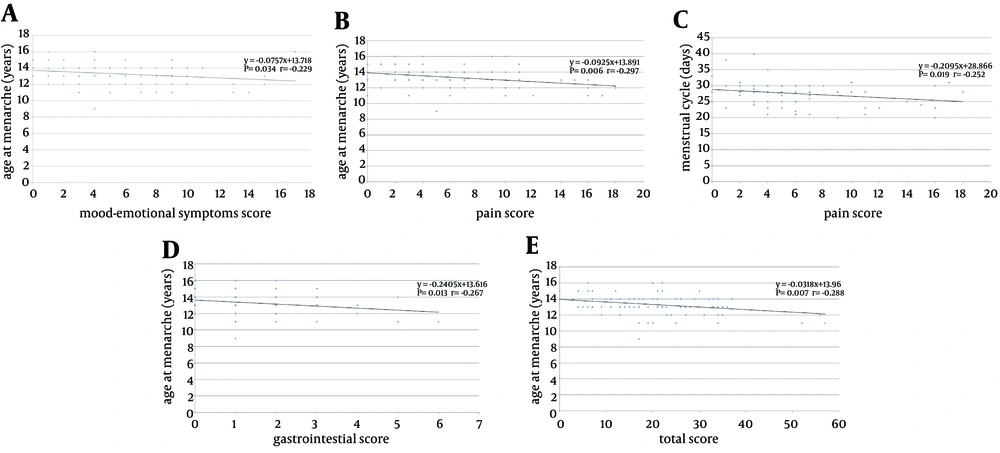
Figure 1.
A) The negative relationship between age at menarche and mood-emotional symptoms score, P = 0.034, r = -0.229. B) The negative relationship between age at menarche and pain score, P = 0.006, r = -0.297. C) The negative relationship between menstrual cycle (days) and pain score, P = 0.019, r = -0.252. D) The negative relationship between age at menarche and gastrointestinal symptoms score, P = 0.013, r = -0.267. E) The negative relationship between age at menarche and total symptoms score, P = 0.007, r = -0.288.
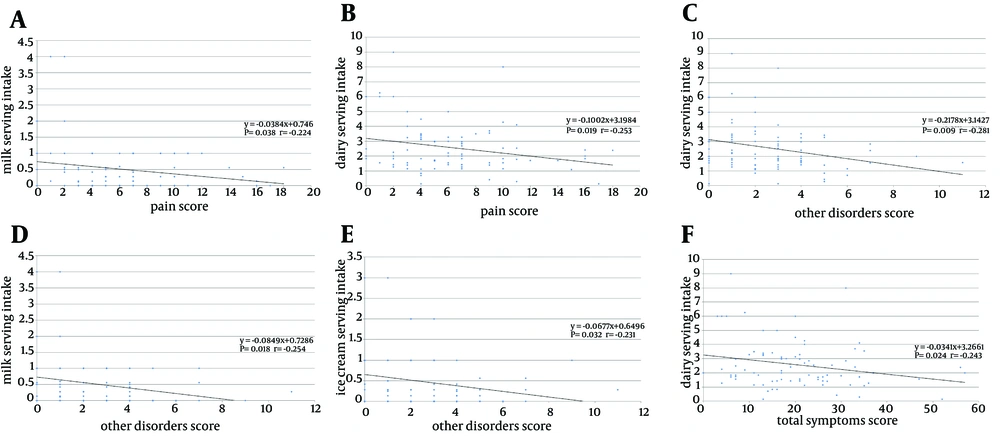
Figure 2.
A) The negative relationship between milk consumption and pain score, P = 0.038, r = -0.224. B) The negative relationship between total dairy consumption and pain score, P = 0.019, r = -0.253. C) The negative relationship between total dairy consumption and other disorders score, P = 0.009, r = -0.281. D) The negative relationship between milk consumption and other disorders score, P = 0.018, r = -0.254. E) The negative relationship between ice cream consumption and other disorders score, P = 0.032, r = -0.231. F) The negative relationship between total dairy consumption and total symptoms score, P = 0.024, r = -0.243.
5. Discussion
This survey shows a negative relationship among age at menarche and mood-emotional symptoms, pain, gastrointestinal, and total disorders. The participants in this study were older than 18, they remembered their age at menarche and reported it. In Taiwan, Liu et al. reported the age range at menarche 11 - 12 years old (79.1% of participants) (21). Our finding was closer to the mean age at menarche of Brazilian girls (13.65 ± 1.4) (22). Although the age at menarche for the university students in our research was higher than for females in Taiwan, the negative relationship between mood and emotional disorders and age at menarche needs further consideration. Accordingly, some studies revealed that an earlier menarche was associated with increased levels of depression (23-25). The important point is that emotional support (26, 27) for female first menstrual experiences (28). Many factors can affect age at menarche such as birth length and weight, social status, family income, and nutrition (29). Therefore, these factors will help females to experience menarche at the appropriate age and then reduce PMS disorders.
In this study, a negative relationship between pain and menstruation cycle period was observed. Severe pain is associated with increased levels of C-reactive protein (CRP) (30). Puder et al. have shown that 100% increases in high sensitive-CRP levels led to a 48% increases in total PMS symptom scores (31). Although we did not determine CRP levels in these female students, there might be the higher levels of CRP followed by more pain, which leads to fewer days in the menstrual cycle period.
In current study, no relationship was observed between bread and grain intake and PMS symptom scores. Mahmoudi et al. compared a high carbohydrate diet, carbohydrate supplements, and protein supplements to reduce symptoms of PMS and found that all interventions had the same reduction effect on the symptoms (14). In another study, participants consumed six high carbohydrate small meals per day for three months and the mood and physical symptoms of PMS decreased at the end of the third month (15). Recommended intakes of bread and grain products according to the Iranian food pyramid are 6 - 11 exchanges per day. The reason for any significant relationship between bread and grain product intake and PMS disorders is that the mean ± SD intake of this food group (9 ± 3.5 exchanges per day) was optimal. Hence, carbohydrate intake was optimal as well.
The interesting results of this survey were the negative relationship between dairy products and pain, other disorders (acne, increased weight, and polyuria) and total symptoms. Akhlaghi et al. used calcium tablets as a supplement for females suffering from PMS. Their results showed significant decreases in some somatic symptoms such as acne, increased weight, headache, joint pain, backache, and some mood-emotional disorders like irritability, depression, appetite changes, fatigue, and sleep disorders (10). Another study that used vitamin E and calcium supplements together showed a decrease of symptoms at the end of the intervention phase (12). Bakhshani indicated that dietary intake in adolescent girls was determined by the food frequency questionnaire. In these girls, dairy product intake led to decreased levels of PMS symptoms (16). Milk and dairy products are good sources of calcium, which explains our results for greater consumption of dairy products leading to a greater intake of calcium and, therefore, fewer symptoms of PMS.
In conclusion, it should be considered that menstruation is a complex problem. Factors affecting menstruation and cycle period are personal and environmental factors along with lifestyle (29). Dietary intake as an environmental factor needs more attention in girls, women during menstruation and optimal intake of foods specially milk, and dairy products (according to an appropriate food pattern like a food pyramid) could be effective against PMS symptoms.