


1. Background
According to anticipations, cardiovascular diseases, especially heart coronary disease and atherosclerosis, are the most common diseases in human societies (1). In the modern industrialized world, these lethal risks are results of inappropriate diet and physical inactivity (1).
Studying the factors that affect the development of cardiovascular diseases such as high blood pressure, increased low-density cholesterol lipoprotein, age, gender, smoking, glucose tolerance, elevated levels of some risk factors including fibrinogen, homocysteine, blood viscosity and changes in hemodynamic features, diabetes and physical inactivity play roles in its development and result in sudden deaths. On the other hand, research reports indicate that improvements in cardiovascular health indices such as high density lipoprotein (HDL), apolipoprotein (A-I) and lipoprotein lipase activity have a direct relationship with preventing cardiovascular diseases (2, 3).
The effect of exercise on the reduction of cardiovascular risk factors and increasing the above mentioned variables is also of general consensus. However, the effect of exercise on these indices depends on duration, intensity and type of physical activity (2-5).
Given the varied physical activities (aerobic, resistance and combined), different patterns and subjects are studied the effect of exercise on lipid profile. Previous studies emphasized that aerobic training leads to reduced blood pressure (6, 7) and serum triglyceride (TG), increased high-density lipoprotein (HDL), increased insulin sensitivity and glucose homeostasis (8). Regarding its relationship with heart attack, on the other hand, adjusting blood lipid level is considered as an important health factor (9). Studies show that the appropriate level of training reduces intra muscle triglyceride and stimulates lipoprotein lipase. Increased lipoprotein lipase activity leads to higher blood TG use which in turn reduces the risk of cardiovascular diseases (10). A study on the effect of pyramid exercises on some blood lipid factors in young males without exercise background showed no significant changes in plasma high-density lipoprotein and triglycerides while low-density lipoprotein and total cholesterol significantly decreased (4). However, there are few studies on resistance trainings, often reporting conflicting results. In a study examining the effect of mere weightlifting exercises and Ramadan fasting on lipid profile, glucose and plasma lipoprotein, it was found that a month of weightlifting exercises had no significant effects on these variables (5). As a model of physical activity, resistance trainings are used to prevent and treat diseases such as osteoporosis and postural disorders. Compared to aerobic activities, resistance trainings seem to have insignificant effects on lipid profile due to not increasingly affecting the heart beating and metabolism. Research on the impact of resistance trainings on cardiovascular risk factors indicated that they decrease low-density lipoprotein (LDL) and increase HDL (11). In contrast, another study showed that resistance trainings do not improve the lipid profile and HDL levels in people prone to cardiovascular diseases (12).
On the other hand, circuit trainings have received attention because of generating a mood similar to aerobic exercises. Ghanbari-Niaki et al., studied the effect of a session of circuit resistance exercise on lipid profile and serum lipoprotein in male students and reported a significant effect of HDL-c, but not other variables (13).
2. Objectives
Given the limited studies on the effect of short term resistance trainings on some factors such as blood fat and plasma lipoproteins, inconsistent results of the mentioned studies and studies on females for specific reasons, authors attempted to answer these questions: Are plasma HDL, LDL and very low density lipoprotein (VLDL) such as lipoprotein indices affected by short term resistance trainings? Are plasma total cholesterol (TC), TG and fasting blood sugar (FBS) such as lipid profile and blood glucose indices affected by short term resistance trainings? The results of the study can help a better understanding of a proper exercise training style to improve cardiovascular and metabolic conditions.
3. Methods
The research method was quasi- experimental with pre and post- test design, experimental and control groups. The study was approved by the research ethics committee of the Iranian sport sciences research institute, and conducted in accordance with the policy statement of the declaration of the Iranian ministry of health.
3.1. Variables and Information Collecting Method
Twenty female students volunteered through public call from the physical education field of the Shomal University. Inclusion and exclusion criteria of the study consisted of luteal phase of their menstrual cycle, not consuming caffeine, alcohol, cigarettes, tobacco and antioxidant supplements, no history of diseases affecting hematologic factors and use of anti-inflammatory drugs. The subjects had to have at least a 2-months background without resistance trainings. Three persons were excluded because of menstrual bleeding. Participants were selected in simple random sampling strategy and divided into two resistance training (n = 9) and control (n = 8) groups.
3.2. Training Protocol
Two weeks before the experiment, all subjects were taken to the training location in three non-continuous sessions to determine one repetition maximum (1RM) records and information on the experiment method. After the last session, subjects underwent a week of bed rest such that they were absent in their practical classes. Then, the main training sessions started (Figure 1).
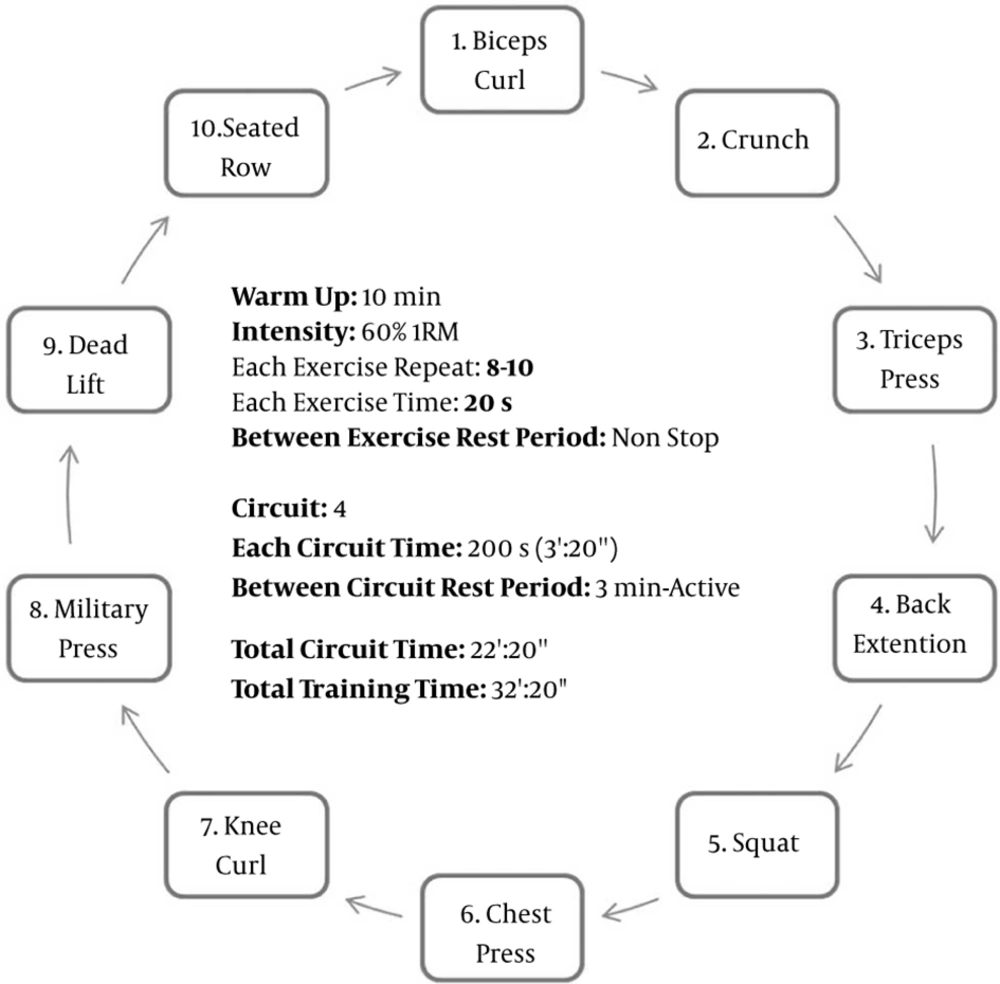
Figure 1.
Exercise Protocol of Each Session
3.3. Blood Sampling
24 hours before the first session and 24 hours after the seventh session, blood samples were collected by Venoject needles from subjects’ brachial veins while sitting in the laboratory and stored in vacuum bottles containing anticoagulant substance Furthermore, for coordinating pre-training nutritional conditions and its potential impact on the variables, the subjects were asked to overnight fast for at least 12 hours. All tests including fasting blood glucose, plasma triglyceride, and total cholesterol and plasma HDL-c measurements were performed using Iranian kits purchased from the MAN company according to the methods including glucose oxidase method; enzymatic method of lipoprotein lipase-glycerol kinase reaction and the enzymatic method of cholesterol esterase-cholesterol oxidase reaction and deposition method of phosphorus Tangsitic -magnesium chloride (Mgcl2). In addition, Friedewald et al. (16) equation was used to compute plasma LDL-c.
LDL-c = TC - (HDL-c + TG/5)
Based on the hemoglobin and hematocrit, blood plasma volume (PV) was calculated using the Dill and Costill (17) equation.
Blood Volumebefore (BVb) = 100 mL
Blood Volumeafter (BVa) = BVb × [Hemoglobinbefore (HGBb) / Hemoglobinafter (HGBa)
Red Cell Volumebefore (RCVb) = Hematocritbefore (HCTb)
RCVa = BVa × HCTa
Plasma Volumebefore (PVb) = [1 - (HCTb/100) × 100]
PVa = BVa - RCVa
3.4. Statistical Analysis
In order to use the appropriate parametric tests, the following were first verified: the assumptions of normality of data distribution, sphericity and equality of error variances by using one sample Kolmogorov-Smirnov test, Mauchly’s and Levene’s tests. ANOVA was used to determine the within group effects [(the effect of each dependent variable) and their interactive effect with the independent variable (the dependent variable × Group)] and the between group effects (comparison between the two experimental and control groups). All data were processed using SPSS software. Data were expressed as mean ± standard error of the mean. The significance level was set at P ≤ 0.05.
4. Results
General findings of the subjects are summarized in Table 1.
Table 1. Morphological Characteristic of Participants
| Variables | Groups | Mean ± SE | |
|---|---|---|---|
| 1 | Weight, kg | Training | 57.11 ± 2.57 |
| Control | 59.87 ± 3.18 | ||
| 2 | Height, cm | Training | 163.66 ± 1.87 |
| Control | 163.62 ± 2.14 | ||
| 3 | BMI, kg/m2 | Training | 21.26 ± 0.68 |
| Control | 22.26 ± 0.82 | ||
| 4 | HRrest, bit/min | Training | 75.33 ± 1.45 |
| Control | 76.50 ± 1.50 |
Abbreviations: BMI, body mass index; HRrest, resting heart rate.
For plasma volume, the effect of time (F = 5.77, P=0.03), group effect (F = 4.856, P = 0.044) and interactive effect of time × group (F = 21.369, P = 0.001) were significant (Figure 2A). In other words, given the significant reduction and insignificant change in training and control groups, respectively (the interactive effect of time × group), PV was significantly reduced in short term adaption to 7 sessions of circuit resistance training.
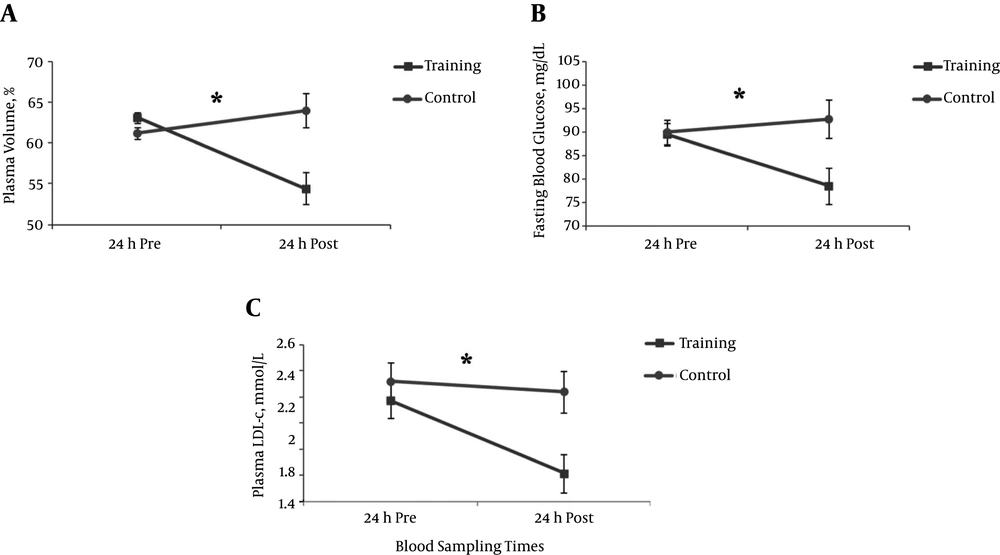
Figure 2.
LDL-c, low density lipoprotein-cholesterol. 24h Pre, 24 hours before beginning of Training; 24h Post, 24 hours after ending 7 sessions training; *, significant interaction effect of Group × Time at P < 0.05 (significant reduction in Training group with insignificant change in Control group).
For plasma glucose, the time effect (F = 1.694, P = 0.213) was insignificant but the group (F = 4.532, P = 0.05) and interactive effects of time × group (F = 21.369, P = 0.001) were significant as shown in Figure 2B. In other words, given the significant reduction and insignificant increases in training and control groups, respectively (the interactive effect of time × group), fasting blood glucose was significantly changed in short term adaption to 7 sessions of circuit resistance training.
For HDL-c, the effects of time (F = 0.067, P = 0.799), group (F=1.23, P = 0.285) and time × group (F = 4.762, P = 0.045) were insignificant as shown in Table 2. In other words, a short term of circuit resistance training had no significant effect on plasma HDL-c in female students.
For plasma LDL-c, the effects of time (F = 11.644, P = 0.004) and time × group (F = 6.68, P = 0.021) were significant but the group effect (F =0.013, P = 0.909) was insignificant (Figure 2C). In other words, given the significant reduction and insignificant change in training and control groups, respectively (the interactive effect of time × group), plasma LDL-c significantly reduced in short term adaption to 7 sessions of circuit resistance training.
For plasma VLDL-c, the effect of time (F = 1.107, P = 0.309), group (F = 0.188, P = 0.671) and time × group (F = 0.633, P = 0.439) were insignificant as shown in Table 2. In other words, 7 sessions of circuit resistance training had no significant effect on plasma VLDL-c in female students.
Table 2.Effect of 7 Consecutive Day of Circuit Resistance Training in Young Female College Student
| Variables | Groups | Mean ± SE | Within Groups Effecta | Between Groups Effectsb | ||
|---|---|---|---|---|---|---|
| 24 h Pre | 24 h Post | Time (F) | Time × Group (F) | Group (F) | ||
| HDL-c, mmol/L | Training | 1.183 ± 0.10 | 1.177 ± 0.06 | 0.003 | 0.001 | 4.312 |
| Control | 1.408 ± 0.11 | 1.406 ± 0.7 | ||||
| VLDL-c, Mg/dL | Training | 12.667 ± 1.31 | 15.27 ± 2.74 | 1.107 | 0.633 | 0.188 |
| Control | 15.00 ± 1.39 | 15.36 ± 2.9 | ||||
| TC, mmol/L | Training | 3.69 ± 0.19 | 3.32 ± 0.21 | 0.86 | 2.11 | 2.637 |
| Control | 3.71 ± 0.2 | 3.95 ± 0.22 | ||||
| TG, mmol/L | Training | 0.72 ± 0.07 | 0.78 ± 0.12 | 0.672 | 0.003 | 0.934 |
| Control | 0.85 ± 0.08 | 0.89 ± 0.13 | ||||
Abbreviations: HDL-c, high density lipoprotein-cholesterol; VLDL-c, very low density lipoprotein-cholesterol; TC, total cholesterol; TG, Triglycerides.
aThere is no significant within groups effect in the variables.
bThere is no significant between groups effects in the variables.
For plasma TC, the effect of time (F = 0.86, P = 0.774), group (F = 0.125, P = 2.637) and time × group (F = 2.11, P = 0.167) were insignificant as shown in Table 2. In other words, 7 sessions of circuit resistance training had no significant effect on plasma TC in female students.
For plasma TG, the effect of time (F = 0.672, P = 0.425), group (F = 0.934, P = 0.349) and time × group (F = 0.003, P = 0.958) were insignificant as shown in Table 2. In other words, 7 sessions of circuit resistance training had no significant effect on plasma TG in female students
5. Discussion
The present study showed that seven consecutive sessions of circuit resistance training did not significantly change HDL-c, VLDL-c, TC, and TG in female students but LDL-c plasma was significantly reduced in the experimental group. Zanetti et al. (2016) reported the nonlinear resistance training group had reduced the levels of TC, LDL-c, and TG, and the HDL-c level increased (18); But their study period was 12 weeks in people living with HIV. Ribeiro et al. (2016) after 8 weeks resistance training (traditional and pyramidal systems), a significant improvements were observed for TG, HDL-C, and LDL-C of older women in both systems (19) but the present research was conducted in 7 training sessions in young female student. In other study by Ribeiro et al. (2015) found that after 8 weeks resistance training in older women with differing levels of resistance training experience (novice and advanced) the TG, HDL-c, and LDL-c had a significant improvement in both group (20). Correa et al. (2014) reported no differences in lipid profile of TC, TG, HDL-c and LDL-c between higher and lower volumes of resistance training (21); their trial was one session. In examining the effect of leucine supplementation and resistance training (a type of scot) in three non-consecutive days on lipid profile, Nicastro et al. (2012) reported that resistance training only led in significantly increased HDL-c and had no significant effect on TC, TG, LDL -c dyslipidemia and VLDL-c in dyslipidemic rats by dexamethasone (22).
Tayebi et al. (2010) investigated the effect of weightlifting training and Ramadan fasting on lipid profile, glucose and plasma lipoproteins, and observed that a month of weightlifting training had no significant effect on these variables (5). In examining the effects of circuit resistance training (in three sets and only one session) in the present research method, Ghanbari-Niaki et al. (2007) reported a significant reduction in plasma LDL-c and VLDL-c in the recovery period (25 minutes after the training) and considered it independent of changes in plasma volume (23). The present study is also consistent with the latter one because seven consecutive sessions of circuit resistance training resulted in significant decreased plasma volume, which in turn should increase the LDL-c due to increased concentration in a certain unit of volume with a reduction in plasma volume. According to Ghanbari-Niaki et al. (2011), a significant increase in plasma TG and glucose was reported after a session of resistance training with intensities of 40%, 60%, and 80% but found that changes in HDL-c, LDL-c and TC were not significant (24).
On the other hand, Wagganer et al. (2015) reported that changes in blood lipids may result from cumulative effects over time than one training session because they found that three sessions of training led to higher increased HDL -c and reduced TG than one session, while LDL-c was repressed in one session (25). Mestek et al. (2006) also concluded that compared with a long session with the same amount of energy used, three consecutive short sessions had higher effects on transient increases of HDL-c (26). In this regard Ghanbari-Niaki et al. (2013) examined the effect of a month of pyramid trainings in young men without exercise on blood lipid factors and reported no significant changes in plasma HDL-c and TG while LDL-c and TC were significantly decreased (4).
The most common lipid abnormalities are elevated TG and reduced HDL-c, which the latter parameter is considered as a risk factor for cardiovascular disease. Despite, as an atherogenic factor, serum LDL-c particles increase with increased triglyceride.
According to researches, there is no clear effect of the volume of exercise on lipoproteins. It has also been shown that relatively high volume of regular exercise can substantially improve overall lipoprotein profile (27). The investigations showed that triglyceride levels are inversely associated with HDL-c levels. An overall view of the research on the effect of aerobic training on lipid profile shows that according to some researchers, exercise trainings rarely affect the levels of TC and LDL-c, unless they are accompanied by diet and weight loss (28). Examining the survey results shows no significant reduction in total cholesterol. Fat tissues have autonomic nerves and numerous capillaries. Therefore, all of their metabolic actions are mainly controlled by thyroidal, sexual and neural hormones and many of them are by physical activity. This could be one reason for unchanged cholesterol levels (28). In the present study, insignificant reduction in triglyceride level can be attributed to the lipoprotein lipase (LPL) response to exercise. LPL is an enzyme serving as the regulator of the lipoproteins and triglyceride breakdown in triglyceride-rich lipoproteins. However, studies have shown reduced and inhibited hepatic lipase (HL) enzyme as the result of regular exercise. Therefore, triglyceride making in LDL-c is reduced. It seems that longer training leads in decreased triglycerides (28). In the present study, HDL-c levels were not significantly different between among the groups. The researchers believed that HDL-c and LDL-c are hardly affected by training. The intensity and duration of training is not been enough to significantly change HDL-c in this study. The researchers showed that the change mechanism of HDL-c after training is complex. Enzymes such as LPL, HL and cholesterol ester transfer proteins (CETP) play a major role in changing HDL-c concentration. Through hydrolysis of plasma triglyceride, LPL is the most important factor in changed HDL-c concentrations. However, increased LPL activity is not responsible for increasing HDL-c immediately after training. HDL-c concentration increasing immediately after training may be related to lower levels of CETP activity. Responsible for lipid transporting in HDL-c molecule and other lipoproteins, CETP is decreased after training. Decreased CETP is a reason for slowing the HDL-c catabolism (increased half-life) and eventually increasing HDL-c concentration (28). In our study, LDL-c level was significantly reduced in the experimental group than in the control group. In terms of mechanisms involved in LDL-c reduction, it can be said that the lipid profile is greatly affected in persons with higher baseline level of TG or LDL-C or lower HDL-c. In the present study, the initial levels of their HDL-c, VLDL-c, TG and TC were within the normal range. This is probably the reason of insignificant changes in lipid indices (29). There seems to be a positive correlation between weight loss and exercise in lipid changes. In line with other studies, our study suggests that it may be necessary to further change body weight and fat percentage to observe significant effects on lipid profile after resistance training (29). In general, the results of this study suggested that circuit resistance training reduces plasma LDL-c, improves cardiovascular health and may possibly reduce related diseases.
The present study showed the significant reduction in blood glucose after 7 sessions of resistance training with moderate intensity. Resistance trainings are recommended as effective tools in the prevention and treatment of metabolic diseases (30). This is based on evidence suggesting that resistance trainings improve muscle mass and increases GLUT-4, protein kinase B and glycogen synthase (31). Ribeiro et al. (2016) observed a significant improvements for glucose of older women after 8 weeks resistance training in both traditional and pyramidal systems (19) Ribeiro et al. (2015) found that the glucose had a significant improvement after 8 weeks resistance training in older women with differing levels of resistance training experience (novice and advanced) (20). In a pilot research, Tibana et al. (2011) found that plasma glucose, triglyceride and HDL-c levels in obese/overweight women were not significantly changed after 8 weeks (24 sessions, 3 sessions per week) (each exercise 3 rounds and each round 8-12 iterations) (30). However, after 7 weeks of high-intensity-resistance-focused training, Russell et al. (2014) reported that the fasting glucose levels were reduced in people with a family history of diabetes and the matched control group (32).
In a meta-analysis, Cornelissen et al. (2011) found that dynamic resistance training (more than 4 weeks) in healthy adults (over 18 years) had no significant effect on TC, HDL-c, LDL-c and fasting blood glucose and significantly decreased plasma triglyceride (33). In a meta-analysis by Kelly and Kelly (2009), it was reported that progressive resistance training (more than 4 weeks) in men and older women (over 18 years) significantly improved TC, TC:HDL-c, and LDL-c with no effects on HDL-c (34).
5.1. Conclusion
In general, the results of this study indicate that moderate-intensity circuit resistance training for 7 consecutive sessions - lasting at least half an hour each- can reduce plasma LDL-c and fasting blood glucose, which are probably associated with improved cardiovascular/ metabolic health and reduced diseases. In this regard, using short-term circuit resistance training is recommended to enhance cardiovascular and metabolic health in girls.
