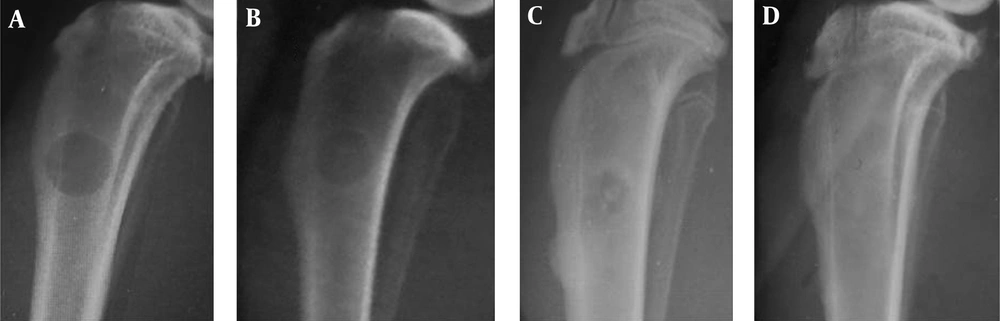
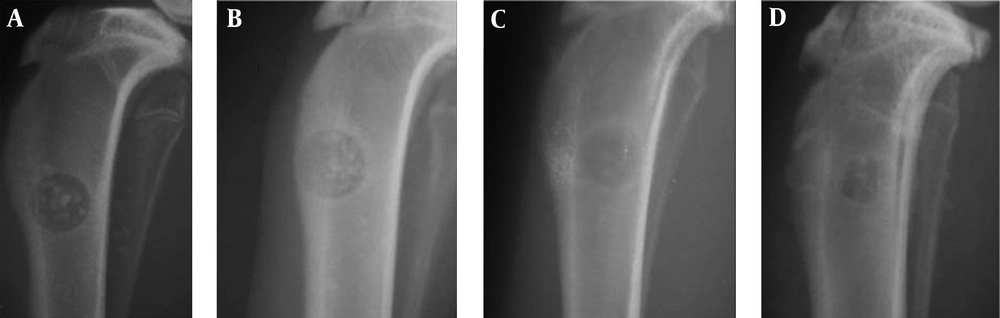
In this study the effect of DBM in combination with LIPUS treatment was investigated on tibial fracture healing in a rabbit model. Use of LIPUS for treatment of diseases was investigated in the last two decades and defined as an effective method in several studies (
12-
14). Due to hazardous effect of high intensity ultrasound (US) on osseous tissue and fracture healing, low intensity US was used in the present study (
15). The mechanism of LIPUS on fracture healing has not clearly been defined but the induced metabolic alteration causes a decrease in the treatment period, brings more comfort to patients and also increases volume of new bone formation. One of the possible mechanisms is the effect of LIPUS on BMP. Huang et al., in 2015 investigated the effect of LIPUS (30 mW/cm
2, 1.5 MHz, 1:4 duty cycle) on osteoblastic cell culture and showed an increase in expression of BMP2 (
16). Wijdicks et al. (2009) studied ultrasound effect on recombinant human BMP-2 in a rat model. They used absorbable collagen sponges loaded with 0-, 1-, 2.5- or 5-mg doses of rhBMP-2, which were implanted subcutaneously. Finally they found that, at two weeks, LIPUS had no effect on rhBMP-2-induced bone formation, but at four weeks, LIPUS increased bone volume in the 1-mg and in the 5-mg dose rhBMP-2–treated implants. Tissue density was reduced at both two and four weeks (
17). Other studies have confirmed US effect on BMP (
18,
19). Another explained mechanism is the effect of US on fracture healing by increasing TGF-β1, IGF, VEGF and FGF (
20-
22). Here we hypothesized that ultrasound therapy can affect the potency of osteogenesis with DBM. In this regards, we used an experimental rabbit model due to the similarity of rabbit bone structure to the human bone tissue (
23).
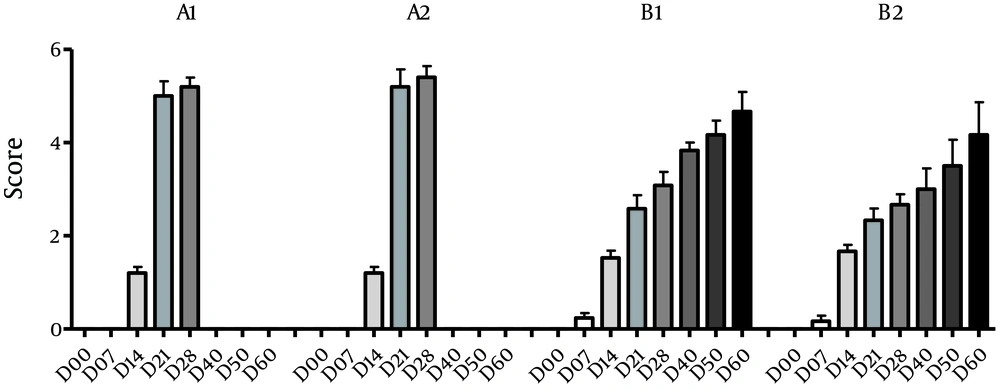
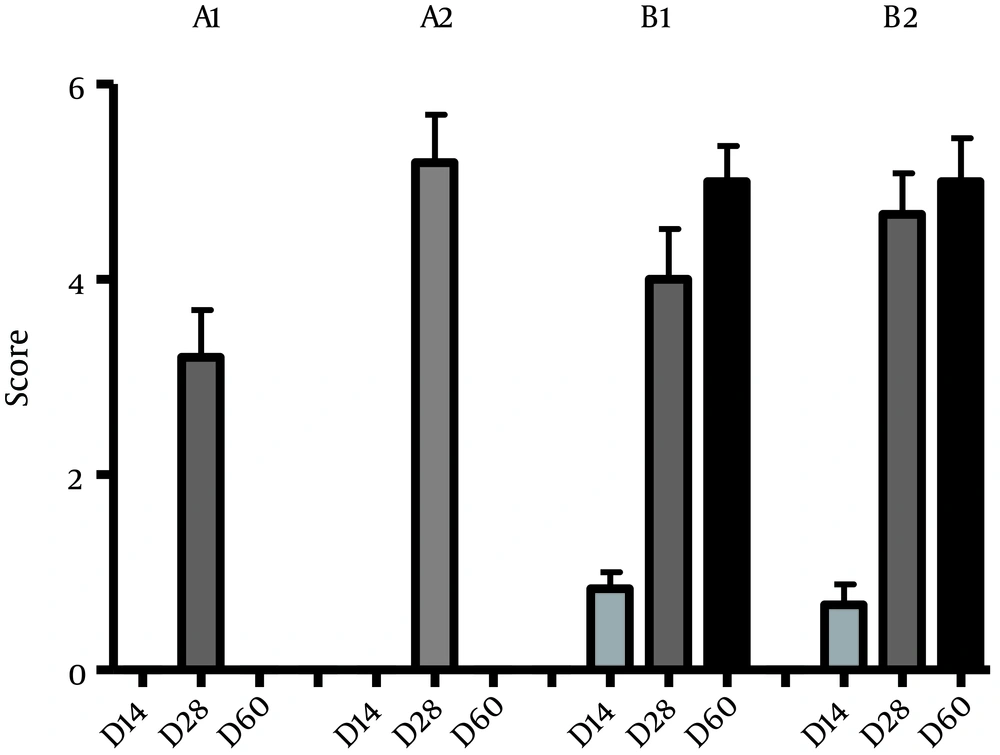
Results of the healing process in non-grafted group indicated the effectiveness of ultrasound on bone repair, which is in line with previous studies (
24,
25). Furthermore, the use of ultrasound in the DBM group with the profile of 1 MHz and intensity of 30 mW/cm
2 and 20 minutes/day scheme, caused a slight (non-significant) delay in the healing process. This finding is in contrast with studies that showed a positive effect of ultrasound on fracture healing and osseous implants (
12,
26). However, our results are similar with the findings of other researchers, who showed no effect for ultrasound on fracture healing such as Lubbert et al. (
27), Emami et al. (
28) and Handolin et al. (
29). The systemic effect of ultrasound can be counted as a possible explanation for the non-significant results in the treatment and control groups. In this regard, Tsai et al. studied osteotomy operation on fibular bone in rabbits and showed ultrasound therapy improves bone growth on the opposite side of the treated fracture. Chung et al. reported new bone formation on contralateral side (sham group) by using ultrasound therapy in osteotomy (
30-
32). On the other hand, many researchers have tried to consider the systemic effect of ultrasound on osteoporosis disease, yet their efforts have not been successful. This raises the question of why US has a different influence on fractured and intact bone. The possible explanation is different effect of ultrasound on bone fractures and intact bones in osteoporosis. In intact bones, US energy rapidly attenuates at the soft tissue–bone interface. Thus, the ultrasonic effect might only influence cells on the periosteal surface and in the outermost layers of the bone cortex. The integrity of the bone cortex is lost in fractured bone and the attenuated effect at the soft tissue-bone interface is reduced in these areas. Therefore, ultrasonic effects might have a greater opportunity to influence bone formation through the fracture gap of the bone (
33). For enhancing contralateral bone formation, growth factors may play an important role. Growth factors such as bone morphogenetic proteins (BMPs) and transforming growth factor (TGF)-β can regulate and stimulate bone formation. To investigate this hypothesis, further studies and measuring the BMP and TGF plasma level are required after treatment with ultrasound (
31).
In this study the DBM putty was used due to its ability in better filling of defects. A study by Kiely et al. showed no differences in bone strength between putty and powder forms of DBM (
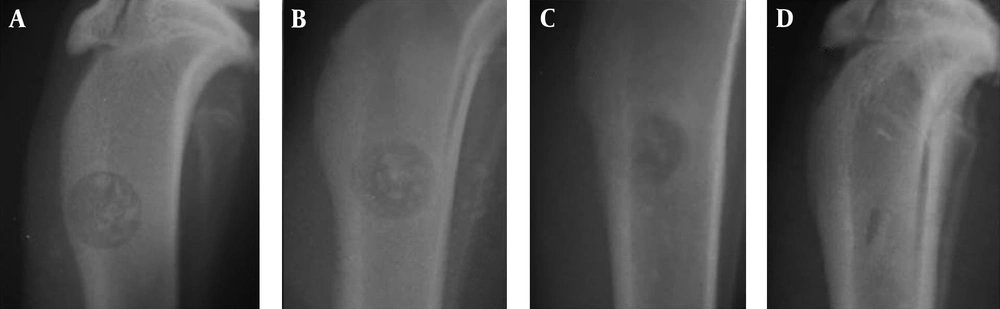
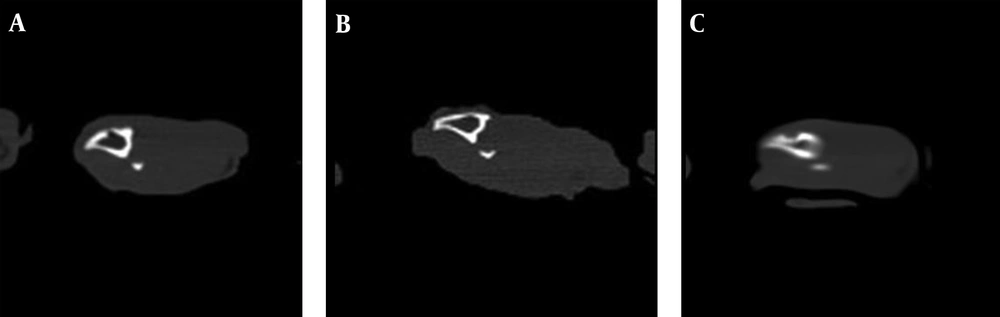
34). In radiographic and CT examinations, it has been shown that particles of DBM have remained in defect for a long time, which means a reduction in DBM absorption. Decreased osteoclast activity by low intensity pulsed ultrasound can be a reason for this observation (
35).
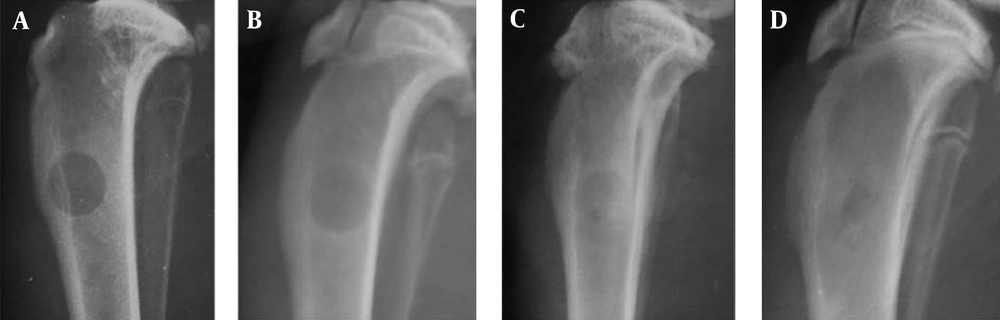
On the other hand, radiology results revealed that the rate of fracture healing in non-grafted group is higher than the DBM group on day 28. Pietrzak showed that BMP concentration could significantly effect osteogenesis potential of DBM (
36). In this study, BMP concentration was not defined in DBM, which can be counted as a limitation of the present study. After formulation and processing, osteoinduction potential of DBM was assessed by using standard intra-muscular implants to induce bone formation in a non-bony structure that had already been proven as an indicator for the presence of biologically active BMP (
37). Some studies have shown that a different concentration of BMP depends on the donor bone, such as age, gender and other factors (
38). However, Trainedes claimed that the processing method might cause different results from the DBM products (
39). Currently, there is no standard way to control power of induction of bone formation. There is no standard test to investigate the biological activity of these substances, which could assist us in explaining the differences of observations (
37).
This study also had some limitations including lack of biomechanical method to evaluate the power tolerance in fracture spot. Another issue was the lack of inactive ultrasound in contralateral side; in the ideal situation this group should be used as a placebo group.
5.1. Conclusion
Ultrasound waves with low intensity is effective in bone healing process and it can be used as a non-invasive and cheap method for fracture healing but we propose using bone implants with ultrasound due to delay in bone formation.