

1. Background
In recent years, chronic renal failure has had a growing trend and it has become an important issue due to its destructive role in causing various diseases and increasing mortality. Many people with this kind of failure undergo renal replacement therapy, namely dialysis, such that dialysis increases the amount of waste removed and enhances a patient’s longevity (1). Although dialysis reduces pain, it does not change the course of the disease and cannot be a complete replacement for a kidney (2). Given physical and mental complications of dialysis, patients undergoing this treatment experience poor quality of life (3). Quality of life refers to a person’s perception of his/her condition in life in the context of the cultural and value system in relation to his/her goals, dreams, and criteria. Accordingly, a proper definition of quality of life can be presented as a set of physical, mental, and social well-being perceived by a person (happiness, satisfaction, economic status, and educational opportunities). In other words, quality of life is a person’s level of enjoyment of and satisfaction with facilities she/he has in life. Health-related quality of life refers to physical, mental, and social aspects that are affected by a person’s experiences, beliefs, expectations, and perceptions (4). According to scientific consensus, the concept of quality of life includes the following four aspects:
1- Physical aspect consisting of power, energy, and ability to do various activities.
2- Mental aspect including anxiety, depression, and fear.
3- Social aspect in relation to family, friends, colleagues, and the society.
4- Symptoms associated with the disease or changes caused by its treatment including pain, nausea, and vomiting (5).
Quality of life can be greatly influenced by a patient’s mood, personality, and adaptability patterns (6). Psychological hardiness has an impact on quality of life (7). Among features of psychological hardiness, which are effective in aiding people to adapt themselves to stressful events, having a strong sense of curiosity, having the desire for gaining interesting and meaningful experiences, displaying self-assertion, being energetic, and considering a change as a normal part of life can be mentioned (8). Based on Brooks, hardiness has a direct correlation with physical and mental health and prevents the occurrence of physical and mental disorders (9). According to a study conducted by Zhang, components of psychological hardiness increase quality of life associated with the health of social relationships (10). Psychological hardiness includes a number of personality traits, which are the source of resistance against the pressures of life. These traits, including having a strong sense of curiosity, having the desire for gaining meaningful experiences, considering mental imaginary as something effective, regarding a change as a normal part of life, considering each stimulus as a reason to grow and develop, and showing self-assertion, strengths, and endurance, play key roles in aiding people to adapt themselves to stressful events. The reason for choosing these features is that having such features leads people to have optimistic cognitive assessments, which make it possible for them to understand the meaning of difficulty. Thus, hard difficulties seem more tolerable. Indeed, psychological hardiness is the result of a harmonious action of three components of control, challenge, and commitment. Control reflects the amount of mastery a person feels over high-pressure factors. When a person has a high control over his/her life, he/she considers life events predictable and believes that the surrounding environment can be affected by his/her attempts. Challenge refers to the fact that the occurrence of change is not considered as a threat but it is rather regarded as an inspiration, which leads to progress and growth. In this regard, by promoting flexibility and acceptability, challenge brings together inconsistent incidents with normal life events. As a result, it aids people to have a desirable assessment. Commitment is the third component, which demonstrates a belief system that makes people perceive a threat caused by difficult issues at the very least. In other words, commitment lays an emphasis on this belief that all life activities are important, interesting, meaningful, and valuable (11). Naderi and Hosseini showed that psychological hardiness and hope for the future were significantly and directly correlated (12). Hope refers to a person’s goals accompanied with motivations to move towards those goals (agency thinking) and ways to achieve the considered goals (pathways thinking) (13). Hope is essential to all aspects of life. Hope can be regarded as a belief to have a better feeling in the future, which, due to its power of simulating a person’s activities, leads him/her to gain new experiences and shapes the desire for having such new experiences in that person (14). Groopman defined hope as a sensation created when a person expects a better future (15). In other words, hope is an active feature that includes having a goal, having the ability to plan for achieving it, paying attention to obstacles, which prevent a person from achieving the goal and eliminating such obstacles (16). In their study, Ghazalseiflou and Esbati indicated that conducting hope-oriented group therapy was effective in improving quality of life among HIV+ male patients (17). In another study, Mashiach-Eizenberg et al. (18) demonstrated that hope had a positive impact on quality of life among patients with multiple mental illnesses.
According to what was mentioned earlier, it seems that psychological hardiness and hope can play key roles in dialysis patients’ quality of life. Therefore, the authors sought to answer the following question: Do components of psychological hardiness and hope play predictive roles in quality of life among dialysis patients in Zabol?
2. Methods
2.1. Research Methods, Statistical Population, and Sample
This descriptive study was followed by a correlational-predictive design. The statistical population included all dialysis patients in Zabol, Sistan and Baluchestan province. Of this population, 66 patients were selected as the sample among the people referred to hospitals in Zabol using the convenience sampling method.
2.2. Questionnaires
Data collection tools in this study were the Kobasa psychological hardiness questionnaire, the Snyder hope scale, and the World Health Organization quality of life assessment.
2.2.1. The Kobasa Psychological Hardiness Questionnaire
This questionnaire was developed by Kobasa in 1988 to evaluate psychological hardiness. It includes 50 items scored based on a 3-point Likert-type scale ranging from 0 (completely false) to 3 (completely true). Items 6 to 21 and 28 to 50 are scored diversely. Psychological hardiness has three subscales of commitment, control, and challenge. Its internal validity was obtained as 53.317 using Bartlett’s Chi-Square test, which was a desirable validity (11). Moreover, correlations of this questionnaire with Beck depression scale and general health questionnaire were examined. Its correlations with the Beck depression scale and the general health questionnaire were -0.73 and -0.59, respectively (11). In Iran, the reliability of this questionnaire was evaluated by Ghorbani in 1994. In this study, the author indicated that correlation coefficient of control, commitment, and challenge were 0.70, 0.52, and 0.52, respectively. Moreover, the correlation coefficient of the whole scale was 0.75, which indicated its desirable reliability.
2.2.2. The Snyder Hope Scale
This self-report scale includes 12 items. Among these items, four items measure agency thinking, four items evaluate pathways thinking, and the other four items are deviant items. This scale includes two main subscales, i.e. agency thinking and pathways thinking. A subject should answer the items based on an 8-point Likert-type scale (1 = totally disagree to 8 = totally agree). Its minimum score is 8 and its maximum score is 64. Several studies were carried out to examine the reliability and validity of this scale and they confirmed its validity and reliability. The internal consistency of the whole scale ranged from 0.74 to 0.84 and its reliability was 0.8. Additionally, its reliability evaluated using a test-retest method in periods of 8 to 10 weeks was even higher than 0.8 (13). The internal consistency of agency thinking ranged from 0.71 to 0.76 and the internal consistency of pathways thinking ranged from 0.63 to 0.8. In addition, Snyder (16) provided several data related to the concurrent validity of this scale with variables, which it can predict. For example, this scale was correlated with questionnaires on optimism, expectations of achievement, and self-esteem; these correlations ranged from 0.5 to 0.6 (16).
2.2.3. The Quality of Life Assessment
This assessment tool was developed by the World Health Organization to assess people’s quality of life and it includes 26 items. Among these items, the first 2 items measure levels of quality of life and people’s general health and the other 24 items examine 4 subscales of physical health, mental health, social health, and environmental health. A subject should answer the items based on a 5-point Likert-type scale. To obtain a score related to each subscale, scores related to items associated to subscales should be added together and the obtained score should be divided by the number of items. In this regard, the score related to each subscale can be calculated. Answers to items vary from totally true (5) to totally false (1). However, items 3, 4, and 26 are scored diversely. In Iran, this assessment tool was standardized by Nejat et al. (19) in 2006 and Cronbach’s alpha coefficients of physical health, mental health, social health, and environmental health were obtained 0.70, 0.73, 0.55, and 0.72, respectively. In a study carried out by Rahimaghaei et al. the reliability of this assessment tool was 0.82 (20).
2.3. Statistical Analyses
Data were analyzed using both descriptive and inferential statistics. In the descriptive level, means, percentages, and standard deviations were used and in the inferential level, the Pearson correlation coefficient and the stepwise regression analysis were applied. To analyze the obtained data, SPSS 16 was used.
3. Results
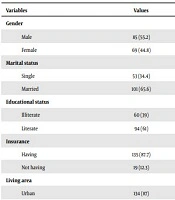
Demographic information of the subjects indicated that 71.2% of them (47 people) were male and 28.8% of them (19 people) were female.
Descriptive results (means and standard deviations) related to hope, psychological hardiness, and quality of life and its subscales are presented in Table 1.
Table 1.The Means and the Standard Deviations of Hope, Psychological Hardiness, and Quality of Life and Its Subscales
| Variables | Mean ± SD |
|---|---|
| Hope | |
| Agency thinking | 38.86 ± 2.22 |
| Pathways thinking | 50.95 ± 2.38 |
| Total | 74.28 ± 1.01 |
| Psychological hardiness | |
| Challenge | 50.31 ± 1.16 |
| Commitment | 44.00 ± 3.56 |
| Control | 46.84 ± 3.97 |
| Total | 1.10 ± 2.30 |
| Quality of life | |
| Total | 70.13 ± 1.16 |
The Pearson correlation coefficient was used to examine the research question, i.e. are psychological hardiness and hope significantly related to the dialysis patients’ quality of life? Results obtained from this analysis are presented in Table 2.
The results presented in the above Table showed that quality of life was significantly and directly related to hope (r = 0.25, P < 0.05) and it was significantly and directly correlated with psychological hardiness (r = 0.29, P < 0.05).
Accordingly, given the confirmation of the above question, the stepwise regression analysis can be applied.
The stepwise regression analysis was used to assess the following question: which of the subscales of psychological hardiness can predict levels of quality of life among dialysis patients?
The results of the stepwise regression analysis conducted to predict levels of quality of life via psychological hardiness indicated that in the first step, challenge was entered into the equation and was able to determine 11% of variances in quality of life. The other subscales of psychological hardiness did not have the criteria for entering into the regression equation and they were eliminated. In the second step, challenge and control were respectively entered into the regression equation and they predicted 16% of the variances of quality of life. The other subscale of psychological hardiness did not have the criteria for entering the regression equation and it was eliminated. In other words, the standard beta coefficients showed that one unit variation in quality of life could change challenge in the first model by 24% and challenge and control in the second model by 25%.
The stepwise regression analysis was used to evaluate the following question: which of the subscales of hope for the future can predict levels of quality of life among dialysis patients?
The results of the stepwise regression analysis conducted to predict levels of quality of life via hope for the future indicated that only agency thinking was entered into the equation and was able to determine 8% of variances in quality of life. The other subscale of hope for the future did not have the criteria for entering into the regression equation and it was eliminated. In other words, the standard beta coefficients showed that one unit variation in quality of life could change agency thinking by 31%.
Table 3.The Results of the Regression Analysis Conducted to Predict Quality of Life Via Psychological Hardinessa
| Step | R | R2 | Adjusted R2 | T | B | Sig |
|---|---|---|---|---|---|---|
| 1. Challenge | 0.37 | 0.14 | 0.11 | 2.06 | 0.24 | 0.04 |
| 2. Challenge and control | 0.44 | 0.20 | 0.16 | 2.12 | 0.25 | 0.03 |
aThe criterion variable: quality of life.
Table 4.The Results of the Regression Analysis Conducted to Predict Quality of Life Via Hope for the Futurea
| Step | R | R2 | Adjusted R2 | T | B | Sig |
|---|---|---|---|---|---|---|
| 1. Agency thinking | 0.31 | 0.10 | 0.08 | 2.68 | 0.31 | 0.00 |
aThe criterion variable: quality of life.
4. Discussion
The present study aimed to examine the predictive roles of hope and psychological hardiness in quality of life among dialysis patients. The results showed that hope and psychological hardiness were significantly related to the dialysis patients’ quality of life and hope and psychological hardiness played roles in predicting levels of quality of life among the dialysis patients. These results are in line with results of a number of previously carried out studies (17, 18, 21-24).
In 2009, Mannix et al. (21) demonstrated that hope predicted levels of quality of life in adolescents with cancer. Mashiach-Eizenberg et al. (18) indicated that promoting hope among patients with severe mental disorders could enhance their quality of life. Moreover, in their study, Ghazalseiflou and Esbati showed that hope was significantly and directly related to levels of quality of life among HIV+ patients (17). To explain these findings, it can be noted that when patients are under the influence of a disease, they lose their hope for the future and their levels of quality of life decrease. Hence, all enjoyments of life seem meaningless to them. This is while when patients, despite pain and difficulties caused by a disease, can maintain their hope; this feeling directs and simulates them to move towards a better life, which changes their lives. In this regard, they accept their disease and instead of focusing on their disease they focus on positive and pleasant aspects of their lives. Consequently, this leads them to be more satisfied with their lives and increases their mental health and quality of life.
Carlson et al. (22) demonstrated that psychological hardiness was significantly and directly related to levels of quality of life among patients with breast cancer. Hasson-Ohayon et al. (23) in their study, indicated that hope played a role in predicting levels of quality of life among patients with schizophrenia and schizoaffective disorders. Additionally, Rhodewalt and Zone (24) examined levels of quality of life among women with and without psychological hardiness and concluded that women with psychological hardiness had better levels of quality of life compared to the other group. To explain these findings, it can be stated that patients with psychological hardiness are able to resist against problems and difficulties and the suffering caused by a disease seems tolerable to them. They do not lose their hope and they consider their difficulties as challenges and do not let their lives be limited to the difficulties, which are caused by the disease. These people have high levels of tolerance and patience. This is why their quality of life cannot be affected by the disease.
Given the abovementioned results and the roles hope and psychological hardiness played in the dialysis patients’ quality of life, it can be concluded that carrying out fun programs and giving motivation to these patients should be taken into consideration to increase these patients’ quality of life and enhance their levels of hope. Furthermore, their quality of life can be promoted by increasing their psychological hardiness and enhancing the thresholds of tolerance among these patients.