Cover image of the article: SARS-CoV-2-Associated CRP, DD, FER, HBA1c, IL6, LDH, PBNP, and PCT Biomarkers and High-Resolution Computed Tomography During the First Three Waves of COVID-19 in Pakistan (2019-2021)

Image Credit:Jundishapur J Microbiol

SARS-CoV-2-Associated CRP, DD, FER, HBA1c, IL6, LDH, PBNP, and PCT Biomarkers and High-Resolution Computed Tomography During the First Three Waves of COVID-19 in Pakistan (2019-2021)

Authors

Umar SaeedUmar Saeed ORCID1,*, Zahra Zahid PirachaZahra Zahid Piracha ORCID1, Rizwan Uppal1, Rehan Uppal1
1Islamabad Diagnostic Center, Pakistan
*Corresponding Author: Islamabad Diagnostic Center, Pakistan. Email: umarsaeed15@yahoo.com

Jundishapur Journal of Microbiology:Vol. 15, issue 1; e119590
Published online:Feb 22, 2022
Article type:Letter
Received:Sep 17, 2021
Accepted:Dec 14, 2021
How to Cite:Saeed U, Zahid Piracha Z, Uppal R, Uppal R. SARS-CoV-2-Associated CRP, DD, FER, HBA1c, IL6, LDH, PBNP, and PCT Biomarkers and High-Resolution Computed Tomography During the First Three Waves of COVID-19 in Pakistan (2019-2021). Jundishapur J Microbiol. 2022;15(1):e119590. doi: https://doi.org/10.5812/jjm.119590

Dear Editor,
The COVID-19 pandemic is not over. Since 2019, persistently augmenting SARS-CoV-2 strains are causing millions of deaths worldwide (1). Although multiple COVID-19 vaccines are commercially available, the rate of mass vaccination is very low due to the lack of mega-scale production capability and limited supply. Also, among poor countries, an acute shortage of SARS-CoV-2 vaccines has become a significant public health issue, causing a rise in ongoing viral pandemics and the rise of multiple variants (2-5). Most commercially available vaccines have been strategized to induce neutralizing antibodies against the spike region of SARS-CoV-2 to block early-stage viral infection. However, these strategies need to be revised and upgraded due to rapidly evolving strains of the virus (6, 7).
In Pakistan, 1.285 million people were infected with SARS-CoV-2, among whom 28,745 individuals died of COVID-19. As of second December 2021, 124,054,300 COVID-19 vaccine doses were administered to the general public aged 12 to 60 years and above (8-12). Herein, we examined the clinical association of biomarkers among SARS-CoV-2-infected people. The abnormal biomarkers linked with SARS-CoV-2 during the first three waves of COVID-19 in Pakistan were investigated during the study. The study was conducted at Islamabad Diagnostic Center (IDC) to analyze COVID-19 infections from first April 2020 to 31 July 2020 (encompassing the first wave of COVID-19), first August 2020 to 31 January 2021 (encompassing the second wave of COVID-19), and first February 2021 to 15 July 2021 (encompassing the third wave of COVID-19). The real-time PCR-confirmed samples were analyzed using the standardized protocols and test kits, as described previously (2), to determine C-reactive protein (CRP), D-dimer (DD), ferritin (FER), hemoglobin A1c (HBA1c), interleukin 6 (IL6), lactate dehydrogenase (LDH), NT-pro-B-type natriuretic peptide (PBNP), and procalcitonin (PCT). This study was approved by the Institutional Review Board of IDC, Pakistan. During the first three waves of COVID-19, 789,998 suspected cases of SARS-CoV-2 were selected.
Among the included subjects, 11.2% were from the first wave of COVID-19 (April - July 2020), 55.4% were from the second wave of COVID-19 (August 2020 - January 2021), and 33.3% were from the third wave of COVID-19 (February - July 2021). Among 516,178 suspected subjects, the overall prevalence rate of SARS-CoV-2 was 12% during 2019-2021 in Pakistan. Among real-time PCR-positive cases, 21.35, 32.5, and 46.15% belonged to the first, second, and third waves of SARS-CoV-2 in Pakistan. During the first wave of COVID-19, among SARS-CoV-2-positive cases, 28.1% of CRP, 12.1% of DD, 18.3% of FER, 21.3% of HBA1c, 1.1% of IL6, 11.6% of LDH, 3.7% of PBNP, and 3.69% of PCT biomarkers were evaluated. Interestingly, based on radiological findings, 2.83% of the subjects were positive for high-resolution computed tomography (HRCT) and the aforementioned biomarkers.
During the second wave, among SARS-CoV-2-infected subjects, 26.14% of CRP, 21.42% of DD, 19.5% of FER, 11.53% of HBA1c, 3.14% of IL6, 9.04% of LDH, 3.37% of PBNP, and 5.82% of PCT biomarkers were evaluated. The results showed that 6.03% of the subjects infected in the second wave of COVID-19 were positive for HRCT and the aforementioned biomarkers. Among SARS-CoV-2-infected subjects in the third wave, 29.3% of CRP, 22.82% of DD, 19.06% of FER, 10.33% of HBA1c, 3.06% of IL6, 9.29% of LDH, 2.171% of PBNP, and 3.92% of PCT biomarkers were analyzed. Of note, 12.65% of SARS-CoV-2-positive cases in the third wave of COVID-19 were positive for HRCT and the aforementioned biomarkers. The analysis revealed that 30.67% of SARS-CoV-2 PCR-positive patients depicted abnormal HBA1c, 51.5% had abnormal DD, and 25.04% had abnormal CRP biomarkers.
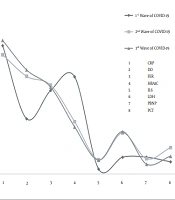
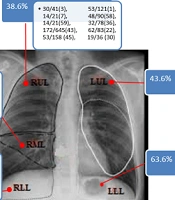
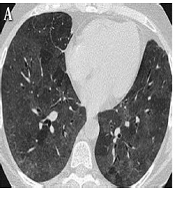
Compared to the first wave of COVID-19, during the second and third waves, the tendency to DD tests was enhanced by 1.7 and 1.88 folds, respectively. Similarly, in contrast to the first wave, IL6 enhanced by 2.85 and 2.78 folds during the second and third waves, respectively. Also, the levels of LDH were enhanced by 2.44 folds during the second wave and 2.5 folds during the third wave of COVID-19, as shown in Figure 1. Of note, during the third wave of COVID-19, the CO-RADS score analysis among patients with abnormal CRP, DD, FER, HBA1C, IL6, LDH, PBNP, and PCT biomarkers revealed that 25.082% of the patients had mild HRCT, 47.8% had moderate HRCT, and 27.07% had severe HRCT status.
COVID-19-associated biomarkers during 2019-2021.
Figure 1.
COVID-19-associated biomarkers during 2019-2021.
The current study is critical not only for physicians across the world but also for health reforming strategic organizations at the international level. The current study revealed that during SARS-CoV-2 infection, CRP, DD, FER, HBA1C, IL6, LDH, PBNP, and PCT biomarkers showed a positive association with mild-moderate and severe HRCT status depending on the SARS-CoV-2 waves during 2019-2021. It also urges the need for further in-depth analysis of biomarkers associated with SARS-CoV-2. Due to limitations, we could not further investigate the effects of these biomarkers on viral replication and their role in intracellular signaling. Furthermore, it would be interesting to determine the impact of these biomarkers in both pre- and post-SARS-CoV-2 vaccinated people. Also, this study would further open doors of investigation among persons with repeated histories of COVID-19 infections.
Footnotes

  • Authors' Contribution: U. S. and Re. U. conceived the study. U. S. performed the analysis and wrote the manuscript. Z. Z. P. and Ri. U. assisted U. S. with the manuscript. Re. U. is the principal investigator (PI) of the study. U. S. is co-PI of the study. Re. U. and Ri. U. finally approved the study.

  • Conflict of Interests: The authors have no conflict of interest.

  • Ethical Approval: Ethical approval was obtained from the IDC institutional review board.

  • Funding/Support: No funding was obtained.

References

  • 1.
    Campbell F, Archer B, Laurenson-Schafer H, Jinnai Y, Konings F, Batra N, et al. Increased transmissibility and global spread of SARS-CoV-2 variants of concern as at June 2021. Euro Surveill. 2021;26(24). [PubMed ID: 34142653]. [PubMed Central ID: PMC8212592]. https://doi.org/10.2807/1560-7917.ES.2021.26.24.2100509.
  • 2.
    Saeed U, Uppal SR, Piracha ZZ, Rasheed A, Aftab Z, Zaheer H, et al. Evaluation of SARS-CoV-2 antigen-based rapid diagnostic kits in Pakistan: formulation of COVID-19 national testing strategy. Virol J. 2021;18(1):34. [PubMed ID: 33581714]. [PubMed Central ID: PMC7881305]. https://doi.org/10.1186/s12985-021-01505-3.
  • 3.
    Saeed U, Uppal SR, Piracha ZZ, Uppal R. SARS-CoV-2 spike antibody levels trend among Sinopharm vaccinated people. Iran J Public Health. 2021;50(7):1486-7. [PubMed ID: 34568189]. [PubMed Central ID: PMC8426791]. https://doi.org/10.18502/ijph.v50i7.6640.
  • 4.
    Saeed U, Zahid Piracha Z, Uppal SR, Uppal R. Evaluation of epidemic prevention abilities for severe acute respiratory syndrome coronavirus-2 and middle east respiratory syndrome coronavirus in south korea. Jundishapur J Microbiol. 2021;14(6):1. e114374. https://doi.org/10.5812/jjm.114374.
  • 5.
    Saeed U, Uppal SR, Zahid Piracha Z, Uppal R. Azithromycin treatment for SARS-CoV-2-related COVID-19 pandemic could worsen extensively drug resistant (XDR) typhoid: a risk of losing the last bullet against Salmonella enterica serovar typhi. Jundishapur J Microbiol. 2021;14(1). e113874. https://doi.org/10.5812/jjm.113874.
  • 6.
    Raman R, Patel KJ, Ranjan K. COVID-19: unmasking emerging SARS-CoV-2 variants, vaccines and therapeutic strategies. Biomolecules. 2021;11(7). [PubMed ID: 34356617]. [PubMed Central ID: PMC8301790]. https://doi.org/10.3390/biom11070993.
  • 7.
    Noh JY, Jeong HW, Shin EC. SARS-CoV-2 mutations, vaccines, and immunity: implication of variants of concern. Signal Transduct Target Ther. 2021;6(1):203. [PubMed ID: 34023862]. [PubMed Central ID: PMC8140323]. https://doi.org/10.1038/s41392-021-00623-2.
  • 8.
    Barouch DH, Kik SV, Weverling GJ, Dilan R, King SL, Maxfield LF, et al. International seroepidemiology of adenovirus serotypes 5, 26, 35, and 48 in pediatric and adult populations. Vaccine. 2011;29(32):5203-9. [PubMed ID: 21619905]. [PubMed Central ID: PMC3138857]. https://doi.org/10.1016/j.vaccine.2011.05.025.
  • 9.
    Logunov DY, Dolzhikova IV, Shcheblyakov DV, Tukhvatulin AI, Zubkova OV, Dzharullaeva AS, et al. Safety and efficacy of an rAd26 and rAd5 vector-based heterologous prime-boost COVID-19 vaccine: an interim analysis of a randomised controlled phase 3 trial in Russia. Lancet. 2021;397(10275):671-81. [PubMed ID: 33545094]. [PubMed Central ID: PMC7852454]. https://doi.org/10.1016/S0140-6736(21)00234-8.
  • 10.
    Saeed U, Zahid Piracha Z, Kanwal K, Munir M, Waseem A, Nisar T, et al. Contemplating SARS-CoV-2 infectivity with respect to ABO blood groups. Int J Clin Virol. 2021;5(2):82-6. https://doi.org/10.29328/journal.ijcv.1001039.
  • 11.
    Nadeem H, Ayesha M, Saeed U, Piracha ZZ, Tahir R, Mehtab F, et al. SARS-CoV-2 infection-associated detrimental effects on the various human organs. Int J Clin Virol. 2021;5(2):72-81. https://doi.org/10.29328/journal.ijcv.1001038.
  • 12.
    Azhar A, Saeed U, Zahid Piracha Z, Amjad A, Ahmed A, Batool SI, et al. SARS-CoV-2 related HIV, HBV, RSV, VZV, Enteric viruses, Influenza, DENV, S. aureus and TB co-infections. Arch. pathol. clin. res. 2021;5(1):26-33. https://doi.org/10.29328/journal.apcr.1001025.

Copyright

Copyright © 2022, Author(s). This is an open-access article distributed under the terms of the Creative Commons Attribution-NonCommercial 4.0 International License (http://creativecommons.org/licenses/by-nc/4.0/) which permits copy and redistribute the material just in noncommercial usages, provided the original work is properly cited.

Similar Articles

19
Jun
2021
A Review of COVID-19: Data Obtained from Chest CT Imaging and RT-PCR

A Review of COVID-19: Data Obtained from Chest CT Imaging and RT-PCR

Hossein Akbari-Lalimi,
Somayyeh Seyedi,
Hadi Akbari-Zadeh,
Milad Najafzadeh,
Alireza Montazerabadi,
Behzad Aminzadeh
,et al.

Akbari-Lalimi H, Seyedi S, Akbari-Zadeh H, Najafzadeh M, Montazerabadi A, et al. A Review of COVID-19: Data Obtained from Chest CT Imaging and RT-PCR. I J Radiol. 2021;18(2):e106852. doi: https://doi.org/10.5812/iranjradiol.106852

14
Feb
2021
Radiological Characteristics of Patients Infected with Coronavirus Disease-2019 (COVID-19): A Retrospective, Observational Study from Iran

Radiological Characteristics of Patients Infected with Coronavirus Disease-2019 (COVID-19): A Retrospective, Observational Study from Iran

Latif Panahi,
Abolfazl Etebarian Khorasgani,
Marzieh Amiri,
Somaye Pouy

Panahi L, Etebarian Khorasgani A, Amiri M, Pouy S. Radiological Characteristics of Patients Infected with Coronavirus Disease-2019 (COVID-19): A Retrospective, Observational Study from Iran. Ann Mil Health Sci Res. 2021;19(1):e111598. doi: https://doi.org/10.5812/amh.111598

1
Aug
2020
Early Computed Tomography Findings of Novel Coronavirus Disease 2019 (COVID-19) Pneumonia

Early Computed Tomography Findings of Novel Coronavirus Disease 2019 (COVID-19) Pneumonia

Pinar Diydem Yilmaz,
Cengiz Kadiyoran,
Suleyman Bakdik,
Necdet Poyraz,
Hulya Vatansev

Yilmaz PD, Kadiyoran C, Bakdik S, Poyraz N, Vatansev H. Early Computed Tomography Findings of Novel Coronavirus Disease 2019 (COVID-19) Pneumonia. Arch Clin Infect Dis. 2020;15(5):e106868. doi: https://doi.org/10.5812/archcid.106868

1
Sep
2024
A Cross-Sectional Study Conducted in Tehran, Iran, Analyzed the Typical Patterns of Primary Lung CT Scans in Critically Ill COVID-19 Patients Using a Semi-Quantitative Scoring System

A Cross-Sectional Study Conducted in Tehran, Iran, Analyzed the Typical Patterns of Primary Lung CT Scans in Critically Ill COVID-19 Patients Using a Semi-Quantitative Scoring System

Mohammad Torabi,
Masoomeh Raoufi,
Shahram Sayadi,
Sara Salarian

Torabi M, Raoufi M, Sayadi S, Salarian S. A Cross-Sectional Study Conducted in Tehran, Iran, Analyzed the Typical Patterns of Primary Lung CT Scans in Critically Ill COVID-19 Patients Using a Semi-Quantitative Scoring System. J Microbiota. 2024;1(2):e143267. doi: https://doi.org/10.5812/jmb-143267

23
Dec
2020
The Spectrum of Chest CT-Scans in the Hospitalized Patients with the Coronavirus Disease

The Spectrum of Chest CT-Scans in the Hospitalized Patients with the Coronavirus Disease

Maria Shirvani,
Alireza Janbakhsh,
Feizollah Mansouri,
Babak Sayad,
Siavash Vaziri,
Mandana Afsharian
,et al.

Shirvani M, Janbakhsh A, Mansouri F, Sayad B, Vaziri S, et al. The Spectrum of Chest CT-Scans in the Hospitalized Patients with the Coronavirus Disease. J Kermanshah Univ Med Sci. 2020;24(4):e111407. doi: https://doi.org/10.5812/jkums.111407

More by these authors

Umar SaeedPubMedScholar
Zahra Zahid PirachaPubMedScholar
Rizwan UppalPubMedScholar
Rehan UppalPubMedScholar
Share
Cited by
Metrics