
1. Background
Coronaviruses are a large family of RNA viruses, which range from the common cold virus to the causative agent of more severe diseases, such as the severe acute respiratory syndrome (SARS), Middle-East respiratory syndrome (MERS), and COVID-19, which cause diseases in birds and mammals as well (1, 2). Seven human-transmitted coronaviruses have been discovered, the most recent of which is the severe acute respiratory syndrome coronavirus 2 (SARS-CoV-2). SARS-CoV-2 was declared a pandemic in December 2019 in Wuhan, China (1, 3).
According to the World Health Organization (WHO) report, the new coronavirus killed more than 636,576 individuals and infected more than 15,656,884 in different countries until 24th July 2020. The first step to preventing the spread of COVID-19 is rapid and accurate diagnosis (4). The common methods used for the diagnosis and monitoring of this virus are real-time polymerase chain reaction (RT-PCR), loop-mediated isothermal amplification (LAMP), ELISA test, and chest computed tomography (CT)-scan (4, 5). RT-PCR is a laboratory technique of molecular biology based on the polymerase chain reaction, which is an accurate detection method. However, it has difficult accessibility given the high cost and complexity due to simultaneous thermal cycling and fluorescence detection (6). On the other hand, LAMP and ELISA tests are simple and inexpensive diagnostic methods for infections, while their accuracy is insufficient (6-8). Chest CT-scan is a quick, easy, and accurate modality with high sensitivity in disease diagnosis (9). In a research in this regard, the comparison of CT-scan and RT-PCR indicated that the sensitivity of CT-scan in the detection of COVID-19 was 98%, while the sensitivity of PCR-assisted diagnosis was 71% (5).
In CT-scan, the volumetric changes in the images could detect the symptoms of the disease (10). The chest CT-scan findings of COVID-19 infection have been observed as bilateral, peripheral, and basal predominant ground-glass opacification, consolidation, pleural effusion, extensive and miniscule pulmonary nodules, and lymphadenopathy (9, 11).
2. Objectives
The present study aimed to investigate the range of CT-scans in the hospitalized patients with the coronavirus disease in Kermanshah, Iran in 2020 to contribute to the accurate diagnosis of the infected patients.
3. Methods
This cross-sectional, observational study was conducted with the approval of the Ethics Committee of Kermanshah University of Medical Sciences, Iran. Convenience sampling was used for the selection of 286 hospitalized patients who were diagnosed with or suspected of the coronavirus disease in Golestan Hospital in Kermanshah City during March-February 2020. Data of the patients were collected using a questionnaire, and data analysis was performed in SPSS version 26. Measures of central tendency and dispersion were calculated for the quantitative variables, relative frequency was estimated for the qualitative variables, and chi-square applied for the statistical comparison. Clinical features were considered as the entry criterion of the study.
4. Results
In total, 286 hospitalized patients who were diagnosed with or suspected of the coronavirus disease were enrolled in the study, including 176 males (61.53%) and 110 females (38.47%). The mean age of the patients was 56 years; the youngest patient was a 13-year-old boy, and the eldest patients were two 90-year-old men. Among the sample population, 237 cases (82.87%) lived in cities, and 110 cases (38.47%) were rural residents. The majority of the patients (n = 86; 30.07%) were self-employed, followed by 80 housekeepers (27.97%). The remaining samples were retired (18.53%), employees (12.94%), unemployed (5.24%), and students (3.50%).
According to the PCR results, 101 patients (35.31%) were infected with coronavirus, while 185 cases (64.69%) had negative results. On the other hand, the CT-scan findings indicated that 221 abnormalities (77.27%) and 65 normal CT-scans (22.73%). Of 217 abnormal chest CT findings, only 91 cases had positive PCR results; in other words, only 41.93% of the PCR results showed the coronavirus disease. With regard to the disease status, 217 patients (75.87%) recovered completely, 53 patients (18.53%) died, 10 patients were referred to another center, four cases (1.40%) had partial recovery, and two cases (0.70%) were hospitalized in the ward (Table 1).
Table 1.
Characteristics of 286 Patients Diagnosed with or Suspected of COVID-19
| Characteristics | Patient (N = 286) |
|---|---|
| Age, y, mean | |
| 13 - 90 | 56 |
| Gender, No. (%) | |
| Male | 176 (61.53) |
| Female | 110 (38.47) |
| Residence, No. (%) | |
| Urban | 237 (82.87) |
| Rural | 49 (17.13) |
| Occupation Status, No. (%) | |
| Self-employed | 86 (30.07) |
| Housekeeper | 80 (27.97) |
| Retired/elderly | 53 (18.53) |
| Employee | 37 (12.94) |
| Unemployed | 15 (5.24) |
| Student | 10 (3.50) |
| Other | 3 (1.05) |
| Unknown | 2 (0.70) |
| PCR Results, No. (%) | |
| Positive | 101 (35.31) |
| Negative | 185 (64.69) |
| CT Findings, No. (%) | |
| Abnormal | 221 (77.27) |
| Normal | 65 (22.73) |
| Disease Status, No. (%) | |
| Complete Recovery | 217 (75.87) |
| Death | 53 (18.53) |
| Referral to Another Center | 10 (3.50) |
| Partial Recovery | 4 (1.40) |
| Hospitalization in Ward | 2 (0.70) |
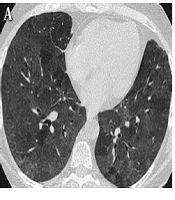
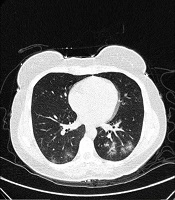
In the present study, all the patients were examined by chest CT-scan 7 ± 4 days after the disease onset. According to the chest CT-scan images, 65 patients (22.73%) had normal CT findings. The major CT abnormalities were diffuse ground-glass opacification (102/286; 35.66%), peripheral ground-glass opacification (bilateral) (61/286; 21.33%), and a combination of diffuse and peripheral ground-glass lesions (54/286; 18.88%). Furthermore, three cases (1.05%) presented with a combination of central and peripheral ground-glass opacification, and one case (0.35%) had central ground-glass opacification (bilateral). The consolidation lesion of one lobe was detected in 16 patients (5.59%), and the consolidation lesion of more than one lobe was observed in 40 patients (13.98%). Table 2 shows the frequency and percentage of the CT-scans in the patients.
Table 2.
Chest CT-Scan Findings of 286 Patients Diagnosed with or Suspected of COVID-19
| CT Findings | No. (%) |
|---|---|
| Normal | 65 (22.73) |
| Diffuse ground-glass opacification | 102 (35.66) |
| Peripheral ground-glass opacification (bilateral) | 61 (21.33) |
| Central ground-glass opacification (bilateral) | 1 (0.35) |
| Combined diffuse and peripheral ground-glass opacification | 54 (18.88) |
| Combined central and peripheral ground-glass opacification | 3 (1.05) |
| Consolidation lesion of one lobe | 16 (5.59) |
| Consolidation lesion of more than one lobe | 40 (13.98) |
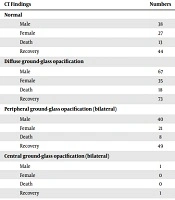
According to the information in Table 3, out of 65 patients with a normal CT-scan, 38 cases were male, 27 cases were female, 13 cases died, and 44 cases recovered partially or completely. Among the patients with diffuse ground-glass opacification, 67 cases were male, 35 cases were female, 18 cases died, and 73 cases recovered partially or completely. As for the patients with peripheral ground-glass opacification (bilateral), 40 cases were male, 21 cases were female, eight cases died, and 49 cases recovered. Central ground-glass opacification (bilateral) was observed in one male patient who recovered completely. On the other hand, combined diffuse and peripheral ground-glass lesions were detected in 34 males and 20 females, from whom four cases died and 44 cases recovered. Combined central and peripheral ground-glass opacification was also detected in three females, one of whom died, and two cases recovered. Among 16 cases of the consolidation lesion of one lobe, 12 were male, and four were female; four of these patients died, and 11 cases recovered. Out of 40 patients with the consolidation lesion of more than one lobe, 23 cases were male, 17 cases were female, one case died, and 30 cases recovered.
Table 3.
Comparison of CT-Scans in Terms of Gender and Disease Status
| CT Findings | Numbers |
|---|---|
| Normal | |
| Male | 38 |
| Female | 27 |
| Death | 13 |
| Recovery | 44 |
| Diffuse ground-glass opacification | |
| Male | 67 |
| Female | 35 |
| Death | 18 |
| Recovery | 73 |
| Peripheral ground-glass opacification (bilateral) | |
| Male | 40 |
| Female | 21 |
| Death | 8 |
| Recovery | 49 |
| Central ground-glass opacification (bilateral) | |
| Male | 1 |
| Female | 0 |
| Death | 0 |
| Recovery | 1 |
| Combined diffuse and peripheral ground-glass opacification | |
| Male | 34 |
| Female | 20 |
| Death | 4 |
| Recovery | 44 |
| Combined central and peripheral ground-glass opacification | |
| Male | 0 |
| Female | 3 |
| Death | 1 |
| Recovery | 2 |
| Consolidation lesion of one lobe | |
| Male | 12 |
| Female | 4 |
| Death | 4 |
| Recovery | 11 |
| Consolidation lesion of more than one lobe | |
| Male | 23 |
| Female | 17 |
| Death | 9 |
| Recovery | 30 |
5. Discussion
The signs and symptoms of COVID-19 manifest after 1 - 14 days of incubation period in the form of fever, cough, and fatigue at the disease onset (12). If the patient receives no treatment or is irresponsive to treatment, mortality occurs after an average of 6 - 41 days (13). One of the most accurate diagnostic methods for the coronavirus disease is to examine the chest CT-scan of the cases suspected of COVID-19 symptoms (10). In the present study, 221 patients (77.27%) had abnormalities in the chest CT-scan images.
Compared to other types of pneumonia, COVID-19 seems to cause milder symptoms and severer pulmonary changes on CT (14). In the current research, the majority of the patients had diffuse ground-glass opacification (35.66%) and peripheral ground-glass opacification (bilateral; 21.33%). In addition, multiple lesions were detected in some of the patients, such as combined diffuse and peripheral ground-glass opacification (18.88%). The least amount of lesions belonged to central ground-glass opacification (bilateral; 0.35%) and combined central and peripheral ground-glass opacification (1.05%). On the other hand, the consolidation lesion of more than one lobe (13.98%) was more common compared to the consolidation lesion of one lobe (5.59%). These findings are consistent with the recently published studies in this regard (14-16).
The findings of the current research demonstrated significant correlations between the CT-scans and the main clinical symptoms. Notably, 20% of the cases with a normal chest CT-scan died due to coronavirus. Among 217 abnormal chest CT findings, only 91 cases had positive PCR results; in other words, only 41.93% of the PCR results showed the coronavirus disease. Therefore, no correlations were observed between the PCR results and chest CT findings, and CT-scan could diagnose the coronavirus disease more effectively than PCR. The most important reasons that may affect PCR accuracy are the improper sample collection from infected patients, accidental contamination of the samples during collection or analysis, and not maintaining the samples at the proper temperature; such issues are not the case in chest CT-scans (5).
The main limitation of the present study was that none of the patients had a lung biopsy or autopsy to reflect histopathological changes.
5.1. Conclusions
According to the results, the most common chest CT findings in the COVID-19 patients included diffuse ground-glass opacification, peripheral ground-glass opacification (bilateral), central ground-glass opacification (bilateral), combined diffuse and peripheral ground-glass opacification, combined central and peripheral ground-glass opacification, consolidation lesion of one lobe, and consolidation lesion of more than one lobe. Furthermore, significant correlations were observed between the CT-scans and the main clinical symptoms.