1. Introduction
Male genital tract infections (MGTIs) are inflammatory conditions caused by the invasion of pathogens, including bacteria, viruses, and fungi, into the urethra, prostate, epididymis, or testes. These infections are highly prevalent among men of reproductive age (1) and typically present with urinary frequency, dysuria, abnormal discharge, and localized inflammation. If left untreated, MGTIs may progress to chronic infection, infertility, and sexual dysfunction. Given their important contribution to male factor infertility, MGTIs and their associated complications require careful clinical attention.
The main pathogenic microorganisms associated with MGTIs include Chlamydia trachomatis, Neisseria gonorrhoeae, Mycoplasma species, and opportunistic enteric commensals such as Escherichia coli. Although N. meningitidis is a well-known commensal of the human nasopharynx and a pathogen capable of causing life-threatening invasive diseases such as meningitis and sepsis (2), its role in urogenital infections is uncommon, and few cases have been reported in China.
Because N. meningitidis may be present as a latent infection and can be rapidly cleared after appropriate antibiotic treatment, it is easily overlooked in clinical practice. However, recent research by Bazan et al. (3) confirmed the global expansion of a specialized lineage, the N. meningitidis urethral clade (US-NmUC). This lineage can acquire genetic material from N. gonorrhoeae through horizontal gene transfer (4). Loss of the polysaccharide capsule and acquisition of the aniA-norB gene cluster allow this strain to occupy the ecological niche typically held by N. gonorrhoeae, enabling anaerobic growth in the male urethra. We recently identified a case of MGTI caused by N. meningitidis during routine outpatient screening. The details of this case are presented below.
2. Case Presentation
On January 11, 2026, a 29-year-old man presented to the andrology department of our hospital with acute urinary symptoms. He reported a 2-day history of urinary frequency, urgency, and dysuria. He had no gross hematuria, significant obstructive voiding symptoms, nausea, or vomiting. At presentation, his body temperature was 36.5°C. He had no respiratory symptoms, such as cough or expectoration, and denied associated back pain. He had no significant past medical history, recent travel history, or history of high-risk sexual activity. He also denied recent orogenital contact. Because the relevant history was too remote, his vaccination status could not be confirmed.
The patient had not taken antibiotics before visiting our hospital, and his partner had no symptoms before the patient was cured. A thin, pale, milky-white purulent discharge was collected from the urethral orifice for laboratory culture. No lesions were detected elsewhere. Laboratory testing included bacterial culture, identification, and antimicrobial susceptibility testing; bacterial smear examination; and real-time fluorescence polymerase chain reaction testing (Daan Gene Co., Ltd.) for N. gonorrhoeae, U. urealyticum, and C. trachomatis. Sabouraud medium (Thermo Fisher) and blood agar plates (Thermo Fisher) were incubated at 37°C under normal aerobic conditions, whereas chocolate agar medium (Thermo Fisher) was incubated at 37°C in a 5% CO2 atmosphere.
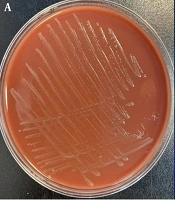
Gram staining showed abundant leukocytes and intracellular and extracellular Gram-negative diplococci that were morphologically indistinguishable from N. gonorrhoeae. Real-time fluorescence polymerase chain reaction testing was negative for N. gonorrhoeae, U. urealyticum, and C. trachomatis. After incubation at 37°C in a 5% CO2 atmosphere, small, translucent, grayish-white colonies were observed on chocolate agar (Figure 1A). Biochemical identification was performed. Gram-stain microscopy at 1000× magnification revealed Gram-negative diplococci (Figure 1B). Oxidase and catalase tests were both positive. Carbohydrate utilization testing showed that the isolate utilized both glucose and maltose, with positive acid production. Automated identification using the VITEK 2 Compact system confirmed the isolate as N. meningitidis (Figure 2). Because of limited laboratory conditions, confirmatory bacterial nucleic acid testing was not performed.
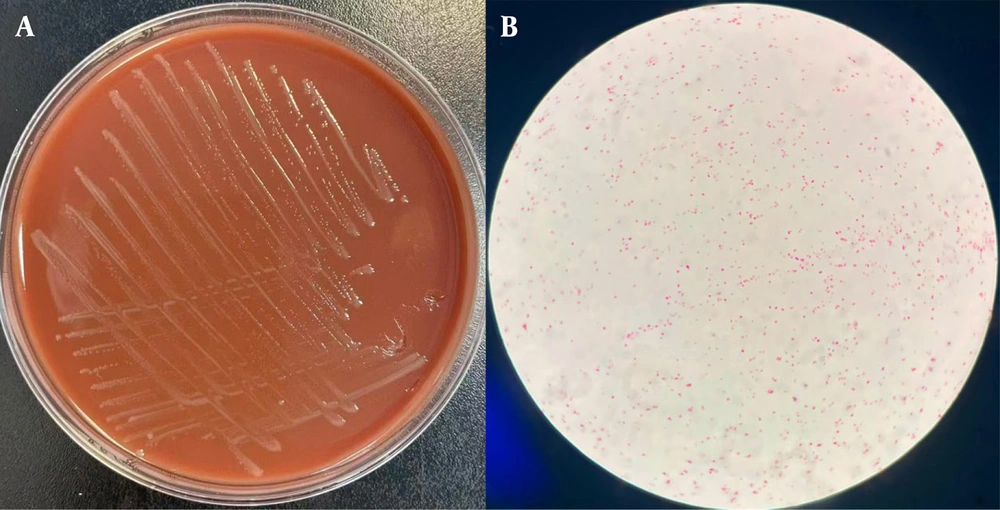
Figure 1.
A, Colonies of N. meningitidis on chocolate agar after 48 hours of incubation at 37°C in 5% CO2, showing small, translucent, grayish-white colonies. B, Gram staining microscopy (1000×, oil immersion) of the isolate, showing Gram-negative diplococci that were morphologically indistinguishable from N. gonorrhoeae.
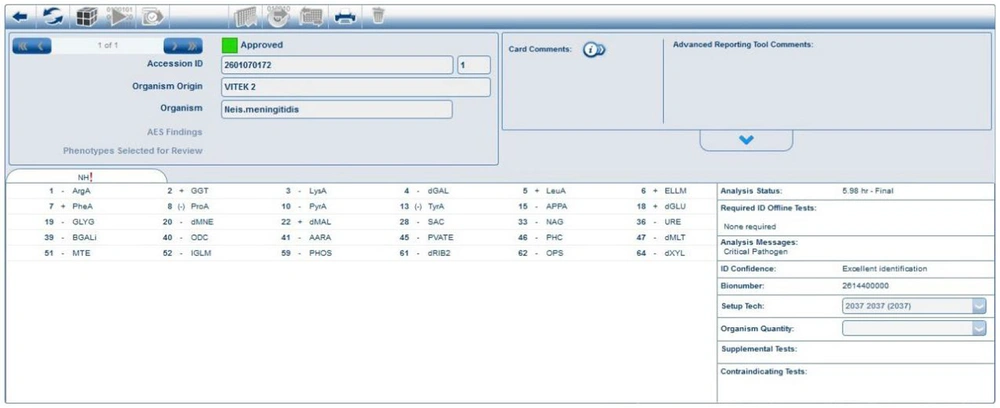
Figure 2.
Identification results from the VITEK 2 Compact system (bioMérieux), confirming the isolate as N. meningitidis.
The antimicrobial susceptibility profile showed that the strain was susceptible to ceftriaxone, meropenem, azithromycin, and minocycline, but resistant to ciprofloxacin, sulfamethoxazole/trimethoprim, penicillin, and ampicillin. Matrix-assisted laser desorption/ionization time-of-flight mass spectrometry (bioMérieux VITEK MS Knowledge Base 3.2) confirmed the identification of N. meningitidis, with a confidence of 99.9% and an excellent confidence level (Figure 3). The patient received a single intramuscular dose of ceftriaxone (500 mg) and a single oral dose of azithromycin (1 g). His symptoms improved after 2 days and resolved completely after 7 days, with negative reculture results. At the 1-month follow-up, he had no symptoms, no recurrence, and no signs of infection in his partner.
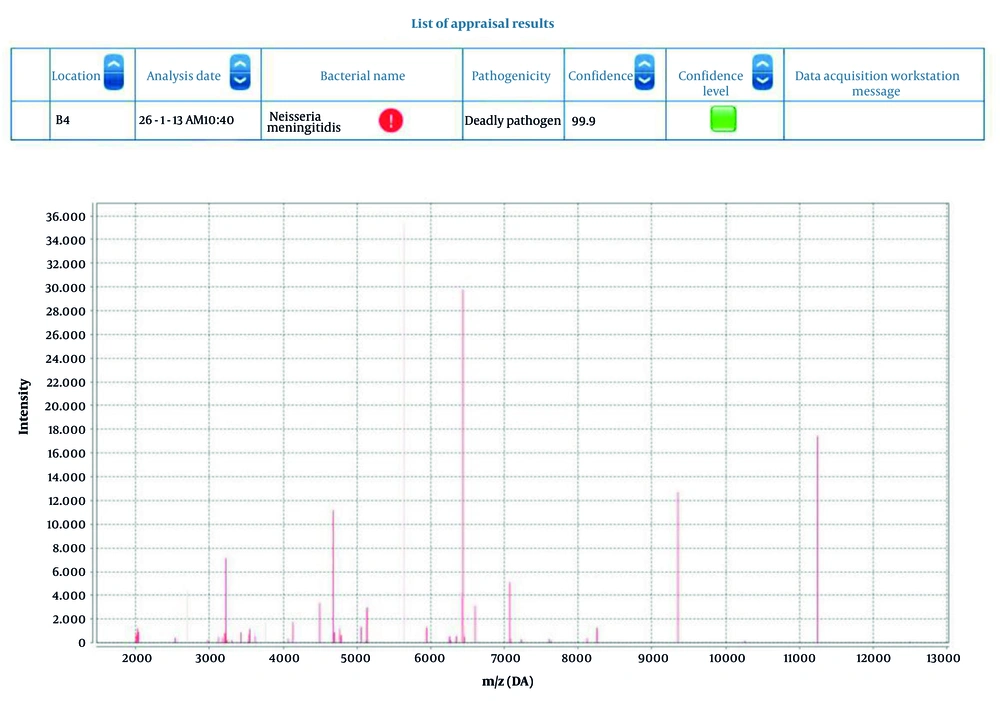
Figure 3.
Identification results from MALDI-TOF MS (bioMérieux, VITEK MS). The spectrum matched N. meningitidis with a high confidence score (99.9%; log score, 2.4).
3. Discussion
This case highlights an important diagnostic gap in current clinical practice. To obtain rapid results (5), many laboratories rely exclusively on nucleic acid amplification tests (NAATs) to detect sexually transmitted infections (6). Although these assays have high specificity for N. gonorrhoeae genes, such as porA or opcA, they typically do not detect N. meningitidis. Consequently, non-gonococcal urethritis caused by the N. meningitidis urethral clade may be misdiagnosed. In this case, conventional culture and identification methods, particularly biochemical profiling and MALDI-TOF MS, were indispensable. Without these tools, the true pathogen would have remained unidentified. Accurate differentiation between N. meningitidis and N. gonorrhoeae is essential not only for individual patient care but also for obtaining reliable epidemiological data.
Urogenital N. meningitidis isolates are increasingly divergent from their nasopharyngeal counterparts. Research on the US-NmUC lineage indicates that these strains show greater invasiveness toward human male urethral epithelial cells than commensal N. meningitidis strains or even some N. gonorrhoeae strains (3). This phenotype is likely related to the loss of the polysaccharide capsule, which exposes surface adhesins and facilitates tighter binding to the urethral mucosa. In addition, horizontal acquisition of the aniA gene allows N. meningitidis to use nitrite as a terminal electron acceptor, enabling anaerobic survival in the oxygen-limited environment of the male urethra. Colonization of overlapping anatomic niches by N. meningitidis and N. gonorrhoeae may facilitate genetic exchange through horizontal gene transfer via conjugation (7), transformation, and transduction. Studies by Bazan et al. (3) and Goldstein et al. (8) identified the blaTEM β-lactamase gene, which is typically associated with penicillin resistance in N. gonorrhoeae, in the US-NmUC lineage. Conversely, N. gonorrhoeae can acquire the N. meningitidis porA gene, a process that can lead to "diagnostic escape" by rendering N. gonorrhoeae undetectable by standard NAATs.
The antimicrobial resistance profile of urogenital N. meningitidis is also evolving. Research by Fu et al. (9) suggests that mutations in the penA-316 and penA-9 alleles contribute to increasing penicillin resistance in these strains. In our case, the patient responded well to standard dual therapy with intramuscular ceftriaxone (500 mg) and oral azithromycin (1 g) (10). However, in vitro testing showed resistance to penicillin, ciprofloxacin, and sulfamethoxazole/trimethoprim. This phenotype resembles N. meningitidis strains recently identified in Shanghai (11), likely linked to PBP2 and gyrA mutations (12). Given the geographical proximity of Shanghai and Ningbo, it is plausible to hypothesize that this urethral clade is expanding across Southeast China. However, because genomic confirmation, such as sequence typing or aniA-norB cluster detection, was not performed for our isolate, this remains a hypothesis informed by the literature rather than a conclusion directly supported by this case. This trend suggests that quinolones should be avoided for the empirical treatment of suspected MGTIs in this region.
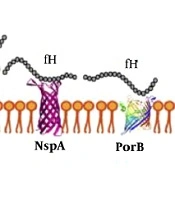
Historically, reports of urogenital N. meningitidis in China have been rare; therefore, this case provides an important clinical alert. The transmission dynamics also warrant closer scrutiny. High-risk sexual behaviors, including unprotected orogenital contact (13) and sex between men (MSM) (14), significantly increase the risk of transmission of N. meningitidis to the urogenital tract. Notably, research by Abara et al. (15) suggests that the 4CMenB vaccine (Bexsero), originally developed for meningitis, may provide 30% - 40% cross-protection against these urethral-tropic strains because of shared outer membrane proteins, such as NHBA and fHbp. This presents a promising opportunity for integrated public health strategies to address both invasive meningococcal disease and emerging urogenital infections. Clinical resolution was achieved after the prescribed treatment. This case supports the following recommendations for managing suspected MGTIs.
3.1. Expanded Diagnostic Protocols
For patients presenting with symptomatic urethritis who have negative NAAT results for common pathogens, bacterial culture of urogenital secretions is imperative. This step is essential for identifying atypical pathogens, such as N. meningitidis, that would otherwise be missed by gene-specific assays.
3.2. Epidemiological Surveillance
Systematic molecular monitoring is needed to track the transmission and antimicrobial resistance trends of the N. meningitidis urethral clade, particularly in regions where it may be emerging as an endemic pathogen.
3.3. ApprovedbyEICComprehensive Partner Management
Clinical vigilance should be prioritized for high-risk populations. To interrupt transmission and prevent recurrence, clinicians should consider screening the oropharyngeal mucosa of sexual partners, because the throat serves as a primary reservoir for N. meningitidis.
Ethics and Consent: This study was approved by the Institutional Review Board of Ningbo Hospital of Integrated Traditional Chinese and Western Medicine (Approval No. 2026018). According to the informed consent statement, the study met the criteria for waiving informed consent, and all personal information associated with the patient was removed.