
1. Background
Renal disorders constitute a substantial public health burden worldwide. Each year, these diseases increase the need for hemodialysis and transplantation (1). Patients with these conditions may develop nosocomial infections, including candidiasis, which can increase morbidity and mortality (2, 3). Factors that increase the risk of fungal infections in this patient population include uremia, immunosuppressive agents, urinary catheterization, cancer, radiotherapy, and frequent exposure to healthcare settings. Candiduria, a common form of candidiasis, may be asymptomatic in critically ill patients (3). This infection is defined as the isolation of Candida species from a urine specimen at a concentration of ≥ 104 CFU/mL. Although it may be asymptomatic in critically ill patients, it can also present with clinical manifestations ranging from lower urinary tract symptoms to invasive renal infection (3, 4). Distinguishing true candiduria from contamination and colonization is essential for appropriate clinical management. As the disease progresses, symptoms such as dysuria, hematuria, frequency, urgency, and suprapubic tenderness may occur (4). Preventing the progression of candiduria to invasive candidiasis relies heavily on early diagnosis, particularly in immunocompromised patients. Current understanding of the pathogenic processes associated with Candida isolates from patients with kidney disease remains limited.
The existing literature identifies C. albicans as the predominant etiological agent of candiduria. Nevertheless, a shift in causative patterns has emerged, with an increasing contribution from non-albicans Candida species. Reports increasingly cite C. glabrata (reclassified as Nakaseomyces glabratus), C. tropicalis, C. parapsilosis, and C. krusei. Some of these non-albicans species, such as C. krusei and C. glabrata, exhibit resistance to antifungal agents, particularly azoles. Thus, accurate species-level identification of Candida isolates is essential for epidemiological purposes and for guiding clinical management. In Candida spp., biofilm formation and secretion of extracellular enzymes are important virulence factors (5). Biofilm formation may shield the organism from host immune cells and restrict the penetration of antifungal drugs (6).
2. Objectives
Extracellular enzyme secretion plays a key role in facilitating host-cell invasion and tissue injury. This study was designed to evaluate biofilm production and enzymatic potential in Candida isolates obtained from renal patients with candiduria, thereby providing clinical insights that may ultimately enhance patient care. In addition, the susceptibility patterns of these isolates to antifungal agents, an essential component of candidiasis management, were investigated.
3. Methods
3.1. Study Design, Patients, and Sample Collection
A cross-sectional study was conducted in the nephrology departments of Shahid Jalil and Shahid Beheshti hospitals (Yasuj University of Medical Sciences, Iran) from March 2022 to February 2023. All patients hospitalized in the nephrology wards during the study period were screened for candiduria. Urine samples were collected specifically for this investigation and were not part of routine clinical diagnostic procedures. Midstream urine samples (approximately 10 - 15 mL) were collected from each patient by trained nursing staff using sterile techniques. After cleaning the external genitalia, patients were instructed to void a midstream urine sample directly into sterile screw-capped containers. All samples were promptly sent to the mycology laboratory, cultured on CHROMagar Candida (France), and incubated at 37°C for 24 - 48 hours. Color and colony counts were recorded, and candiduria was defined as ≥ 104 CFU/mL.
3.2. Molecular Identification
Colony purity was confirmed by subculturing the isolates on Sabouraud dextrose agar (SDA; Condalab, India). DNA was extracted according to Lõoke et al. (7). A single colony was picked and mixed with 200 mM lithium acetate (Sigma-Aldrich, Germany) and 1% SDS (Scharlau, Spain). After incubation at 70°C for 5 minutes, 300 µL of absolute ethanol was added. The mixture was then centrifuged at 15,000 × g for 2 minutes. The resulting pellet was washed with 70% ethanol, centrifuged again, air-dried, and resuspended in 100 μL of sterile deionized water. Candida species were identified by PCR sequencing as described by Gharaghani et al. (8), using V9G and LS266 primers. The reaction mixture (25 µL total volume) included 1 µL of each primer, 3 µL of DNA, and Taq DNA Polymerase 2× Master Mix RED with 1.5 mM MgCl2 (Ampliqon, Denmark). The resulting amplicons were sequenced (CardioGenics Company, Shahid Rajaee Heart Hospital, Tehran, Iran), after which the sequences were aligned, cross-referenced with genomic databases, and deposited in GenBank.
3.3. Phylogenetic Analysis
Phylogenetic analysis was performed by constructing a maximum-likelihood tree from the aligned sequences using MEGA-X v.10. Branch support was determined using 1,000 ultrafast bootstrap iterations. Bootstrap values are indicated by triangles sized proportionally to the support values. The tree was visualized and annotated using iTOL, with accession numbers shown on the right.
3.4. Antifungal Susceptibility Testing
Preparation of RPMI 1640 medium: The medium was prepared by dissolving 17.27 g of MOPS (Bio Basic, Canada) and 5.02 g of RPMI 1640 powder (Gibco, UK; without sodium bicarbonate and with L-glutamine) in 500 mL of distilled water. After complete dissolution, the pH was adjusted to 7.0 using 4% NaOH (Kian Kaveh, Iran). The medium was then sterilized by filtration through a 0.22-µm sterile syringe filter and collected in pre-autoclaved sterile glass bottles. This medium was used to prepare both drug dilutions and the yeast inoculum.
Preparation of antifungal drugs: Antifungal susceptibility testing was performed by broth microdilution according to CLSI protocols (M27, M60-Ed2, and M59) (9-11), with Candida albicans ATCC 10231 as the quality-control strain. According to CLSI guidelines, water-soluble drugs such as fluconazole (Sigma-Aldrich, Germany) were dissolved directly in sterile distilled water. Drugs with low water solubility, including itraconazole, amphotericin B, and caspofungin (Sigma-Aldrich, Germany), were first dissolved in DMSO, and subsequent dilutions were prepared in RPMI 1640 medium. The final concentration of DMSO in the test wells did not exceed 1%, the maximum recommended concentration to avoid toxic effects on fungal growth. All drugs were serially diluted in RPMI 1640 medium (Gibco, UK). The concentration ranges tested were as follows: amphotericin B, 32 - 0.015 μg/mL; fluconazole, 32 - 0.031 μg/mL; itraconazole, 8 - 0.015 μg/mL; and caspofungin, 4 - 0.031 μg/mL (Table 1).
Table 1.
Final Drug Dilutions and Concentration Ranges
| Antifungal Agent | Serial Dilution Steps (µg/mL) | Final Concentration Range (µg/mL) |
|---|---|---|
| Fluconazole | 32, 16, 8, 4, 2, 1, 0.5, 0.25, 0.125, 0.062, 0.031 | 0.031 - 32 |
| Itraconazole | 8, 4, 2, 1, 0.5, 0.25, 0.125, 0.062, 0.031, 0.015 | 0.015 - 8 |
| Amphotericin B | 32, 16, 8, 4, 2, 1, 0.5, 0.25, 0.125, 0.062, 0.031, 0.015 | 0.015 - 32 |
| Caspofungin | 4, 2, 1, 0.5, 0.25, 0.125, 0.062, 0.031 | 0.031 - 4 |
Standard fungal suspension: Clinical Candida isolates were cultured on SDA for 24 hours at 35°C. Under sterile conditions, a loopful of colony material was transferred to a sterile Falcon tube containing sterile distilled water and vigorously vortexed. Turbidity was measured spectrophotometrically at 530 nm; an absorbance of 75 - 78 (equivalent to a 0.5 McFarland standard, approximately 1 - 5 × 10⁶ CFU/mL) was considered appropriate for yeast samples. The suspension was then diluted 1:1000 with RPMI 1640 medium to achieve a final inoculum concentration of approximately 0.5 - 2.5 × 10³ CFU/mL. Finally, 100 µL of the diluted inoculum was added to each well containing 100 µL of drug dilution (total volume, 200 µL per well). Plates were incubated at 35°C for 24 hours, and MICs were defined according to M60 and M59 (10, 11). Serial 2-fold dilutions (12 steps for amphotericin B) were dispensed into columns 1 through 12 of 96-well microplates. The fungal inoculum was prepared by suspending 24-hour colonies to match the 0.5 McFarland standard, diluting in RPMI, and dispensing into the plates containing the serial drug dilutions. The positive growth control (yeast inoculum without an antifungal drug) and negative control (antifungal drug with RPMI) were placed in columns 1 and 2 of the second row of the same microplate and processed under identical conditions. Plates were incubated at 35°C for 24 hours, and MICs were defined according to M60 and M59 (10, 11). Test results were accepted only when the positive controls showed adequate growth and the negative controls remained clear.
3.5. Enzymatic Activity
Proteinase: Proteinase activity was assessed using a medium containing 1 g KH2PO4 (Merck, Germany), 0.5 g MgSO4 (Merck, Germany), 0.1 g yeast extract (QueLab, Canada), 10 g glucose (Sigma-Aldrich, Germany), and 2 g bovine serum albumin (Sigma-Aldrich, Germany), dissolved in 100 mL of distilled water and sterilized by filtration through a 0.22-µm sterile syringe filter, then added to autoclaved agar medium (20 g agar in 900 mL of distilled water) (12). Activity was visualized using 1% Amido black stain (Sigma-Aldrich, Germany), and the diameter of the transparent halo surrounding each colony was recorded. Assay plates were incubated at 37°C for 5 - 7 days. Activity was scored as follows:
Score 0: No visible clear zone
Score 1: Clear zone less than 2 mm
Score 2: Clear zone 2 - 4 mm
Score 3: Clear zone greater than 4 mm
Hemolysin: Hemolysin activity was evaluated using blood agar plates (SDA with 3% glucose and 7% defibrinated sheep blood; Baharafshan, Iran), as described by Francis et al. (1). Activity appeared as a hemolysis ring around colonies. Plates were incubated at 37°C for 5 - 7 days. The hemolytic zone was classified as follows:
Score 0: No hemolytic zone (β-hemolysis absent)
Score 1: Partial hemolysis (α-hemolysis; greenish discoloration)
Score 2: Complete hemolysis (β-hemolysis; clear zone less than 4 mm)
Score 3: Complete hemolysis (β-hemolysis; clear zone greater than 4 mm)
Phospholipase: Phospholipase activity was assessed according to Ramos et al. (13) using 65 g SDA, 58.44 g NaCl (Merck, Germany), and 0.55 g CaCl2 (Merck, Germany) in 920 mL of distilled water, sterilized and supplemented with 8% egg yolk. Plates were incubated at 37°C for 5 - 7 days. Enzymatic activity was calculated as the colony diameter divided by the total diameter. Values of 1 were considered negative; 0.9 - 0.99, low; 0.8 - 0.89, medium; 0.7 - 0.79, strong; and < 0.69, very strong activity (14). For each enzyme assay, a standardized 5-µL suspension (0.5 McFarland) of each Candida isolate from 24-hour SDA cultures was spot-inoculated onto freshly prepared assay plates immediately after medium solidification (within 15 - 30 minutes). Plates were incubated at 37°C for 5 - 7 days and examined daily for enzyme activity (12, 13).
3.6. Biofilm Activity
Biofilm formation was evaluated as described by Melo et al. (15). Candida isolates were grown overnight on SDA at 35°C. The biomass was then inoculated into RPMI medium and incubated overnight at 37°C with orbital shaking at 200 rpm. The yeast cells were harvested by centrifugation, washed with PBS, and resuspended to match the 0.5 McFarland standard. For the biofilm assay, 100 µL of the cell suspension was added to each well of a sterile, flat-bottomed 96-well polystyrene microtiter plate and allowed to adhere during a 90-minute incubation at 37°C with gentle agitation (75 rpm). After removal of planktonic cells, the wells were gently washed twice with 150 µL of PBS, supplied with 150 µL of RPMI 1640, and further incubated at 37°C for 72 hours with shaking (75 rpm). After incubation, the wells were washed twice with PBS, dried at 35°C for 20 minutes, and stained with 110 µL of 0.4% crystal violet for 45 minutes. The stained wells were rinsed with sterile distilled water and destained using 200 µL of 95% ethanol. Absorbance was measured at 570 nm using an ELISA reader, with negative-control values subtracted. Biofilm formation was categorized as low (A570 < 0.160), medium (0.160 - 0.632), or high (> 0.632) (16).
3.7. ABC Genotyping
ABC genotyping of C. albicans was performed according to Gharaghani et al. (8) using primers CAINT-L (5′-ATAAGGGAAGTCGGCAAAATAGATCCGTAA-3′) and CAINT-R (5′-CCTTGGCTGTGGTTTCGCTAGATAGTAGAT-3′). Amplification was carried out with an initial denaturation at 95°C for 7 minutes, followed by 35 cycles at 94°C for 30 seconds, 59°C for 25 seconds, and 72°C for 30 seconds, ending with a final extension step. The resulting PCR amplicons were separated by 1.5% agarose gel electrophoresis to visualize genotype-specific banding patterns. The ABC genotyping system discriminates 3 distinct genotypes based on PCR product size, reflecting the presence or absence of the group I intron in the 25S rRNA gene (Table 2):
Table 2.
ABC Genotypes of Candida albicans Based on PCR Product Size and Group I Intron Status in the 25S rRNA Gene
| Genotype | Amplicon Size (bp) | Intron Status | Description |
|---|---|---|---|
| Genotype A | 450 bp | Intron present (~450 bp) | Contains the full-length group I intron; the most common genotype among clinical isolates |
| Genotype B | 840 bp | Intron present (~840 bp) | Contains a larger group I intron variant with an additional insertion; less common |
| Genotype C | 450 bp and 840 bp | Mixed intron population | Contains both intron variants (heterozygous); indicates simultaneous presence of both genotypes |
3.8. Statistical Analysis
A chi-square test of independence was used to assess the association between fungal species and enzyme activity scores (0 - 3) for proteinase, phospholipase, hemolysin, and biofilm formation.
4. Results
A total of 245 patients were screened, of whom 40 (16.3%) tested positive for candiduria, yielding 44 Candida isolates; 4 samples yielded 2 isolates each. The demographic and clinical characteristics of the patients with candiduria are summarized in Table 3. The mean age of the patients was 55.2 ± 14.8 years (range, 26 - 85 years), with a female predominance (n = 27, 67.5%). The most common reasons for hospitalization were renal calculi (n = 15, 37.5%), followed by hemodialysis (n = 10, 25%), diabetes mellitus (n = 10, 25%), cancer (n = 11, 27.5%), and polycystic kidney disease (n = 1, 2.5%). The mean duration of hospitalization was 12.4 ± 9.2 days (range, 2 - 37 days). Most patients (n = 39, 97.5%) were asymptomatic with candiduria; only 1 patient (2.5%), a patient with diabetes who was receiving corticosteroid therapy for rheumatism, presented with mild urinary symptoms. Nine patients (22.5%) had received broad-spectrum antibiotics (ceftriaxone, vancomycin, cefixime, or azithromycin) before sample collection, whereas none were receiving antifungal therapy. A urinary catheter was present in 12 patients (30%).
Table 3.
Demographic and Clinical Characteristics of Patients with Candiduria (N = 40) a
| Characteristic | Number (%) |
|---|---|
| Age (y) | 55.2 ± 14.8 (26 - 85) |
| Gender | |
| Male | 13 (32.5) |
| Female | 27 (67.5) |
| Reason for Hospitalization | |
| Renal calculi | 15 (37.5) |
| Hemodialysis | 10 (25) |
| Diabetes mellitus | 10 (25) |
| Cancer | 11 (27.5) |
| Polycystic kidney disease | 1 (2.5) |
| Duration of Hospitalization (d) | 12.4 ± 9.2 (2 - 37) |
| Urinary Catheter | |
| Yes | 12 (30) |
| No | 28 (70) |
| Antibiotic Use | |
| Yes | 9 (22.5) |
| No | 31 (77.5) |
| Antifungal Therapy | |
| Yes | 0 (0) |
| No | 40 (100) |
| Underlying Comorbidities | |
| Diabetes | 10 (25) |
| Cancer | 11 (27.5) |
| Immunosuppressive therapy | 1 (2.5) |
a Values are expressed as mean ± SD (range) or No. (%).
The most frequently identified species by PCR sequencing was C. glabrata (N. glabratus), as summarized with the other species in Table 4. Maximum-likelihood phylogenetic inference indicated that patients with identical underlying diseases carried genetically related isolates (Figure 1). Notably, this analysis revealed significant genetic similarity between C. tropicalis and C. glabrata isolates from patients with renal calculi.
Table 4.
Frequency of Candida Species in Urine Samples
| Species | No. (%) | Accession Number |
|---|---|---|
| Nakaseomyces glabratus | 23 (52.3) | PP352583 - 602 |
| Candida albicans | 17 (38) | PP352566 - 80 |
| C. parapsilosis | 3 (6.8) | PP352581 |
| C. tropicalis | 1 (2) | PP352582 |
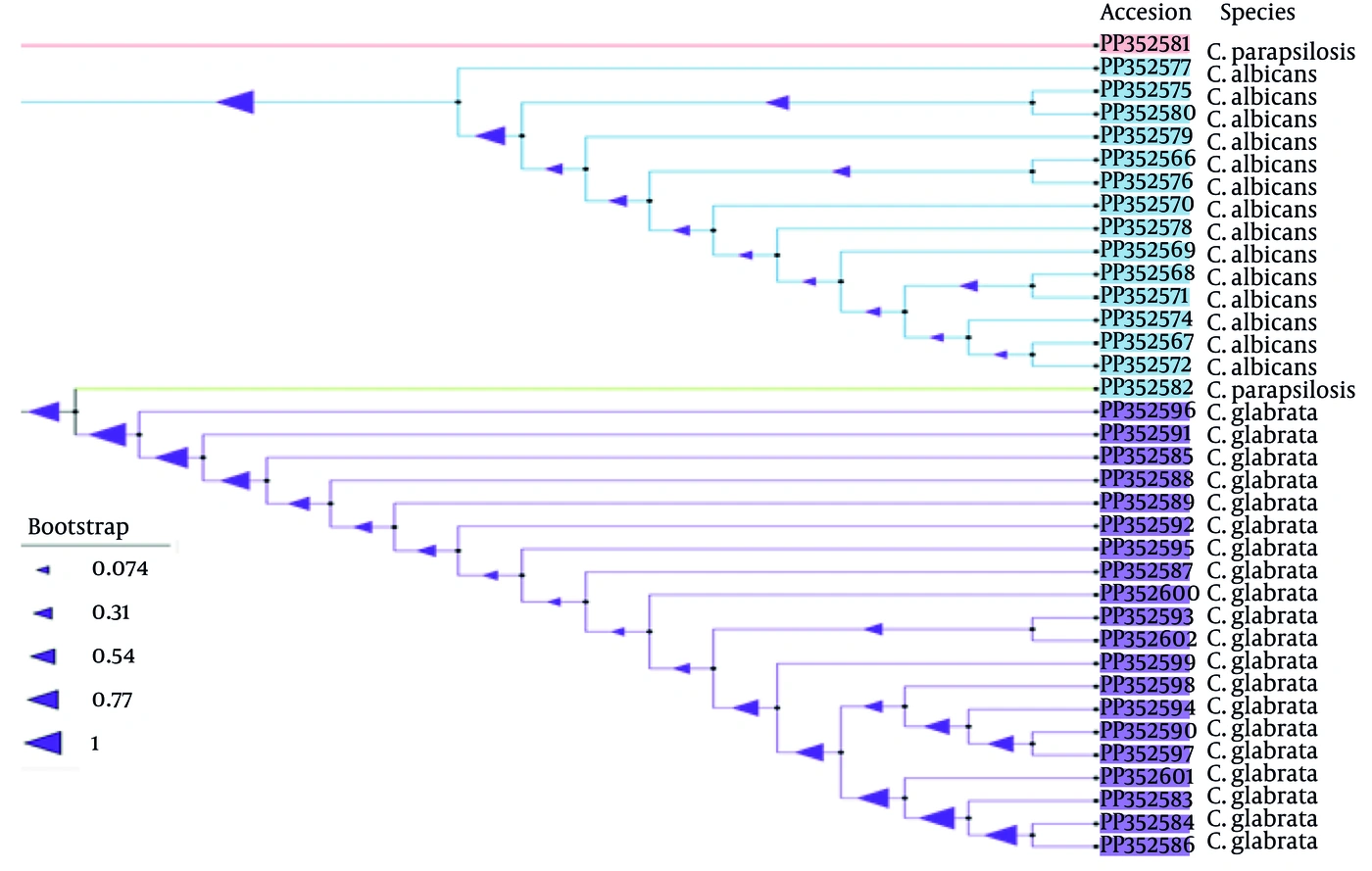
Figure 1.
Phylogenetic analysis using a maximum-likelihood tree involved the nucleotide sequence of Candida species based on analysis of the ITS region.
Enzymatic and biofilm activities are summarized in Table 5. C. albicans isolates exhibited the highest overall enzyme secretion potency, although levels varied by enzyme: 47% showed high hemolysin activity versus 29.4% with high phospholipase activity. Among the non-albicans species, the highest enzymatic activity was attributed to phospholipase. Statistically significant differences in enzyme potency among Candida species were observed for all enzymes except phospholipase (P < 0.05).
Table 5.
Enzymatic and Biofilm Activity of 44 Isolated Candida Species a
| Activities / Species | 0 | 1 | 2 | 3 | P-Value |
|---|---|---|---|---|---|
| Proteinase | 0.005 | ||||
| Candida glabrata | 8 (34.8) | 6 (26) | 7 (30.5) | 2 (8.7) | |
| C. parapsilosis | 0 | 1 (33.3) | 2 (66.7) | 0 | |
| C. albicans | 2 (11.8) | 2 (11.8) | 6 (35.3) | 7 (41.2) | |
| C. tropicalis | 0 | 0 | 1 (100) | 0 | |
| Phospholipase | 0.064 | ||||
| C. glabrata | 4 (17.4) | 8 (34.8) | 8 (34.8) | 3 (13) | |
| C. parapsilosis | 0 | 1 (33.3) | 1 (33.3) | 1 (33.3) | |
| C. albicans | 3 (17.6) | 5 (29.4) | 4 (23.5) | 5 (29.4) | |
| C. tropicalis | 0 | 0 | 0 | 1 (100) | |
| Hemolysin | < 0.001 | ||||
| C. glabrata | 13 (56.5) | 7 (30.5) | 3 (13) | 0 | |
| C. parapsilosis | 2 (66.7) | 0 | 1 (33.3) | 0 | |
| C. albicans | 2 (11.8) | 1 (5.9) | 6 (35.3) | 8 (47) | |
| C. tropicalis | 1 (100) | 0 | 0 | 0 | |
| Biofilm | 0.001 | ||||
| C. glabrata | 6 (26) | 7 (30.5) | 8 (34.8) | 2 (8.7) | |
| C. parapsilosis | 2 (66.7) | 0 | 1 (33.3) | 0 | |
| C. albicans | 0 | 1 (5.9) | 5 (29.4) | 11 (64.7) | |
| C. tropicalis | 0 | 0 | 1 (100) | 0 |
a Values are expressed as No. (%).
Based on our results, 100% of C. albicans isolates produced biofilm according to Melo et al.'s criteria (15). As shown in Table 5, biofilm-forming ability was detected in only 26% of C. glabrata strains compared with 66.7% of C. parapsilosis isolates. A statistically significant difference in biofilm formation was evident among the Candida species tested (P < 0.05).
The antifungal susceptibility data are summarized in Table 6. Fluconazole MICs for C. glabrata ranged from 0.062 to 16 μg/mL (MIC50 = 0.5 μg/mL; MIC90 = 8 μg/mL), with uniform susceptibility observed across all tested strains. All isolates were classified as wild type (WT) to itraconazole, as evidenced by MICs of 0.062 - 2 μg/mL. The amphotericin B MIC ranged from 0.031 to 16 μg/mL, with 21.7% of isolates classified as non-wild type (NWT). The caspofungin MIC ranged from 0.25 to 2 μg/mL, with 56.5% susceptible and 43.5% resistant. For C. albicans, the fluconazole MIC similarly ranged from 0.062 to 16 μg/mL, with 11 susceptible, 3 intermediate, and 3 resistant isolates. All isolates were WT for itraconazole (MIC, 0.031 - 1 μg/mL). The amphotericin B MIC ranged from 0.031 to 4 μg/mL (6 resistant isolates), and the caspofungin MIC ranged from 0.25 to 2 μg/mL (23.5% resistant). Other Candida species were generally susceptible, although the limited sample size precluded detailed analysis.
Table 6.
Antifungal Susceptibility Profile of Isolated Candida Species a
| Species / Antifungal | MIC (μg/mL) | MIC50 | MIC90 | MICGM | WT | NWT | S | I/SDD | R |
|---|---|---|---|---|---|---|---|---|---|
| Candida glabrata (23) | |||||||||
| Fluconazole | 0.062 - 16 | 0.5 | 8 | 0.84 | - | - | - | 23 (100) | - |
| Itraconazole | 0.062 - 2 | 0.25 | 1 | 0.38 | 23 (100) | 0 | - | - | - |
| Amphotericin | 0.031 - 16 | 0.5 | 4 | 0.61 | 18 (78.3) | 5 (21.7) | - | - | - |
| Caspofungin | 0.25 - 2 | 0.25 | 2 | 0.52 | - | - | - | 13 (56.5) | 10 (43.5) |
| Candida albicans (17) | |||||||||
| Fluconazole | 0.062 - 16 | 0.5 | 8 | 0.76 | - | - | 11 (64.7) | 3 (17.6) | 3 (17.6) |
| Itraconazole | 0.031 - 1 | 0.125 | 0.5 | 0.19 | - | - | - | - | - |
| Amphotericin | 0.031 - 4 | 0.5 | 2 | 0.40 | 11 (64.7) | 6 (35.3) | - | - | - |
| Caspofungin | 0.25 - 2 | 0.25 | 1 | 0.53 | - | - | 9 (52.9) | 4 (23.5) | 4 (23.5) |
| Others (4) b | |||||||||
| Fluconazole | 0.062 - 1 | - | - | - | - | - | - | - | - |
| Itraconazole | 0.031 - 1 | - | - | - | - | - | - | - | - |
| Amphotericin | 0.25 - 4 | - | - | - | - | - | - | - | - |
| Caspofungin | 0.25 - 0.5 | - | - | - | - | - | - | - | - |
a Values are expressed as range or No. (%).
b Including three isolates of C. parapsilosis and one isolate of C. tropicalis.
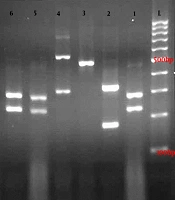
In this study, 17 C. albicans strains underwent ABC genotype analysis. The results revealed 2 predominant genotypes: genotype A, detected in 70.6% of isolates, and genotype B, found in 29.4% (Figure 2).
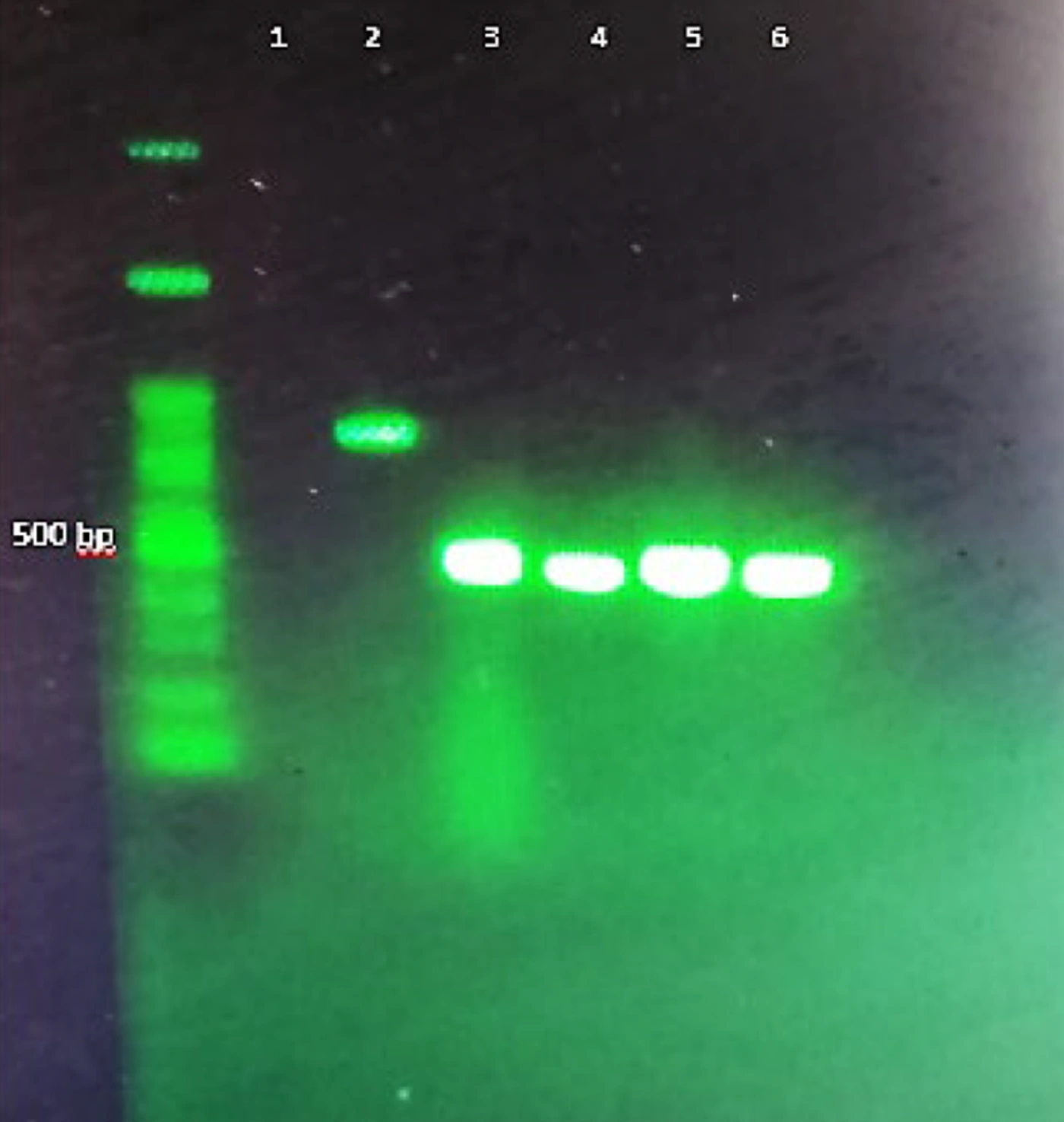
Figure 2.
The ABC genotype profiles of the C. albicans strains are shown, with genotype A producing a 450-bp amplicon and genotype B yielding an 840-bp fragment. The gel image includes a negative control in lane 1, a genotype B isolate in lane 2, and genotype A isolates in lanes 3 - 6.
5. Discussion
The increased use of parenteral nutrition, broad-spectrum antibiotics, indwelling devices, and chemotherapy drugs has contributed to the rising frequency of candiduria in hospitalized patients (17). Community-onset candiduria is uncommon in immunocompetent individuals with an intact urinary system. Conversely, patients with underlying kidney pathology are at increased risk of fungal infections. According to Denis et al., 4.3% (52/1223) of kidney transplant recipients had more than 1 episode of candiduria, and 51 (98%) patients were asymptomatic (3). Patients with diabetes, those receiving immunosuppressive therapy, and those with urinary catheters are at higher risk; all enrolled patients had a history of immunosuppressive disorders. Severe cases can lead to emphysematous cystitis, pyelonephritis, and the formation of fungus balls in the renal pelvis, ureter, or bladder (18, 19). The physicochemical properties of the urinary microenvironment likely influence the expression of virulence factors in urinary Candida isolates. Urine pH, which can be altered in renal patients, has been shown to modulate phospholipase and proteinase activity, with optimal enzyme function at neutral to slightly alkaline pH (6.5 - 7.5) and suppression under acidic conditions (1, 2). Other urine components, including glucose concentration (relevant to our diabetic patients, who constituted 25% of the cohort), urea, and creatinine, may also influence enzyme activity.
Hyperglycemic conditions have been associated with increased production of phospholipases and proteinases in C. albicans, potentially explaining the elevated enzymatic activity observed in patients with diabetes (20). In addition, urinary catheterization, present in 30% of our patients, can alter the local environment by promoting biofilm formation on device surfaces, where the structured extracellular matrix creates distinct microenvironments with altered pH gradients and nutrient availability compared with those of planktonic cells (7). Coexisting urinary microorganisms may also affect fungal virulence through competitive inhibition, interference with quorum sensing, or production of bacterial metabolites that modify the local niche (4-6). Notably, 22.5% of our patients had received broad-spectrum antibiotics, which likely disrupted the native urinary microbiota and influenced Candida colonization. In this study, approximately 16% of nephrology ward patients had asymptomatic candiduria, with a female predominance similar to that reported by Pramodhini et al. (21). The prevalence of 16.3% is higher than the 0.48%-6.2% range reported in other studies (12, 22, 23), likely because of differences in patients' underlying conditions and age groups. Consistent with our findings, C. glabrata was the most common pathogen reported by Denis et al. (3), and Safdar et al. noted its predominance in renal transplant recipients (19); in contrast, Pramodhini et al. found C. tropicalis to be the most commonly isolated species (21).
Yeasts in urine may originate from bladder colonization, specimen contamination, or upper urinary tract infection via hematogenous or retrograde spread (4). Candiduria is often treated empirically, and overtreatment of asymptomatic patients is common, as noted by He et al. (24). In this study, all 23 C. glabrata isolates were susceptible to fluconazole, whereas 43.5% were resistant to caspofungin. However, despite good in vitro activity, caspofungin achieves low urinary concentrations, underscoring the need for antifungal agents with effective urinary penetration (25). Fluconazole is the first-line treatment for candidiasis, and caspofungin is a key agent against various Candida strains (19, 26). However, C. glabrata exhibits intrinsic azole resistance (27), and empirical therapy without species identification can lead to adverse patient outcomes. This investigation highlights the importance of accurate identification of Candida species to inform effective therapeutic decisions.
Among the key virulence determinants of Candida species, particularly C. albicans, are extracellular enzymes, including proteases, phospholipases, and hemolysins, which promote tissue penetration and injury. Consistent with our findings, Wiebusch et al. reported strong proteinase activity in 50% and moderate activity in 41.66% of C. albicans isolates, whereas phospholipase production was limited to 8.33% (28). In our study, however, 29.4% of C. albicans isolates demonstrated strong phospholipase activity. Biofilm formation was observed in 91.66% of the isolates (28). Our findings showed that 64.7% of C. albicans strains displayed pronounced biofilm activity. Both biofilm development and enzymatic activity contribute to the adaptability and pathogenicity of Candida species in urinary tract infections. Reported biofilm formation rates vary by source and methodology: Zarei Mahmoudabadi et al. found that 100% of C. albicans isolates from multiple sources formed biofilms, with 83.3% showing maximum potential (29), whereas only 22.6% of bloodstream isolates formed biofilms in another study, compared with 71.4% of C. tropicalis isolates (30). These discrepancies likely reflect differences in isolate origin, clinical setting, or detection technique. Biofilms protect yeasts from antifungal agents and host defenses, promoting persistent infections, particularly in catheterized patients. As biofilms mature, their structured matrix enhances enzymatic secretion, nutrient acquisition, and drug resistance, complicating treatment (31).
ABC genotyping identified genotype A as the most common among urinary C. albicans isolates in our study (70.6%), followed by genotype B (29.4%). In contrast, Chaves et al. reported that genotype B isolates from urine have a greater tendency to cause invasive infections, whereas Gharaghani et al. similarly found genotype A to be predominant (8). The association between ABC genotypes and enzymatic activity in C. albicans isolates has been investigated in several studies, although findings remain somewhat inconsistent. Gharaghani et al. (8) reported that genotype A isolates from pediatric patients demonstrated significantly higher phospholipase and proteinase activity than genotype B isolates, suggesting that genotype A strains may possess enhanced tissue-invasive capabilities. Similarly, Sardi et al. (32) found that genotype A isolates from various clinical sources exhibited greater hemolysin production than genotype B isolates. However, other investigators have reported contrasting results; Chaves et al. (33) observed that genotype B isolates from urine samples showed higher phospholipase activity and a greater capacity for biofilm formation, which they associated with increased potential for invasive disease.
Among the 17 C. albicans urinary isolates in the present study, genotype A strains (n = 12) demonstrated higher enzymatic activity scores across all 3 enzymes tested than genotype B strains (n = 5). Specifically, 75% (9/12) of genotype A isolates showed strong (score 3) proteinase activity versus 40% (2/5) of genotype B isolates. Similarly, 58.3% (7/12) of genotype A isolates exhibited strong hemolysin activity compared with 20% (1/5) of genotype B isolates. Phospholipase activity also trended higher in genotype A strains, with 41.7% (5/12) showing strong activity versus 20% (1/5) of genotype B strains. These findings align with the observations of Gharaghani et al. (8), supporting the hypothesis that genotype A may be associated with a more virulent enzymatic phenotype in urinary isolates. The discrepancy between our findings and those of Chaves et al. (33) may be attributable to differences in study populations, geographic variation in strain distribution, or methodological differences in enzyme activity assessment. Furthermore, biofilm formation capacity in our study was notably higher in genotype A isolates (75%, 9/12) than in genotype B isolates (40%, 2/5), consistent with the hypothesis that genotype A strains may possess enhanced pathogenic potential in the urinary tract environment. These observations suggest that ABC genotyping may serve as a useful adjunctive marker for predicting virulence potential in C. albicans urinary isolates, although larger multicenter studies are needed to confirm these associations and elucidate the molecular mechanisms underlying genotype-specific differences in enzymatic activity.
5.1. Conclusions
The increasing frequency of candiduria in inpatient settings is attributable to the extensive use of parenteral nutrition, broad-spectrum antimicrobials, invasive devices, and chemotherapy. This study demonstrates that asymptomatic candiduria affects a substantial proportion of renal patients, reinforcing the need for rigorous monitoring and appropriate diagnostic protocols. Nakaseomyces glabratus was the most commonly isolated species. The ability of Candida organisms to form biofilms and produce extracellular enzymes significantly enhances their pathogenicity, making them serious threats in urinary tract infections.