1. Background
Excessive and improper use of antimicrobials (antibiotics and biocide) in hospitals and community has led to development and acquisition of bacterial resistance to antimicrobials (1). These factors can transfer within mobile genetic elements such as conjugative plasmids, transposon, integron and chromosomes (2, 3). Resistance to a wide range of antimicrobial agents and emergence of MDR, extreme drug resistant (XDR) and pan drug resistant (PDR) phenotypes between some nosocomial infectious agents such Acinetobacter species in some countries especially in Iran has increased (4-6) During the last three decades, Acinetobacter species are detected accompanied by beta-lactamase encoded enzymes, blaTEM, blaCTX and New-Delhe-metallo-B-lactamase-1 from a wide variety of environments (7).
Also the presence of OXA-48, OXA-181, CTX-M-15, SHV, blaoxA-23,24,51, blaCTX (oxA-10,2), TEM (blaTEM-1,2,13), methylase, ESBL, qnr and six types of NDM5 (1-2-3-4-5-6), disinfectant resistance genes, quc (A-E) (8) and detection of new plasmids such as PNDm-1-DOK01 encoding different types of outer membrane proteins (OMPA), siderophores and iron acquisition systems (9), presence of pili mediated DNA uptake and biofilm formation by fimbria and exopolysaccharides on biotic and abiotic surfaces convert the Acinetobacter baumannii to a super bug (10, 11). Authors were eager to study A. baumannii isolates collected from hospital ICU environments and medical equipment surfaces in Tehran. The frequency of blaTEM and blaCTX resistance genes was evaluated by molecular techniques among the isolates. In the next step, the susceptibility of A. baumannii isolates to 2% glutaraldehyde solution was determined.
2. Objectives
The current study aimed to investigate the responsible genes and mechanism of resistance and sensitivity of Acinetobacter species to 2% glutaraldehyde in order to design protective schemes such as controlling infection in hospital and precise determination of phenotype and genotype resistance patterns for MDR species.
3. Materials and Methods
3.1. Bacterial Isolates and Identification
The current experimental analysis collected 588 samples from surfaces of medical equipment of ICUs of different hospitals in Tehran from January 2013 to November 2013 by standard sampling methods including swabs and transport medium Tryptic soy broth (MERCK, Germany). One hundred-thirty-one samples of A. baumannii were biochemically identified as explained in Table 1.
Table 1.
Identification of Acinetobacter Speciesa
| Test | Reaction |
|---|---|
| Oxidase | - |
| KIA | K/K |
| TSI | K/K |
| Growth on MAC | + |
| Motility | - |
| OF-glucose | + |
| OF-lactose | + |
| Urea | - |
| Growth at 42°C | + |
| Nitrate | - |
| Hemolysis | - |
| Arginine | - |
| Malonate | + |
| Gelatin hydrolysis | - |
aDefinitions: +, means growth; –, means no growth.
Antibiotic disks used in the study were imipenem (10 µg ), meropenem (10 µg), ceftizoxime (30 µg), oxacillin (1 µg), gentamicin (10 µg ) and lincomycin (2 µg ) ciprofloxacin (5 µg), ceftazidime (30 µg), cefotaxime (30 µg), ampicillin (10 µg), tetracycline (30 µg), cefixime (5 µg ) and colistin (10 µg) collected from (Mast Diagnostics, Mast group Ltd., Mersey side, UK). The level of sensitivity or resistance of the isolates to antibiotics were measured by disk diffusion method and the minimum inhibitory concentration (MIC) of MDR strains to imipenem and meropenem antibiotics was measured by microdilution method (12). The responsible genes to detect beta-lactamases (blaTEM and blaCTX) were detected in resistant isolates according to their appearance on the electrophoresis bonds.
3.2. Amplification of blaTEM and blaCTX-M Genes by PCR Method
Boiling method was used to extract DNA of A. baumanii MDR isolates. The isolated DNA with specific primers for the study was confirmed by BLAST bank, and blaTEM and blaCTX were detected by PCR. The PCR primers used to amplify blaTEM, blaCTX genes in the study are shown in Table 2. The PCR mix consisted of 25 µL containing 7.5 µL distilled water, 12.5 µL 10X PCR master mix (Fermentas Company, Burlington, Ontario, Canada) and 3 µL of DNA template; 1 µL of each forward and reverse primers of the genes TEM and CTX in 10 pmol concentration were used. The primer sequences are summarized in Table 2. The temperature gradient and the temperature of annealing for both genes were 54°C. To reassure the accuracy of the test and considering reversibility of the results, PCR levels were performed twice for each and every one of the MDR strains. To sequence the TEM, CTX genes http:www.lahcy.orgs site (13) was used. PCR conditions genes are summarized in Table 3.
Table 2.
Primer Sequences and Length of Amplification Products
| Genes | Primer Sequences (5' - 3') | Product Sizes, bp |
|---|---|---|
| BlaCTX-A | 5'-CGCTTTGCGATGTGCAG-3' | 550 |
| BlaCTX-B | 5'-ACCGCGATATCGTTGGT-3' | 550 |
| BlaTEM-A | 5'-GAGTATTCAACATTTCCGTGTC-3' | 800 |
| BlaTEM-B | 5'-TAATCAGTGAGGCACCTATCTC-3' | 800 |
Table 3.
PCR Conditions Genesa
| Step | Temp,°C | Time | ||
|---|---|---|---|---|
| CTX | TEM | CTX | TEM | |
| Initial denaturation of heat shock | 94 | 94 | 3 min | 3 min |
| DNA denaturation | 94 | 94 | 30 s | 30 s |
| Primer annealing pairing | 63 | 45 | 1min | 1 min |
| Primer extension / elongation | 72 | 72 | 1 min | 1 min |
| Final extension/ final elongation | 72 | 72 | 10 min | 10 min |
aNumber of the PCR cycles = 35.
3.3. Electrophoresis
The PCR products were screened by agarose gel electrophoresis method on 1.5% agarose (UltrapureTM Invitrogen, CA, USA). Electrophoresis was performed by 90 A voltage in 60 minutes (14). Amplified genes were separated according to their molecular size. The product were stained by ethidium bromide (0.5 g/mL) and then washed with distilled water twice. Finally the stained gels were monitored by gel documentation system (T. N.) and the corresponding images were taken and analyzed for their associated bounds accordingly to detect the location and size of the DNA of the goal genes GenRulerTM 1 kb DNA ladder, ready-to-use (Fermentas Company, Burlington, Ontario, Canada) was used (Figures 1 and 2). The data were analyzed by SPSS statistical software and t-test was used to analyze antibiotic resistance and the product of the blaTEM and blaCTX genes.
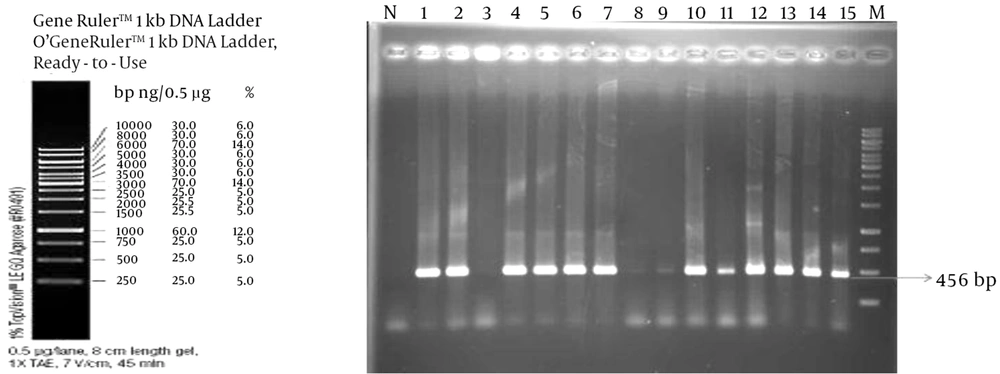
Figure 1.
N, number of template DNA; M, size marker 1 kb ladder.
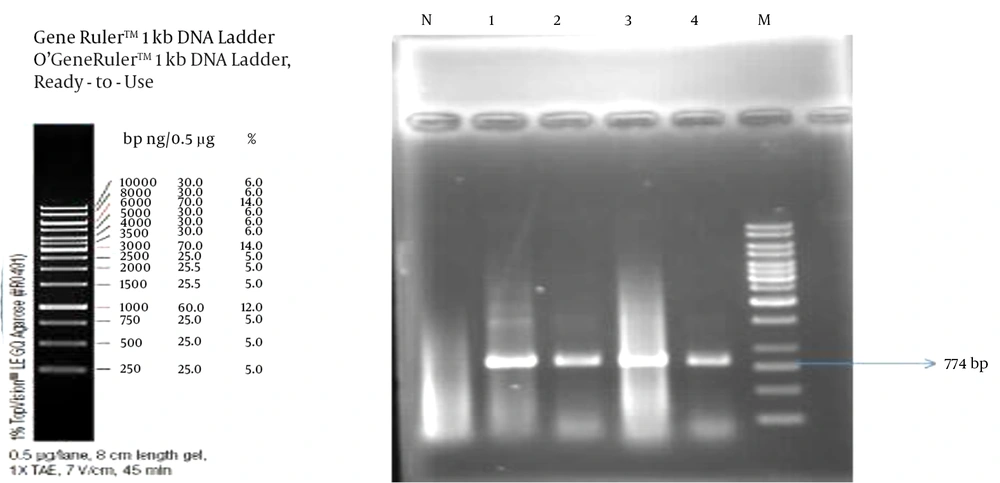
Figure 2.
N, number of template DNA; M, size marker 1 kb ladder.
3.4. Treating 2% Glutaraldehyde With MDR Strains
Bacterial suspension perpetrated by direct colony suspension method (DCS) based on McFarland 0.5 standards. The suspension exposure to 2% glutaraldehyde (neodishersepto 3000 according to EC with the number 20048164) at 5, 10 and 15 minutes, stops the growth of MRD bacteria in the suspension. Shorter exposures had no impact on the bacteria.
The suspensions were cultured on blood agar and incubated for 16 - 18 hours at 37°C. The growth of the resistant isolates was considered after 18 hours. Then 2% sodium hydroxide was added to neutralize glutaraldehyde which raised the pH to 12; to back the suspension to the neutralized pH, some acids such as hydrochloric acid was used. By adding sterile PBS, the solutions were washed and again cultured on blood agar plates and incubated for 16 - 18 hours at 37°C. The growth of the resistant isolates was considered after 18 hours again. At this level, a specific volume of microbial suspension (tied to McFarland 0.5) was spread on some surfaces with the dimensions of 25 cm2 and immediately the 2% glutaraldehyde was added and 5, 10 and 15 minutes after the exposure, sampling was performed using standard and sterile swaps; samples were cultured on blood agar and incubated for 16 - 18 hours at 37°C.
4. Results
In the current study 131 A. baumannii (22.3%) were isolated out of 588 samples. The minimum and maximum average frequencies of the MDR strains in the ICUs were 21% and 24%, respectively. The most frequent MDR strains were isolated from ICU II of Fayazbakhsh hospital (22.8%) and the least was found in ICU and NICU of Taleghani hospital (21.3%). Antimicrobial resistance ranges are shown in Table 4. MIC50% and MIC90% of imipenem and meropenem were 32 ± 1 and 64 ± 1 µg/mL respectively (P < 0.9) (Table 5). The results of the amplification were confirmed by PCR method (Figures 1 and 2).
Table 4.
Antimicrobial Resistance of Clinical Isolates of Acinetobacter baumannii
| Antimicrobial Resistance Trait | No. (%) of Isolates |
|---|---|
| Imipenem (10 µg) | 100 |
| Meropenem (10 µg) | 100 |
| Lincomycin (2 µg) | 100 |
| Ceftazidime (30 µg) | 99 |
| Ciprofloxacin (30 μg) | 98 |
| Oxacillin (1 µg) | 90 |
| Ceftizoxime (30 µg) | 90 |
| Gentamicin (10 µg) | 85.97 |
| Tetracycline (30 µg) | 70.2 |
| Ampicillin (10 µg) | 70.2 |
| Cefotaxime (30 µg) | 69.4 |
| Cefixime (5 µg) | 69.4 |
Table 5.
Minimum Inhibitory Concentration of Meropenem and Imipenem on Acinetobacter baumannii
| Antibiotic | Acinetobacter baumannii, µg/mL | ||
|---|---|---|---|
| MIC50%a | MIC90%a | MIC Range | |
| Imipenem | 32 ± 1 | 64 ± 1 | 4 - 128 |
| Meropenem | 32 ± 1 | 64 ± 1 | 4 - 128 |
aValues are expressed as mean ± SD.
4.1. Evaluation of Treating 2% Glutaraldehyde on Resistant Isolates
The previous data recommended that the 2% glutaraldehyde disinfectants at least in 10 or 15 minutes have inhibitory effect on the growth of A. baumannii suspension equivalent to McFarland 0.5 standard. In the current experiment longer and shorter exposure times were also evaluated. The results indicated that 5 minutes (the shorter recommended time) exposure to 2% glutaraldehyde disinfectant had no inhibitory effect on the bacterial growth.
The current study demonstrated that, through various mechanisms such as linking with non-protein amines in the level of bacterial cell, hydroxyl and amine in micro-organisms, cross linking with alpha amino acid amine lysine and other amino acids and preventing the transmission and activation of dehydrogenized elements, glutaraldehyde can be applied as a disinfectant to sterilize and disinfect surfaces and medical equipment in the special care wards of hospitals.
5. Discussion
Multi drug resistance in A. baumannii is considered as the major cause of the failure of nosocomial infections treatment. Because of spontaneous resistance and adaptation of the genetic elements which carry resistance genes, and also acquisition of enzymatic and non-enzymatic resistance genes, facing antibiotics and biocides and by the emergence of PDR, XDR, MDR phenotypes, global health concerns are raised. However, A. baumannii antibiotic resistance due to defects or reduction in expression of outer membrane proteins such as porins, presence of leakage system (efflux pumps) (15), mutations in topoisomerase, occurrence of resistance-nodulation cell division (RND) and toxic compound extrusion are considered as some of the resistance mechanisms (16, 17). In the previous studies, the frequencies of multidrug-resistant A. baumannii species were reported as 30 - 89% in the world.
Ferreira et al. found that 68% of the bacterial isolates in Brazil were multidrug resistant (18). In Greece, the number of A. baumannii MDR phenotype was reported 83.9%. Peymani et al. in Tabriz found that 80% of the isolates were multidrug resistant (19). Based on the study of Ghalavand in Tehran, the frequency of MDR and XDR isolates of A. baumannii were 83% and 44.8%, respectively. In the current study 87.3% of the isolates were multidrug resistant, similar to the previous findings. No resistance to colistin was reported in Iran which corresponded to the reports from different parts of the world.
In Ghalavand’s study, the rate of resistance to carbapenems was 92%. In the present study all A. baumannii isolates (100%) were resistant to carbapenems which compared to other previous data were the high incidence of carbapenem resistance in A. baumannii isolates. Ghalavand et al. reported the incidence of resistance to meropenem, ciprofloxacin and cefepime in A. baumannii isolates as 99%, 98% and 90% respectively which were similar to the current study results and those of Faizabady’s; it was in contrast with the study by Hujer et al. in U.S.A which the rate of resistance to meropenem and imipenem were reported more than 90% (21, 22). According to the current study results, the frequency of imipenem-meropenem resistant A. baumannii was in contrast with the results of world researches.
The high rates of resistance are related to excessive and improper use of antimicrobials in the ICUs in Iran. Hujer research reported that 40% of the isolates carried blaCTX and 12.8% carried blaTEM (22). On the other hand, multi drug efflux pumps play an important role in the appearance of resistant strains to some drugs because of sobestrical wide variety, side effects of the increase in statements and abundance of the efflux pumps which results in boosting and leaking of a huge range of antimicrobials, antiseptic, colors, detergents and disinfections. Making some new drugs to cope multi-drug resistance is the new goal in medical treatments. Moreover, phenotype test shows that 131 isolates of Asenitobacter species, carrying blaCTX (19.4%) and blaTEM (3.2%) genes which confirms that the resistant to glutaraldehyde is significant. PCR is known as a sensitive and effective method for epidemiological analysis and tracing MDR, XDR and PDR species.
This study showed that 2% glutaraldehyde is an effective disinfectant to sterile surfaces and medical equipment of ICUs. This compound has different mechanisms such as linking with non-protein amines of bacteria cell, cross linking with alpha amino acid, amine (lysine) and other amino acids, preventing transfer, dehydrogenating and interaction. It can also, to a lower extent, react with lipase, carbohydrates and nucleotidases. Due to the fact that proteins are universal compound in cells, glutaraldehyde is capable to link cellular compounds. Presence of MDR species necessitates the use of 2% glutaraldehyde, washing hands and maintaining hygiene in hospitals.
The results of this study showed that the genetic patterns of particular genes blaTEM and blaCTX in A. baumannii isolates have wide diversity Hence evaluation of new antibacterial and disinfectant agents, efficacy, and proper management of antimicrobial agents can control A. baumannii infection and prevent appearance of resistant strains in the hospitals and community. Also conducting more precise and comprehensive study on phenotypic and genotypic resistance patterns of A. baumannii against different classes of antibiotics and disinfectant agents is recommended.