Dear Editor,
Studies of Helicobacter pylori show that it is the cause of duodenal ulcers, gastric ulcers, gastric adenocarcinoma, and primary gastric B cell lymphoma (MALT lymphoma). Helicobacter pylori is the first established carcinogenic bacterium. Thus, it is very important to diagnose and treat H. pylori infection and determine the effectiveness of eradication treatments. The C14-urea breath test (C14-UBT) is a rapid, well-tolerated, non-invasive method to detect H. pylori, with a sensitivity of 94.9% and specificity of 100% (1). We employed C14-UBT to investigate the prevalence of H. pylori infection and evaluate its association with epidemiological, demographic, socioeconomic, and environmental factors of patients.
In this study, we recruited 2,929 patients (1,751 females; 1,118 males; mean age: 35.54 ± 20.41 years; range 3 - 82 years) who had been referred for C14-UBT between April 2007 and January 2017. The exclusion criteria included previous gastric surgery, H. pylori eradication treatment, and equivocal C14-UBT results (25 - 50 cpm). Helicobacter pylori infection status was determined with C14-UBT. The patients were assessed based on a standard questionnaire completed by the patients or their parents. The patients were grouped according to age, gender, blood group, body mass index (BMI), past medical history, demographic properties such as education level, smoking and/or alcohol habit, the existence of common systemic disease, presence of companion animals, and the family history of gastric disease.
Capsules of urea (Helicap®, Isotop, Budapest, Hungary) labeled with 37 kBq (1 µCi) of C-14 were swallowed with 50 mL of water. After 15 min, the patients breathed out into a card (Heliprobe BreatheCardTM, Kibion, Stockholm, Sweden) until the indicator color turned from orange to yellow. The activity was counted for 250 seconds and the results were given in counts per minute (cpm) by a Heliprobe analyzer (HeliprobeTM- analyzer, Kibion, Stockholm, Sweden) as a special Geiger-Müller counter. The values of ≤ 25 cpm indicated no infection, between 25 and 49 cpm indicated a suspicion, and ≥ 50 cpm indicated an infection. Statistical analysis was performed by SPSS 20.0 using the Wilcoxon signed-rank test, Student’s t test for unpaired data, and simple regression analysis, as appropriate. A P value of < 0.05 was considered statistically significant.
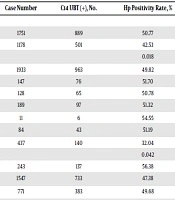
According to the results, 1,390 (47.4%) cases were H. pylori-positive (42.55% in males and 50.77% in females). The rate of UBT positivity was 262/609 (43%) in the pediatric group, 877/1749 (50%) in the adult group, and 251/571 (44%) in the geriatric group. The difference was statistically significant between pediatrics and the other age groups (P = 0.043). A positive correlation was found between C14-UBT positivity and age (r = 0.76) (Table 1). There was a significant relationship between C14-UBT positivity and existence of common systemic disease, education level, and income level (P = 0.018, P = 0.042, P = 0.037, respectively) (Table 2). C14-UBT positivity was not correlated with gender, smoking/alcohol habits, family history of gastric disease, presence of companion animals, BMI, and blood type (P > 0.05).
| Number | Age, y | C14-UBT (+) | C14-UBT (-) | |
|---|---|---|---|---|
| Pediatrics (< 16 years) | 609 | 13.19 ± 2.91 | 262 (43) | 347 (57) |
| Adults (16 - 65 years) | 1749 | 36.18 ± 12.51 | 877 (50) | 872 (50) |
| Geriatrics (> 65 years) | 571 | 69.51 ± 5.68 | 251 (44) | 312 (56) |
| Total | 2929 | 35.54 ± 20.41 | 1390 (47.4) | 1531 (52.6) |
Abbreviations: C14-UBT (+), positive result for C14-Urea Breath Test; C14 UBT (-), negative result for C14-Urea Breath Test.
aThere was a statistically significant difference between the pediatric group and the other age groups (P = 0.043) and a positive correlation between C14-UBT positivity and age (r = 0.76).
bValues are expressed as mean ± SD or No. (%).
Table 2.
The Percentage of Patients with Positive Test Results According to Gender, Past Medical History, Education level, Income Level, Smoking/Alcohol Habits, Gastric Disease History in the Family, the Presence of Companion Animals, BMI, and ABO/Rh Blood Group Typea
| Characteristics | Case Number | C14 UBT (+), No. | Hp Positivity Rate, % | P Value |
|---|---|---|---|---|
| Sex | 0.216 | |||
| Female | 1751 | 889 | 50.77 | |
| Male | 1178 | 501 | 42.53 | |
| Past medical history | 0.018 | |||
| None | 1933 | 963 | 49.82 | |
| Diabetes Mellitus | 147 | 76 | 51.70 | |
| Asthma | 128 | 65 | 50.78 | |
| Hypertension | 189 | 97 | 51.32 | |
| Renal Disease | 11 | 6 | 54.55 | |
| Rheumatologic Diseases | 84 | 43 | 51.19 | |
| Other GIS Diseases | 437 | 140 | 32.04 | |
| Education level | 0.042 | |||
| Illiterate | 243 | 137 | 56.38 | |
| Primary Education | 1547 | 733 | 47.38 | |
| High School | 771 | 383 | 49.68 | |
| University | 357 | 132 | 36.97 | |
| Master or Doctorate | 11 | 3 | 27.27 | |
| Level of income | 0.037 | |||
| Low | 1187 | 658 | 55.43 | |
| Middle | 1241 | 489 | 39.40 | |
| High | 501 | 243 | 48.50 | |
| Smoking and/or alcohol habit | 0.296 | |||
| Yes | 540 | 282 | 52.22 | |
| No | 2389 | 1108 | 46.38 | |
| Presence of family history of gastric disease | 0.187 | |||
| Yes | 645 | 338 | 52.40 | |
| No | 2284 | 1052 | 46.06 | |
| Presence of companion animals | 0.772 | |||
| Yes | 183 | 126 | 68.85 | |
| No | 2746 | 1264 | 46.03 | |
| BMI | 0.214 | |||
| Low | 606 | 271 | 44.72 | |
| Normal | 1136 | 568 | 50.00 | |
| High | 753 | 338 | 44.89 | |
| Obese | 325 | 171 | 52.62 | |
| Morbidly obese | 109 | 42 | 38.53 | |
| ABO/Rh blood group type | 0.836 | |||
| A Rh (+) | 887 | 326 | 36.75 | |
| B Rh (+) | 855 | 415 | 48.54 | |
| AB Rh (+) | 480 | 167 | 34.79 | |
| O Rh (+) | 275 | 122 | 44.36 | |
| A Rh (-) | 187 | 97 | 51.87 | |
| B Rh (-) | 143 | 55 | 38.46 | |
| AB Rh (-) | 67 | 30 | 44.78 | |
| O Rh (-) | 35 | 18 | 51.43 |
Abbreviations: BMI, body mass index; C14-UBT (+), positive result for C14-Urea Breath Test; Hp, Helicobacter pylori.
aThere was a significant relationship between the test positivity and the past medical history, education level, and income level (P = 0.018, P = 0.042, P = 0.037, respectively). The H. pylori positivity was not correlated with gender, smoking/alcohol habits, gastric disease history in the family, the presence of companion animals, BMI, and blood type (P > 0.05).
Epidemiological studies show that the prevalence of H. pylori infection increases with age because of inadequate hygiene, low education level, and low socioeconomic conditions in developing countries (2-4). Similar to previous studies (1, 5), our study demonstrated that H. pylori infection was not associated with smoking, alcohol habits, blood groups/Rh factors, and gender. We did not find any relationship between H. pylori positivity and BMI, the presence of companion animals, and a positive family history of gastric disease. we believe that an existing chronic diseases or condition (such as diabetes, asthma, hypertension, renal disease, rheumatologic disease, and other gastrointestinal diseases) may show predisposition of H. pylori positivity.
As a conclusion, there is a statistically significant correlation between H. pylori positivity and increasing age, education level, income level, and presence of common systemic disease, while no significant relationship was found between H. pylori prevalence and the other parameters; these findings were in accordance with the literature.