
1. Background
Bleeding management is among the major issues in medicine, especially during surgery. Different bleeding management methods have been tested by specialists, and research is still carried out to find a more efficient method. Bleeding, especially uncontrollable bleeding, is a major surgical complication (1).
Bleeding during surgery is among the problems faced by surgeons and anesthesiologists (2). A surgeon needs a clear sight with minimum bleeding to be able to perform a sensitive and delicate surgery. In addition, one of the concerns of anesthesiologists is to reduce bleeding in order to maintain hemodynamic stability during surgery. Electrocauterization and administration of antihypertensive drugs are among the methods used for controlling bleeding during surgery (3). In electrocauterization, the vessels are burned using a bipolar electric current applied to both sides of the bleeding vessel. However, this method has shortcomings, including the blockage of cauterized vessels, lack of blood supply to the tissues nurtured by the vessel, and micronecrosis in cauterized areas (4). Although collateral vessels will supply blood to these tissues, this process will take some time, during which small areas of the tissue become necrotic. This necrosis extends surgical wound healing time and the duration of recovery, accompanied by the formation of scar tissues, surgical site deformity, and disruption of some physiological functions (5).
Various techniques are used to reduce bleeding during surgery, including hemodynamic methods such as controlled blood pressure reduction, use of topical vasoconstrictors, epidural blocks (6), and chemical and biological drugs, such as desmopressin (7), aprotinin (8), tranexamic acid (8), epsilon aminocaproic acid (9), and estrogen.
According to the World Health Organization (WHO), over 80% of the world’s population use herbal drugs for treating diseases (10). Almost a quarter of the drugs produced worldwide have herbal origins, and either are directly extracted from plants or are synthesized based on herbal compounds (11). Most studies show that the correct processing of plants and herbal drugs significantly increases the effects of these natural drugs and makes them more cost-effective compared to synthetic drugs. Therefore, it is of great importance to identify the potential applications of medicinal plants used in traditional medicine (12).
Various plants are used in traditional medicine to control bleeding. Pomegranate (Punica granatum Linn) is among the plants widely used in various industries. Pomegranate is a small tree belonging to the Punicaceae family. It is a medicinal plant about which a considerable amount of information can be found in the traditional medicine literature (13). Recently, many reports have been published on the therapeutic properties of Pomegranate flowers, seeds, and peel, such as antioxidant, anti-inflammatory, anticancer, and antimicrobial effects. Pomegranate is a native plant grown in the south of Iran. It is widely used in traditional Iranian medicine to treat many diseases, especially bleeding disorders, such as menorrhagia, gingivitis, and diarrheal diseases (14).
Myrtle is a rare specific plant species found in limited areas of Iran and other parts of the world. Its small shrubs normally range in size from 1 to 3 m. Some studies have suggested Myrtle extract as a potential remedy for excessive bleeding (15, 16).
Rhus coriaria L belongs to the Anacardiaceae family and contains flavonoids, phenolic acid, citric acid, and tartaric acid (17). In traditional medicine, Rhus coriaria L was used to treat dyspepsia, loss of appetite, diarrhea, bleeding, and hyperglycemia. Antioxidant, antimicrobial, antipyretic, anti-inflammatory, and antihemorrhagic effects are among the medicinal properties of this plant (18).
Quercus is another name for oak tree fruits (Quercus brantii Lindl.). The decoction of Quercus has been noted as a remedy for bleeding gums. The antihemorrhagic effects of Quercus have been mentioned in some modern books (19).
2. Objectives
The purpose of this study was to investigate the effects of Pomegranate peel and flower, Myrtle, Quercus fruit, and Rhus coriaria L extracts on bleeding control in rats.
3. Methods
This experimental study was approved by the Ethics Committee of Rafsanjan University of Medical Sciences (ethics code: IR.RUMS.REC.1398.059).
Thirty-two male 8-10-month-old Wistar rates weighing 200 - 250 g were housed under standard laboratory conditions with free access to sufficient water and food (20). The animals in all experimental groups received the same care and were kept under 12:12 h light/dark cycles and temperature of 23 ± 2.0°C. The rats were randomly divided into four groups: (a) topical application of the extracts on tail wounds, bleeding time (B.T.) measurement; (b) intraperitoneal injection of the extracts, measurement of prothrombin time (P.T.) and partial thromboplastin time (PTT) in blood samples drawn from the heart; (c) control group 1 (tail wounds without topical application of the extracts, B.T. measurement); and (d) control group 2 (determination of P.T. and PTT, without intraperitoneal injection of the extracts).
3.1. Plant Extracts
Plant extracts were prepared by the experts working at the Agricultural Sciences Department, Vali-Asr University, Rafsanjan, Kerman Province, Iran.
3.1.1. Rhus coriaria L. Ethanolic Extract
After preparing Rhus coriaria L. fruits and having them confirmed by the scientists of the Department of Botany and Plant Sciences, the Faculty of Agriculture, Vali-Asr University of Rafsanjan, the ethanolic extract was obtained using 100 g of powered Rhus fruit in 200 mL of 80% ethanol for 24 h at room temperature while protecting from sunlight. The extract was placed in an incubator at 37°C for six days to be concentrated by the complete evaporation of ethanol. The extract was dissolved in distilled water in a 1:1 ratio (w/v). The resulting solution (50% Rhus coriaria extract) was sterilized by passing through a 0.22 µm filter and stored in a dark screw-cap sterile container in a refrigerator until use (21).
3.1.2. Pomegranate Flower Hydroalcoholic Extract
For preparing the hydroalcoholic extract, 50 g of Pomegranate flower was collected in spring and dried in a dark and cool place. The resultant was mixed with 200 mL of 70% ethanol and placed on a shaker at room temperature (about 22°C) for 72 h. The extract was filtered and concentrated on reaching a volume of 25 mL by being placed in an incubator at 45°C (22).
3.1.3. Pomegranate Peel and Seed Methanolic Extract
One-hundred g of peel and seed powders was mixed with 10 mL of methanol, then extracted using a Soxhlet apparatus with 200 mL methanol. The solvent was evaporated under reduced pressure at 40°C. The extract was reconstituted by being dissolved in distilled water before use (23).
3.1.4. Myrtle Methanolic Extract
In this step, 10 g of dried Myrtle leaves was mixed with 50 mL methanol and allowed to stand still for 24 h. On the next day, the liquid phase was separated, and fresh solvent was added. This process was repeated three times. On the last day, the liquid phase was dried by an incubator (24).
3.1.5. Quercus Extract
After preparing Quercus, its seeds were separated and dried away from light; 200 g of seed powder was mixed with 500 mL of distilled water and 500 mL of 96% ethanol and kept in a dark place for two days. The suspension was stirred for 20 minutes every day. After that, the suspension was filtered using the Whatman filter paper, and the filtered liquid was vacuum extracted by an evaporator at 50°C. The concentrated extract was dried in an incubator at 40°C. Using this method, 56 grams of extract were obtained from 20 kilograms of oak (25).
3.2. Study Groups
The rats were divided into four experimental groups.
3.2.1. Group A: Topical Application of Extracts on Tail Wounds and Bleeding Time Measurement
A small transverse incision (up to 5 mL) was made by sharp surgical scissors 2 mm from the end of the tail under anesthetize. The rats were anesthetized using urethane (1.5 g/kg, intraperitoneal). One drop of the mixed extract of the above-mentioned plants was placed on the wound, and B.T. was measured by a chronometer from the time of applying the herbal extract. It is noteworthy that normal B.T. in human is 2-7 min. This method was first invented by Chan et al. (26).
3.2.2. Group B: Intraperitoneal Injection of Extracts
In this group, the herbal extract was first passed through 0.2 µm filters to remove impurities and microorganisms that could probably cause inflammation or infection. Then 0.1 mL of the extract was intraperitoneally injected by an insulin syringe with needle #31. Two mL of heart blood was drawn into tubes containing 3.8% trisodium citrate (9:1, V/V) to prevent coagulation. The blood samples were centrifuged for 10 min (2000 rpm) to separate the plasma, and P.T. and PTT were measured by an optical method using a coagulometer. To measure P.T., 100 µL of plasma was mixed with 200 µL of thromboplastin and incubated at 37°C. To measure PTT, 100 µL of plasma was incubated with 100 µL of aPPT-SA reagent for three minutes at 37°C; then 100 µL of CaCl2 solution was added. Finally, P.T. and PTT were determined by calculating the absorbance difference at 560 nm (20).
3.2.3. Group C: Control Group 1
No herbal extract was received by the rats in this group. Five mm transverse incisions were made by sharp surgical scissors 2 mm from the end of the tail, and B.T. (the time needed for the complete cessation of bleeding) was immediately measured by a chronometer.
3.2.4. Group D: Control Group 2
Rats in this group did not receive any herbal extract intraperitoneally. Similar to group B, 2 mL of heart blood was collected, and P.T. and PTT were measured.
3.3. Statistical Analyses
Statistical analysis was performed using SPSS 16 software. All data were expressed as mean ± S.E.M. Differences between the study groups were determined using ANOVA followed by Tukey’s post-hoc test. P-value < 0.05 was considered the statistical significance level.
4. Results
The results of the independent t-test showed that the mean B.T. in the control group (3.57 ± 0.20 seconds) was significantly longer than in group A (1.56 ± 0.13 seconds) (P < 0.001). The mean of P.T. in the control group (15.91 ± 0.72 seconds) was not significantly different from the corresponding value in group B (15.56 ± 1.23 seconds) (P = 0.499) (Table 1 and Figure 1).
The results of the independent t-test showed that mean PTT in the control group (18.24 ± 2.82 seconds) was significantly shorter compared to mean PTT in group B (38.00 ± 14.49 seconds) (P = 0.006) (Table 1 and Figure 1).
Table 1.
Comparison of Bleeding Time, Prothrombin Time and Partial Thromboplastin Time in the Two Intervention and Control Groups
| Variables and Groups | Number of Rats | Mean ± SD | Min-Max | P-Value |
|---|---|---|---|---|
| B.T. | < 0.001 | |||
| Intervention | 8 | 1.56 ± 0.13 | 1.40 - 2.15 | |
| Control | 8 | 3.57 ± 0.20 | 3.30 - 4.30 | |
| P.T. | 0.499 | |||
| Intervention | 8 | 15.56 ± 1.23 | 14.40 - 16.70 | |
| Control | 8 | 15.91 ± 0.72 | 14.80 - 16.70 | |
| PTT | 0.006 | |||
| Intervention | 8 | 38.00 ± 14.49 | 17.0 - 58.0 | |
| Control | 8 | 18.24 ± 2.82 | 15.0 - 24.0 |
Abbreviations: B.T., bleeding time; P.T., prothrombin time; PTT, partial thromboplastin time.
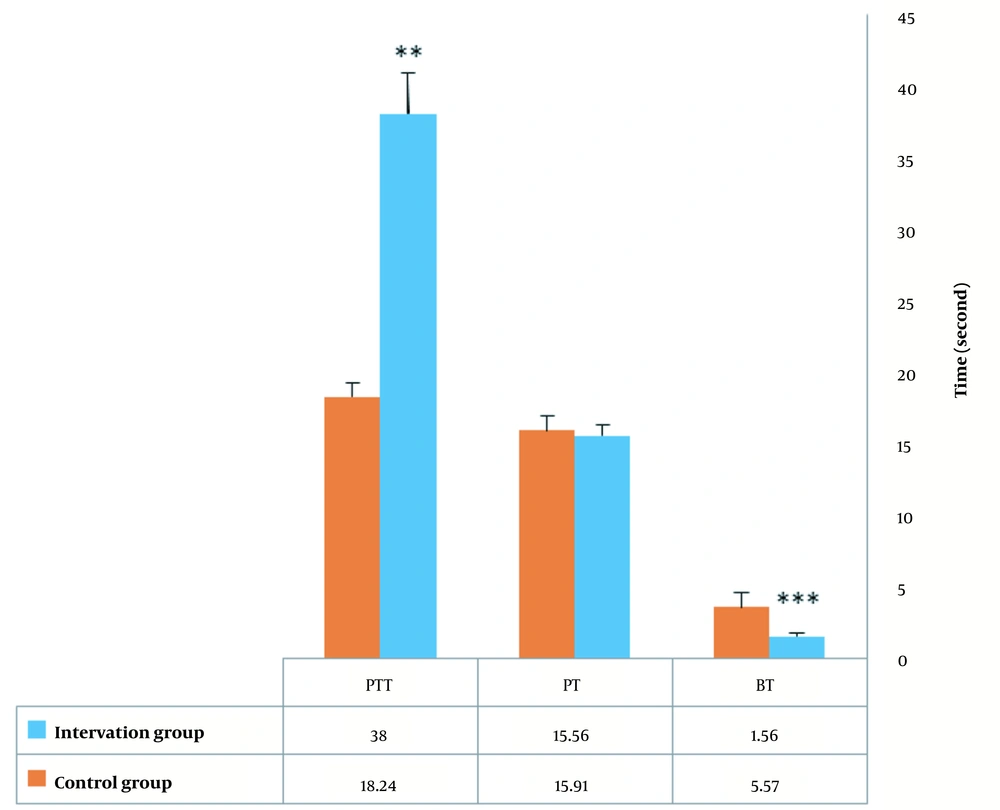
Figure 1.
Comparison of bleeding time (B.T.), prothrombin time (P.T.), and partial thromboplastin time (PTT) between the two intervention and control groups. *** P < 0.001, ** P < 0.05.
5. Discussion
This study investigated the effects of Pomegranate peel & flower, Myrtle, Rhus coriaria L., and Quercus extracts on bleeding control in rats. According to the results, mean B.T. in the intervention group was shorter than in the control group. In other words, the herbal extract decreased B.T. in the rats treated with the herbal extracts. According to another study, three months of consuming Myrtle extract significantly reduced the number of bleeding days in women with abnormal menorrhagia compared to the control group (15). Also, Pomegranate flower extract could significantly control menstrual bleeding and reduce the volume of bleeding in women, improving relevant clinical indices and their life quality (27). Riaz and Khan showed that Pomegranate extract had cardioprotective effects and coagulant properties (28). Pomegranate peels had been used by ancient Egyptians and Indians as a therapeutic agent to control nosebleeds. These results concerning the anticoagulant effects of Pomegranate flowers were consistent with our findings. In a study, Pomegranate was reported to reduce gingival bleeding (29). According to Tansaz et al., Pomegranate has been considered an effective substance in Iranian traditional medicine to manage menorrhagia (17).
Pomegranate flowers are widely used in Greek, Chinese, and Indian medical systems and are known as an excellent traditional antidiabetic and anti-bleeding agent (30). According to studies, consuming Pomegranate flower extract significantly changed PTT, platelet count, and fibrinogen level and significantly reduced P.T. (31). In a study, researchers reported that Pomegranate peel extract showed the same effects as mefenamic acid in controlling mensural bleeding, improving life quality, and increasing hemoglobin levels among recipients (32). The results of our study were consistent with another report supporting the efficacy of Pomegranate flower extract in controlling excessive uterine bleeding (33). Recent studies show that the medicinal effects of Pomegranate peel can be attributed to its tannins such as ellagitannins, ellagic acid, punicalagins, flavonoids, and phenolic compounds. Flavonoids are a subset of condensed tannins, and their procoagulant effects are consistent with their biological structure, suggesting them as viable sources for manufacturing coagulant reagents (34).
Qaraaty et al. studied the anticoagulant properties of Myrtle. They found that Myrtle syrup could be used as a potential drug to control excessive uterine bleeding (menorrhagia) (15). The results of these studies on the coagulant effects of Myrtle were consistent with our findings.
Myrtle ingredients were also able to prevent edema and inflammation in rats. The most important ingredients of Myrtle (a total of 26 compounds) included five α-pinene compounds (41.55%), 1,8-cineol or eucalyptol (32.24%), linalool (7.13%), α-terpineol - α (4.74%), and linalyl acetate (3.19%), constituting 88.85% of the total content of Myrtle (35).
One of the limitations of the present research was the lack of using the active ingredients of the plants studied. Therefore, we could not relate the therapeutic effects observed to a specific component in these plants. However, these preliminary results provide a basis for future studies.
5.1. Conclusions
Considering the plausible procoagulant effects of Pomegranate (flowers and peels), Myrtle, Rhus coriaria L., and Quercus extracts compared to the control group, these extracts can provide a suitable adjuvant drug to control bleeding. Although the procoagulant effects of these extracts have been mentioned in many traditional medicine texts, human tests are required to reject or confirm their clinical effects.