In agreement with other studies that used scopolamine to model AD-like conditions (
26,
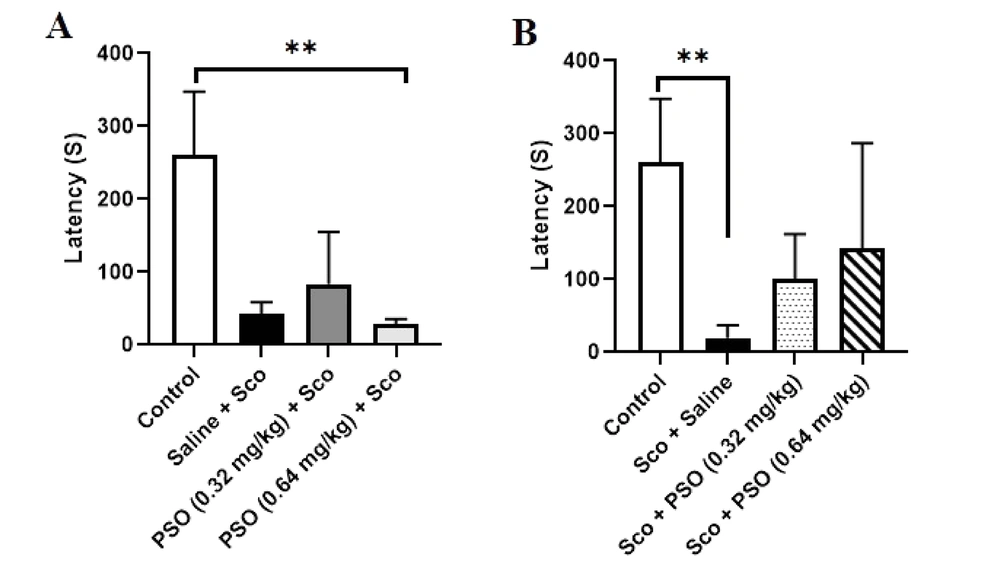
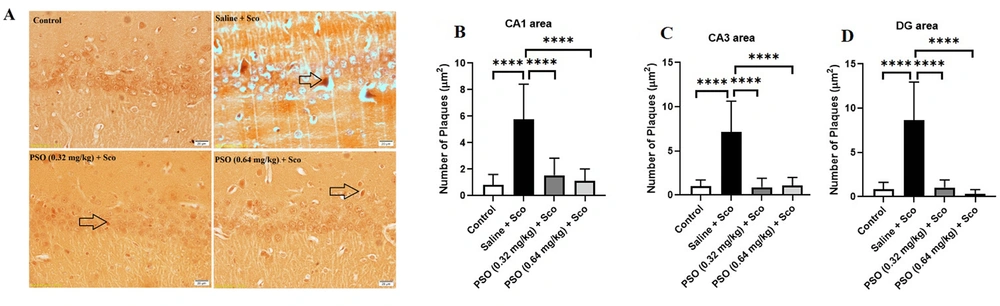
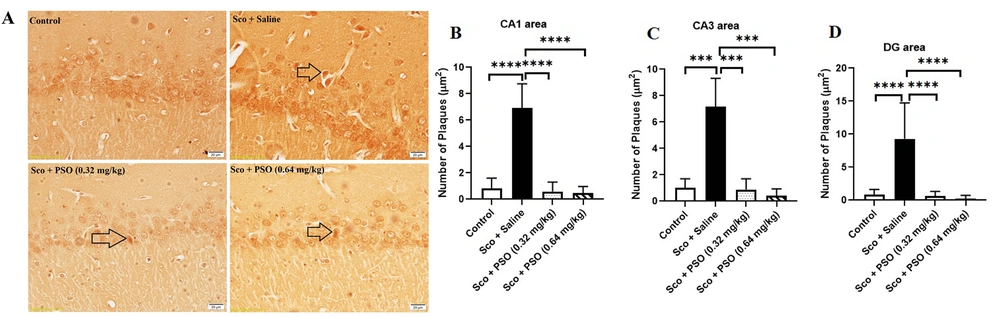
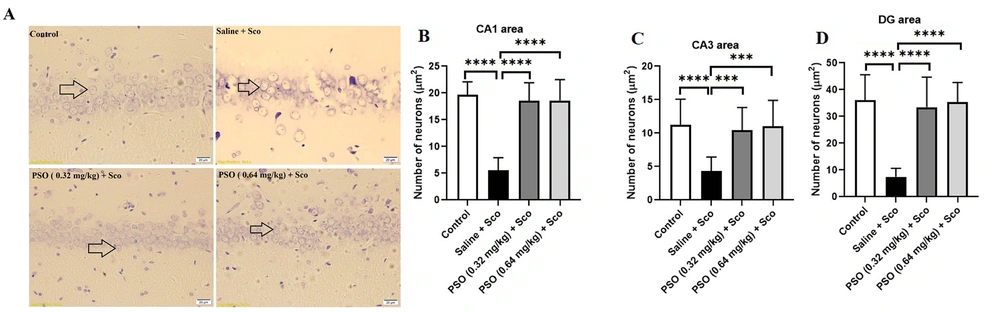
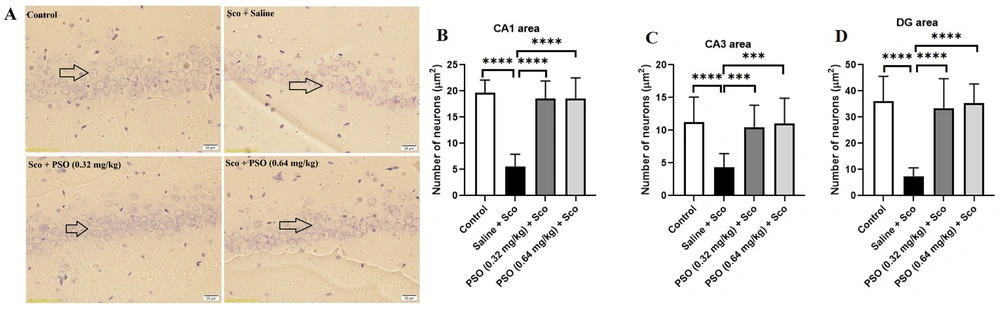
27), our findings confirmed impaired memory in the scopolamine-injected groups compared to the control group. We found that PSO re-established scopolamine-induced impairment in passive avoidance memory. Furthermore, we observed a notable reduction in the density of Aβ plaques and an increase in the number of neurons across various subfields of the hippocampus, the main structure involved in memory formation and stabilization.
Pomegranate is recognized as a medicinal plant that offers effective neuroprotection against several neurodegenerative disorders (
28-
30). Sarkaki (
15), in 2013, reported that continuous treatment with pomegranate seed extract for 14 days could ameliorate both passive and active memory impairments in cerebral ischemia model rats, due to the phytoestrogen and antioxidative effects of pomegranate seed extract (
10). Another study revealed that pomegranate juice at a 20% concentration for 29 days improved learning and memory while protecting brain cells from degeneration induced by aluminum chloride (
31). Moreover, pomegranate juice has been found to enhance spatial learning performance by reducing amyloid formation in AD model transgenic mice (
7).
Dietary supplementation with pomegranate has shown promising effects on cognitive functions, particularly in APPsw/Tg2576 mice, where a 4% pomegranate diet improved memory, learning, locomotor functions, and reduced anxiety (
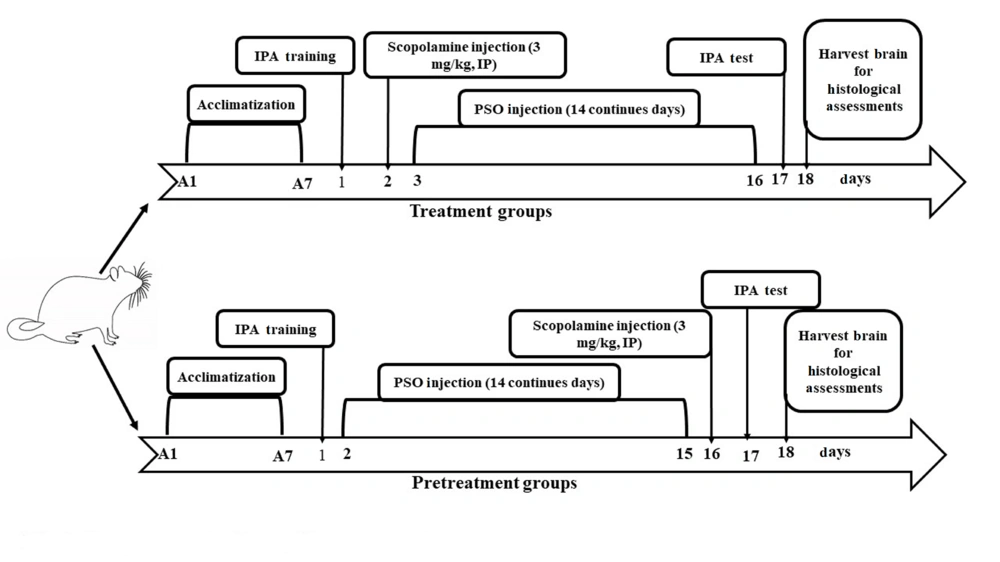
14). The results of the current study showed that treatment with 0.32 mg/kg and 0.64 mg/kg of pomegranate seed oil could improve passive avoidance memory in scopolamine-treated rats; however, these improvements were not significant. Remarkably, pretreatment with 0.64 mg/kg of PSO resulted in decreased memory performance.
The dysfunction of the cholinergic system results in the deterioration of learning and memory processing in AD. Scopolamine blocks acetylcholine muscarinic receptors, leading to increased acetylcholinesterase activity in the hippocampus and cortex (
32). This enhancement is associated with memory deficits and oxidative stress in the brain. Notably, PSO has been shown to possess neuroprotective properties by inhibiting acetylcholinesterase activity and enhancing antioxidant capacity (
33).
Synaptic plasticity is essential for the maintenance of learning and memory, which is impaired in AD pathology. Administration of 4% pomegranate over 15 months ameliorated the loss of key synaptic proteins, including PSD-95, Munc18-1, SNAP25, and synaptophysin (
34). These proteins are vital for synaptic function and plasticity, indicating that pomegranate may play a significant role in enhancing cognitive functions through its protective effects on synaptic integrity.
The protective effects of PSO and pomegranate extract are thought to stem from their ability to neutralize reactive oxygen species (ROS), upregulate the expression of antioxidant genes, and exert anti-inflammatory, anti-apoptotic, and ATP-replenishing effects (
11,
35). Studies have demonstrated that PSO protects against toxins such as mercuric chloride, hexachlorobutadiene, diazinon, cisplatin, gentamicin, and H
2O
2 (
36,
37). In addition, pretreatment with pomegranate extract before ischemia/reperfusion in rats resulted in protection against brain injury and DNA damage (
35).
Amyloid aggregation is a crucial pathological feature of AD (
38). Deposition of Aβ peptides, especially Aβ1-42, increases oxidative stress, neuroinflammation, and neuronal death (
39). The administration of scopolamine increased Aβ production and oxidative stress while reducing neuronal density in rodent brains (
19,
38). These findings align with the current study, which demonstrated that a single injection of scopolamine (3 mg/kg) elevated the density of Aβ plaques and reduced neuronal density in the hippocampus of rats.
Previous studies have shown that pomegranate juice and extracts exert neuroprotective effects against AD pathogenesis in several transgenic animal models, though the exact bioactive compounds have not yet been fully identified. Urolithins are suggested to mediate the neuroprotective effects of pomegranate against AD, as they inhibit Aβ fibrillation in vitro (
40). It has been reported that pomegranate prevents amyloidogenesis in SK-N-SH cells stimulated with interleukin-1β. It is assumed that pomegranate is a potent nutritional strategy to slow neurodegeneration in AD (
41). Pomegranate peel extract (800 mg/kg/day) reduced the density of Aβ plaques in Aβ peptide-treated mice (
28). In transgenic mice, pomegranate juice hindered the accumulation of soluble Aβ1-42 and amyloid deposition in the hippocampus (
7).
Moreover, the phenolic compounds in PSO have demonstrated significant neuroprotective effects. Shrivas et al. (2023) developed a stable microemulsion incorporating PSO as an adjuvant for galantamine hydrobromide (GHBr). The optimized ratio of GHBr to PSO showed promising outcomes, including reduced toxicity, enhanced antioxidant activity, and protection against Aβ-induced cell death. The study highlights PSO as a potential treatment to enhance the efficacy of anti-Alzheimer’s therapies (
12). Additionally, PSO can inhibit key enzymes, reduce ROS, prevent microglial activation, inhibit tau protein hyperphosphorylation, maintain synaptic plasticity, exhibit anti-inflammatory activity, and suppress beta-secretase-1 (BACE-1) (
42).
These benefits are largely attributed to punicic acid, the primary bioactive compound in PSO, which is an omega-5 isomer of conjugated α-linoleic acid. Punicic acid possesses potent antioxidant and anti-inflammatory properties, reducing oxidative damage and inflammation by upregulating peroxisome proliferator-activated receptors. It further mitigates AD pathology by reducing beta-amyloid deposition and tau hyperphosphorylation through mechanisms such as enhanced GLUT4 protein expression and inhibition of calpain activation (
43).
Pomegranate peel extract has been shown to decrease apoptosis and chromatolysis in the DG and CA3 areas of the hippocampus, reduce neurofibrillary tangles and senile plaques, and restore Nissl granules (
44,
45). Consistent with these findings, the current study discovered that pretreatment and treatment with pomegranate seed oil (0.32 and 0.64 mg/kg) can reduce the density of Aβ plaques in scopolamine-injected rats. Additionally, it increased the density of neurons in the rat hippocampus. These results confirm the neuroprotective properties of pomegranate seed oil against the adverse effects of AD pathogenesis. Essa et al. (
46) observed that long-term administration of pomegranate (for 15 months) decreased the levels of Aβ1–40 and Aβ1–42 in the brains of transgenic AD mice. In the current study, the protective effects of PSO were observed during a two-week treatment, which reduced the density of Aβ plaques in the hippocampus of scopolamine-injected rats. It has also been reported that pomegranate extract is more protective when administered as a pretreatment rather than as a therapeutic, as it reduces the histopathological features of AD (
44). However, this study found that both pretreatment and treatment with pomegranate seed oil can be protective against the extension of Aβ plaques and the loss of neuronal density.
5.1. Conclusions
This study highlights the neuroprotective effects of PSO in a scopolamine-induced Alzheimer's disease rat model. The PSO reduced amyloid-β plaques, preserved neuronal density in the hippocampus, and restored memory function. While further research is needed to elucidate detailed mechanisms and validate these findings in humans, this study suggests that PSO is a promising agent for AD treatment.
5.2. Limitation
This study had several limitations. First, while the neuroprotective effects of PSO were demonstrated, the specific bioactive compounds responsible and their mechanisms of action were not fully clarified. Additionally, the molecular pathways through which PSO reduces amyloid-β plaques and oxidative stress remain unclear. These aspects should be further explored in future studies. Moreover, it is recommended to focus on clinical trials to confirm the neuroprotective effects of PSO and evaluate its potential as a therapeutic agent for Alzheimer’s disease.