Optimization of culture media for antibody production, as demonstrated in the current study, holds significant industrial relevance by markedly improving protein yield and solubility — two critical factors for scalable biopharmaceutical manufacturing (
26). Strategies such as utilizing TB as a nutrient-rich medium and incorporating glycerol as a solubility-enhancing additive help reduce dependence on costly protein refolding processes, simplify production workflows, and improve batch-to-batch consistency (
18).
Moreover, carefully optimized induction parameters — such as temperature and IPTG concentration — help minimize metabolic stress in microbial cell factories, thereby enhancing the efficiency and reliability of expression systems. These advancements not only streamline downstream processing and lower production costs, but also support compliance with stringent quality standards, making them applicable across a broad range of recombinant protein production platforms (
27).
In this study, we examined the effects of four different media — TB, LB, TY2x, and M9 — on growth and scFvs production in engineered
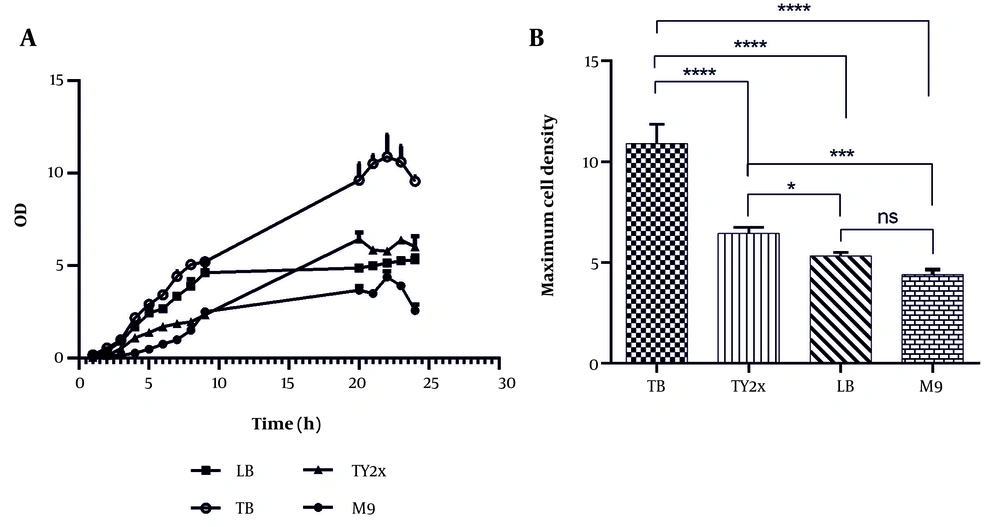
E. coli K-12 BW25113. According to our findings, compared to TB, LB, and TY2x, which exhibited lag phases of approximately two hours, a prolonged lag phase of four hours was observed in the M9 medium, emphasizing
E. coli’s dependence on nutritional richness for rapid adaptation and development (
21,
28).
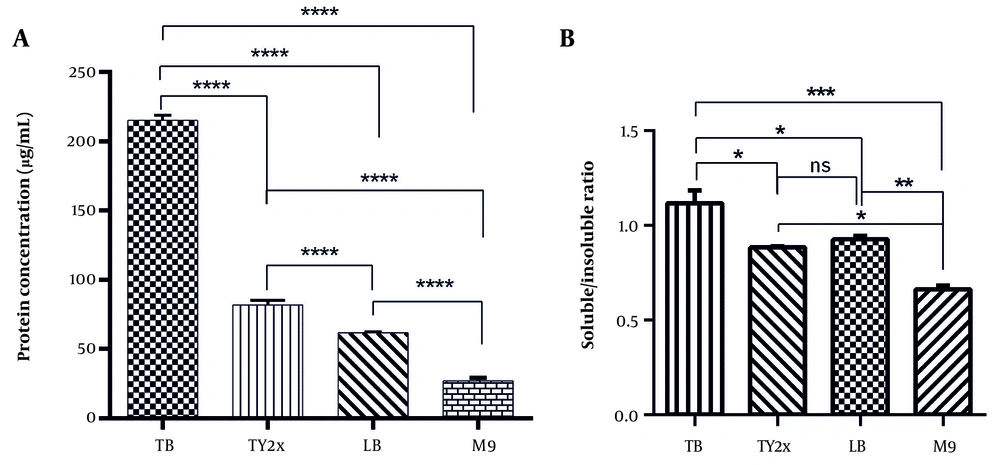
In terms of cell density, the highest OD (10.89 ± 0.84) was achieved in TB medium, followed by TY2x (OD = 6.44 ± 0.26), LB (OD = 5.32 ± 0.17), and M9 (OD = 4.4 ± 0.22). Thus, TB proved to be the most effective medium for promoting bacterial growth, reaching its peak OD during the stationary phase after 22 hours. Additionally, TB supported the highest level of scFvs antibody production (215.19 ± 3.27 µg/mL), representing an approximately 3.5-fold increase compared to LB (61.98 ± 0.637 µg/mL). A similar pattern was observed in a study by Latifah et al., where TB yielded higher levels of recombinant rhEGF (503.48 μg/mL) and cell densities nearly five times greater than those in LB (
29). It is well established that media composition directly affects bacterial growth rates and the metabolic pathways involved in protein biosynthesis (
11,
30). TB and LB are among the most commonly used media for
E. coli cultivation, particularly in recombinant protein production (
21). Compared to LB, which contains 0.5% yeast extract and 1% tryptone, TB contains significantly higher concentrations — 2.4% yeast extract and 1.2% tryptone. Tryptone serves as a rich source of amino acids, nitrogen, and peptides, which are essential for both bacterial growth and protein synthesis. Meanwhile, yeast extract provides a wide array of vitamins, growth factors, and minerals that facilitate enzymatic reactions supporting various metabolic pathways, improving cell viability, and accelerating growth. The increased concentration of yeast extract in TB (2.4% vs. 0.5% in LB) enhances nutrient availability, promoting enzymatic activity and reducing cellular stress responses — such as protease production — that can impair recombinant protein yield and stability (
31). The abundance of amino acids, carbon sources, vitamins, and peptides in nutrient-rich media boosts bacterial metabolism and ATP production. This energy surplus supports more efficient transcription and translation processes, reducing stress on host cells during protein synthesis (
32). Additionally, glycerol in TB functions as a chemical chaperone, reducing protein aggregation during synthesis and promoting proper protein folding. Glycerol also contributes to increased ATP generation by enhancing carbon availability for cellular respiration (
18). Because cells can use glycerol not only as an energy source but also as a precursor for biosynthetic pathways, its presence in TB further supports biomass accumulation and elevated metabolic activity.
Since amino acids are the primary carbon source in LB medium, bacterial growth tends to cease once these amino acids are depleted, leading to lower overall recombinant protein production. In contrast, TB includes phosphate buffering agents such as KH
2PO
4 and K
2HPO
4, which help maintain a stable pH during fermentation. This buffering capacity prevents pH fluctuations that could otherwise induce cellular stress or death, thereby negatively impacting both cell growth and protein yield. In LB medium, the pH can increase significantly (up to pH 9) due to ammonium excretion resulting from amino acid catabolism. Elevated pH levels can inhibit enzyme activities essential for protein synthesis. Moreover, low phosphate concentrations in LB can limit cell density, as phosphate is an essential nutrient that may become depleted under intensive culture conditions (
11,
33).
According to our results, LB — a commonly used bacterial culture medium — led to lower antiEpEX-scFv production compared to TY2x (1.32-fold increase) and TB (3.5-fold increase). Similar findings have been reported in previous studies where alternative complex media outperformed LB in supporting recombinant protein production. For example, nutrient broth was shown to enhance cell growth and lipase production by approximately 1.3-fold compared to LB broth (
34). Additionally, Tripathi et al. compared different media compositions — including LB, super broth (SB), TB, M9, TY, 5× LB, and GE (glucose-enriched) — for their effectiveness in achieving high cell density of
E. coli and high yield of recombinant dengue epitopes. Among these, LB resulted in the lowest protein content (10.37 mg/L) and cell density (1.12 g/L) (
10).
Similarly, Hanapiah et al. investigated the impact of different culture conditions — including media type [LB, TB, super optimal broth (SOB), M9, and TY2×] and nitrogen source (tryptone and yeast extract) — on
E. coli BL21 (DE3) growth and xylonic acid production. Their findings indicated that SOB medium yielded significantly higher biomass and xylonic acid production (up to 8.69 g/L) compared to LB (
35). In our study, a substantial 8-fold reduction in protein expression was observed in M9 medium compared to TB, reinforcing conclusions from other studies that minimal media often lack critical nutrients required for effective recombinant protein production (
12). The markedly reduced scFv yield in M9 underscores the importance of using nutrient-rich media to achieve high levels of recombinant protein expression.
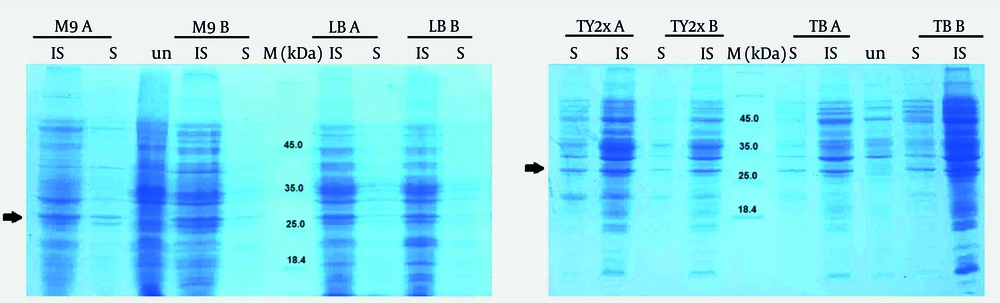
The data indicate that in TY2x medium, most of the expressed scFv protein is soluble and potentially functional, which is critical for efficient downstream processing. Differences in protein solubility are likely influenced by the specific nutrient composition of each medium (
11). The presence of particular nutrients in TY2x may promote proper protein folding by supporting the biosynthesis of molecular chaperones. In contrast, the absence of essential amino acids and growth factors in the M9 medium may contribute to the formation of insoluble protein due to incomplete folding or aggregation.
Although TB and LB also demonstrated acceptable levels of protein solubility, these were lower than those observed in TY2x. This suggests that even among nutrient-rich media, specific formulations can significantly impact protein folding and solubility, likely by modulating intracellular stress responses and folding efficiency.
In conclusion, our findings demonstrate that the metabolic rate of E. coli is directly influenced by the composition of TB, which supplies essential substrates and maintains optimal growth conditions. Among the four tested media, complex media such as TB resulted in the highest yields of viable cells and recombinant proteins — showing an approximately 8-fold increase in scFv expression compared to M9. While TB maximized overall yield, the highest soluble-to-insoluble protein ratio (1.117 ± 0.048) was observed in TY2x, suggesting more favorable conditions for proper protein folding in this medium. These results highlight a critical trade-off in industrial scFv production: Terrific broth provides higher yield, whereas TY2x supports greater solubility and potentially higher functional activity. Future process optimization should aim to enhance TB’s productivity through strategies such as continuous culture or fed-batch fermentation, while also improving solubility using genetic engineering tools. These may include co-expression of molecular chaperones and the incorporation of solubility-enhancing fusion tags to increase the proportion of biologically active scFv. However, several limitations should be acknowledged. These include the use of shake flasks, which may not accurately replicate bioreactor conditions; the use of a semi-quantitative method for protein quantification; the limited number of media tested; the absence of induction condition optimization; and the restricted generalizability of the results, given the focus on a single scFv construct and a specific E. coli strain. These constraints underscore the need for further research to fully optimize scFv production and validate the robustness of these findings. Nevertheless, the study suggests broader implications for the production of recombinant proteins.


![Sodium dodecyl sulfate-polyacrylamide gel electrophoresis (SDS-PAGE) and western blotting analyses of the antiEpEX-single-chain variable fragment (scFv) recombinant protein. After separation on a 12% SDS-PAGE gel, coomassie brilliant blue R250 staining was visualized protein bands. Total protein derived from the <i>Escherichia coli</i> strain K-12 BW25113 Δpka ΔarcA harboring pET22b-antiEpEX-scFv vector before induction (lane un) and after induction with isopropyl-β-D-thiogalactopyranoside (IPTG), (1 mM) for 24 h at 37°C in different media. The experiments were performed in duplicates for each medium and the replicates were indicated as A and B. A, lane M, unstained protein marker (14.4-116 kDa). Western blotting analysis of the recombinant scFv antibody produced in luria bertani (LB) medium. B, Bacterial lysate of the <i>E. coli</i> strain K-12 BW25113 Δpka ΔarcA before (lane un) and after (lane 1, 2, and 3 which are three technical replicates) induction was subjected to the anti His monoclonal antibody (mAb) [M: Pre-stained protein molecular weight standards (10 - 250 kDa)]. The expressed antibody with the expected size of ~ 30 kDa was indicated by an arrow.](https://brieflands.com/journals/jjnpp/articles/160690/figures/jjnpp-160690-i001-F1-preview.webp "Sodium dodecyl sulfate-polyacrylamide gel electrophoresis (SDS-PAGE) and western blotting analyses of the antiEpEX-single-chain variable fragment (scFv) recombinant protein. After separation on a 12% SDS-PAGE gel, coomassie brilliant blue R250 staining was visualized protein bands. Total protein derived from the <i>Escherichia coli</i> strain K-12 BW25113 Δpka ΔarcA harboring pET22b-antiEpEX-scFv vector before induction (lane un) and after induction with isopropyl-β-D-thiogalactopyranoside (IPTG), (1 mM) for 24 h at 37°C in different media. The experiments were performed in duplicates for each medium and the replicates were indicated as A and B. A, lane M, unstained protein marker (14.4-116 kDa). Western blotting analysis of the recombinant scFv antibody produced in luria bertani (LB) medium. B, Bacterial lysate of the <i>E. coli</i> strain K-12 BW25113 Δpka ΔarcA before (lane un) and after (lane 1, 2, and 3 which are three technical replicates) induction was subjected to the anti His monoclonal antibody (mAb) [M: Pre-stained protein molecular weight standards (10 - 250 kDa)]. The expressed antibody with the expected size of ~ 30 kDa was indicated by an arrow.")