
1. Background
Infectious diseases caused by microbial infections are major catastrophes in the medical and biomedical fields, imposing considerable economic, financial, and health-related burdens on patients and healthcare systems (1-4). For example, bacterial keratitis is a bacterial infection of the cornea that may lead to vision loss or blindness (5). Corneal infection by Pseudomonas aeruginosa may arise following extended contact lens wear, eye surgery, and other pathogenic-involving situations. Treatment options depend on microorganism culture and sensitivity tests, leading to the prescription of proper antibiotics (6).
Levofloxacin is a prototypical agent of the third-generation fluoroquinolones, exerting broad-spectrum antimicrobial activity against both gram-positive and gram-negative bacteria (7). Besides bacterial keratitis, levofloxacin can also be successfully prescribed to treat other infectious diseases, such as chronic bacterial prostatitis, lower respiratory tract infections, urinary tract infections, and H. pylori infections. Chemically, levofloxacin is a chiral fluorinated carboxyquinolone, which is the (-)-(S)-enantiomer of the racemic drug substance ofloxacin (Figure 1) (8). It is an amphoteric molecule (pKa1 and pKa2 values of 6.22 and 7.81, respectively) with a log P of 0.59 at the isoelectric pH of 7.10. Levofloxacin topical ophthalmic solution (5 mg/mL) is indicated for treating corneal ulcers and bacterial ocular infections.
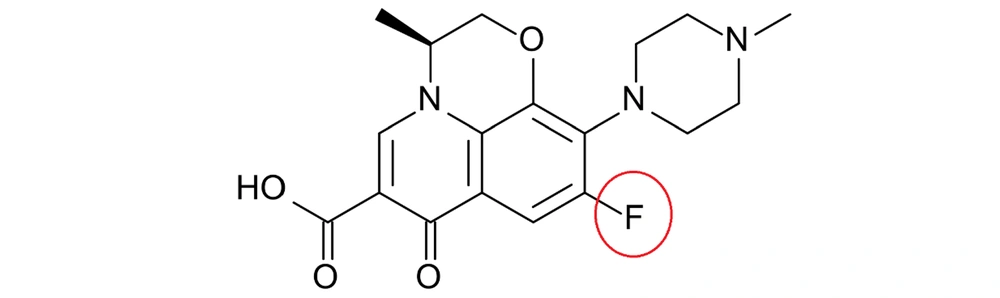
Figure 1.
Chemical structure of levofloxacin
The antibacterial activity of levofloxacin is related to its inhibition of enzymes (i.e., topoisomerase II, topoisomerase IV, and gyrase) responsible for separating bacterial DNA. It blocks cell transcription, replication, repair, and recombination, consequently resulting in cell death (9-12). According to reported structure-activity data, the fluorine atom at position 6 of the naphthyridine ring helps broaden levofloxacin’s activity spectrum against both gram-negative and gram-positive pathogens (Figure 1) (7, 8, 13). It is shown that the antibacterial activity of the S-isomer of levofloxacin is approximately 130 times higher than that of the R-isomer (7).
The bacterial killing activity of quinolones shows a concentration-dependent manner and increases with rising drug concentration. In this regard, as the serum drug concentration of levofloxacin rises to around 30 times the minimum inhibitory concentration (MIC), the antiseptic and bactericidal activity increases (9, 13, 14). However, the topical administration of levofloxacin drops in treating bacterial keratitis exhibits lower bioavailability due to the eye’s unique anatomical and physiological constraints. Therefore, the bactericidal effect of levofloxacin in treating bacterial keratitis is achieved with a repeatable dose at defined time intervals. Although the repeated administration of the drug decreases patient compliance, it also prevents bacterial resistance to the treatment (6, 14).
Another factor that may influence the effectiveness of the treatment is the stability of the substance in pharmaceutical formulations, which impacts the effective concentration of the drug. As a result, quantitative determination of drug concentration in pharmaceutical formulations and human plasma is an essential parameter to consider in levofloxacin administration to obtain better clinical outcomes. To date, several analytical methods have been introduced to quantify the amount of levofloxacin in different dosage forms, including 1H NMR spectroscopy, ultra-performance liquid chromatography (UPLC), capillary electrophoresis, and high-performance liquid chromatography coupled with ultraviolet (HPLC-UV), fluorescence (HPLC-FL), and tandem mass spectrometry (HPLC-MS/MS) detectors (15).
In high-performance liquid chromatography (HPLC) methods, different kinds of additives have been employed as mobile phase components to improve peak shape and resolution. For example, triethanolamine (TEA), tetrabutylammonium bromide (TBAB), butadiene styrene brominated ammonium (BSBA), tetrabutylammonium hydrogen sulfate (TBHS), and sodium or potassium phosphate buffers have been used in the mobile phase to improve peak shape (6, 15-18). Other methods were also conducted under the gradient elution method using formic acid, trifluoroacetic acid, and methanol at low concentrations (0.05 - 0.1%) as mobile phase components (19, 20). However, these methods result in a relatively long separation time, approximately 13 minutes. On the other hand, using additives in the mobile phase in gradient elution introduces additional disadvantages, including slow equilibrium time, reduced column lifetime, tailing peaks, early elution, late elution, and artifact peaks (21, 22).
Moreover, many of these HPLC methods rely on specific detectors that are not widely available in all laboratories due to the high cost of the equipment. In addition, although different HPLC methods have been applied to determine and quantify levofloxacin and its various derivatives in human plasma and standard solutions, the application of HPLC for determining levofloxacin concentration in real and pharmaceutical solutions has not been reported in the previous literature.
2. Objectives
With this background in mind, this study aimed to develop and validate a rapid, simple, economical, and precise HPLC method for quantitatively determining levofloxacin in ophthalmic drop solutions and other pharmaceutical formulations.
3. Methods
3.1. Material and Reagents
The levofloxacin standard was kindly gifted by Pioneer Pharmaceutical Industry, Iraq. All solvents used in this study were HPLC grade, and all reagents were analytical grade. Acetonitrile and trifluoroacetic acid were purchased from Merck, Germany. Water was purified with Milli-Q® Plus, Millipore System. Membrane filters with a pore size of 0.45 µm were acquired from Pall Life Sciences, India, and all solvents and solutions were filtered through a membrane filter and degassed before use.
3.2. Instrumentation; High-Performance Liquid Chromatography System
High-pressure liquid chromatograph model Waters Alliance 2695 HPLC system (Waters Corporation, Milford, MA, USA) equipped with an autosampler injection system, quaternary pump, vacuum degasser, and photodiode array detector (DAD) with Waters 2487 dual absorbance UV/Vis detector. The 2487 UV-Vis wavelength provides the most sensitive and versatile absorbance detection on HPLC. The analytical column was a phenyl L11 stationary column (250 × 4.6 mm, 5 µm, GL Sciences Inc., Japan).
3.3. Sample Preparation
A stock solution (1000 µg/mL of levofloxacin) was prepared by transferring an appropriate volume of Oftaquix 5 mg/mL ophthalmic solution (Santen Pharmaceutical Industry, Japan) into a volumetric flask and diluting it with diluent (acetonitrile:water 18:82 v/v) to a volume of 100 mL. The solution was shaken well and then sonicated for about 10 minutes. It was then filtered through a 0.45 µm pore size filter, and 20 µL of the filtered solution was injected into the HPLC system. All solutions were prepared fresh each day.
3.4. Method Evaluation and High-Performance Liquid Chromatography Condition
The method was optimized under various experimental conditions to determine the optimal mobile phase ratio, column temperature, flow rate, and type of column stationary phase. The mobile phase consisted of acetonitrile: 0.1% trifluoroacetic acid (18:82 v/v). The injection volume was 20 µL, and all solutions, including the mobile phase, were sonicated for 10 minutes before use. UV detection was made at 294 nm for all experiments. The best separation was obtained by isocratic elution at a flow rate of 1.5 mL/min. All analyses were performed at a constant column temperature of 30 ± 2°C.
3.5. Preparation of Calibration Standard
A stock solution with a concentration of 1000 µg/mL was prepared by transferring an accurate amount of levofloxacin and dissolving it in a diluent consisting of acetonitrile: Water (18:82 v/v). Series solutions with five different concentration levels (50.19, 75.28, 100.38, 125.47, and 150.57 µg/mL) were prepared from the standard stock solution and conveniently diluted with the diluent solution. Each concentration was injected five times, and mean values of peak areas were plotted against concentrations.
3.6. Validation Parameters
Validation parameters such as linearity, the limit of detection (LOD), limit of quantification (LOQ), accuracy, specificity, and precision were carried out to determine the accuracy and precision of the obtained method according to the International Conference on Harmonization (ICH) guidelines. The sensitivity of measurements was estimated in terms of LOD and LOQ using the following equations (23): LOD = 3.3 × N/P, LOQ = 10 × N/P. Where N is the standard deviation of the peak areas of the levofloxacin (n = 5), and P is the slope of the corresponding calibration curve.
4. Results
The development of a rapid, straightforward, and precise method for determining the drug in pharmaceutical formulations and human plasma at the pharmacokinetic range is essential for drug analysis and bioequivalence studies in many laboratories. To this end, the best resolution of peak shapes at the chromatographic conditions was examined. Parameters like the symmetry of peaks, capacity factor, and theoretical plate were studied to select the best mobile phase. It was observed that the mobile phase containing acetonitrile: 0.1% trifluoroacetic acid (18:82 V/V) at a flow rate of 1.5 mL/min at the optimum wavelength of 294 nm gives the best isolation of peak response of levofloxacin in both standard and sample solutions with no detection in the placebo solution, as shown in the respective chromatograms in Figure 2A - C. The retention time of levofloxacin at the flow rate of 1.5 mL/min is obtained at 9.5 minutes, which characterizes a short analysis time.

Figure 2.
A, levofloxacin peak in standard solution; B, levofloxacin peak in sample solution; C, placebo chromatogram.
4.1. System Suitability Test
The system suitability test was performed before the validation step according to the Food and Drug Administration (FDA) guidelines to ensure the instrument was performing well. In this regard, the established HPLC method passed all the required criteria in terms of plate count (> 2000), tailing factor (< 2.0), and relative standard deviation (%RSD) value (< 1.0%). Therefore, the developed method was proven to give good performance in the quantification of levofloxacin in standard and sample solutions.
4.2. Method Validation
The developed method was validated to ensure accuracy, linearity, and recovery as required by ICH guidelines.
4.2.1. Linearity of Response
Different concentrations of the standard levofloxacin solution ranging from 50.19 µg/mL to 150.57 µg/mL were analyzed to obtain the linear calibration curve. Each concentration was injected five times, and an average peak area was plotted versus the respective concentration. The result showed an excellent correlation between concentration and peak area with a correlation coefficient (R2) of 0.9999. The calibration curve of levofloxacin is shown in Figure 3, and the data used to create the standard calibration curve are also summarized in Table 1.
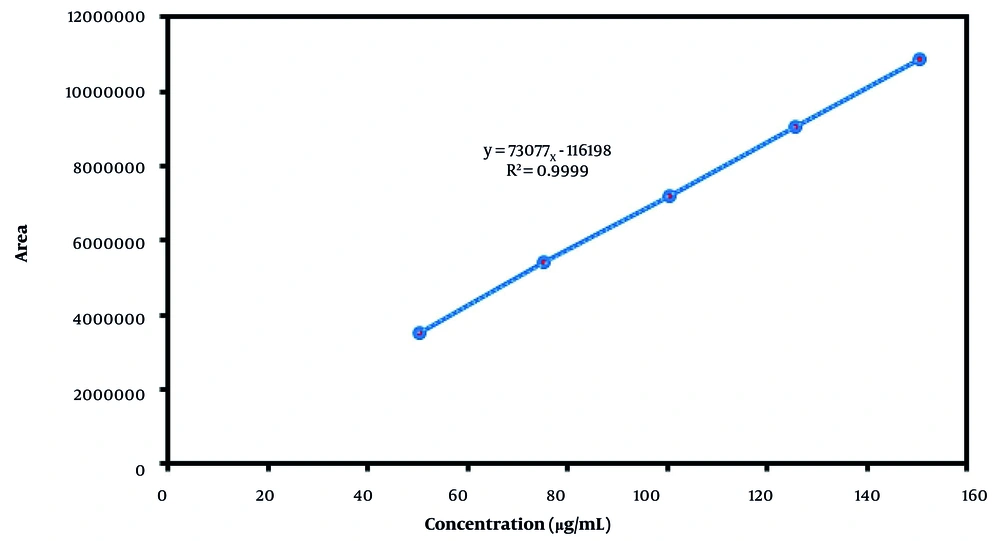
Figure 3.
High-performance liquid chromatography (HPLC) calibration curve of levofloxacin
Table 1.
The Data Used to Create the Standard Calibration Curve of Levofloxacin
| Levels (%) | Concentration (µg/mL) | Area | Average Area |
|---|---|---|---|
| 50 | 50.19 | 3202975.615 | 3517782.715 |
| 3599406.283 | |||
| 3596082.301 | |||
| 3599022.267 | |||
| 3591427.11 | |||
| 75 | 75.28 | 5440183.623 | 5435350.571 |
| 5437422.66 | |||
| 5435823.793 | |||
| 5429380.419 | |||
| 5433942.36 | |||
| 100 | 100.38 | 7226640.59 | 7214718.931 |
| 7209162.866 | |||
| 7215224.796 | |||
| 7208150.723 | |||
| 7214415.678 | |||
| 125 | 125.47 | 9049063.412 | 9046726.799 |
| 9041729.719 | |||
| 9056174.365 | |||
| 9032871.557 | |||
| 9053794.941 | |||
| 150 | 150.57 | 10881339.98 | 10881317.23 |
| 10870525.53 | |||
| 10878365.22 | |||
| 10891160.02 | |||
| 10885195.39 |
The equation of the calibration curve obtained was y = 73077x - 116198. The correlation coefficient was 0.9999 (Figure 3 and Table 2). The present method showed a good linear range with respect to the methods reported in previous studies (24).
Table 2.
Results of Validation of the High-Performance Liquid Chromatography-Photodiode Array Detector Determination of Levofloxacin in Oftaquix 5 mg/mL Ophthalmic Solution
| Parameters | Results |
|---|---|
| Range (μg/mL) | 50 to 150 |
| Slope | 73077 |
| Intercept | -116198 |
| Determination coefficient (R2) | 0.9999 |
| LOD (μg/mL) | 2.13 |
| LOQ (μg/mL) | 6.47 |
Abbreviations: LOD, limit of detection; LOQ, limit of quantification.
4.2.2. Precision
The precision of any analytical procedure provides evidence of unsystematic errors. It is also a measure of agreement between sequences of measurements obtained from numerous samplings of the identical homogeneous sample solution under defined conditions. Precision was assessed at two levels: Interday and intraday. The intraday analysis was completed by examining the intermediate concentration of the drug, while the interday analysis was measured by evaluating the same drug concentration over six consecutive days. The percentage of %RSD value was calculated. The data obtained from interday and intraday %RSD is less than 2% for levofloxacin, confirming that the established method is precise. The results of inter- and intraday precision analysis are summarized in Table 3.
4.2.3. Accuracy
Recovery was examined by adding a known amount of levofloxacin standard corresponding to 75%, 100%, and 125% of the labeled claim of the drug. At each level, three readings were obtained (n = 3). The percentage of recovery of the drug ranged from 99.4% to 101.2%. The result is shown in Tables 4 and 5, which indicates that excellent accuracy was achieved at each added concentration.
Table 4.
Relative Standard Deviation
| Conc. μg/mL | Areas | Average Area | SD | %RSD |
|---|---|---|---|---|
| 100.379 | 7209163.00000 | 7214719.2000 | 7356.79 | 0.1 |
| 7208151.00000 | ||||
| 7214416.00000 | ||||
| 7215225.00000 | ||||
| 7226641.00000 |
Abbreviations: SD, standard deviation; RSD, relative standard deviation.
Table 5.
Accuracy Values; Recovery of Levofloxacin a
| Levels (%) | Amount Spiked μg/mL | Area | Amount Recovered μg/mL | Recovery (%) b | Average Recovery (%) | %RSD |
|---|---|---|---|---|---|---|
| 75 | 75.28 | 5467342 | 76.07 | 101.04 | 101.03 | 0.08 |
| 5462085 | 75.99 | 100.94 | ||||
| 5470237 | 76.11 | 101.09 | ||||
| 100 | 100.38 | 7172160 | 99.79 | 99.41 | 99.38 | 0.04 |
| 7166670 | 99.71 | 99.33 | ||||
| 7172160 | 99.79 | 99.41 | ||||
| 125 | 125.47 | 9109131 | 126.74 | 101.01 | 101.18 | 0.19 |
| 9121820 | 126.91 | 101.15 | ||||
| 9144065 | 127.22 | 101.39 | ||||
| Average | - | - | - | - | 100.53 | - |
Abbreviation: RSD, relative standard deviation.
a Each individual, sample recovery should lie within the range of 98% - 102%.
b The percentage recovery of the spiked placebos should be 100 ± 2.0% for the average of each set of three weights.
4.2.4. Stability in Solution and in the Mobile Phase
The assay of levofloxacin in solution stability confirmed that the active pharmaceutical ingredient (API) was stable in the diluent solution at ambient temperature (24 ± 2°C) for up to 48 hours, with %RSD less than 1.0%.
4.2.5. Eye Drop Application
The proposed method has been applied for levofloxacin analysis in Oftaquix 5 mg/mL ophthalmic solution. The drug content in each sample was calculated by comparing it with the standard solution. An amount of 4.96 mg/mL was found in commercially available eye drops (Table 6). The mean assay for six samples was 99.3%, with a %RSD value of 0.84% for six samples.
Table 6.
Percentage of Relative Standard Deviation Value
| Drug | Label Claim (mg/mL) | Amount Found (mg/mL) | Assay (%) | %RSD |
|---|---|---|---|---|
| Levofloxacin | 5 | 4.96 | 99.3 | 0.84 |
Abbreviation: RSD, relative standard deviation.
5. Discussion
Developing simple, rapid, and precise methods for determining drug concentrations in pharmaceutical formulations is useful for drug analysis, bioequivalence, and achieving desired therapeutic outcomes. To date, several analytical methods, including 1H NMR spectroscopy, UV-Vis spectrophotometry, UPLC, capillary electrophoresis, and various HPLC methods with different types of detectors and mobile phases, have been applied for the quantification of levofloxacin in various pharmaceutical formulations. Among these techniques, HPLC-based methods, as robust tools for pharmaceutical analysis, present several significant advantages, including high resolution, sensitivity, and versatile detection modes. However, the high cost, operational complexity, extensive sample preparation requirements, and time-consuming issues pose certain challenges while using these methods (15, 19, 20).
As a result, developing straightforward HPLC methods with short analysis times and high specificity and accuracy is highly important for the practical applications of these methods in determining various pharmaceuticals in commercial products. Therefore, in this study, we developed an HPLC method for determining levofloxacin in eye drop solutions used for treating bacterial keratitis. The overall results showed good linearity, LOD, LOQ, accuracy, precision, and stability for the developed method according to the ICH and FDA guidelines, with a short time of analysis (9.5 minutes).
Many HPLC methods have been reported for levofloxacin determination in pharmaceutical formulations in previous studies (6, 9, 24, 25). The developed method was a modification of the method developed by Czyrski (24); however, in our study, a different ion-pair reagent (trifluoroacetic acid instead of triethylamine) and column (ODS-phenyl column instead of LiChroCART guard column with silanol groups) were applied for chromatographic separation. Although the application of triethylamine resulted in a shorter analysis time (5 vs. 9.5 minutes), both applied ion-pair reagents resulted in the desired accuracy, precision, and stability for the developed methods (24). It is reported that the addition of an ion-pair reagent enhances the interaction of levofloxacin with the stationary phase and reduces the tailing of the peaks when combined with the proper pH value (15, 24, 26). The possible separation mechanism involves a hydrophobic interaction between levofloxacin and the phenyl groups of the stationary phase. Trifluoroacetic acid reduces the availability of the hydrophilic functional groups of levofloxacin (hydroxyl group, carbonyl group, etc.) and improves its hydrophobic interaction with the stationary phase. Table 7 summarizes the HPLC conditions, mobile phase, and the results of some studies reported for the separation and determination of levofloxacin in different media.
Table 7.
High-Performance Liquid Chromatography Conditions and Comparative Results of Previous Studies Reported for Separation and Determination of Levofloxacin
| HPLC Condition | Mobile Phase | Results | Ref. |
|---|---|---|---|
| Column: Luna; Phenomenex® C18 (250 4.6 mm; 5 μm); detector: UV detector at 295 nm; flow rate: 1 mL/min; injected volume: 20 μL | Acetonitrile, methanol, and phosphate buffer pH 3.0 (17:3:80 v/v/v) | RT (min): 7.66 ± 0.01; area: 563189.33 ± 6301.42; R2: 0.9998; LOD: 0.66686 μg/mL; LOQ: 2.22286 μg/mL; precision: -; recovery%: 100.69 | (6) |
| Column: LiChroCART 125-4 RP-18 (125 × 4 mm, 5 μm); detector: Fluorescence; detector (λex at 295 nm and λem at 490 nm); flow rate: 1 mL/min; injected volume: 50 μL | Acetonitrile and 0.4% triethylamine, pH 3.0 (24:76 v/v) | RT (min): 1.7; area: -; R2: 0.998; LOD: 0.03 mg/L; LOQ: 0.15 mg/L; precision: < 10%; recovery%: - | (14) |
| Column: XB-C18 column (100 Å, 100 mm × 4.60 mm, 2.6 μm); detector: DAD G7115A at 292 nm; flow rate: 0.5 mL/min; injected volume: - | 18% acetonitrile and 82% triethylamine 0.5% in water (pH adjusted to 2.5 with H3PO4). | RT (min): 3.2; area: -; R2: 0.99984; LOD: 0.77 ng/mL; LOQ: 3.11 ng/mL; precision: < 10%; recovery%: Intraday: 99.23%; interday: 98.21 | (9) |
| Column: LiChroCART column (125 × 4 mm, 5 μm); detector: UV detector at 295 nm; flow rate: 1 mL/min; injected volume: - | Acetonitrile and 0.4% triethylamine, pH 3.0, (24:76 v/v) | RT (min): 3.7; area: -; R2: 0.99984; LOD: 0.019 mg/mL; LOQ: -; precision: < 4.21%; recovery%: - | (27) |
| Column: LiChrospher® 100 RP-18 (125 mm × 4 mm, 5 μm); detector: UV-Vis at 295 nm; flow rate: 1 mL/min; injected volume: 20 μL | Water:acetonitrile (80:20, v/v) with 0.3% triethylamine, pH 3.3 | RT (min): 2.37; area: -; R2: 0.9999; LOD: 0.15 μg/mL; LOQ: 0.46 μg/mL; precision: -; recovery%: 96.86 - 103.57% | (25) |
| Column: Phenyl L11 stationary column (250 × 4.6mm, 5µm); detector: DAD/UV-vis at 294 nm; flow rate: 1.5 mL/min; injected volume: 20 μL | Acetonitrile: 0.1% trifluoroacetic acid (18:82 v/v) | RT (min): 9.5; R2: 0.9999; LOD: 2.13 μg/mL; LOQ: 6.47 μg/mL; precision: < 2%; recovery%: 100.53% | This study |
Abbreviations: HPLC, high-performance liquid chromatography; LOD, limit of detection; LOQ, limit of quantification; DAD, photodiode array detector.
In this study, an HPLC method was tested on the commercially available ophthalmic solution of levofloxacin at a concentration of 5 mg/mL, and the separation provided the total resolution of the analyte (Figure 2A - C). The temperature was ambient, and higher temperatures did not significantly influence the chromatographic separation (14). The average inter- and intraday precision was found to be in the range of 96.465 ± 0.0080% to 97.060 ± 0.0034%. The sample preparation involves a simple dilution with the mobile phase and does not require more laborious techniques of sample preparation, such as liquid-liquid extraction or solid-phase extraction.
The calibration curve was linear within the range of 50 - 150 μg/mL, with a regression coefficient higher than 0.9999. The lowest concentration from the calibration curve is 50.19 ± 0.24 μg/mL. The LOD and LOQ are 2.13 and 6.47 μg/mL, respectively, which are satisfactory for the determination of levofloxacin in commercial pharmaceutical formulations. Accordingly, the application of the developed method for the determination of levofloxacin in Oftaquix 5 mg/mL ophthalmic solution revealed a concentration of 4.96 ± 0.0084 mg/mL levofloxacin in this formulation, which closely matches the value reported on the product label (5 mg/mL) with 99.3% accuracy and a 0.84% RSD value.
5.1. Conclusions
In conclusion, a new, rapid, and simple HPLC-DAD method was optimized and validated according to the ICH and FDA guidelines in terms of linearity, LOD, LOQ, accuracy, precision, and stability. A good system performance was observed for the established method based on FDA requirements. The developed method showed a good linear relationship between levofloxacin concentration and area within the 50.19 - 150.57 µg/mL range, with a correlation coefficient of 0.9999. The validation results of the HPLC method for levofloxacin eye drops indicated that the method is accurate, linear, and precise, and samples are stable during analysis and up to 48 hours.
In general, the developed HPLC-DAD method in this study is simple and accurate and can be applied for routine analysis of levofloxacin amounts in pharmaceutical formulations and bioequivalence studies in quality control departments and the pharmaceutical industry. However, the present study also has some limitations. For example, the effects of forced degradation conditions, including heat, light, and pH stress, have not been investigated in this study, and the validation methods were limited to a single commercial brand (Oftaquix). Evaluating the effect of these parameters in the detection and separation of levofloxacin requires additional studies in this field. Moreover, potential constraints in resource-limited settings may necessitate the selection of alternative analytical methods, such as UV-Vis spectrophotometry, rather than the HPLC method that was successfully established and validated in this study.