
1. Background
Diabetes is a chronic metabolic disorder that causes a malfunction or lack of insulin and an increase in blood glucose. It disrupts the metabolism of carbohydrates, lipids, and proteins. Hyperglycemia is the fundamental characteristic of this disease, and it leads to kidney, vision, and cardiovascular complications in the long term (1). Type 1 diabetes (T1D) is caused by the destruction of beta cells as a result of autoimmunity and the subsequent inability to produce insulin, but in type 2 diabetes (T2D), disorders related to the metabolism of fats and carbohydrates cause defects in insulin secretion and resistance to this hormone (2). Among the factors that play a significant role in the pathogenesis of both types of diabetes are oxidative stress and free radicals, which contribute to the development of the mentioned disorders (3).
According to the statistics published by the International Diabetes Federation, the population of diabetics will increase to 642 million people by 2040. According to recent reports, approximately 10% (41.5 million) of the diabetic population (425 million) worldwide suffer from T1D (4). In the past, researchers viewed T1D as a childhood and adolescent disorder; however, age no longer limits the onset of disease symptoms (5).
Symptoms of T1D include sudden weight loss, polyphagia, polydipsia, lack of energy, polyuria, and extreme fatigue. Failure and morphological changes in the endocrine portion of the pancreas, along with an insulin deficiency and alterations in the function of other hormones, play an important role in this process. In the last few years, many studies have led to the development of new drugs to address diabetes and its related complications by managing these conditions (6, 7).
The pathophysiology of diabetes is complex and influenced by various environmental, genetic, and epigenetic factors. Although the precise mechanisms that initiate the disease remain unclear, significant immunological components play a role in its development. The history of T1D suggests that autoimmunity, caused by T lymphocytes in response to environmental factors, results in the destruction of beta cells in genetically predisposed individuals (8). In T1D, the infiltration of T lymphocytes and the activity of macrophages residing in the tissue, as a result of autoimmunity, cause the selective eradication of beta cells in the pancreatic islets (9). Islet transplant is one of the treatment options, but the accumulation of immune cells in transplanted islets is its challenge, which causes transplant rejection (10, 11). The production and secretion of chemotactic cytokines from islet cells, especially beta cells, causes immune cells to infiltrate into these areas, resulting in the development of autoimmune diabetes (12). Cytokines released from these cells also lead to the synthesis of oxygen and nitrogen free radicals in pancreatic islets and cause mitochondrial damage and beta cell death. On the other hand, the lack of antioxidant enzymes such as glutathione peroxidase and catalase increases the sensitivity of these cells against free radicals. Controlling mitochondrial redox reactions offers an effective approach to protecting beta cells (13).
The use of natural compounds with antioxidant properties has been recommended in the treatment of diabetes and in reducing the side effects of this disease. Astaxanthin (AST), a xanthophyll carotenoid, demonstrates various biological functions, including modulating oxidative stress and inflammation by capturing free radicals (14) and enhancing the expression of genes related to the activation of endogenous antioxidant systems (15, 16). Because of its special structure, this compound’s placement between cell membrane layers allows it to exert antioxidant effects, maintaining cell membrane integrity and preventing lipid oxidation (17). In a study conducted in 2015, treatment with AST in type 1 diabetic rats demonstrated that the anti-diabetic properties of AST were associated with a decrease in levels of reactive oxygen species (ROS), advanced glycation end-products (AGEs), and lipid peroxidation (18). This compound is available in both natural and synthetic forms and is considered one of the strongest carotenoids. Natural sources of AST are marine animals such as salmon, krill, shrimp, and crab (19, 20).
A polyene chain in AST causes high antioxidant capacity and traps free radicals by donating electrons (21). Studies have shown that the use of AST, even in high doses, does not have any side effects in humans (22). Given these properties, AST has significantly contributed to the treatment of diabetes and its complications, such as cardiovascular disorders, retinopathy, nephropathy, and neuropathy (3).
Gamma-aminobutyric acid (GABA) is one neurotransmitter found in pancreatic islets. The signaling system of neurotransmitters in the pancreas regulates the function of the exocrine part and the secretory activity of alpha and beta cells. The high concentration of GABA in beta cells of the pancreas is considerable, compared to other tissues, such as the adrenal medulla, placenta, ovary, and uterus. On the other hand, GABA, along with glutamic acid decarboxylase (GAD) and GABA transporter, is expressed in large amounts in the islets and plays an important role in islet cell activity (23). In beta cells, there are pseudo-synaptic microvesicles containing GABA, which are stored together with insulin granules. GABA has important activities such as inhibiting the immune response, maintaining beta cells, and regulating the secretion of hormones. The GAD synthesizes GABA in beta cells; sometimes the presence of autoantibodies against this enzyme causes T1D (24).
In one study, GABA increased the mass of beta cells and decreased alpha cell mass, as well as reducing blood glucose levels. The synergistic use of sitagliptin and GABA increased the effect of GABA on the mentioned parameters, compared to the single use of this substance (25). Alternatively, investigating the anti-diabetic properties of AST shows that this compound induces hypoglycemia and lowers cholesterol levels in T2D. In addition, AST increases the expression of genes related to insulin sensitivity, such as AdipoR1, AdipoR2, and Adiponectin (26).
Routine treatments for T1D are based on insulin injections, which are associated with complications. Therefore, the trend towards the use of natural compounds, especially complementary treatments, has increased. Some studies have reported the role of GABA and AST in the control and treatment of diabetes in animal models (27, 28). Therefore, in the pancreas, GABA is an effective compound for coordinating the activity of islet cells and moderating the activity of the immune system. On the other hand, AST, with its high antioxidant capacity, can play a role in the treatment of diabetes and the preservation of beta cells. One of the important goals of T1D treatment is to preserve the population of beta cells.
2. Objectives
This study aimed to investigate the effects of AST and GABA alone and in combination on the regeneration of beta cell mass and the levels of fasting blood sugar (FBS) and oxidative stress in Streptozotocin (STZ)-induced diabetic rats.
3. Methods
In this experimental in vivo study, 30 male Wistar rats (200 ± 10) were prepared and treated according to the guidelines approved by the Ethics Committee of the Kermanshah University of Medical Sciences (IR.KUMS.AEC.1401.010). The temperature and humidity of the animal-keeping environment were 23 ± 1°C and 55 ± 15%, respectively. Other conditions included exposure to a 12-h light/dark cycle, and access to water and food ad libitum.
To induce diabetes, after a 12-hour fast, a fresh solution of STZ (Sigma Chemical Company, St. Louis, MO, USA) in citrate buffer (PH = 4.6) was injected intraperitoneally at a dose of 55 mg/kg (29). To evaluate the blood glucose level, after 72 hours, a blood sample was taken from the tail vein of rats, and fasting blood glucose was measured using a Bionime glucometer (Taichung City, Taiwan). Rats with blood glucose levels higher than 250 mg/dL were considered diabetic. Animals were divided into five groups (n = 6): the control group (non-diabetic), the diabetic group (DM), the diabetic treated with GABA (Sigma-Aldrich) (100 mg/kg) (DM + GABA), intraperitoneally (26), AST (Sigma-Aldrich) (20 mg/kg) (DM + AST), orally (27), and the combination therapy group (AST and GABA). The dose received in different groups was administered daily for 21 days. Finally, all rats were killed for serum and tissue analysis.
3.1. Biochemical Analysis
At the end of the study, fasting rats were weighed and FBS was determined, then they were anesthetized with ketamine/xylazine (100/20 mg/kg, Sigma-Aldrich, Germany), and a cardiac puncture was performed. After centrifugation at 3000 rpm for 15 minutes, the obtained serum was collected and used to measure insulin, C-peptide, nitric oxide (NO), and total antioxidant capacity (TAC). Insulin and C-peptide were assessed by a special rat ELISA kit (SunLong Biotech, China).
3.2. Nitric Oxide Assay
Serum NO level was measured using the Griess method to evaluate oxidative stress. Because of the instability of NO, the method was used in which nitrite and nitrate were used as stable metabolites of NO in the samples. Zinc sulfate was added to 400 μL serum samples for deproteinization and centrifuged. Then 100 μL of deproteinized samples were mixed with 100 μL vanadium chloride, and 50 μL N-(1-naphthyl) ethylene diamine di-hydrochloride (NEDD), and the absorbance was measured at a wavelength of 450 and 630 nm. Sodium nitrate was also used to draw the standard curve (30).
3.3. Total Antioxidant Capacity
The TAC of serum was evaluated using the ferric-reducing antioxidant power (FRAP), which is a colorimetric method that measures the ability of antioxidants to reduce ferric ions. Reagents include 40 mM acid, acetate buffer, FeCl₃ solution, and 2,4,6-tripyridyl-s-triazine (TPTZ) dye. First, the TPTZ is dissolved in 40 mM acid. Then, the stock solution is prepared by adding TPTZ solution, FeCl₃ (20 mM in water), and acetate buffer solutions in ratios of 1:1 and 10, respectively. Following this, the mixture was heated to 37˚C for 10 minutes before use. 200 μl of serum sample is added to 1500 μl of the stock solution, and after that, it is placed in an incubator at a temperature of 37˚C for 30 minutes. Finally, TPTZ color was detected after a reaction with iron at a wavelength of 593 nm using a spectrophotometer device. In addition, iron sulfate (FeSO₄) was also used for the calibration of the device (31).
3.4. Histological Analysis
Rats were dissected, and the pancreas was removed. In the studied groups, some pancreatic tissue was used to check the gene expression, and the remaining tissues were fixed in 10% formalin. After dehydration, clearing, and paraffin embedding, 5-micron serial sections were prepared. Hematoxylin-eosin (H&E) and modified aldehyde-fuchsin (AF) staining were used for histological changes. Finally, parameters such as the number of beta cells and the staining ability of their granules were evaluated (32).
3.5. Real-time Polymerase Chain Reaction
The PDX1 (Gene ID: 3651, updated on 3-May-2025), Neurogenin-3 (Gene ID: 60329) gene expression was evaluated by real-time reverse transcription-polymerase chain reaction (real-time PCR). The sample total RNA was extracted using Trizol (Life Biolab, Heidelberg, Germany); then quantity and quality were measured with a NanoDrop spectrophotometer (Thermo Scientific, Waltham, MA USA). The total RNA samples were stored at -80°C. The cDNA synthesis was performed using 500 ng of total RNA sample and a 2-step cDNA synthesis kit (BioFACT, Yuseong-Gu, Daejeon, South Korea) based on the manufacturer's instructions. The cDNA samples were saved at -20°C.
In this gene expression assay, we utilized Biosystems™ Real-Time PCR instruments (Applied Biosystems, Wayne, Pennsylvania, USA). We employed RealQ Plus 2x Master Mixes, SYBR Green I, High Rox (2x Real-Time Master mix, Amplicon, Stenhuggervej, Denmark). The real-time cycle condition was as follows: first denaturation at 95°C for 15 minutes, then running 40 cycles of denaturation (95°C for 15 seconds) and annealing/extension (60°C for 1 minute). GAPDH served as the reference gene for calculating relative gene expression using the (2-ΔΔCT) method. The primers were purchased from Cinagene Company (Tehran, Iran). The primer sequences are shown in Table 1.
Table 1.
Primer Sequences
| Genes and Sequences | Primer Sequences |
|---|---|
| PDX1 | |
| Forward | 5′- CCCGAGCTTCTGAAAACTTTG -3′ |
| Reverse | 5′- CTTTTCATTGTCCTCAGTTGGG -3′ |
| NEUROG3 | |
| Forward | 5′- TCCAGACGCAATTTACTCCAG -3′ |
| Reverse | 5′- CTAGTTCTCCGGGCTCAAAAG -3′ |
| GAPDH | |
| Forward | 5′- TGGAGTCTACTGGCGTCTT -3′ |
| Reverse | 5′- TGTCATATTTCTCGTGGTTCA -3′ |
3.6. Statistical Analysis
All data were analyzed using the SPSS software package version 18 (Inc., Chicago, IL, USA) and two-way Analysis of variance (ANOVA) with GraphPad Prism7. They were represented as the mean ± SE, and by one-way ANOVA, differences between groups were analyzed, followed by Duncan's post hoc test.
4. Results
4.1. Metabolic Profile
The GABA/AST monotherapy or combination therapy prevents hyperglycemia in diabetic rats. The FBS levels were significantly decreased in treated groups (AST, GABA, AST + GABA) compared to the DM (P < 0.05). This difference in the combination therapy group was less than that of the other groups, and the AST-treated group showed the best result, and FBS reached a normal level (Figure 1A). The weight of diabetic rats showed a significant decrease compared to that of normal rats. It was improved in all treated rats (Figure 1B). Combination and monotherapy treatments with GABA and AST significantly reduced blood sugar levels. However, in the groups receiving monotherapy, blood sugar decreased more than in the combination therapy group. The weight of rats in both the monotherapy and combination treatment groups increased comparably when compared to the DM.
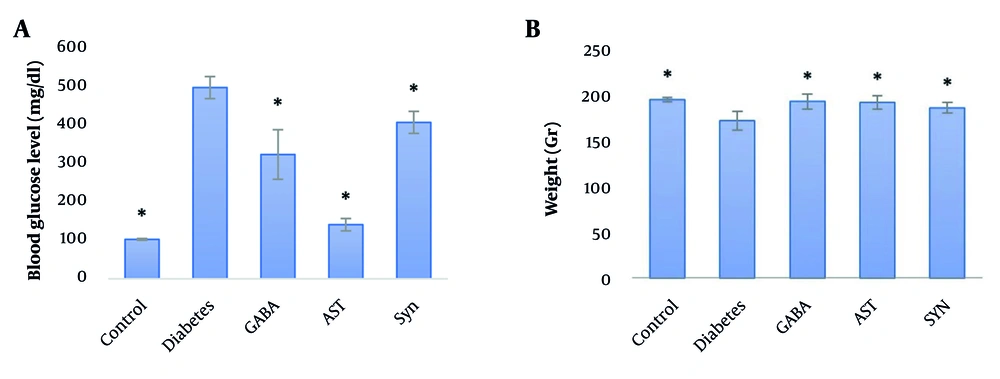
Figure 1.
A, The FBS in control, diabetic, and treated groups: Oral AST (20 mg/kg), intraperitoneal GABA injection (100 mg/kg), and their combination for 3 weeks in rats. B, fasting weight is shown in the studied groups on the 21st day. Data are represented as mean ± SE (n = 6). *: Significant (P < 0.05) difference versus the diabetic group. (Abbreviations: FBS, fasting blood sugar; AST, astaxanthin; GABA, gamma-aminobutyric acid)
4.2. Insulin and C-Peptide Level
Serum insulin levels in the DM decreased compared to the control group. The AST, GABA, and combination therapy all significantly increased serum insulin levels compared to the DM (P < 0.05, Figure 2A). The group treated with AST showed the best result and is almost the same as the control group (Figure 2A). Similar to insulin, the level of C-peptide in the AST and GABA groups increased significantly (P < 0.05) compared to the diabetes group, so that it decreased in the combination therapy group (Figure 2B). Combination therapy with AST and GABA did not influence the increase in C-peptide and insulin levels. However, in the monotherapy groups, these parameters rose significantly. The values obtained from each group have a direct relationship with the blood sugar results.
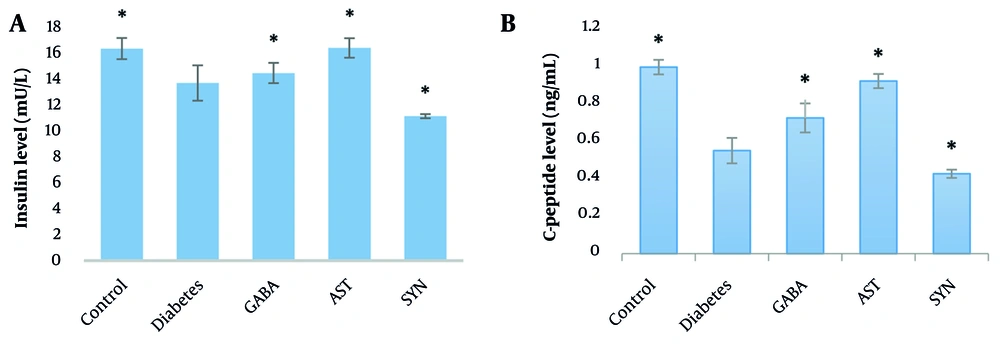
Figure 2.
A, The insulin level in control, diabetic, and treated groups: Oral AST (20 mg/kg), intraperitoneal GABA injection (100 mg/kg), and their combination for 3 weeks; B, C-peptide is shown in the studied groups on the 21st day. Data are represented as mean ± SE (n = 6). *: Significant (P < 0.05) difference versus the diabetic group. (Abbreviations: AST, astaxanthin; GABA, gamma-aminobutyric acid)
4.3. Nitric Oxide and Total Antioxidant Capacity
The serum NO levels in diabetic rats increased significantly (P < 0.05) compared to the control group. In contrast, levels decreased significantly (P < 0.05) in rats treated with AST, GABA, and the combination treatment, when compared to the DM (Figure 3A). The most significant decrease in NO levels was observed in the AST-treated group compared to the combination therapy and GABA-treated groups. The FRAP level in the DM is lower than that of the control and other groups. As shown in Figure 3B, this parameter increased significantly in the treated groups and returned to normal levels in the AST and GABA groups. The FRAP levels were significantly increased in the combination therapy group compared to the AST, GABA monotherapy groups, DM, and control group (P < 0.05, Figure 3B), indicating a greater antioxidant effect of the combined treatment.
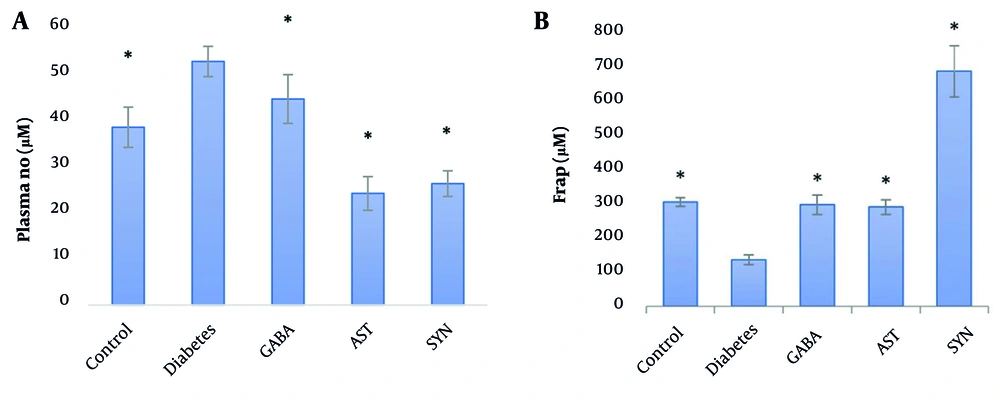
Figure 3.
The changes of biochemical factors in different groups after administration of GABA and AST have been shown. A, no changes; B, TAC changes determined by FRAP. Data are represented as mean ± SE (n = 6). *: Significant (P < 0.05) difference versus the diabetic group. (Abbreviations: GABA, Gamma-aminobutyric acid; AST, Astaxanthin; NO, nitric oxide; TAC, total antioxidant Capacity; FRAP, ferric-reducing antioxidant power)
4.4. Real-time Polymerase Chain Reaction
The expression of PDX1 gene in different groups was shown in Figure 4A. The daily administration of GABA (100 mg/kg) and AST (20 mg/kg) has increased the expression of this gene compared to the DM, and its expression was 6-fold higher in the GABA group and 4-fold higher in the AST group compared to the DM. Although its expression in the combination therapy group increased. The expression of NEUROG3, in the groups treated with GABA, AST, and combination therapy, increased significantly compared to the diabetes groups. The highest expression of NEUROG3 in the combination therapy group was more than in the DM. In both AST and GABA groups, this gene had significant expression compared to the diabetes groups (Figure 4B).
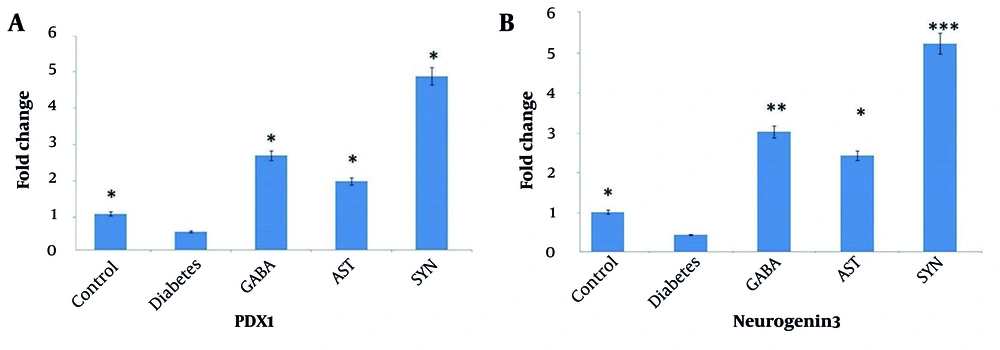
Figure 4.
Comparative analysis of PDX1 and NEUROG3 in different groups. Relative expression levels of A, PDX1 and B, NEUROG3 genes evaluated by real-time polymerase chain reaction. The expression of genes significantly increased in the GABA and AST groups compared to the diabetic group. The data are expressed in terms of percent of control cells as the means ± SD (*: P < 0.05, **: P < 0.01; ***:P < 0.001) compared with diabetic group, two-way ANOVA with GraphPad Prism7). (Abbreviation: GABA, gamma-aminobutyric acid; AST, astaxanthin; ANOVA, analysis of variance)
4.5. Histological Assay
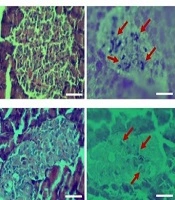
Diabetic rats showed severe pancreatic beta-cell loss and inflammatory infiltration upon H&E and AF staining of their pancreatic tissue. The AST (20 mg/kg) and GABA (100 mg/kg) treatment boosted beta cell counts while lessening immune cell infiltration. The DM showed fewer beta cells than the AST and GABA groups. The use of AST and GABA helps save some beta cells and their granules. It has been found that the granules in the groups treated with GABA are more than in the AST and combination therapy groups (Figure 5). Statistical interaction between AST and GABA was tested using two-way ANOVA; no significant interaction effects were observed for most parameters, suggesting additive rather than synergistic effects.
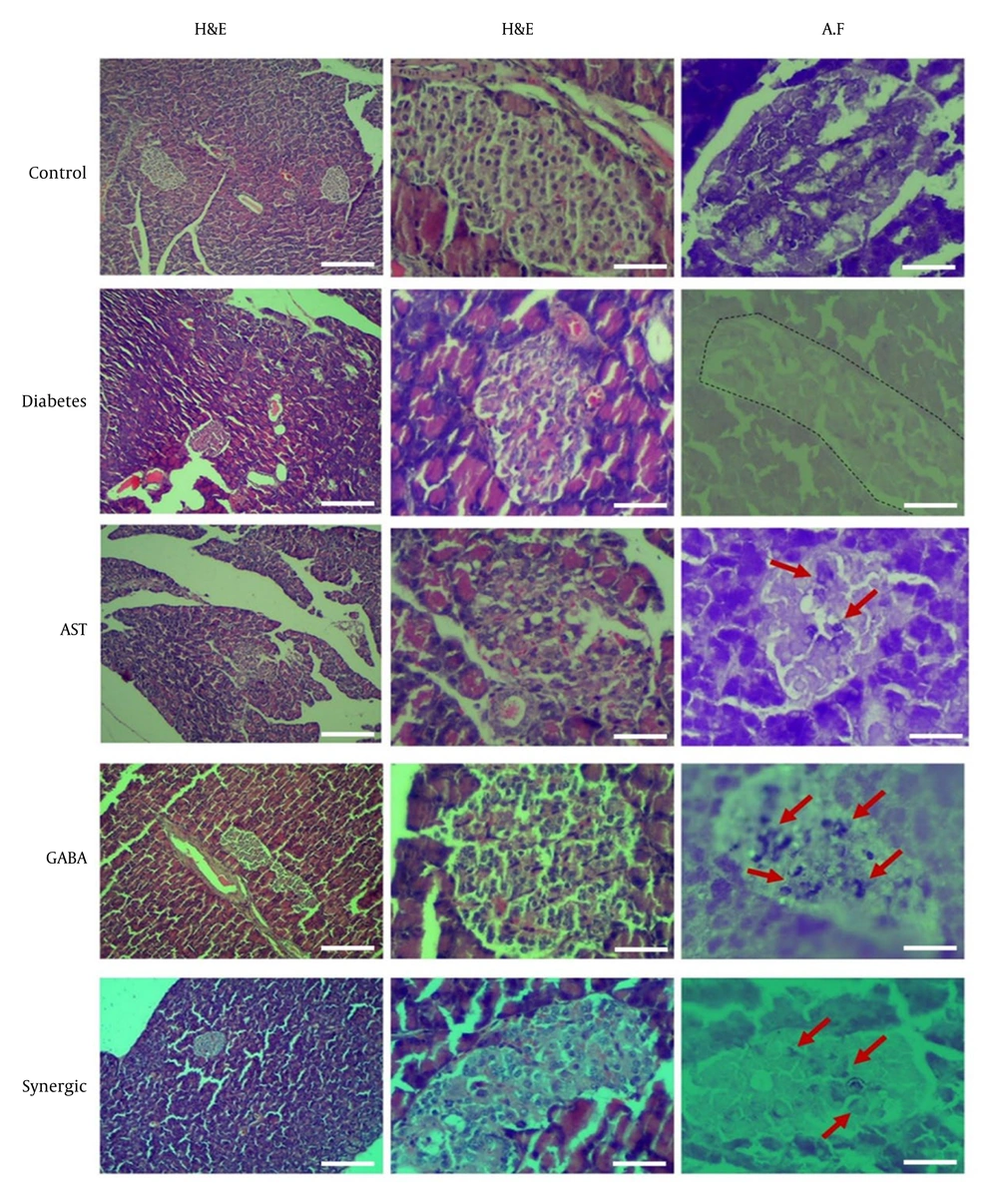
Figure 5.
The images displayed in the first (100x magnification, scale bar 200 μm) and second (400x magnification, scale bar 50 μm) columns show tissue sections stained with H&E, and the third (400x magnification, scale bar 50 μm) column, on the other hand, displays tissue sections stained with aldehyde fuchsin (A.F.), which is a specific stain used to detect beta cells in pancreatic tissue. The arrows in the images are placed precisely to indicate the presence of insulin-containing granules in these beta cells. This information is of great importance in the study of diabetes and other related conditions. (Abbreviation: H&E, hematoxylin-eosin)
5. Discussion
This study demonstrated that treatment with AST and GABA, either individually or in combination, produced significant therapeutic effects in diabetic rats. All treated groups showed improvements in biochemical, molecular, and histological parameters compared to the untreated DM, confirming the potential of these natural compounds in managing T1D. Both AST and GABA effectively reduced FBS levels: The AST directly lowered FBS to levels closer to the control group, while GABA gradually reduced FBS over longer treatment periods by increasing beta cell count.
In this study, diabetes induction led to decreased insulin and C-peptide levels, with C-peptide serving as a valuable marker of insulin secretion since it reflects the amount of insulin released from beta cells (33). Treatment with AST and GABA, whether individually or in combination, significantly increased plasma insulin and C-peptide levels in diabetic rats, indicating that part of their anti-hyperglycemic effect is mediated by stimulating insulin release. The AST monotherapy produced stronger effects than combination therapy in some outcomes, such as FBS reduction and insulin/C-peptide restoration, while GABA monotherapy showed results comparable to or better than the combined treatment in certain parameters. These findings suggest that both compounds, whether used alone or together, support beta-cell restoration and exert clinically relevant therapeutic effects, although no single treatment can be considered the “best” overall.
The NO is an important messenger and has beneficial or harmful effects in various conditions. NO is synthesized by the NO synthase enzyme (NOS), and its excess amount causes the formation of peroxynitrite, which is a very strong oxidant (34). The NO and NOS are related to various diseases, such as diabetes, diabetic retinopathy, and the early stages of diabetic neuropathy. Using their inhibitor can prevent the progression of these diseases. In this experiment, we found that the amount of NO increased in diabetic rats compared to the normal group. The AST and GABA together significantly reduce the amount of NO. As an inhibitor of NOS, AST can reduce NO levels through its anti-inflammatory effects. The results show that AST, with its high antioxidant properties, reduces the amount of NO, which is evident in the AST and combination therapy groups. However, the amount of NO in the treatment group with GABA and STZ is still higher.
Diabetes is associated with an increase in oxidative stress, which is accompanied by a decrease in antioxidant power (35). Cakatay and Kayali also reported a significant decrease in the TAC levels in the serum of diabetic animals compared to controls (36). Our study found a significant reduction in plasma TAC of diabetic rats compared to the normal group. Treatment with AST and GABA significantly improved antioxidant power in diabetic rats compared to the untreated group.
The diabetes group showed a severe decline in beta cells compared to the control group. In the treatment groups receiving AST and GABA, AF staining showed an increase in insulin granules in the treated groups compared to the DM; there was a reduction in inflammatory cell infiltration and beta cell vacuolation. Histological findings showed that GABA and AST preserve beta cells.
It is noteworthy that, in T1D, oxidative stress affects beta cells more than other cells (37). Hyperglycemia treatment may benefit from AST's potent antioxidant properties, as our study suggests. According to our results, consumption of GABA and AST improved insulin secretion and reduced FBS levels of diabetic rats. The amount of C-peptide increased after GABA and AST administration. According to this information and insulin-specific tissue staining (AF), it is clear that AST and GABA increase insulin secretion by protecting beta cells and promoting their proliferation/restoration. More studies are needed to be able to more accurately identify the mechanisms that promote these processes.
Pdx1 is one of the transcription factors that has an effective role in maintaining the function and survival of beta cells and their homeostasis (38). Pancreatic agenesis is caused by a complete deficiency of Pdx1, but the relative lack of this gene causes diabetes in humans and rodents due to dysfunction of beta cells and their death (39). One of the mechanisms that occurs after the reduction of Pdx1 expression is inhibition of the insulin/insulin-like growth factor (IGF) signaling pathway. This pathway commonly stimulates most apoptotic mechanisms in beta cells (39). The AST and GABA combination increases the expression of this gene and reduces the symptoms of diabetes by inhibiting the pathways that lead to beta cell death.
NEUROG-3 is one of the transcription factors whose expression is associated with the proliferation of beta cells (38). The GABA and AST, both in combination and individually, increase the expression of this gene and thus increase the proliferation of these cells (38). Specific tissue staining of beta cells also confirmed this. What is clear in the tissue sections is the increase in the number of beta cells compared with the DM, which is seen in all three cases. The present study, which evaluates the hypothesis that combination therapy by AST and GABA can be effective in protecting beta cells and promoting their proliferation, may offer a promising strategy for improving T1D. Several therapeutic agents, when combined, may control autoimmune diabetes, enhancing and extending their effects.
Importantly, while the combination of AST and GABA did not consistently surpass the effects of individual treatments, it still led to clear and statistically significant improvements compared with the untreated DM. This suggests that AST and GABA can be considered promising therapeutic candidates for T1D, with efficacy both in isolation and in combination. Further studies with longer treatment durations and larger sample sizes will be necessary to clarify whether synergistic interactions may emerge under different conditions.
Our findings align with previous studies demonstrating that AST improves glycemic control and reduces oxidative stress by lowering ROS, AGEs, and lipid peroxidation in diabetic models, while GABA enhances beta-cell survival, proliferation, and insulin secretion in STZ-induced diabetes. These results confirm the individual therapeutic potential of both compounds in T1D. According to this study, AST and GABA can increase antioxidant power, reduce oxidative stress, or both. These compounds likely improved oxidative stress by reducing FBS in diabetic rats, thereby preventing excessive production of free radicals.
5.1. Conclusions
In conclusion, both AST and GABA demonstrated significant therapeutic effects in improving biochemical, molecular, and histological parameters of T1D in rats. While monotherapy sometimes showed stronger effects than the combined treatment, all treatment groups were effective compared with untreated diabetic animals. These findings suggest that AST and GABA, either individually or together, may serve as promising therapeutic options for T1D management.