
1. Background
Punica granatum (pomegranate) is a fruit known for its antibacterial and anti-inflammatory properties. Both the fruit and its peel are used for their antioxidant activity (1). Pomegranate seeds constitute approximately 3% of the total fruit weight and typically contain 12 - 20% oil (2). Polyphenols, such as ellagitannins, are among the natural compounds found in pomegranate (3). Emerging evidence suggests that nutrients such as pomegranate seed oil have health-promoting effects in cellular and animal models. However, these benefits are limited by poor physicochemical stability, low intestinal absorption, and rapid metabolism. To overcome these limitations, various carriers have recently been developed (2).
Pomegranate essential oil is a rich source of vitamin C, which has been shown to be effective in treating dry skin. Regular topical application can reduce skin roughness (4). Many topical formulations are systemically absorbed and may be detected in urine and blood, potentially causing side effects. Therefore, there is a need for an ideal carrier that not only encapsulates the active ingredient but also enhances its therapeutic effects (5).
The health-promoting effects of pomegranate, attributed to its antioxidant and antibacterial activities, are linked to its polyphenols. Accordingly, natural compounds such as polyphenols are increasingly accepted by consumers because of their beneficial effects. Compounds in pomegranate essential oil are a rich source of vitamin C, which research has shown to be effective in treating dry skin. Regular topical application enhances these effects (1). The antioxidant activity of these compounds occurs through several mechanisms, including inhibition of lipid peroxidation and neutralization of reactive oxygen species (2).
Vitis vinifera (grape) is one of the most widely consumed fruits, primarily as juice and wine. There are more than 1,000 varieties of black and white grapes worldwide (6). Grape seed oil has had medicinal importance since ancient times and is rich in phenolic compounds, fatty acids, and vitamins (7). Grape seeds contain 6 - 20% oil, which is extracted by pressing and refining (8). Grapes are high in linoleic acid (68 - 76%), an essential fatty acid for the human body. Its presence in the diet is important for tissue function and overall body maintenance. Grapes are also abundant in bioactive compounds with various health-promoting properties (9). Recent studies indicate that grape seed oil is effective in regulating blood sugar, preventing cancer, and reducing the risk of heart disease. This oil is rich in flavonoids, beta-carotene, and vitamins C and E. Its antioxidant properties help combat harmful free radicals in the body. It also exhibits anti-inflammatory, anti-allergic, and anticancer properties. This oil is used to treat skin conditions (acne, dermatitis, sunburn, and age spots), diabetes, high blood pressure, rheumatoid arthritis, cataracts, and skin wrinkles. Grape seed oil is an excellent emollient that penetrates deeply into the skin layers to nourish and moisturize them effectively. Natural antioxidants, such as polyphenolic compounds and tocopherols, protect the oil from oxidation, rancidity, and degradation at high temperatures (10).
One of the most common applications of nanoparticles in the food and pharmaceutical industries is their use as carriers for food ingredients, drugs, and bioactive compounds. Over the past decade, nanoparticle-based carriers have become well established in pharmaceutical and clinical research (11). Nanocarriers include lipid-based systems, metal-based systems, systems produced by microorganisms, polymeric systems, and other categories such as graphenes and fluoresceins (12). Nanocarriers offer substantial opportunities in medicine, including drug delivery and early and precise diagnosis. Their higher surface-to-volume ratio can improve pharmacokinetic properties and drug distribution in the body, thereby reducing toxicity associated with drug accumulation (12).
Several systems, including polymeric nanoparticles, liposomes, dendrimers, and inorganic drug carriers, have been developed to address problems such as low water solubility and rapid enzymatic degradation of potent drugs (13). Among innovative drug-delivery systems, lipid-based carriers, particularly solid lipid nanoparticles (SLNs) and nanostructured lipid carriers (NLCs), have attracted considerable interest because of their good biocompatibility and the natural lipids used to compose these nanoparticles. Unlike polymeric systems, SLNs and NLCs do not leave residual organic solvents; therefore, their toxicity is lower (14). The low drug-loading capacity and drug leakage during long-term storage associated with SLNs can be overcome by NLCs, which provide greater stability and better control of release kinetics. These nanosystems have therefore become important tools in nanomedicine, bridging laboratory innovation and industry.
To overcome the poor physicochemical stability, low intestinal absorption, and rapid metabolism of pomegranate essential oil, a new NLC-based formulation was developed. Incorporating this natural compound into NLCs may enhance its efficacy while minimizing potential adverse effects. In addition, this system enables controlled drug release.
2. Objectives
The present study aimed to prepare and characterize NLCs containing pomegranate essential oil. Grape seed oil was used as the liquid lipid in the formulation to enhance antioxidant activity and potentially improve the efficacy of pomegranate essential oil. Grape seed oil is rich in unsaturated fatty acids, such as linoleic acid; contains low levels of cholesterol; and is a source of natural antioxidants, such as polyphenols and tocopherols, which help protect against damage caused by free radicals (7).
3. Methods
3.1. Materials
Tween 20 (polysorbate), Span 80, and stearic acid were purchased from Merck Company (Germany). Pomegranate essential oil was obtained from Giyahkala Co. (purity ≥ 95%). Dimethyl sulfoxide (DMSO) was provided by Dae Jung (Korea). Deionized distilled water was freshly prepared. Analytical-grade solvents and chemicals were used in the experiments without further purification.
3.2. Synthesis of Lipid Nanoparticles
Lipid nanoparticles containing pomegranate essential oil and grape seed oil were prepared using hot homogenization and ultrasonication. The aqueous phase (water and Tween 20) and the organic phase, comprising Span 80, solid lipid (stearic acid), and liquid lipid components (grape seed oil and pomegranate essential oil), were weighed according to the formulations listed in Table S1 in the Supplementary File. Each phase was placed separately in a Falcon tube and then placed in a water bath to melt the organic phase and equilibrate the temperatures of both phases. The aqueous phase was then added to the organic phase. The beaker containing the mixture was maintained in the warm water bath to prevent a decrease in temperature. A milky emulsion formed and was immediately homogenized for 3 minutes. The resulting emulsion was subsequently subjected to ultrasonic waves for 3 minutes. The mixture was then left at room temperature for 24 h to cool and equilibrate with the environment, resulting in the formation of NLCs (15).
3.3. Characterization
3.3.1. Determination of Encapsulation Efficiency of NLCs
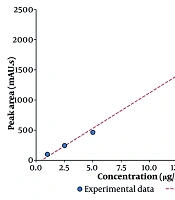
An appropriate concentration of pomegranate essential oil was first scanned using a UV-Vis spectrophotometer (CE1021, CECIL, England), and the maximum wavelength (λmax) of the essential oil was determined for subsequent measurements. An indirect method was used to determine the encapsulation efficiency and percentage drug loading of the nanocarriers. A centrifuge and a filter-equipped Falcon tube (Amicon) with a cutoff of 10 kDa were used. Pomegranate essential oil concentrations of 0.5, 1, 1.5, 2, and 2.5 mg mL-1 were prepared, and their absorbance was measured at 278 nm using UV-Vis spectroscopy. A calibration curve was plotted. To calculate the loading percentage, 0.5 mL of the selected formulation was transferred to the filter-equipped Falcon tube and centrifuged at 6000 rpm for 30 minutes. The supernatant was collected, its absorbance was measured, and the amount of pomegranate essential oil in the supernatant was calculated using the calibration curve.
Finally, the encapsulation efficiency (EE%) of the NLCs was calculated using the following formula (16, 17):
Where:
A: The initial amount of the active ingredient used in the formulation.
B: The amount of the active ingredient detected in the supernatant after separation of the aqueous and lipid phases.
EE%: The percentage of drug loaded into the NLCs.
3.3.2. Particle Size and Zeta Potential
Transmission electron microscopy (TEM; Philips, VP 1450, Netherlands) and a Particle Size Analyzer (Nano-ZS; Malvern Instruments Ltd., UK) were used to evaluate the particle size of the lipid nanoparticles. Zeta potential plays a crucial role in the stability of particulate systems because it reflects the magnitude of repulsion or attraction between adjacent particles with similar charges.
For this purpose, 10 µL of a freshly prepared sample equilibrated to room temperature was transferred to a 1.5 mL microtube and diluted with 990 µL of the external phase (deionized water) at a 1:100 ratio. The instrument measures particle size based on number, volume, and intensity. Zeta potential was measured using the same instrument (16).
3.3.3. Morphological Evaluation of Lipid Nanoparticles Using Electron Microscopy
TEM was used to investigate the morphology of the NLCs. The sample was diluted 15-fold with distilled water, and 20 µL of this solution was placed on a carbon-coated grid. After 30 s, excess liquid was removed using filter paper. Subsequently, 20 µL of 2% uranyl acetate in water was applied to the grid and allowed to remain for 30 s before drying with filter paper. The prepared sample was then observed under the electron microscope (18).
3.3.4. Fourier-Transform Infrared Spectroscopy
Fourier-transform infrared (FTIR) spectroscopy was used to identify organic compounds by determining the functional groups and bonds present in their molecular structure. Approximately 10 mg of the freeze-dried sample was mixed with 0.5 g of KBr in a mortar and ground thoroughly until a homogeneous mixture was obtained. The mixture was pressed at 10 tons for 2 min. The results were recorded using Spectrum software. The same procedure was followed for the optimized formulation and the blank (18).
3.4. Stability Study
The optimized formulation was stored at 4 °C for 6 months, after which EE%, polydispersity index (PDI), and particle size were determined.
3.5. Statistical Analysis
A five-factor central composite design was implemented using Design-Expert software (version 10.0.3; Stat-Ease Inc., Minneapolis, MN, USA) to investigate the effects of lipid percentage, lipid ratio, surfactant percentage, surfactant feed ratio, and the percentage of pomegranate essential oil as the medicinal substance. The levels of these parameters are listed in Table S1 in the Supplementary File. The outcomes of 26 runs, including particle size, zeta potential, and PDI determined by dynamic light scattering (DLS), were recorded.
4. Results
4.1. Data Analysis Using Design-Expert Software
The optimization results for the preparation of pomegranate oil-loaded NLCs are presented in Table S1 in the Supplementary File. The investigated factors included lipid percentage, lipid ratio, surfactant percentage, surfactant feed ratio, and the percentage of pomegranate essential oil as the medicinal substance.
4.2. Analysis of DLS Data and Comparison with Software Predictions
The DLS data were compared with the predictions generated by Design-Expert software. Sample No. 17 was selected as the optimal formulation. This formulation contained 1% pomegranate essential oil and 3% surfactant. The measured particle size, PDI, and zeta potential were 150 ± 4.98 nm, 0.218 ± 0.068, and -22.6 ± 4.72 mV, respectively. The corresponding predicted values were 145 nm, 0.231, and -21.8 mV, respectively.
These results indicate close agreement between the experimental data and the software predictions, supporting the reliability of the optimized formulation (Table 1).
Table 1.
Error Percentages for DLS Data and Software-Predicted Values
| Variables | DLS Data | Predicted Values | Error (%) |
|---|---|---|---|
| Size (nm) | 150 | 145 | 3.3 |
| PDI | 0.218 | 0.231 | 2.2 |
| Zeta potential (mV) | -22.6 | -21.8 | 3.5 |
4.3. Particle Size
Particle size and particle-size distribution play crucial roles in the physicochemical properties of colloidal systems, including stability, biological activity, and solution appearance. Reducing particle size increases the surface-to-volume ratio, and smaller particle sizes are generally associated with more favorable properties. The particle size ranged from 150 to 521 nm. This range indicates that the nanoparticles were successfully synthesized within the desired nanoscale, which is expected to enhance their stability, bioavailability, and overall performance in pharmaceutical applications.
4.4. Zeta Potential
Zeta potential is an important indicator of the electrical status of a surface. It reflects charge accumulation in the immobile layer and the extent of counterion adsorption on the surface, thereby indicating electrostatic stability. Zeta potential is measured based on electrophoretic mobility. A decrease in zeta potential can lead to particle aggregation.
The zeta potential measured using the Particle Size Analyzer ranged from -21 to -23 mV, as indicated in Table S1 in the Supplementary File. This range suggests that the nanoparticles possess sufficient surface charge to maintain electrostatic stability, prevent aggregation, and preserve the colloidal dispersion (19).
4.5. Transmission Electron Microscopy Imaging
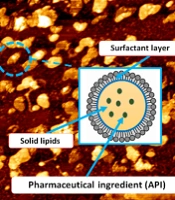
The morphology of the lipid-based nanocarriers containing pomegranate essential oil was examined using TEM. Figure 1 confirms the spherical shape of the synthesized NLCs. Spherical morphology is a desirable characteristic for nanocarriers because it often correlates with improved stability, uniform drug distribution, and enhanced cellular uptake. These results further support the successful formulation of the NLCs and their potential for the effective delivery of bioactive compounds.
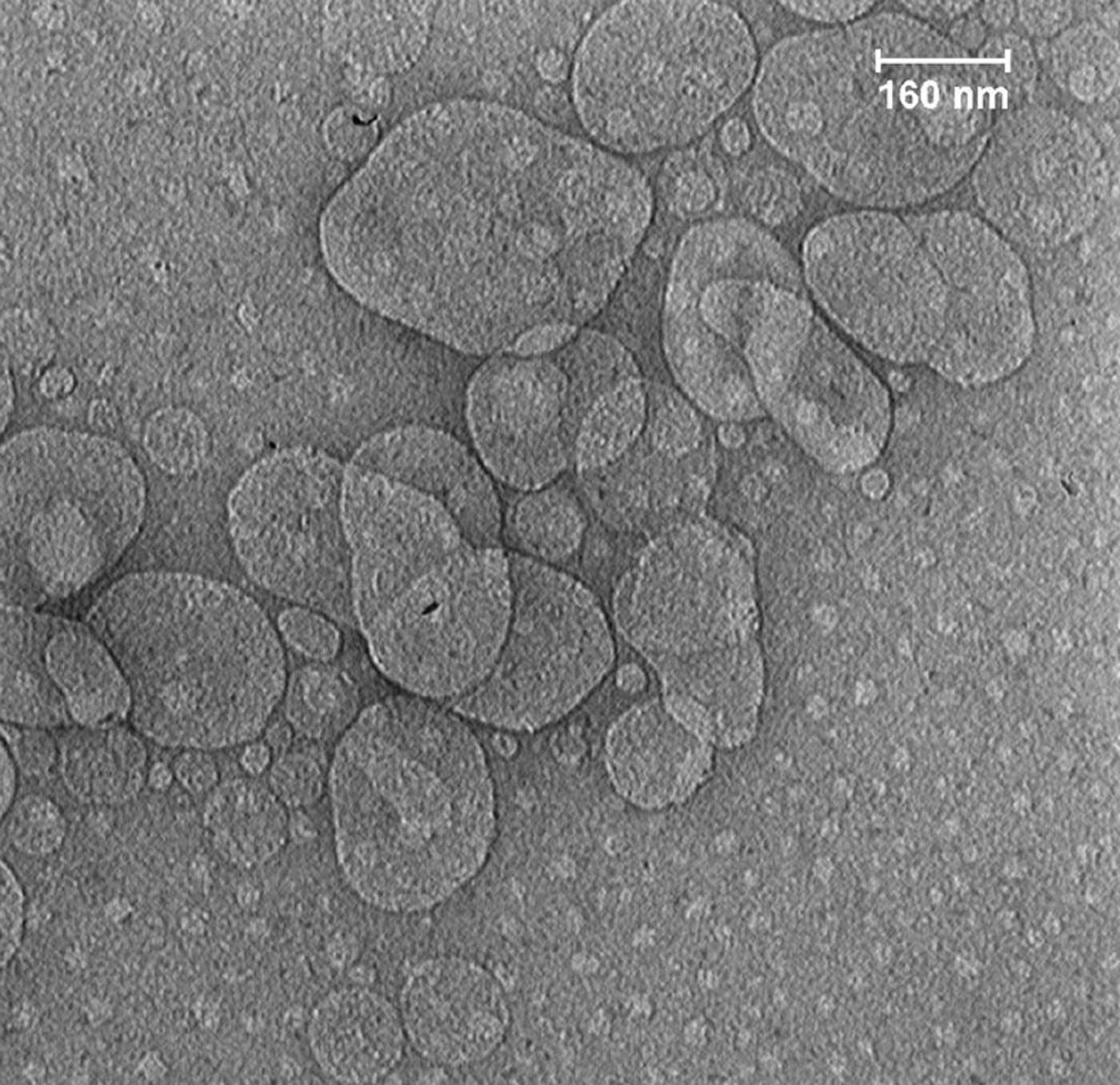
Figure 1.
Electron microscopy image of synthesized nanoparticles
4.6. FTIR Spectra
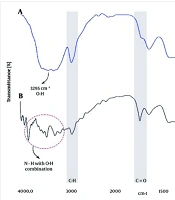
FTIR spectroscopy is commonly used to identify specific functional groups or chemical bonds in a substance. For pomegranate essential oil (Figure 2A), the peaks at 2963 and 2878 cm-1 represent asymmetric CH2 stretching vibrations of acyl chains and methylene chains in fatty acids. Carbonyl stretching vibrations of esters in fatty acids are shown at 1728 cm-1. The bands at 1234, 1134, and 1042 cm-1 correspond to C-O or CH2 stretching or out-of-plane bending vibrations of functional groups in fatty acids (20).
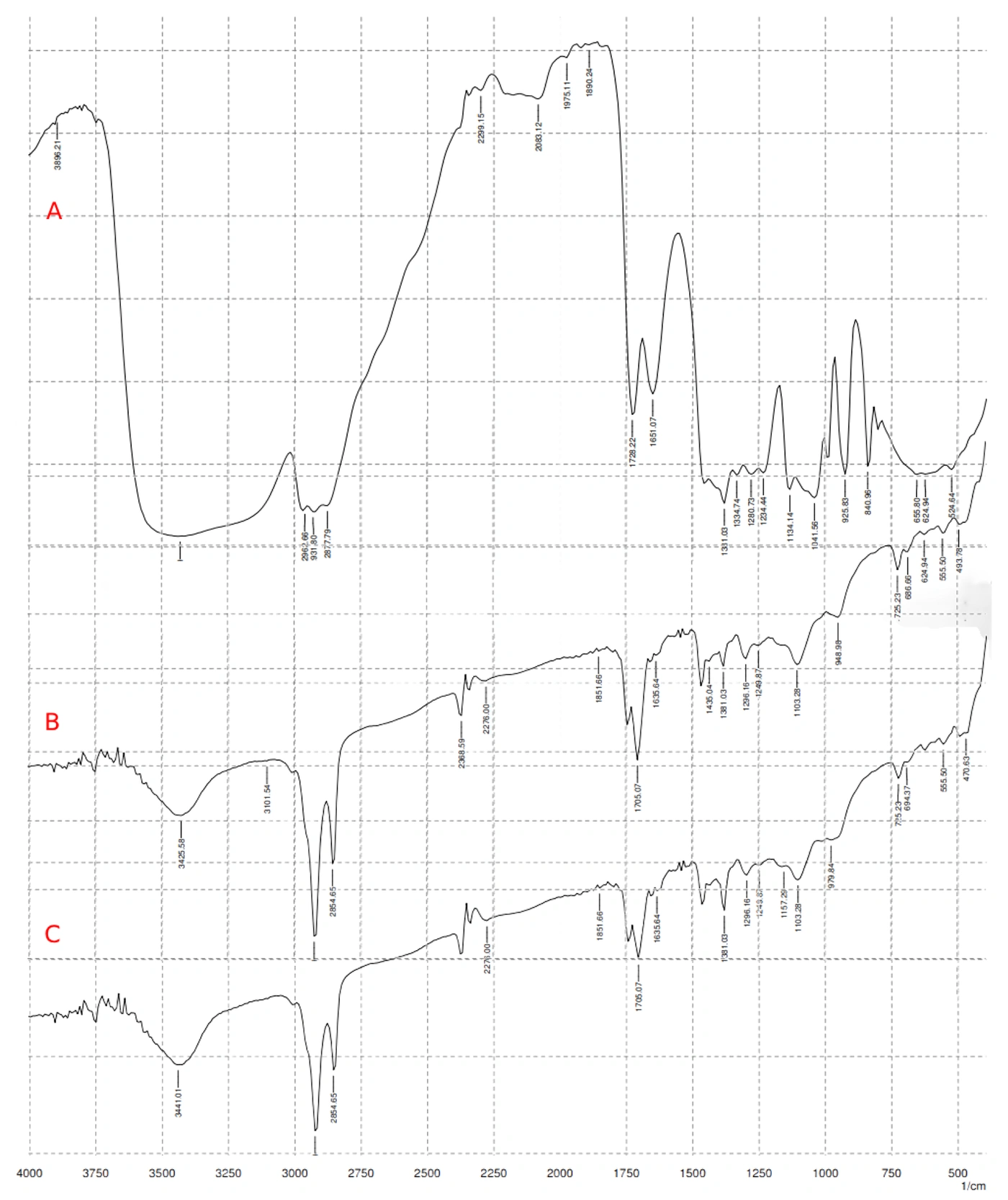
Figure 2.
FTIR spectrum of pomegranate essential oil (A), pomegranate essential oil-loaded NLCs (B), and blank NLCs (C)
These peaks confirm the presence of various functional groups in pomegranate essential oil that are characteristic of its complex chemical composition, including polyphenols, flavonoids, and other bioactive compounds. The FTIR spectra of NLCs containing pomegranate essential oil and blank NLCs were very similar (Figure 2B and 2C). However, the peaks in the spectrum of NLCs containing pomegranate essential oil were smaller. The lower intensity of the characteristic absorption bands of pomegranate essential oil in the NLC formulation may be attributed to the incorporation and dilution of the oil within the lipid matrix.
4.7. Encapsulation Efficiency
The loading efficiency was calculated to be approximately 99%. This high loading efficiency may indicate that pomegranate essential oil was encapsulated within the formulation. These findings suggest that NLCs could have potential as carriers for the delivery of the encapsulated bioactive compounds.
4.8. Stability Study
The stability profile of NLCs was assessed after 6 months. As reported in the literature, recrystallization of the lipid phase results in particle growth, which subsequently reduces lipid stability over time. The structure of surfactants and the interactions among lipids can significantly influence crystallization. In the present investigation, the sample exhibited no changes in odor, color, or texture. Particle size, PDI, and EE% were 154 ± 1.1 nm, 0.23 ± 0.059, and 97%, respectively (Figure 3).
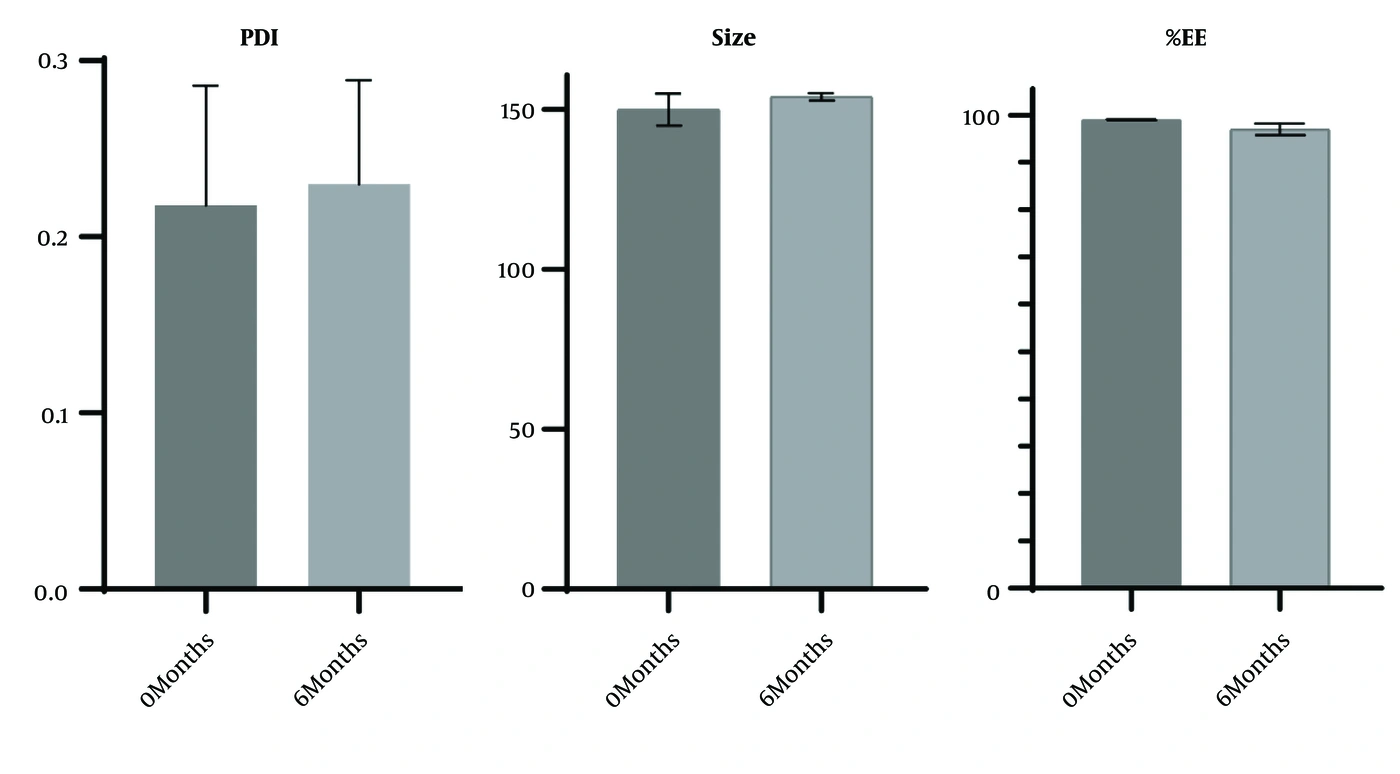
Figure 3.
Physicochemical stability of the formulation between month 0 and month 6
All experimental data are expressed as mean ± SD. To evaluate the physicochemical stability of the formulation (particle size, PDI, and EE%) between month 0 and month 6, a paired Student t-test was performed using 3 independent replicates (n = 3). A P value < 0.05 was considered statistically significant.
4.9. Statistical Analysis
Following model fitting, statistically insignificant terms (P > 0.05) were removed using backward elimination to obtain a reduced quadratic model. Thus, particle size (Y) was significantly affected by independent factors A, C, and E (Table S2 in the Supplementary File).
Y = 253.17 + 150.81A − 47.83C + 24.17E − 29.57AC + 11.93AE − 38.21BC + 49.29BE − 13.67CD + 13.33DE + 71.83A2 + 11.33C2 − 8.17D2 − 8.17E2.
No statistically significant polynomial relationship was observed between the studied formulation variables and zeta potential within the investigated experimental domain.
The reduced quadratic model developed for PDI was highly significant (P < 0.0001), with a very low residual error (Table S3 in the Supplementary File).
Y = 0.3484 + 0.1226A − 0.0029B − 0.0415C − 0.0050D + 0.0026E + 0.0352AB − 0.0129AC + 0.0081AD + 0.0103AE − 0.0392BC − 0.0077BD + 0.0072BE − 0.0137CD − 0.0077CE + 0.0013DE − 0.0206A2 + 0.0035B2 + 0.0134C2 − 0.0006D2 + 0.0014E2.
5. Discussion
The optimized formulation had a particle size of 150 ± 4.98 nm, a PDI of 0.218 ± 0.068, and a zeta potential of -22.6 ± 4.72 mV, indicating the successful formation of a nanosized carrier with acceptable homogeneity and stability. The relatively small particle size may be attributable to hot homogenization and ultrasonication, in which lower lipid viscosity at higher temperatures, combined with ultrasonic energy, facilitates the formation of smaller nanoparticles (21, 22). A PDI below 0.3 indicates a relatively uniform particle-size distribution, whereas the moderately negative zeta potential indicates reasonably good nanocarrier stability due to electrostatic repulsion (22, 23).
Soleimanian et al. reported pomegranate seed oil-loaded NLCs prepared by melt emulsification and ultrasonication, with particle sizes ranging from 71 to 366 nm depending on the formulation composition (22). They also reported disruption of crystallinity and lattice defects when liquid lipid was added to the solid lipid, which is a beneficial structural factor for NLC formation and for accommodating bioactive compounds within the structure. Similarly, Fitriani et al. developed tea tree oil-loaded NLCs with an average particle size below 400 nm that remained stable during storage, supporting the use of essential oils in nanocarriers (23). Chura et al. obtained optimized red sacaca essential oil-loaded NLCs with particle sizes below 100 nm and PDI values below 0.25 (24). Balouchi et al. prepared grape seed oil-containing NLCs by hot homogenization and ultrasonication, with an optimized particle size of 253.4 nm and a PDI of 0.241 (21). In comparison, the present formulation had a smaller mean particle size and a narrower particle-size distribution.
The novelty of this study lies in the development of an NLC system combining pomegranate essential oil with grape seed oil using hot homogenization and ultrasonication. To the best of our knowledge, this combination has not previously been reported in NLC technology developed using this method. Thus, the present study introduces a new formulation and demonstrates the feasibility of incorporating these oils into a nanostructured lipid carrier with beneficial characteristics.
5.1. Conclusions
In this study, pomegranate essential oil was incorporated into NLCs by hot homogenization and ultrasonication. Grape seed oil was also added to the formulation because of its potential antioxidant activity. The formulation was characterized by zeta potential, particle-size determination, morphological analysis, and FTIR spectroscopy. A particle size of 150 ± 4.98 nm, PDI of 0.218 ± 0.068, zeta potential of -22.6 ± 4.72 mV, an entrapment efficiency of approximately 99%, and FTIR findings indicated successful drug loading in the formulation. Overall, these findings suggest that this formulation could potentially serve as a versatile system for delivering other bioactive compounds and provide a promising strategy for further exploration in pharmaceutical and nutraceutical applications.