
1. Context
Biosurfactants (BSs) are heterogeneous, biodegradable, bioactive molecules typically produced by microorganisms inhabiting environments with limited bioavailable resources, where they may support growth and confer competitive advantages. They have diverse applications, including antimicrobial and anti-adhesion activity, emulsification, wetting, and viscosity reduction (1, 2). Another emerging property is broad-spectrum antiviral activity (3-5). Viruses infect or affect organisms across all domains of life (6, 7) and vary widely in type, structure, and size. They can target different cells, tissues, and organs and cause a broad range of diseases, including conditions associated with death or lifelong impairment due to secondary complications (8, 9). Their rapid replication can also facilitate epidemics and impose substantial social, political, and economic burdens (6, 10).
The emergence and resurgence of viral infections, together with genetic changes such as phenotypic mixing and genetic reassortment, can contribute to antiviral drug resistance and remain major healthcare challenges, as highlighted by the COVID-19 pandemic. Therefore, the development of novel broad-spectrum antiviral treatments is important (11, 12). Antiviral treatment is complex because viruses have diverse structures, replicate rapidly, and can continuously mutate and evolve (7, 13). Numerous chemical compounds have been investigated as antiviral drugs; however, their use may be associated with adverse effects in humans and the environment and may contribute to the selection of resistant variants (14, 15). Natural, biocompatible compounds may therefore provide useful supplementary options for antiviral treatment (10, 16, 17). In 1990, pumilacidins, heptapeptide compounds produced by Bacillus pumilus, were reported to have virucidal activity against herpes simplex virus type 1 in a rat model (18). A comparative overview of biosurfactant-based antivirals and conventional antiviral therapies is presented in Table 1.
Table 1.
| Specifications | Biosurfactant | Conventional Antivirals |
|---|---|---|
| Main antiviral mechanism | Direct virucidal activity, membrane disruption, inhibition of viral attachment/entry, and, in some studies, enzyme inhibition | Target-specific inhibition of viral enzymes or receptors |
| Spectrum of activity | Broad activity mainly against enveloped viruses Activity against non-enveloped viruses is generally weaker | Usually active against one virus or a limited number of viral families |
| Resistance development potential | Theoretically lower due to membrane-level and multi-target physicochemical mechanisms | Resistance development is well documented due to viral mutations in specific targets |
| Production strategy | Microbial fermentation | Chemical synthesis or advanced biologic manufacturing systems |
| Cost of goods | Potential long-term cost-effectiveness through sustainable substrates and fermentation | Established industrial production pipelines already optimized |
| Batch consistency | Challenging due to heterogeneous congener mixtures and structural variability | More standardized and regulated manufacturing processes |
| Environmental impact | Generally biodegradable, eco-friendly, renewable, and lower environmental persistence | Some synthetic antivirals and surfactants may contribute to pollution and chemical waste |
| Clinical and regulatory maturity | Mostly preclinical and experimental | Multiple FDA/EMA-approved therapies available |
| Current evidence level | Primarily mechanistic, in vitro, and early animal studies | Extensive clinical, pharmacological, and regulatory evidence |
Biosurfactants are produced mainly as microbial secondary metabolites and generally exhibit lower toxicity and greater biocompatibility than synthetic surfactants (19, 20). Their amphipathic nature enables foaming, emulsifying, and dispersing activity and promotes interactions with lipid membranes, thereby reducing hydrophobicity, increasing permeability, and causing leakage (4, 21). Enveloped animal viruses are generally more susceptible than non-enveloped viruses to biosurfactants because of interactions between the hydrophobic portions of biosurfactants and viral lipid envelopes (22, 23). Biosurfactants may also interfere with other stages of the viral life cycle (24).
2. Evidence Acquisition
The literature was searched in PubMed, Scopus, and Google Scholar using combinations of the keywords “biosurfactant,” “lipopeptide,” “glycolipid,” “rhamnolipid,” “sophorolipid,” “antiviral activity,” “viral inhibition,” and “enveloped viruses.” Peer-reviewed, English-language original articles and reviews were included. Preprints, grey literature, non-English publications, and nonviral antimicrobial studies were excluded unless they were mechanistically relevant. Duplicate records were removed using EndNote before screening, and approximately 116 relevant studies were included in this narrative review.
3. Results
3.1. Main Types of Biosurfactants
Based on their structure, biosurfactants are categorized as lipopeptides, glycolipids, glycolipoproteins, peptides, fatty acids/phospholipids, and particulate compounds. Biosurfactants containing peptide components usually have higher molecular weights than other classes (25). Figure 1 shows the main categories of biosurfactant compounds.
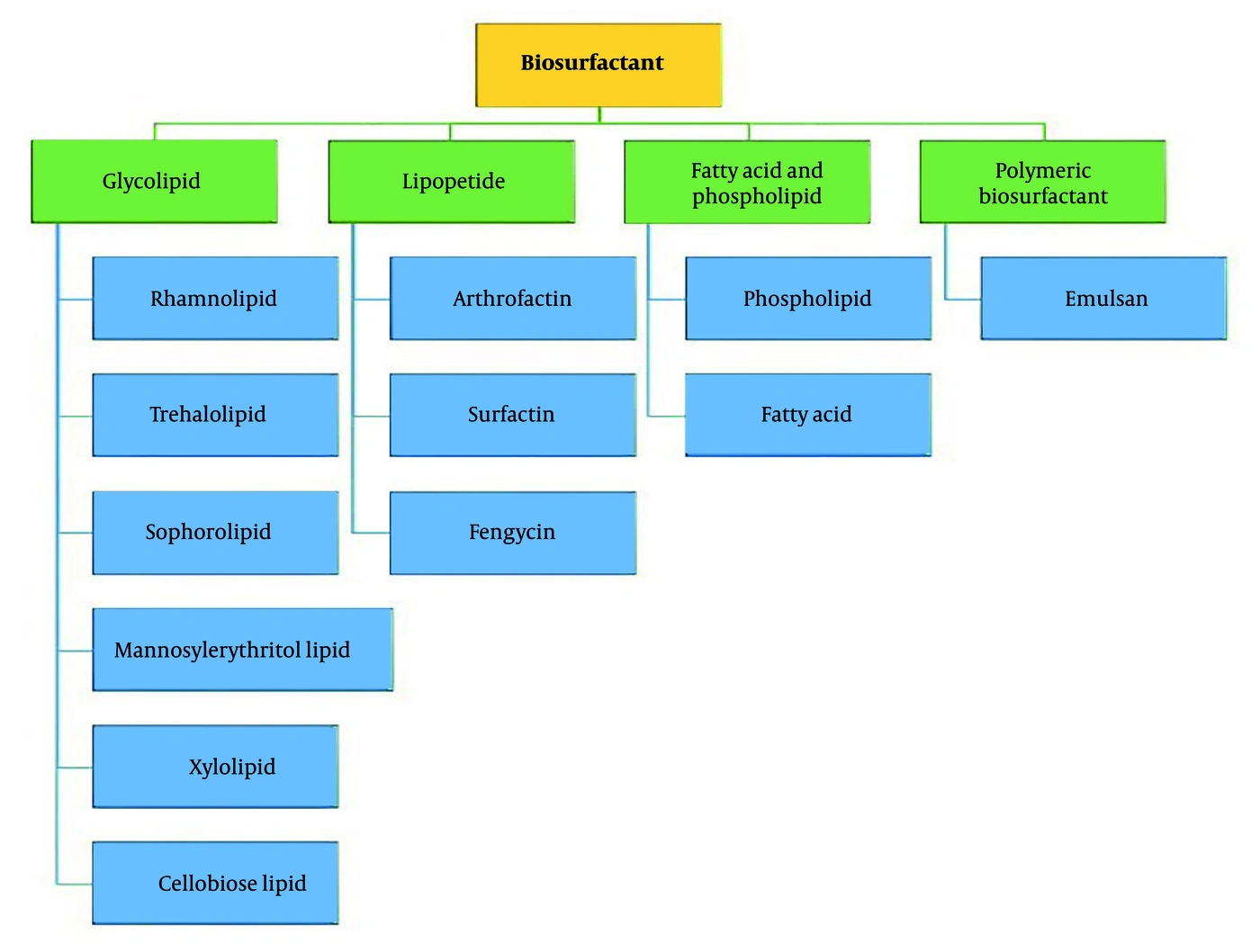
Figure 1.
The main categories and types of microbial biosurfactants.
3.1.1. Glycolipids
Glycolipids are well-known biosurfactants consisting of conjugated carbohydrates and fatty acids linked through an ether or ester bond (31). Their hydrophilic head groups may contain carbohydrates such as rhamnose, sophorose, or trehalose (32). Pseudomonas aeruginosa and the yeast Candida bombicola (now Starmerella bombicola) are among the best-known microorganisms used to produce glycolipid biosurfactants (33-35). Common glycolipids include rhamnolipids, trehalolipids, and sophorolipids (36).
3.1.1.1. Rhamnolipids
3.1.1.2. Trehalolipids
Trehalolipids are glycolipid biosurfactants composed of trehalose linked to mycolic acids (39). Their size and structure vary according to the producing microorganism, including differences in carbon-chain length and degree of saturation. In culture broth, trehalolipids can substantially reduce surface and interfacial tension (40). They are produced by various species of Mycobacterium, Nocardia, and Corynebacterium. For example, Rhodococcus erythropolis produces trehalose dimycolate, which is also a major cell-wall component of Mycobacterium tuberculosis (41).
3.1.1.3. Sophorolipids
Sophorolipids (SLs) are extracellular glycolipids consisting of the dimeric carbohydrate sophorose linked to a long-chain hydroxy fatty acid through a glycosidic bond (42). They occur as mixtures containing at least 6 - 9 different hydrophobic side chains (43). Sophorolipids produced by Starmerella bombicola and related structural analogues have demonstrated spermicidal, anti-HIV, and cytotoxic properties (44). Purified sophorolipids may have greater surface activity, lower water solubility, and stronger cytotoxic effects (45). Both lactonic and acidic sophorolipids reduce the interfacial tension between n-hexadecane and water and remain stable across changes in pH and temperature (46). Sophorolipids are also produced by yeasts such as C. bogoriensis, Candida (Torulopsis) petrophilum, and C. apicola (47).
3.1.2. Lipopeptides
A substantial number of cyclic lipopeptides are produced by microorganisms, including decapeptide antibiotics (such as gramicidins) and lipopeptide antibiotics (such as polymyxins). These compounds comprise a lipid moiety attached to a polypeptide chain (48, 49). One notable example is surfactin, a biosurfactant with exceptional surface activity. It belongs to a group of cyclic lipoheptapeptides that contain beta-hydroxyl fatty acids and D-/L- amino acid residues (50). The cyclic lipopeptide surfactin is produced by Bacillus sp. It is composed of a seven-amino acid ring structure coupled to a fatty acid chain via a lactone linkage (51). Lipopeptides/lipoproteins constitute a diverse class of biologically active peptides, many of which have antimicrobial properties. Examples include the decapeptide antibiotics (gramicidins) produced by Bacillus brevis and the lipopeptide antibiotics (polymyxins) produced by Bacillus polymyxa (52). Two particularly effective cyclic lipopeptide biosurfactants are Arthrofactin and Surfactin (SF) (53). Surfactin is among the popular lipopeptide BSs and contains a ring of seven amino acids (54, 55). Bacillus spp., Nocardia, and Mycobacterium are the most common producers of lipopeptide and lipoprotein BSs (56). Bacillus subtilis strains are known to produce a wide range of lipopeptides with potent biosurfactant properties and specific antimicrobial and antiviral activities (53). One such compound is the cyclic lipodecapeptide fengycin (57).
3.1.3. Fatty Acids and Phospholipids
Fatty acids and phospholipids are biosurfactant classes produced by numerous yeasts and bacteria and have biomedical applications, including the management of respiratory failure in premature infants (56, 58). Various bacteria and yeasts produce substantial amounts of fatty-acid and phospholipid surfactants while growing on n-alkanes (59). Hydrocarbon-chain length influences the properties of these complex lipids. They contain fatty acids that often have a hydroxyl group on the β carbon or elsewhere along the chain. A widely recognized phospholipid biosurfactant is produced by Corynebacterium lepus, which can grow on kerosene (52, 60).
3.1.4. Polymeric Biosurfactants
Extracellular polymeric substances (EPSs) are crucial in influencing both the beneficial and detrimental impacts of microbial aggregates, including biofilms, flocs, and biological sludges (61). In biofouling, they contribute to increased friction resistance and changes in surface properties, such as hydrophobicity, roughness, and color (62). In metal biocorrosion, they can bind metal ions (62, 63). In bio-weathering, they aid in mineral dissolution through their complexing properties (64). EPSs also serve as sorption sites for pollutants, including heavy metal ions and organic molecules (62). In addition, EPSs have various biotechnological applications, such as contributing to viscosity in food, paints, and oil-drilling "muds," and their hydrating properties are used in cosmetics and pharmaceuticals (65). They also have potential uses as surface-active agents, such as in tertiary oil production, and as a biological glue (66). The most well-studied polymeric biosurfactants include Emulsan, Liposan, Mannoprotein, and other polysaccharide-protein complexes (67).
3.2. Antiviral Effects of Biosurfactants and Their Mechanisms
The antiviral effects of biosurfactants have been investigated through several mechanisms, including direct virucidal activity, inhibition of viral entry, enzyme inhibition, and intracellular antiviral activity; selected examples are presented in Table 2. Unless otherwise specified in Table 2, mechanistic claims are based primarily on in vitro assays, and in vivo confirmation remains extremely limited. Natrialba sp. M6 (MK063890), a haloarchaeon, was reported by Hegazy et al. (68) to produce a cationic lipopeptide biosurfactant active against herpes simplex virus (HSV) and hepatitis C virus (HCV). HCV infection is a major cause of liver cirrhosis and hepatocellular carcinoma, and interferon-based treatment has historically been associated with adverse effects. HSV-1 causes oral and corneal lesions and is an etiologic cause of encephalitis in adults. Biosurfactant production by Natrialba sp. M6 was investigated and optimized. The product was reported to inhibit binding of the HCV E2 protein and HSV glycoprotein D and to suppress viral proliferation through effects on RNA and DNA polymerases, respectively. These findings were evaluated in peripheral blood mononuclear cells (PBMCs) and Vero cell lines.
Table 2.
Some Examples of Studies of the Effect of Biosurfactants on Viruses
| Biosurfactant | Source | Virus Tested and Cell Line | Assay Type | IC50/EC50 | CC50 | Selectivity Index | Mechanism | Type of Study | Ref |
|---|---|---|---|---|---|---|---|---|---|
| Cationic lipopeptide | Natrialba sp. | Virus tested: HCV genotype 4a Cell line: Peripheral blood mononuclear cells | qPCR, MTT assay, polymerase inhibition assay | EC50 = 20.12 ± 1.8 μg/mL | 326.3 ± 1.8 μg/mL | 16.33 ± 1.3 | Direct virucidal activity Viral envelope disruption Inhibition of NS5B polymerase Binding to E2 protein | in vitro + in silico | (68) |
| Cationic lipopeptide | Natrialba sp. | Virus tested: HSV-1 (KOS, acyclovir-sensitive strain) Cell line: Vero cells | qPCR, MTT assay, polymerase inhibition assay | EC50 = 8.569 ± 0.2 μg/mL | 268.2 ± 5.9 μg/mL | 31.33 ± 1.4 | Direct virucidal activity Viral envelope disruption Inhibition of DNA polymerase Binding to gD protein | in vitro + in silico | (68) |
| Cationic lipopeptide | Natrialba sp. M6 | Virus tested: ADV7 Cell line: Vero cells | Crystal violet assay, qPCR, ELISA, DNA polymerase inhibition assay | IC50 = 0.814 ± 0.08 μg/mL; EC50 = 206.11 μg/mL | Not reported | Not reported | Direct virucidal and anti-replicative activity Capsid binding DNA polymerase inhibition | in vitro + in silico | (69) |
| Cationic lipopeptide | Natrialba sp. M6 | Virus tested: H1N1 Cell line: Madin-Darby canine kidney (MDCK) cells | Crystal violet assay, hemagglutination inhibition assay, neuraminidase inhibition assay, molecular docking | IC50 = 0.267 ± 0.06 μg/mL; EC50 = 304.4 μg/mL | Not reported | Not reported | Virucidal Anti-adsorptive, and anti-replicative activity Inhibition of hemagglutinin and neuraminidase | in vitro + in silico | (69) |
| Cationic lipopeptide | Natrialba sp. M6 | Virus tested: HCoV-229E Cell line: Vero E6 cells | Crystal violet assay | IC50 = 0.636 ± 0.03 μg/mL; EC50 = 412.5 μg/mL | Not reported | Not reported | Direct virucidal and anti-replicative activity | in vitro + in silico | (69) |
| Cationic lipopeptide | Natrialba sp. M6 | Virus tested: SARS-CoV-2 3CL protease Cell line: Cell free enzymatic assay | 3CL protease inhibition assay, molecular docking | IC50 = 5.319 ± 0.305 μg/mL | Not reported | Not reported | Inhibition of SARS-CoV-2 3CL protease | in vitro + in silico | (69) |
| Cyclic lipopeptide | Bacillus clausii TS | Virus tested: SARS-CoV-2 Cell line: Not reported | Competitive ELISA, ITC, molecular docking, molecular dynamics simulation | Not reported | Not reported | Not reported | Binding and inhibition of SARS-CoV-2 spike protein S1 and receptor binding domain (RBD) | in vitro + in silico | (69) |
| Cyclic lipopeptide | Bacillus amyloliquefaciens PPL | Virus tested: Cucumber mosaic virus Cell line: Pepper plants (Capsicum annuum cv. Bugang) | Foliar application assay, disease severity scoring, qRT-PCR, western blotting, LC-MS/MS, TLC fractionation | Not reported | Not reported | Not reported | Direct inhibition of CMV development/replication Induction of plant defense responses via SA- and JA-related pathways (LOX, PAL, GLU upregulation) Synergistic effect of fengycin with surfactin suggested | in vitro + in vivo | (70) |
| Glycolipid | Candida bombicola | Virus tested: Human Immunodeficiency Virus type 1 Cell line: HeLa cells | HIV inactivation assay, β-galactosidase reporter gene assay | EC50 values for all compounds were < 200 μg/mL. Most potent derivative: Leucine-SL ethyl ester, EC50 = 24.1 μg/mL. | Not reported | Not reported | Viral envelope membrane disruption/lipid perturbation | in vitro + in vivo | (34) |
| Alkaloid-based biosurfactant | Shewanella aquimarina | Virus tested: Herpes simplex virus type 1, Herpes simplex virus type 2, Acyclovir-resistant HSV-1, Human coronavirus 229E, Poliovirus type 1 Cell line: Vero cells | Plaque reduction assay, virus pre-treatment, co-treatment, post-treatment, cell pre-treatment | Not reported | Not reported | Not reported | Primarily direct virucidal activity against enveloped viruses through disruption/inactivation of viral envelope Possible interference with viral entry/fusion. For PV-1 | in vitro | (71) |
| Lipopeptide biosurfactant | Acinetobacter junii B6 | Virus tested: H1N1/PR8 Cell line: MDCK | MTT assay | EC50 = 10.00 | 13.93 ± 0.10 | 1.4 | The substance may inhibit cell membrane-virus interaction through a non-specific mechanism. | in vitro | (5) |
A later investigation by this group (66) examined the cytotoxicity of a surfactin-containing biosurfactant produced by Natrialba sp. M6 against pulmonary viruses, including influenza A virus (H1N1), adenoviruses (ADV), and coronaviruses (HCoV-229E and SARS-CoV-2). For these pulmonary viruses and the cytopathic mechanisms of surfactin, the following results were suggested: surfactin attached to the ADV capsid protein and suppressed nucleic acid polymerization, resulting in viral function breakdown; it inhibited neuraminidase in the envelope of H1N1 and hemagglutinin glycoprotein receptors. For coronaviruses, the cytotoxic effect of surfactin against HCoV-229E and SARS-CoV-2 was attributed to anti-replicative properties and suppression of 3CL protease activity, respectively. Hegazy et al. demonstrated dose-dependent inhibition of SARS-CoV-2 3CL protease by surfactin, with an IC50 value of 5.319 ± 0.305 μg/mL, which was substantially lower than that observed for the accompanying carotenoid fraction (IC50 = 69.30 ± 7.98 μg/mL). Molecular docking analyses further suggested stable interactions of surfactin within the active-site region of 3CLpro, supporting the experimentally observed inhibitory effect (69). It is important to note that the polymerase- and protease-inhibition mechanisms have been reported primarily in studies by Hegazy et al. (68, 69) and have not been confirmed for other biosurfactant classes. Further independent studies are needed to establish the generalizability of this mechanism. Shewanella aquimarina, a marine bacterium, produces secondary imidazolium alkaloid metabolites (as imidazolium alkaloids surface-active biosurfactant molecules) that interact with HSV-1 strain SC16, HSV-2 strain 333, HSV-1r, poliovirus (PV-1), and HCoV-229E. Giugliano et al. (71) assayed its antiviral effect using a plaque abatement assay on an African green monkey (Vero) cell line. The results showed that the biometabolite prevented penetration of HCoV-229E and HSV into mammalian cells at 200 μg/ml and inactivated PV-1 at that concentration. The wide-ranging effects of these compounds can be attributed in part to their biosurfactant activities, leading to membrane disruption via a mechanism of action similar to that of detergents, making them potential solutions for combating drug-resistant infectious diseases. The Iturin family of cyclic lipopeptide biosurfactants is typically produced by Bacillus subtilis, Bacillus amyloliquefaciens, and other Bacilli strains. A member of this family, Iturin A, acted by blocking SARS-CoV-2 cell membrane binding (72). Moreover, another lipopeptide biosurfactant of the surfactin group, also produced by a Bacillus species, had potential effects in combating HSV, Suid herpes virus, Semliki forest virus, Murine encephalomyocarditis virus, Simian immunodeficiency virus, and Feline calicivirus through detergency activity that generated rupture of the viral envelope and prevented attachment between the host-cell membrane and the virus (15, 72, 73). Surfactin generated from Bacillus subtilis has also been reported to be virucidal against enveloped viruses, including SARS-CoV-2, through a proposed mechanism involving micelle formation around the viral particle, leading to denaturation of the lipid bilayer. This mechanism has been demonstrated for other enveloped viruses such as HSV and influenza, but direct experimental confirmation for SARS-CoV-2 remains limited. Additionally, it has been reported that the hydrophilic chains of surfactin molecules produced by B. subtilis and containing acetyl groups and a specific number of carbon atoms enhance its virucidal effects (74, 75).
The virucidal effect of a peptidoglycan-associated biosurfactant has been investigated for combating viruses (45). Notably, Yuan et al. (76) investigated a linear synthetic surfactin molecule with potential effects on porcine epidemic diarrhea virus (PEDV) and lower hemolytic activity than cyclic surfactin. This synthetic lipopeptide includes three carboxylic groups and prevents PEDV fusion with bilayer membranes. Bacillus clausii TS, a probiotic bacterium, produces a lipopeptide substance resembling members of the surfactin family (surfactin C) with antiviral effects on SARS-CoV-2 through attachment to and suppression of the S1 protein; this was confirmed by competitive ELISA, isothermal titration calorimetric assay, and docking simulation by Baindara et al. (77). Competitive ELISA assays and isothermal titration calorimetry revealed measurable inhibitory binding, with a reported binding constant of approximately 1.78 × 10⁻⁴ M-1, indicating that antiviral activity may involve interference with spike–host receptor interactions in addition to membrane disruption mechanisms.
Sophorolipid biosurfactants (SL) are produced by the yeasts Starmerella bombicola, C. apicola, and C. bogoriensis (78, 79, 80). Another possible mechanism, proposed as a hypothesis by Daverey et al. (45), is the prevention of glycoprotein spike binding to the angiotensin-converting enzyme 2 (ACE2) receptor on host membrane cells by gathering around it and creating a spatial barrier. This mechanism has been hypothesized based on the known surfactant properties of sophorolipids but has not been experimentally confirmed (45). This mechanism has been observed in the deactivation of human immunodeficiency virus (HIV). In vitro assays demonstrated that purified non-acetylated derivative congeners of SL were more effective against HIV than when combined with lactonic congeners (34, 35). It has been reported that acidic SLs with short fatty-acid chain lengths and diacetylated ethyl ester forms have the most substantial antiviral effects (35). Notably, therapeutic effects against herpes virus have also been reported through fostering cytokine activation by increasing SL hydrophilicity via acetylation of the sophorose head group (27).
Mycobacterium synthesizes a glycolipid biosurfactant known as trehalose 6,6′ dimycolate (TDM) or cord factor (81). Hoq et al. (82) reported that non-specific immunity in mice increased against influenza virus after intravenous TDM injection, most likely by promoting the proliferation and concentration of gamma delta T-cells in the lung.
A rhamnolipidic biosurfactant produced by Pseudomonas aeruginosa PS-17 was reported by Remichkova et al. to have potent anti-HSV activity in Madin-Darby bovine kidney (MDBK) cell cultures and to exert a dose-dependent cytotoxic effect before micelle formation, with inhibition of viral replication. The same result was observed when the biosurfactant and alginate were combined, with a 50% higher inhibition effect (83). In another study by Jin et al. (84), rhamnolipid 222B showed cytopathic functions against HSV-1. Interestingly, the biosurfactant coating on plastic or fabric surfaces acted as a mask or shield, inactivating HSV-1 by disrupting its lipid envelope (84). Rhamnolipid nano-micelles revealed a high capacity to pass through the lipid membrane of SARS-CoV-2 and damage the stability of its glycoproteins in vitro. Bakkar et al. (85) reported that rhamnolipid nano-micelles exhibited a high capacity to penetrate the lipid membrane of SARS-CoV-2 and destabilize its glycoproteins in vitro. The nano-micelle formulation enhanced antiviral activity compared with free rhamnolipids, suggesting that nanoformulation strategies may improve biosurfactant efficacy by increasing solubility, stability, and membrane interaction (85). It is important to note that several studies cited against SARS-CoV-2 used pseudovirus systems, recombinant proteins, or cell-free enzymatic assays rather than live virus (Table 3). While these approaches provide valuable mechanistic insights, they do not fully replicate the complexity of live virus infection.
Table 3.
The Methods Used for SARS-CoV-2 Antiviral Studies
| Biosurfactant | Study | Method Used | Live Virus |
|---|---|---|---|
| Surfactin-containing biosurfactant (Natrialba sp. M6) | Hegazy et al. (69) | 3CL protease inhibition assay (cell-free) | No |
| Surfactin-like lipopeptide (Bacillus clausii) | Baindara et al. (77) | Competitive ELISA, ITC, molecular docking (spike S1/RBD binding) | No |
| Surfactin (Bacillus subtilis) | Khodavirdipour et al. (75) | Review article; no primary experimental data | N/A |
| Sophorolipids | Daverey et al. (45) | Hypothesis/review; no primary experimental data | N/A |
| Rhamnolipid nano-micelles | Bakkar et al. (85) | in vitro assay (methodology not fully specified) | Unclear |
In the pursuit of effective biosurfactants against the contagious Newcastle Disease Virus (NDV) strain of LaSota, which typically infects poultry and birds, Behzadnia et al. investigated Lactobacilli biosurfactants. They explored different surplus carbon sources and agricultural substrates (sugar cane molasses, whey permeates, dates, rice bran, and husk) capable of supporting the growth of Lactobacillus plantarum to produce biosurfactant with the help of ultrasound waves at various phases of cellular development, and optimized production using central composite design (CCD). According to the results, low-intensity ultrasonication might be effective during the growth phase by increasing cell-membrane permeability and enhancing oxygen or nutrient transfer. The extracted amphiphilic biosurfactants affected surface proteins and inhibited viral entry. Interestingly, the antiviral activity of the biosurfactant produced from waste-based substrates was greater than that extracted from synthetic broth (86). In another study, Sakr et al. (87) optimized production of a glycoprotein biosurfactant by another strain, Lactobacillus plantarum 60FHE, using CCD; this biosurfactant showed anti-Hepatitis A virus activity in an MTT assay. It had weak antiviral activity, and the highest proportion versus HAV was observed at 1000 μg/ml (87).
In a recent study by Kok et al. (88), probiotic extracts were reported to have biosurfactant activities with the ability to reduce growth of the delta variant of SARS-CoV-2 by up to 99.9% within 48 hours under a prevention setting and by up to 99.6% within 48 hours under a treatment setting. This suggests that the multi-strain probiotic extract has potential as an antiviral agent because it can disrupt the formation of ion channels in the viral membrane, leading to the loss of crucial proteins normally needed for infection and replication. This interaction can also disrupt the viral membrane, leading to viral inactivation. It has been observed that biosurfactants with a fatty-acid chain containing 15 carbon atoms and one negative ion exhibit the most effective antiviral activity (88).
Emerging biophysical and computational studies support the hypothesis that biosurfactants disrupt viral envelopes through hydrophobic insertion and micellization-mediated membrane destabilization. Several molecular dynamics (MD) simulation studies have demonstrated that amphiphilic surfactants can penetrate biological membranes through hydrophobic insertion pathways. For example, all-atom MD simulations of fatty-acid surfactants interacting with Gram-negative bacterial envelopes revealed translocation through the peptidoglycan layer, insertion into lipid bilayers, membrane thinning, hydrophobic mismatch, and inner-membrane poration. Short-chain surfactants such as laurate exhibited the strongest membrane-disruptive effects, correlating with enhanced permeability and membrane destabilization (89). Additional MD-based studies examining surfactants and antimicrobial peptides crossing bacterial outer membranes further highlighted the importance of free-energy barriers, insertion pathways, and cooperative lipid perturbation during membrane disruption processes (90).
Biosurfactants generally possess low critical micelle concentrations (CMC) and readily self-assemble into micelles, vesicles, and other supramolecular aggregates. For example, sophorolipids and mannosylerythritol lipids form organized micellar and liquid-crystalline structures that contribute to strong interfacial activity and membrane solubilization (30, 91). Combined NMR and MD studies on micellar systems have further characterized hydrophobic and hydrophilic domain organization and guest-molecule interactions within surfactant aggregates (92, 93). Finally, coarse-grained MD simulations of amphiphilic polymeric systems demonstrated a capture-and-disrupt mechanism involving membrane adsorption, hydrophobic side-chain insertion, localized membrane thinning, puncturing, and eventual vesicle rupture through cooperative electrostatic and hydrophobic interactions (94). Although these systems are not virus-specific, they provide a strong physical framework supporting direct envelope disruption by amphiphilic biosurfactants.
3.3. Structure-Activity Relationships Governing Antiviral Activity of Biosurfactants
Current evidence suggests that the antiviral activity of biosurfactants is strongly influenced by molecular structure, particularly hydrophobic chain length, head-group composition, molecular charge, and congener architecture. Although systematic antiviral structure-activity relationship (SAR) studies remain limited, several experimentally supported trends have emerged (34, 35, 51, 55, 76).
Fatty-acid chain length appears to influence antiviral efficacy. Synthetic surfactin analogues with modified lipid chains demonstrated altered antiviral activity against porcine epidemic diarrhea virus (PEDV), suggesting that changes in lipid-chain architecture can affect antiviral performance (76).
For lipopeptide biosurfactants, congener composition and cyclic structure substantially affect biological activity. Surfactin consists of multiple isoforms differing in fatty-acid chain length and amino-acid composition, and these structural variations influence physicochemical and biological properties (51, 55). Furthermore, surfactin-like lipopeptides isolated from Bacillus clausii exhibited direct binding to the SARS-CoV-2 spike glycoprotein, indicating that structural features of cyclic lipopeptides may contribute to antiviral activity (77).
Among glycolipid biosurfactants, sophorolipid head-group chemistry has a major impact on physicochemical behavior. Comparative interfacial studies demonstrated that lactonic sophorolipids possess lower critical micelle concentrations, greater hydrophobicity, and stronger interfacial activity than acidic sophorolipids (46). In contrast, acidic sophorolipids display greater aqueous solubility and improved formulation flexibility (42, 46). Moreover, amino acid-conjugated sophorolipid derivatives exhibited enhanced anti-HIV activity, with leucine-sophorolipid ethyl ester showing the greatest antiviral activity among the tested compounds (34, 35).
Collectively, available evidence suggests that hydrophobic chain architecture, congener composition, cyclic peptide structure, and head-group chemistry are important determinants of biosurfactant antiviral activity. However, systematic congener-by-congener SAR investigations remain scarce, highlighting the need for future studies employing purified biosurfactant variants and standardized antiviral assays to establish predictive SAR models.
3.4. Challenges and Opportunities
Biosurfactants generally exhibit stronger antiviral activity against enveloped viruses because their amphiphilic structures target lipid membranes through insertion, destabilization, and micellization mechanisms (30). In contrast, non-enveloped viruses possess stable protein capsids and therefore show greater resistance to surfactant-mediated inactivation (95, 96). Experimental studies have demonstrated that certain biosurfactants effectively inactivate enveloped viruses while showing minimal activity against non-enveloped viruses such as poliovirus and norovirus (97). However, susceptibility varies among non-enveloped viruses, and synergistic formulations containing surfactants with acids or protein-denaturing agents may enhance antiviral efficacy (95, 98). It is also important to distinguish between membrane disruption (the primary mechanism against enveloped viruses) and capsid binding (reported for adenovirus), as these represent fundamentally different antiviral strategies. Capsid binding may interfere with viral attachment or uncoating but does not involve lipid membrane destabilization. These findings suggest that reduced activity against non-enveloped viruses reflects both an intrinsic mechanistic limitation and a current gap in mechanistic research.
Importantly, the current evidence for SARS-CoV-2 should be interpreted cautiously because several reported mechanisms are based on cell-free assays, recombinant proteins, molecular docking, or review-based hypotheses rather than experiments using live virus. Reported in vitro potency values also vary substantially depending on the biosurfactant, virus, experimental system, and assay endpoint. For example, the 5.319 ± 0.305 μg/mL value reported for surfactin against SARS-CoV-2 was obtained from a cell-free 3CL protease inhibition assay rather than viral replication in infected cells. Therefore, these findings provide mechanistic indications, but the reported potency values should not be directly compared numerically with conventional antiviral drugs such as acyclovir, remdesivir, sofosbuvir, or zidovudine (Table 4). Nevertheless, several potential advantages warrant further investigation. First, biosurfactants target viral lipid envelopes through physical mechanisms (membrane disruption and micellization), which are less susceptible to viral mutation and resistance development than enzyme-targeting drugs. Second, biosurfactants exhibit broader-spectrum activity against multiple enveloped viruses, potentially offering a single therapeutic option for diverse viral infections. Third, biosurfactants are biodegradable, environmentally sustainable, and generally biocompatible, with lower ecotoxicological impact than synthetic antivirals. Fourth, biosurfactants may be formulated for topical or surface applications (e.g., hand sanitizers, mask coatings, mucosal delivery) where lower systemic potency is acceptable, and where their physical mechanism of action provides rapid and broad-spectrum antiviral effects. These advantages, combined with their potential use in combination therapies, suggest that biosurfactants merit further investigation despite their lower intrinsic potency.
Table 4.
Comparison of In Vitro Antiviral Potency of Selected Biosurfactants and Standard Antiviral Drugs
| Compounds | Virus | IC50/EC50 | Reference |
|---|---|---|---|
| Biosurfactants | |||
| Surfactin-containing biosurfactant (Natrialba sp. M6) | SARS-CoV-2 3CLpro | 5.319 ± 0.305 μg/mL | Hegazy et al. (69) |
| Cationic lipopeptide | HSV-1 | 8.569 ± 0.2 μg/mL | Hegazy et al. (68) |
| Rhamnolipid | HSV-1 | ~10 - 20 μg/mL | Remichkova et al. (83) |
| Sophorolipid derivative | HIV-1 | 24.1 μg/mL | Azim et al. (34) |
| Standard Antivirals | |||
| Acyclovir | HSV-1 | 0.1 - 2 μg/mL | Standard |
| Remdesivir | SARS-CoV-2 | ~0.5 - 1.5 μg/mL | Standard |
| Sofosbuvir | HCV | ~0.01 - 0.1 μg/mL | Standard |
| Zidovudine (AZT) | HIV-1 | ~0.001 - 0.01 μg/mL | Standard |
Although antiviral biosurfactants demonstrate promising in vitro efficacy, comprehensive pharmacokinetic, biodistribution, immunogenicity, and long-term toxicity data remain largely unavailable. To date, only one study has reported in vivo antiviral efficacy of a biosurfactant in a rat model of HSV-1 infection. No additional animal efficacy studies have been published since, and there are no clinical investigations of antiviral biosurfactants in humans. Furthermore, systematic in vivo toxicity, pharmacokinetic, and biodistribution data are entirely lacking. This near-complete absence of in vivo validation represents a critical translational gap and underscores the urgent need for well-designed preclinical animal studies, including toxicity profiling, dose-finding, and efficacy evaluation, before clinical translation can be considered. Current preclinical evidence is dominated by cytotoxicity and antiviral assays, with only limited short-term animal safety studies reported. Some biosurfactants, such as surfactin, exhibit dose-dependent cytotoxicity due to membrane-active properties (99), whereas a halobacterium-derived biosurfactant has demonstrated comparatively low hemolytic activity and acceptable short-term biocompatibility in nanoformulation studies (100). Several biosurfactants also possess immunomodulatory activities, including cytokine regulation and macrophage modulation (3, 101, 102); however, to the best of our knowledge, formal immunogenicity assessments such as anti-drug antibody formation or complement activation have not yet been systematically investigated. Moreover, no detailed pharmacokinetic or tissue biodistribution studies have been reported for antiviral biosurfactants intended for systemic administration.
The safety of biosurfactants in pharmaceutical dosage forms requires careful consideration, and toxicologic and safety evaluations should assess the lowest effective concentrations (103). Although biosurfactants can be produced effectively at laboratory scale, scale-up remains limited. In addition, substantial variation in biosurfactant structure and congener composition between batches may affect the safety, efficacy, and quality of the final product (103, 104).
It is important to distinguish between topical/surface applications and systemic therapeutic use of biosurfactants. Topical and surface applications, such as hand sanitizers, surface disinfectants, and mask coatings, may offer a potentially more accessible translational pathway than systemic therapeutic applications, although regulatory requirements depend on the intended product, jurisdiction, route of exposure, and regulatory classification. Several studies have demonstrated the feasibility of biosurfactant-based formulations for surface disinfection (Jin et al., 2021 (84); Bakkar et al., 2021 (85)). In contrast, systemic administration of biosurfactants for therapeutic purposes generally requires more extensive evaluation of pharmacokinetics, toxicology, immunogenicity, safety, and efficacy. Therefore, topical and surface applications may represent the most realistic near-term pathway for biosurfactant translation, while systemic therapeutic use remains a longer-term goal.
Engineered producer strains with enhanced productivity and selectivity are essential for pharmaceutical translation (11, 100). Approaches including recombinant DNA technology, hyperproducer mutant selection (100, 105), and pathway engineering may enrich specific antiviral congeners while reducing downstream purification complexity. In addition, statistical design tools such as Plackett–Burman design, Box–Behnken design, response surface methodology, and design-of-experiments (DOE) frameworks have already been successfully applied to optimize biosurfactant yield and surface activity and could be adapted for GMP-compatible upstream manufacturing processes. Optimization of substrate composition, pH, salinity, temperature, and agitation may improve both antiviral potency and production efficiency while enabling the use of low-cost renewable substrates (68, 106, 107).
Given the inconsistent purity profiles of biosurfactants, robust analytical and purification workflows are required. Recent studies have shown that tailored solid-phase extraction and UHPLC-MS/MS methods can yield highly purified rhamnolipid and sophorolipid fractions suitable for congener-specific biological testing (108). Standardized purification pipelines could therefore combine solvent extraction, precipitation, solid-phase extraction, and chromatographic separation with advanced characterization methods such as UHPLC-MS/MS, HPLC, TLC, GC-MS, NMR, and SDS-PAGE (103, 107, 108, 109).
Biosurfactants have shown strong compatibility with nanomedicine platforms (11, 110). These systems may improve antiviral stability, controlled release, bioavailability, mucosal penetration, and reduced toxicity. For example, lipid nanocapsule-hydrogel systems demonstrated prolonged release and acceptable cytocompatibility for hydrophobic antiviral compounds (107).
Another important translational challenge is the stability of biosurfactants in biological environments. Interestingly, biosurfactants produced by Lactobacillus and other commensal microorganisms naturally function on mucosal surfaces, suggesting stability under physiological conditions (11, 111, 112). In addition, rhamnolipids, sophorolipids, and surfactin have shown compatibility with hydrogels, nanoparticles, and liposomal systems while improving formulation stability and drug solubility without significant additional cytotoxicity (113). Nevertheless, comprehensive in vivo studies on serum stability, enzymatic degradation, and pharmacokinetic behavior remain limited.
Regulatory approval of antiviral biosurfactants is challenging because they are heterogeneous mixtures with variable composition. Their translation may therefore follow regulatory frameworks used for other complex biologics, relying on Quality by Design (QbD) and advanced analytical characterization, such as HPLC, NMR, UHPLC–MS/MS (103), to ensure batch consistency, purity, and functional reproducibility. Although specific FDA/EMA guidelines for biosurfactants are currently lacking, existing pathways for biologics and nanomedicines may provide a suitable framework for future development.
Beyond direct antiviral activity, several biosurfactants exhibit immunomodulatory properties that may support their use as vaccine adjuvants or host-directed therapeutic agents. Biosurfactants such as sophorolipids and rhamnolipids can modulate cytokine production and immune-cell activation (11, 30, 102), while Bacillus-derived lipopeptides may stimulate TLR2 signaling and cytotoxic T-cell responses (3, 30). Their amphiphilic properties may also enhance antigen delivery and mucosal uptake in nanoemulsion or intranasal vaccine systems (102, 114, 115). Moreover, anti-inflammatory and membrane-permeabilizing effects suggest potential synergy with antiviral therapies (101). However, direct in vivo evidence for these applications remains limited and requires further investigation.
To date, no study has demonstrated viral resistance to biosurfactants, and no serial-passaging studies appear to have evaluated the potential for resistance development. Physical mechanisms such as membrane disruption and micellization may create a higher barrier to resistance than target-specific antiviral mechanisms; however, this remains experimentally unvalidated. The proposed lower resistance potential of biosurfactants therefore requires confirmation through serial-passaging studies. Similarly, cross-resistance between biosurfactants and standard antiviral drugs has not been investigated. Given their distinct mechanisms of action (physical membrane disruption versus enzymatic inhibition), cross-resistance may be unlikely, but this hypothesis also requires experimental confirmation.
4. Conclusions
Biosurfactants are a promising and potentially environmentally favorable class of antiviral biomolecules. This review summarizes the potential effects of several biosurfactant classes, particularly lipopeptides and glycolipids, against viral infections through mechanisms that include interactions with lipid membranes, inhibition of replication or spread, suppression of viral attachment, and penetration, disruption, or both of the lipid envelope. However, the current evidence remains at an early preclinical stage, with only one reported in vivo study of antiviral efficacy and no comprehensive in vivo toxicology or pharmacokinetic data. Substantial preclinical validation is therefore required before clinical translation can be considered. Although biosurfactants are generally biodegradable and may be derived from renewable resources, formal life-cycle assessments have not been conducted for antiviral biosurfactant production; therefore, environmental sustainability claims should be interpreted cautiously. Additional obstacles include poor batch-to-batch consistency, heterogeneous composition, limited scalability, and the need for standardized regulatory approaches. Their behavior in biological environments, including cytotoxicity, hemolytic potential, and stability, also requires further evaluation.
Future research should prioritize serial passaging studies of resistance development, systematic evaluation of structure-activity relationships, optimization of microbial production, and the development of robust analytical and purification methods. Advanced pharmaceutical formulations, including nanoparticles, hydrogels, and mucosal delivery systems, may improve biosurfactant stability and targeted antiviral performance. These developments could support antiviral strategies with potentially lower resistance risk while offering opportunities for more environmentally favorable approaches.