


1. Background
2. Objectives
3. Methods
3.1. Microorganisms and Microbial Culture
3.2. Determining the Growth Rate of Probiotics in Culture Media
3.3. Cell-Free Culture Supernatant Preparation
3.4. Study of Long-term Stability
3.5. Formulation of a Stable Probiotic Powder
3.6. Animal Study
3.6.1. Evaluation of Gastric Ulcers
3.6.2. Histopathological Studies
3.6.3. Levels of Lipid Peroxidation
3.6.4. Evaluation of Interleukin-6 Concentration in Tissue
3.7. Statistical Analysis
4. Results
4.1. Growth Kinetics of Lactobacillus casei
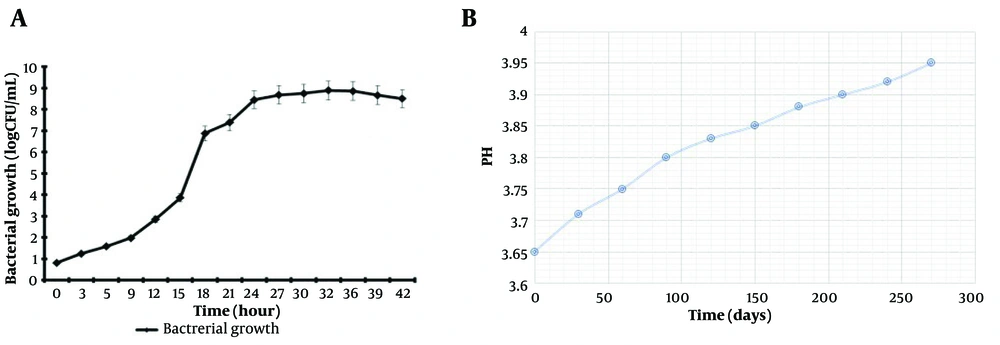
A, The growth kinetics of Lactobacillus casei growth in MRS medium at 37°C for 42 hours under microaerophilic condition. Long- term stability of supernatant of L. casei stored at 4°C for 9 months; B, values of pH in the supernatant were determined during the storage period.
4.2. Long-term Stability of Supernatant
4.3. Animal Studies
4.3.1. Quantification of Ulceration
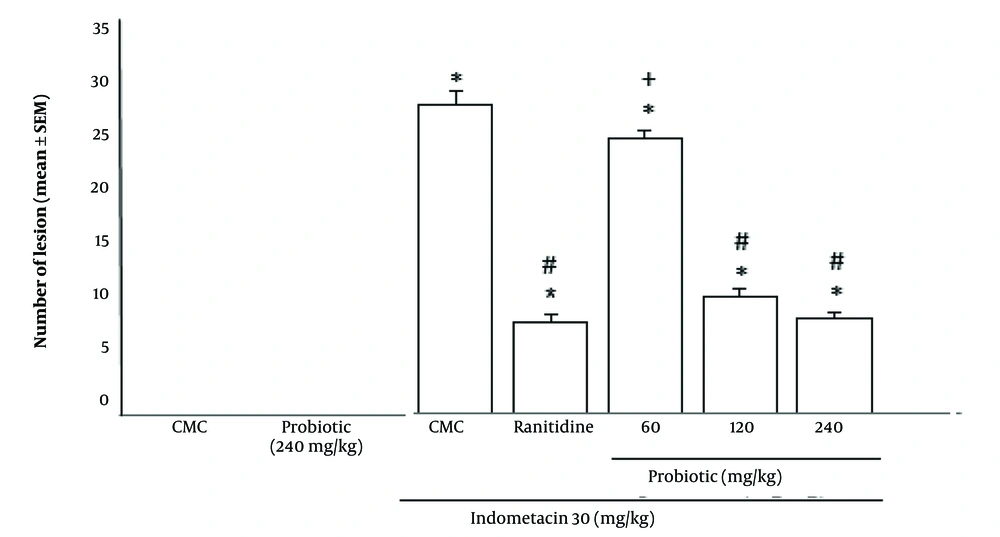
Effect of oral powder containing Lactobacillus casei metabolites on Ulcer Index of indomethacin ulcerated rats. Data are expressed as means ± SEM; n = (6). All groups were compared to carboxymethyl cellulose (CMC) group (* P < 0.05), indomethacin plus CMC (# P < 0.05), ranitidine plus indomethacin (+ P < 0.05) according to analysis of variance (ANOVA) followed by Tukey post-hoc test.
4.3.2. Macroscopic Evaluation
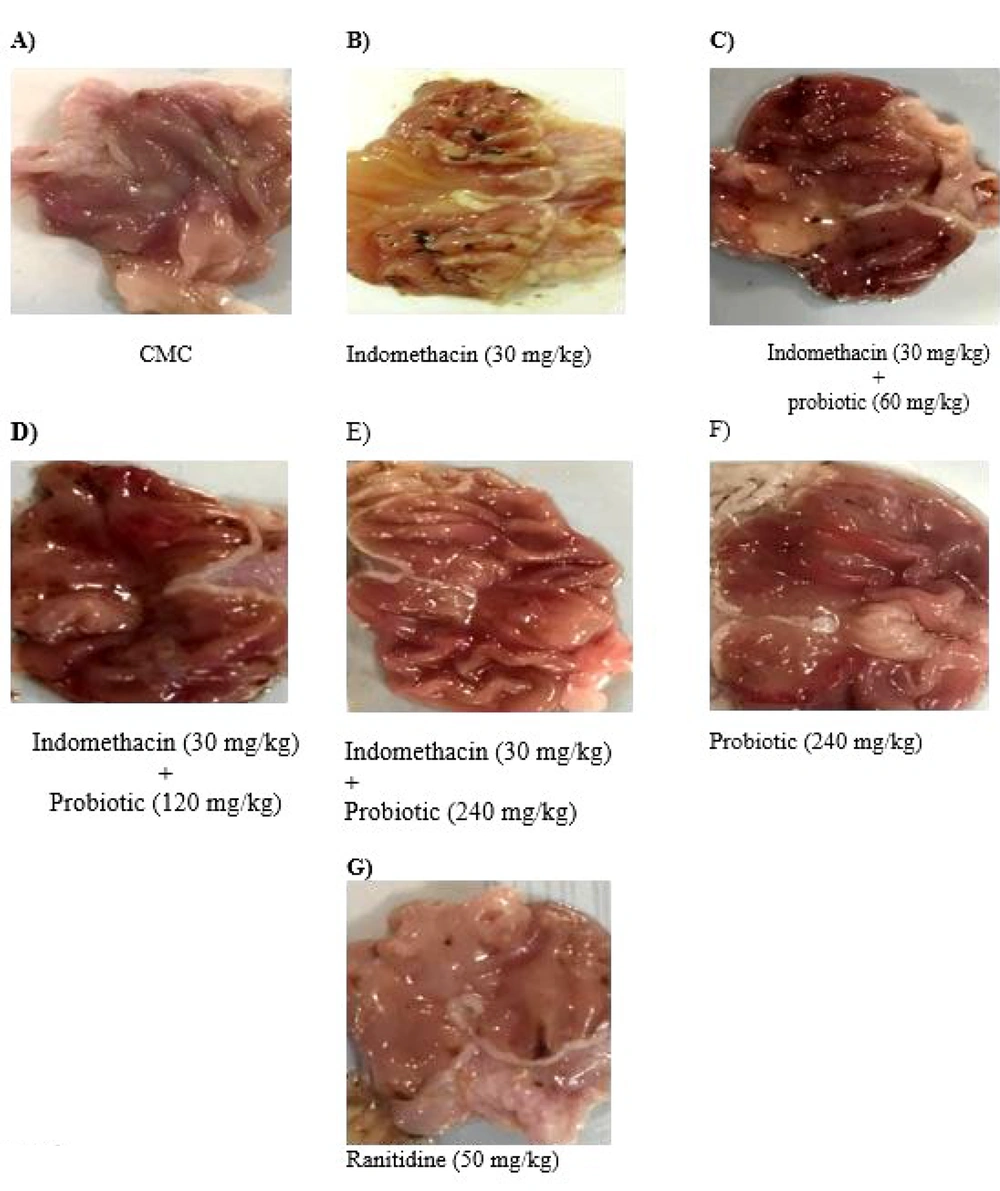
The gross appearance of gastric ulcers induced by Indomethacin(30 mg/kg) and protective effects of Powder Containing Probiotic Metabolites (60, 120, or 240 mg/kg). A, CMC; B, iandomethacin (30mg/kg); C, iandomethacin and pretreatment with 60 mg/kg Powder Containing Probiotic Metabolites; D, iandomethacin and pretreatment with 12o mg/kg Powder Containing Probiotic Metabolites; E, iandomethacin and Powder Containing Probiotic Metabolites (240mg/kg). F, powder Containing Probiotic Metabolites (240mg/kg); G, iandomethacin and ranitidine (50 mg/kg).
4.3.3. Histopathological Studies
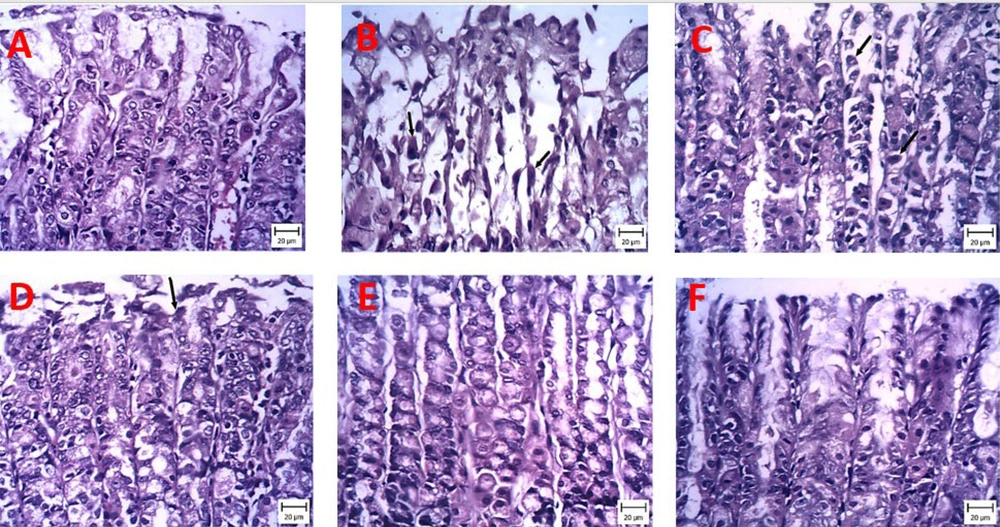
Representative pictures of stomach sections stained with hematoxylin and eosin (H&E) examined under a microscope. Protective effects of powder containing probiotic metabolites (60, 120, or 240 mg/kg) on histopathological changes of gastric tissue induced by indomethacin (hematoxylin and eosin staining, magnification × 200). A, carboxymethyl cellulose (CMC); B, iandomethacin (30 mg/kg); C, iandomethacin and pretreatment with 60 mg/kg powder containing probiotic metabolites, D, iandomethacin and pretreatment with 120 mg/kg powder containing probiotic metabolites; E, iandomethacin and powder containing probiotic metabolites (240mg/kg); F, iandomethacin and ranitidine (50 mg/kg).
4.3.4. Levels of Lipid Peroxidation
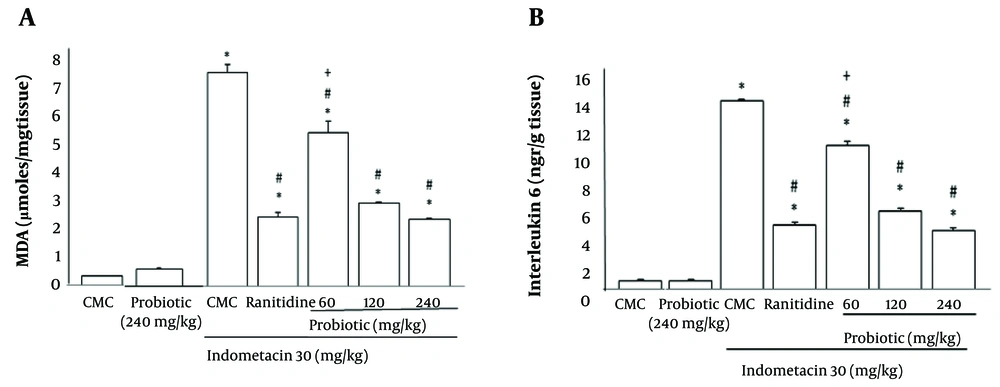
A, Effect of oral powder containing Lactobacillus casei metabolites on levels of lipid peroxidation; B, effect of oral powder containing L. casei metabolites on interleukin-6 (IL-6) concentration in tissue. Data are expressed as means ± SEM; n = 6. All groups were compared to carboxymethyl cellulose (CMC) group (* P < 0.05), indomethacin plus CMC (# P < 0.05), ranitidine plus indomethacin (+ P < 0.05) according to analysis of variance (ANOVA) followed by Tukey post-hoc test.


