
1. Background
Colorectal cancer is a major contributor to illness and death worldwide. It ranks third in terms of how often it occurs, and is the second most common cause of cancer-related fatalities. According to the Global Cancer Observatory (GLOBOCAN) 2020, there are over 1.9 million new cases and 935,000 deaths from colorectal cancer annually (1). These statistics highlight the considerable public health challenge. The trend of increasing incidence is evident not only in developed nations, but also in developing countries such as Indonesia. Factors associated with modern lifestyles, including diets high in fat and low in fiber, obesity, smoking, and alcohol use, have been identified as contributing to rising rates of colorectal cancer (2).
In Indonesia, the rate of colorectal cancer is 8.6 cases per 100,000 individuals. Many patients are diagnosed at a late stage, primarily because of a lack of public awareness about early screening, insufficient screening facilities, and obstacles to undergoing colonoscopy (3). Recent studies have found that over 60% of colorectal cancer cases are identified at stages III and IV, contributing to a low five-year survival rate (4). A national cohort study revealed that the five-year survival rate was 80% for stage I but only 12% for stage IV (2, 5). These findings highlight the critical need to enhance prevention strategies, boost early detection efforts, and develop innovative treatment strategies.
Colorectal cancer progression is driven by complex interactions among genetic alterations, epigenetic regulation, chronic inflammation, and the tumor microenvironment, which actively promotes immune escape rather than merely providing structural support. Tumor cells contribute to an immunosuppressive milieu through the secretion of anti-inflammatory cytokines such as interleukin-10 (IL-10), which enhances regulatory T-cell activity and promotes macrophage polarization toward the M2 phenotype, thereby attenuating effective antitumor immune surveillance (5). This immunoregulatory shift reduces the infiltration and cytotoxic function of CD8+ T lymphocytes and natural killer (NK) cells, limiting their ability to eliminate malignant cells through perforin - granzyme release and apoptosis-mediated pathways. Concurrently, persistent inflammatory signaling increases cyclooxygenase-2 (COX-2) expression, which stimulates tumor proliferation and further suppresses immune responsiveness. In parallel, vascular endothelial growth factor (VEGF)-mediated angiogenesis facilitates neovascularization, ensures nutrient supply, and supports metastatic spread. Together, immune suppression, chronic inflammation, and angiogenic activation act synergistically to sustain colorectal cancer progression and complicate therapeutic management, highlighting the importance of targeting multiple pathways in comprehensive treatment strategies.
Treatment options typically include surgery, chemotherapy, radiotherapy, and molecular-targeted therapy. Surgery is effective in the early stages; however, patients with more advanced conditions require a combination of treatments. Chemotherapy, which involves drugs such as 5-fluorouracil, oxaliplatin, and irinotecan, can improve survival rates, but has significant side effects such as neuropathy, nausea, vomiting, diarrhea, and immunosuppression (2, 6). Radiotherapy carries the risk of damaging healthy tissues around the tumor (8). Molecular targeted therapies, including bevacizumab and cetuximab, show positive results in some patients, but they are very expensive, and drug resistance often develops (6). These issues highlight the need for new treatments that are not only effective and safe, but also affordable and capable of working through multiple mechanisms.
Medicinal plants represent an important source of bioactive compounds with potential anticancer properties. Various phytochemicals, including flavonoids, alkaloids, terpenoids, and polyphenols, have been reported to exert immunomodulatory, anti-inflammatory, and anti-angiogenic effects. Phyllanthus niruri L., a herbal plant widely used in Asia and Africa, has traditionally been applied to support immune function and manage infectious and inflammatory conditions. Contemporary pharmacological studies suggest that P. niruri extract enhances macrophage phagocytic activity, modulates cytokine production, and stimulates the activation of natural killer (NK) cells and cytotoxic T lymphocytes (10). Experimental findings further indicate that the extract may influence the tumor microenvironment by attenuating inflammatory signaling and regulating macrophage polarization (11).
Preclinical investigations in animal models of colorectal cancer have demonstrated tumor growth suppression following administration of P. niruri extract, accompanied by reduced inflammatory mediators and improved immune cell infiltration. Evidence also suggests decreased interleukin-10 (IL-10) production and a shift in macrophage phenotype toward a more immunostimulatory profile, supporting enhanced antitumor immunity (12). Despite these promising findings, comprehensive in vivo studies specifically examining immunological, angiogenic, and inflammatory markers in colorectal cancer remain limited, highlighting the need for further mechanistic investigation.
2. Objectives
This study aimed to evaluate the effects of Phyllanthus niruri L. extract on the progression of colorectal cancer in Sprague-Dawley rats induced by 1,2-dimethylhydrazine (DMH). The study specifically examined cytotoxic T lymphocyte (CTL) expression as an indicator of cellular immune response, vascular endothelial growth factor (VEGF) expression as a marker of angiogenesis, and cyclooxygenase-2 (COX-2) expression as a marker of inflammation. It was hypothesized that administration of P. niruri L. extract would significantly increase CTL expression while decreasing VEGF and COX-2 expression compared with untreated colorectal cancer controls, thereby inhibiting tumor progression through modulation of immune, angiogenic, and inflammatory pathways.
3. Methods
3.1. Research Design
This study employed a laboratory-based experimental design using a post-test-only control group approach. A pre-test assessment was not conducted because baseline biomarker measurements (CTL, VEGF, and COX-2 expression) require invasive tissue sampling that would interfere with tumor induction and compromise animal survival. In addition, colorectal carcinogenesis was experimentally induced using 1,2-dimethylhydrazine (DMH), ensuring that all animals were initially comparable prior to intervention through random allocation. Therefore, a post-test-only design was considered methodologically appropriate to evaluate the effects of Phyllanthus niruri L. extract on tumor progression and associated immunological, angiogenic, and inflammatory markers without introducing procedural bias (11).
3.2. Experimental Animal
The study involved 50 male Sprague-Dawley rats, aged 8 weeks and weighing 200 - 250 g. The minimum sample size was determined using the Federer formula for completely randomized experimental designs, (t-1)(n-1) ≥ 15, where t represents the number of groups and n the number of animals per group. With three groups, the calculation required a minimum of six animals per group; therefore, the sample size was expanded to enhance statistical power and account for potential attrition during carcinogen induction. Animals were randomly allocated into three groups using a computer-generated randomization sequence to ensure equal probability of assignment and reduce selection bias. The rats were housed under controlled environmental conditions (temperature 22-25°C, humidity 55-65%, 12-hour light/dark cycle) with ad libitum access to food and water. All experimental procedures complied with the Guide for the Care and Use of Laboratory Animals and were approved by the University Animal Research Ethics Committee.
3.3. Induction of Colorectal Cancer
Colorectal carcinogenesis was induced using 1,2-dimethylhydrazine (DMH) administered at a dose of 20 mg/kg body weight once weekly for 12 consecutive weeks. The carcinogen was dissolved in saline and adjusted to an appropriate pH to maintain stability prior to administration (11, 13). The selected dose was based on established experimental protocols demonstrating that 20 mg/kg is sufficient to induce progressive colorectal tumor formation while minimizing excessive toxicity and mortality compared with higher-dose regimens (e.g., 30 mg/kg). This dosing strategy allows gradual tumor development that more closely resembles the multistage progression of colorectal carcinogenesis in vivo. The DMH-induced model is widely recognized as a reliable and reproducible method for studying colorectal cancer pathogenesis and therapeutic interventions (13).
3.4. Treatment of P. niruri L. Extract
An ethanol extract of Phyllanthus niruri L. was prepared using the maceration method. The extract was administered orally at a dose of 13.5 mg/kg body weight once daily. Treatment began after completion of the 12-week DMH induction period (week 13) and continued until the end of week 16. Therefore, the extract was given during the post-induction phase to evaluate its therapeutic effects on established colorectal carcinogenesis rather than its preventive effects during tumor initiation. The selected dosage was based on previous preclinical studies demonstrating immunomodulatory and anticancer activity at comparable concentrations (4, 15-17).
3.5. Group Division
Following randomization, the animals were allocated into three experimental groups with balanced distribution to ensure comparability:
Group K - (healthy control, n = 16): Rats did not receive 1,2-dimethylhydrazine (DMH) induction and were not administered P. niruri L. extract.
Group X1 - (cancer control, n = 17): Rats received DMH induction without extract treatment.
Group X2 - (treatment group, n = 17): Rats received DMH induction followed by oral administration of P. niruri L. extract during the post-induction phase.
This allocation ensured comparable group sizes while accounting for potential attrition during carcinogen induction.
3.6. Research Parameter Examination
Cytotoxic T lymphocyte (CTL) expression was evaluated using immunohistochemistry with monoclonal antibodies against CD8 and granzyme B. In this study, CTLs were defined as CD8+ T lymphocytes expressing granzyme B as a marker of cytotoxic activity. Positive cells were counted in five high-power fields (400× magnification), and the mean number of positive cells per field was calculated (18).
VEGF expression was examined using an anti-VEGF-A antibody. The percentage of positively stained tumor cells relative to the total observed cells in five high-power fields (400× magnification) was calculated to assess angiogenic activity (12, 19).
COX-2 expression was assessed using immunohistochemical staining and analyzed with a semi-quantitative immunoreactivity score (IRS) system. Staining intensity was scored as 0 (no staining), 1 (weak), 2 (moderate), and 3 (strong), while the proportion of positive cells was scored as 0 (<10%), 1 (10-25%), 2 (26-50%), and 3 (>50%). The final IRS score (range 0-9) was obtained by multiplying the intensity and proportion scores. An IRS score ≥4 was classified as high expression, whereas a score <4 was considered low expression. COX-2 slides were independently evaluated by two observers blinded to group allocation, and inter-observer agreement was assessed using Cohen’s kappa coefficient. CTL and VEGF were quantified using predefined scoring procedures; however, formal duplicate blinded assessment for these two markers was not documented and is therefore acknowledged as a limitation.
3.7. Data Analysis
Data were analyzed using IBM SPSS Statistics software. The Shapiro - Wilk test was performed to assess normality. For normally distributed data, comparisons among groups were conducted using one-way analysis of variance (ANOVA) followed by Tukey’s HSD for adjusted pairwise comparisons. For non-normally distributed data, the Kruskal-Wallis test was followed by Dunn’s test with Bonferroni correction. Effect sizes were calculated to estimate the magnitude of between-group differences; eta squared (η²) is reported below for the main biomarker outcomes. Statistical significance was set at P < 0.05.
4. Results
4.1. Characteristics of Laboratory Animals
All experimental rats (n = 50) survived until the end of the study period. At baseline (week 0), the mean body weights were comparable among groups, with no statistically significant differences (P > 0.05). The mean baseline body weights were 214.6 ± 11.2 g in the Healthy Control group, 216.1 ± 10.8 g in the Cancer Control group, and 215.4 ± 12.0 g in the Treatment group. By week 16, significant differences in body weight were observed among the three groups (P < 0.05). The Healthy Control group reached a mean body weight of 285.3 ± 15.6 g, whereas the Cancer Control group showed a lower mean body weight of 248.7 ± 18.4 g. Rats treated with P. niruri L. extract demonstrated a mean body weight of 272.9 ± 16.1 g, which was significantly higher than that of the untreated Cancer Control group (P < 0.05) but remained slightly lower than the Healthy Control group. These data are summarized in Table 1.
Table 1.
Body Weight Characteristics of Experimental Rats at Baseline and Week 16 a
| Group | Baseline body weight (g) | Week 16 body weight (g) |
|---|---|---|
| Group K - (healthy control) | 214.6 ± 11.2 | 285.3 ± 15.6 |
| Group X1 - (cancer control) | 216.1 ± 10.8 | 248.7 ± 18.4 |
| Group X2 - (treatment group) | 215.4 ± 12.0 | 272.9 ± 16.1 |
a Values are expressed as mean ± SD.
4.2. CTL, VEGF, and COX-2 Expression
Immunohistochemical analysis revealed significant variations in CTL, VEGF, and COX-2 expression among the three experimental groups (overall P < 0.001). Quantitative comparisons of biomarker expression are presented in Table 2, and the pairwise p-values reported below correspond to adjusted post hoc comparisons.
Table 2.
Average Expression of CTL, VEGF, and COX-2 in Experimental Rats a
| Group | CTL (mean positive cells/HPF) | VEGF (% positive) | COX-2 (score) |
|---|---|---|---|
| Group K - (healthy control) | 5.8 ± 0.9 | 12.1 ± 3.4 | 1.3 ± 0.5 |
| Group X1 - (cancer) | 2.4 ± 0.6 | 68.7 ± 7.9 | 6.9 ± 1.1 |
| Group X2 - (cancer + P. niruri L. extract) | 4.9 ± 0.8 | 39.4 ± 6.2 | 3.8 ± 0.9 |
a Values are expressed as mean ± SD.
Significant differences in CTL expression were observed between groups (overall P < 0.001; η² = 0.79). CTL expression, defined as the mean number of CD8+/granzyme B+ positive cells per high-power field (HPF), was lowest in Group X1 (2.4 ± 0.6 mean positive cells/HPF) and highest in Group K (5.8 ± 0.9 mean positive cells/HPF). Administration of P. niruri L. extract significantly increased CTL expression to 4.9 ± 0.8 mean positive cells/HPF compared with untreated Group X1 (adjusted P < 0.01), indicating improved cytotoxic immune activity. The measurable CTL signal in Group K was interpreted as baseline mucosal immune surveillance rather than nonspecific staining.
VEGF expression, expressed as the percentage of positively stained cells, was significantly elevated in Group X1 (68.7 ± 7.9%) compared with Group K (12.1 ± 3.4%) (overall P < 0.001; η² = 0.94). Following treatment with P. niruri L. extract, VEGF expression was significantly reduced to 39.4 ± 6.2% (adjusted P < 0.01 vs. Group X1), demonstrating suppression of angiogenic activity. The VEGF signal observed in healthy colonic tissue likely represents baseline physiological expression associated with normal mucosal turnover and maintenance of the microvascular network rather than pathologic angiogenesis.
A significant difference in COX-2 expression was also observed among groups (overall P < 0.001; η² = 0.88). Group X1 exhibited the highest COX-2 immunoreactivity score (6.9 ± 1.1), whereas Group K showed the lowest score (1.3 ± 0.5). Group X2 demonstrated a reduced COX-2 score (3.8 ± 0.9), which was significantly lower than that of Group X1 (adjusted P < 0.01), although not fully normalized to Group K levels.
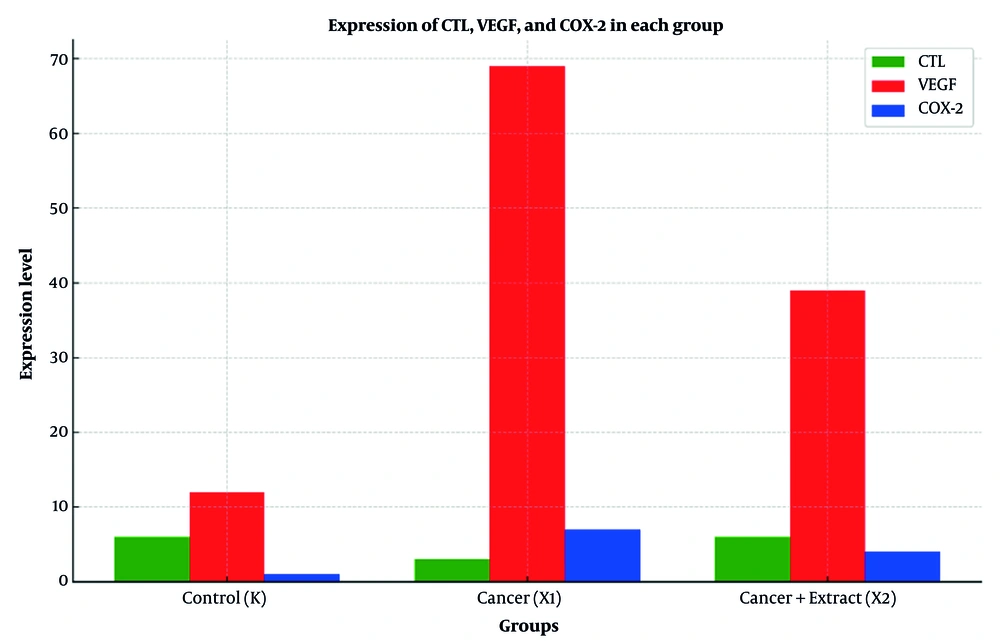
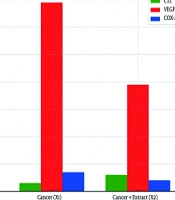
Figure 1.
Combined graph of cytotoxic T lymphocytes (CTL), vascular endothelial growth factor (VEGF), and cyclooxygenase-2 (COX-2) expression in each group
Overall, these results indicate that P. niruri L. extract enhances cytotoxic T lymphocyte activity, suppresses angiogenic signaling, and attenuates inflammatory responses in colorectal cancer models. Graphical comparisons of CTL, VEGF, and COX-2 expression among groups are shown in Figure 1.
5. Discussion
5.1. Immunomodulatory Effect of Phyllanthus niruri L.: Increased Expression of Cytotoxic T Lymphocytes
In the present study, administration of Phyllanthus niruri L. extract resulted in a significant increase in CTL expression in colorectal cancer tissues compared with the untreated cancer group. This finding indicates that the extract enhances cytotoxic CD8+ T-cell activity within the tumor microenvironment. The markedly lower CTL levels observed in the cancer control group confirm the presence of tumor-induced immunosuppression in the DMH-induced colorectal carcinogenesis model. Such immunosuppression is commonly associated with impaired CD8+ T-cell infiltration, elevated anti-inflammatory cytokines such as IL-10, regulatory T-cell expansion, and macrophage polarization toward the M2 phenotype, all of which collectively weaken cellular antitumor responses (20, 17).
The restoration of CTL expression in the treatment group suggests that P. niruri L. may partially reverse this immunosuppressive state. Increased CD8+ T-cell presence enhances perforin - granzyme - mediated apoptosis and promotes cytokine secretion, including IFN-γ and TNF-α, which further stimulate antitumor immune signaling. In the present experimental setting, the magnitude of CTL elevation indicates not merely a statistical difference but a biologically meaningful modulation of cellular immunity. This supports the hypothesis that P. niruri L. acts as an immunostimulatory agent capable of reinforcing adaptive immune surveillance against tumor cells (21).
The immunomodulatory pattern observed in this study is consistent with the known pharmacological profile of P. niruri constituents, particularly flavonoids, lignans, tannins, and polyphenols, which have been reported to enhance macrophage activity, modulate cytokine release, and support cytotoxic lymphocyte responses. Rather than proving activation of specific signaling cascades in the present experiment, the increased CTL expression should be interpreted as an in vivo finding that aligns with previously reported immunomodulatory properties of these bioactive compounds.
From a therapeutic perspective, increased CTL expression represents a key determinant of improved antitumor immunity. Contemporary immunotherapies aim to reactivate cytotoxic T cells; however, such approaches remain costly and inaccessible in many regions. The present study suggests that P. niruri L. may offer a phytotherapeutic strategy to augment endogenous cytotoxic responses in a more accessible manner. While further mechanistic and clinical investigations are required, the observed enhancement of CTL expression provides strong experimental evidence that P. niruri L. functions as an immunomodulator capable of improving cellular immune responses against colorectal cancer.
5.2. Anti-Angiogenic Mechanism of Phyllanthus niruri L.: Decreased VEGF Expression
In the present study, administration of Phyllanthus niruri L. extract significantly reduced VEGF expression in colorectal cancer tissues compared with the untreated cancer group. Given the central role of VEGF in promoting angiogenesis, this finding indicates that the extract exerts a measurable anti-angiogenic effect within the tumor microenvironment. Angiogenesis is essential for sustained tumor growth and metastatic potential, as newly formed blood vessels provide oxygen, nutrients, and structural support for expanding tumor tissue. The marked elevation of VEGF in the cancer control group reflects active angiogenic signaling in the DMH-induced colorectal cancer model, whereas its suppression in the treatment group suggests biological interference with tumor vascularization (12, 19).
The reduction in VEGF expression observed in this study is particularly relevant because excessive angiogenic activity is strongly associated with tumor aggressiveness and poor prognosis in colorectal cancer. By attenuating VEGF levels, P. niruri L. may limit vascular supply to tumor tissue, thereby restraining tumor expansion and potentially reducing metastatic risk. Importantly, this anti-angiogenic effect was observed concurrently with improvements in immune-related parameters, indicating that modulation of angiogenesis and immune activation may occur simultaneously in response to extract administration (6).
Bioactive constituents of P. niruri, including flavonoids, lignans, and polyphenols, have previously been associated with suppression of pro-angiogenic mediators and attenuation of endothelial activation. Accordingly, the reduced VEGF expression observed in this study is consistent with the reported anti-angiogenic pharmacology of the extract. However, because upstream molecular mediators were not directly measured, the present data support a literature-grounded biological interpretation rather than direct evidence of pathway-specific inhibition.
From a clinical perspective, targeting VEGF remains a cornerstone of anti-angiogenic therapy in colorectal cancer. Pharmacological inhibitors of VEGF have demonstrated survival benefits but are often associated with high costs and adverse effects. The findings of the present study suggest that P. niruri L. extract may represent a phytotherapeutic approach capable of attenuating angiogenic activity in a biologically meaningful manner. Although further mechanistic and translational studies are required, the demonstrated reduction in VEGF expression provides experimental support for the anti-angiogenic potential of P. niruri L. in colorectal cancer.
5.3. Anti-Inflammatory Effect of Phyllanthus niruri L.: Reduction of COX-2 Expression
In the present study, administration of Phyllanthus niruri L. extract significantly reduced COX-2 expression in colorectal cancer tissues compared with the untreated cancer group. The elevated COX-2 levels observed in the cancer control group confirm the presence of an active inflammatory microenvironment in the DMH-induced colorectal carcinogenesis model. COX-2 plays a central role in tumor-associated inflammation through the conversion of arachidonic acid into prostaglandins, particularly prostaglandin E2 (PGE2), which is known to promote tumor growth, angiogenesis, and immune evasion. Therefore, the suppression of COX-2 expression observed in this study indicates attenuation of inflammatory signaling that supports tumor progression (4, 8, 20).
Chronic inflammation is a critical driver of colorectal cancer development. Sustained COX-2 overexpression enhances prostaglandin production, leading to increased cellular proliferation, enhanced vascular formation, and reduced immune surveillance. In the present experimental model, the decrease in COX-2 expression following P. niruri L. treatment suggests partial disruption of this pro-inflammatory loop. Notably, this anti-inflammatory modulation occurred concurrently with changes in CTL and VEGF expression, indicating that inflammatory, immune, and angiogenic pathways may be interconnected within the tumor microenvironment (20, 23, 24).
The anti-inflammatory effect observed here is likewise consistent with prior reports that P. niruri phytochemicals can reduce inflammatory mediator production and temper COX-2-associated responses. Therefore, the lower COX-2 expression in the treatment group should be interpreted as an in vivo anti-inflammatory signal that accords with known pharmacological properties of the extract, while the exact upstream molecular regulators remain to be determined.
Importantly, although COX-2 suppression is frequently associated with enhanced apoptosis and improved therapeutic response in colorectal cancer, apoptosis was not specifically analyzed in relation to COX-2 modulation in this section of the study. Therefore, the findings should be interpreted as evidence of anti-inflammatory activity rather than definitive proof of apoptosis restoration. Nevertheless, reducing COX-2 expression likely contributes to a less immunosuppressive tumor microenvironment, potentially facilitating improved immune effector function.
From a therapeutic standpoint, targeting COX-2 remains clinically relevant, as elevated inflammatory signaling is associated with tumor aggressiveness and resistance to chemotherapy. The present findings demonstrate that P. niruri L. extract exerts measurable anti-inflammatory effects in vivo, supporting its potential role as a complementary phytotherapeutic agent that modulates inflammatory pathways in colorectal cancer.
5.4. Clinical Implications and Prospects of Phytopharmaceuticals
The findings of the present animal study indicate that P. niruri L. extract acts through multiple biological mechanisms, including enhancement of cellular immunity, inhibition of angiogenesis, and reduction of inflammation. These combined effects suggest a broader biological activity compared with single-target agents that act on one molecular pathway. This overall pattern is in agreement with the 2025 systematic review and meta-analysis cited in this manuscript, which summarized evidence that P. niruri modulates inflammatory and tumor-related markers in colorectal cancer models. Our study extends that body of evidence by specifically demonstrating increased CTL expression together with reduced VEGF and COX-2 expression in a DMH-induced therapeutic model.
The results of this study offer a preclinical scientific basis for exploring P. niruri L. as a potential adjunct to chemotherapy or immunotherapy. However, these implications should be interpreted cautiously, as the current findings are limited to an animal model. The plant’s availability, affordability, and reported safety profile in traditional use suggest possible relevance in resource-limited settings, but clinical efficacy and safety must be established through well-designed human studies before therapeutic recommendations can be made.
Incorporation of P. niruri L. into complementary therapeutic strategies may warrant further investigation. Resistance to 5-fluorouracil-based chemotherapy has been associated with inflammatory and angiogenic signaling pathways, including COX-2 and VEGF. In the present study, reduction of COX-2 and VEGF expression, along with enhancement of CTL activity, suggests that P. niruri L. may influence mechanisms relevant to treatment response. Nevertheless, whether these molecular changes translate into improved chemotherapy sensitivity requires validation in controlled preclinical combination studies and clinical trials (17, 23).
The potential supportive effects of P. niruri L. on inflammatory regulation may also be relevant in the broader context of cancer management. While anti-inflammatory modulation could theoretically contribute to improved quality of life, such outcomes were not directly evaluated in this study. Therefore, any assumptions regarding symptom relief or reduction of treatment-related side effects remain speculative and require dedicated clinical investigation (5).
Indonesia’s abundant availability of P. niruri L. provides an opportunity for further development of phytopharmaceutical research based on local biodiversity. However, translation into standardized clinical products would require rigorous pharmacological characterization, toxicity profiling, dose optimization, and regulatory evaluation. The present in vivo findings contribute to the mechanistic understanding of P. niruri L. in colorectal cancer but represent an early stage in the translational pathway (5).
Application of these findings in clinical practice will depend on confirmation through large-scale clinical trials. Additional preclinical studies exploring dose-response relationships, treatment duration, and molecular targets are necessary to strengthen the evidence base. Evaluation of additional biomarkers, including pro-inflammatory cytokines and transcription factors, may provide deeper insight into the pathways influenced by P. niruri L. Only after comprehensive translational validation could P. niruri L. be considered a candidate for integration into evidence-based colorectal cancer management strategies (8, 24).
5.5. Conclusions
The findings of this experimental animal study demonstrate that Phyllanthus niruri L. extract modulates key biological pathways involved in colorectal carcinogenesis, as evidenced by increased CTL expression and reduced VEGF and COX-2 levels in a DMH-induced colorectal cancer model. These results suggest coordinated immunomodulatory, anti-angiogenic, and anti-inflammatory effects within the tumor microenvironment. Nevertheless, the study remains limited by the post-test-only design, the use of a single extract dose without a positive control, the absence of direct tumor-burden endpoints such as tumor number, tumor size, histopathological grading, or survival analysis, the lack of phytochemical standardization of the extract, and the absence of uniform formal blinded assessment for all biomarkers. Therefore, although the present findings provide encouraging preclinical evidence, further studies incorporating extract standardization, dose - response evaluation, tumor-specific endpoints, mechanistic analyses, and well-designed clinical trials are required before translational application in colorectal cancer management can be considered.