
1. Background
Global production of fresh fruits and vegetables has doubled from 30 to 60 million tons in recent years, reflecting their crucial role in human nutrition and disease prevention through their rich content of minerals, vitamins, and dietary fiber (1-3). However, this increased consumption is accompanied by growing concerns about foodborne pathogens, as raw vegetables frequently serve as vectors for bacterial and parasitic contamination (4, 5). The practice of consuming vegetables raw or minimally cooked to preserve nutritional value, combined with the use of contaminated irrigation water in agricultural lands, has led to increased food safety risks (6). While conventional washing under running water remains a common practice, its limited effectiveness against persistent contaminants has prompted the exploration of alternative disinfection methods (7). Previous studies have shown promising results with specific treatments, such as vinegar's ability to reduce Escherichia coli populations in lettuce by three logs after five minutes of exposure (8). Despite the importance of disinfection, there have been limited comprehensive assessments of the effectiveness of various methods against both bacterial and parasitic contamination. Despite numerous studies evaluating vegetable decontamination, most investigations have focused exclusively on either bacterial or parasitic contamination. Comprehensive assessments that simultaneously evaluate the efficacy of common household washing methods against both microbial groups under comparable conditions remain limited. This gap hampers the development of unified, evidence-based decontamination guidelines for raw vegetables.
2. Objectives
This study aims to evaluate and compare different disinfection techniques in terms of their efficacy in reducing bacterial and parasitic contamination in vegetables, addressing the pressing need for standardized decontamination protocols.
3. Methods
3.1. Study Design and Ethics
This cross-sectional study was conducted following approval from the Ethics Committee of Ahvaz Jundishapur University of Medical Sciences, Ahvaz, Iran (approval code: IR.AJUMS.REC.1398.015)
3.2. Sample Collection and Preparation
Sample collection was conducted during the spring season. We analyzed seven commonly consumed vegetables: Lactuca sativa (lettuce), Portulaca oleracea (purslane), Ocimum basilicum (basil), Mentha spp. (mint), Allium ampeloprasum (leek), Raphanus sativus (radish), and Lepidium sativum (cress). Two kilograms of vegetables in total were sourced from multiple authorized retail outlets in Ahvaz, Iran. Samples were transported to the Department of Parasitology, Ahvaz Jundishapur University of Medical Sciences, maintaining appropriate temperature and handling conditions throughout transit. Although the total sample weight (2 kg) may appear limited, this study was designed as an exploratory cross-sectional assessment focusing primarily on comparative washing efficacy rather than precise regional prevalence estimation. The sample size was selected based on comparable preliminary studies and logistical feasibility. Post-hoc power estimation indicated that the sample size was sufficient to detect significant differences between washing treatments; however, larger multi-seasonal studies are recommended for population-level prevalence generalization. The total sample weight (2 kg) comprised multiple independent subsamples from each vegetable type. Each vegetable category was represented by three independent retail samples (approximately 250 - 300 g each), which were processed separately and considered the unit of analysis. Sampling was performed using a convenience sampling strategy from authorized retail outlets to reflect commonly available consumer products in the study area.
3.3. Parasitological Analysis
Samples were processed using the Food and Drug Administration (FDA)-recommended sediment concentration method (9). The analytical approach was designed to recover parasitic stages dislodged from the vegetable surfaces into the washing solution rather than to assess parasite inactivation directly. Therefore, detected parasites represent organisms recovered from wash fluids following treatment. Five washing treatments were evaluated: water alone (control), 0.09% NaCl solution, vinegar solution, a common dishwashing detergent solution, and a commercial disinfectant solution containing benzalkonium chloride. The vinegar used in this study was commercial white vinegar containing 5% acetic acid (v/v). It was diluted 1:1 with sterile distilled water to obtain a final acetic acid concentration of approximately 2.5%. The detergent solution consisted of a household dishwashing liquid containing anionic surfactants (primarily linear alkylbenzene sulfonates) prepared at 0.1% (v/v). The commercial disinfectant contained benzalkonium chloride at a final concentration of 200 ppm, prepared according to the manufacturer’s instructions. A 0.09% NaCl solution was used to simulate low-salinity washing conditions commonly applied in household vegetable rinsing in the study region; however, this concentration is lower than physiological saline (0.9%) and was included for comparative purposes. For each treatment, vegetables were immersed in separate test containers and agitated for 30 seconds, followed by a 15-minute incubation period at room temperature (22 ± 2°C). The 15-minute exposure time was selected to approximate commonly recommended household vegetable soaking practices and to allow sufficient contact time for chemical action. While shorter or longer exposure periods may influence decontamination efficacy, particularly for resilient parasitic cysts, evaluation of time-dependent effects was beyond the scope of the present study and warrants further investigation. The vegetables and supernatant were carefully removed, and the precipitate was allowed to settle for 24 hours at room temperature. The resulting sediment was resuspended and centrifuged at 3,000 × g for 5 minutes. After supernatant removal, the precipitate was examined microscopically (magnification: 10X and 40X) (10).
3.4. Microbiological Analysis
3.4.1. Escherichia coli Detection
Bacterial identification followed standardized protocols. Primary isolation was performed on MacConkey agar, and confirmatory biochemical tests were conducted, including Sulfide Indole Motility (SIM), Triple Sugar Iron (TSI) agar, Methyl Red-Voges Proskauer (MRVP), and citrate utilization tests. Confirmed isolates were preserved in tryptic soy broth containing 20% glycerol at -70°C for further analysis (11). The microbiological detection limit of the culture-based assay was 10 CFU/g. Samples showing no colony growth were interpreted as having bacterial loads below this detection threshold rather than complete absence of viable organisms. Bacterial growth was recorded using a semi-quantitative colony density approach due to the absence of precise colony enumeration for all samples.
3.4.2. Enterohemorrhagic Escherichia coli Screening
For enterohemorrhagic E. coli detection, samples were cultured on Sorbitol MacConkey agar and incubated at 37°C for 18 hours. Sorbitol-negative colonies were identified as enterohemorrhagic E. coli (11).
3.4.3. Quality Control
All culture media and biochemical reagents were prepared according to manufacturers' specifications and subjected to sterility testing prior to use. Reference strains from the American Type Culture Collection (ATCC) were used as controls: Escherichia coli ATCC 25922 served as a positive control for biochemical tests, while Enterobacter aerogenes ATCC 13048 was used as a negative control. For enterohemorrhagic E. coli detection, E. coli O157:H7 ATCC 43895 was employed as a positive control. Quality control of culture media was performed using these reference strains to verify their growth-supporting and selective properties. All biochemical tests and bacterial isolations were performed in triplicate under aseptic conditions in a certified BSL-2 laboratory. The pH of all media was verified using a calibrated pH meter (Mettler Toledo S220) and adjusted when necessary. Environmental conditions, including temperature and humidity, were monitored throughout the experimental period using calibrated instruments. All equipment used for sample processing was sterilized according to standard laboratory protocols, and sterility controls were included in each batch of analysis.
3.5. Statistical Analysis
Statistical analyses were performed using SPSS version 26.0 (IBM Corp., Armonk, NY, USA). Data normality was assessed using the Shapiro-Wilk test. The Kruskal-Wallis test followed by Mann-Whitney U tests with Bonferroni correction were used to compare washing methods' effectiveness. Paired t-tests evaluated bacterial load reductions. Fisher's exact test and chi-square analysis assessed contamination patterns across vegetable types. Spearman's correlation examined relationships between bacterial and parasitic loads. Results are presented as means ± standard deviation (SD) or frequencies where appropriate, with P < 0.05 considered statistically significant. Non-parametric tests were applied for comparisons involving non-normally distributed ordinal data, whereas paired t-tests were used exclusively for normally distributed quantitative bacterial load reductions following confirmation of normality. Post-hoc analyses were selected according to the primary test assumptions to avoid methodological inconsistency.
4. Results
4.1. Efficacy of Washing Methods Against Microbial Contamination
Washing treatments demonstrated significantly different efficacies in eliminating microbial contamination (Kruskal-Wallis test, χ² = 24.83, df = 4, P < 0.001). Both vinegar and commercial disinfectant treatments completely eliminated detectable Escherichia coli, while water alone, 0.09% NaCl solution, and detergent treatments showed positive results with varying colony counts, as detailed in Table 1 (P < 0.001 for all pairwise comparisons). Mean bacterial load reductions were highest for commercial disinfectant (3.5 ± 0.4 log CFU/g) and vinegar treatments (3.4 ± 0.5 log CFU/g), significantly outperforming other methods (Mann-Whitney U tests with Bonferroni correction, P < 0.001). No sorbitol-negative colonies suggestive of enterohemorrhagic E. coli (O157:H7) were detected in any of the examined samples.
Table 1.
The Rate of Escherichia coli Contamination with Different Washing Methods in Vegetables
| Washing Methods | Cultivation Results | Results | Colony Count a | |
|---|---|---|---|---|
| Blood Agar Media | EMB Media | |||
| Water | + | + | Positive | +++ |
| Water+NaCl (0.09%) | + | + | Positive | + |
| Water+Vinegar | - | - | Negative | - |
| Water+Detergent | + | + | Positive | ++ |
| Water+Disinfectant | - | - | Negative | - |
a Colony counts were recorded semi-quantitatively based on growth density on culture media, where + indicates low growth, ++ moderate growth, and +++ heavy growth.
4.2. Parasitic Contamination Patterns
We identified four parasitic species across the vegetable samples, with G. lamblia being the most prevalent (n = 9). Giardia lamblia showed persistent contamination across all washing methods, though with varying frequencies: Detergent solution (33.3%), water alone (22.2%), vinegar solution (22.2%), and both NaCl and commercial disinfectant solutions (11.1% each), as shown in Figure 1 and Table 2.
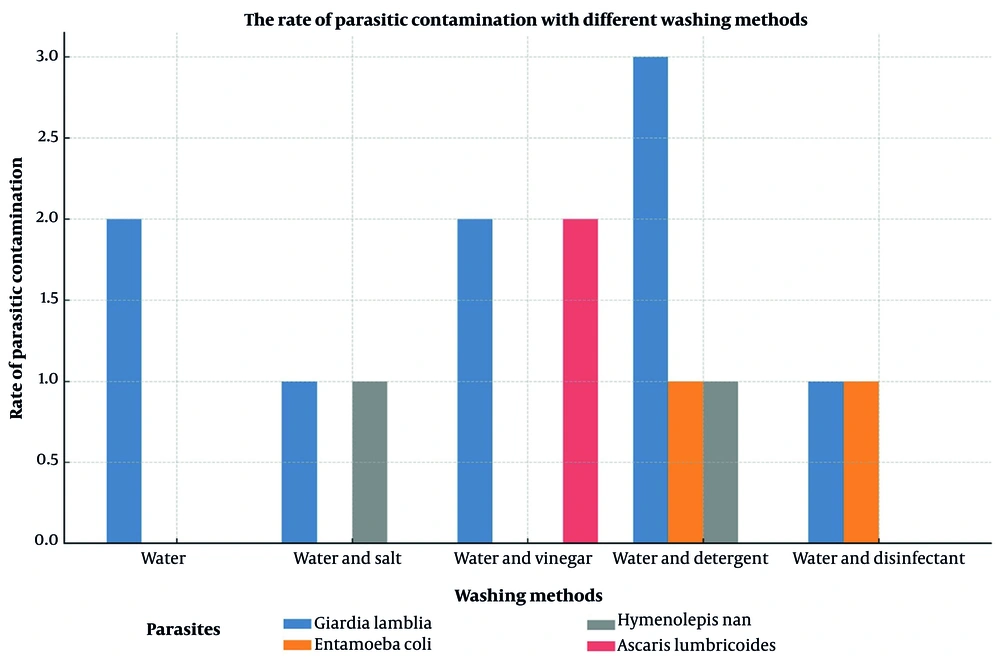
Figure 1.
The rate of parasitic contamination with different washing methods in vegetables; other detected parasites included Entamoeba coli (single occurrence in detergent-treated samples), Hymenolepis nana (two cases), and Ascaris lumbricoides (three cases), with their distribution varying significantly across treatment methods (Fisher's exact test, P = 0.038); percentages are calculated based on the total number of examined samples within each washing treatment group.
| Parasite | Water | Water+NaCl (0.09%) | Water+Vinegar | Water+Detergent | Water+Disinfectant |
|---|---|---|---|---|---|
| Giardia lamblia | 2 (22.2) | 1 (11.1) | 2 (22.2) | 3 (33.3) | 1 (11.1) |
| Entamoeba coli | 0 | 0 | 0 | 1 (100) | 0 |
| Hymenolepis nana | 0 | 1 (50) | 0 | 0 | 1 (50) |
| Ascaris lumbricoides | 0 | 0 | 2 (66.6) | 1 (33.3) | 0 |
a Values are expressed as No. (%).
b Percentages were calculated based on the total number of positive samples for each parasite. Each washing group included nine vegetable samples.
4.3. Vegetable-Specific Contamination Patterns
Leafy vegetables exhibited significantly higher contamination susceptibility compared to root vegetables (odds ratio = 3.2, 95% CI: 1.8 - 5.7, P < 0.001). This pattern was consistent across both bacterial and parasitic contamination, with a strong positive correlation between bacterial and parasitic loads (Spearman's rs = 0.68, P < 0.001). Lettuce and basil showed particularly high contamination rates compared to radish samples (Fisher's exact test, P = 0.007).
4.4. Washing Method Effectiveness
While all washing methods achieved significant reductions in microbial load compared to untreated samples (paired t-tests, P < 0.001 for all methods), none achieved complete elimination of parasitic contamination. The differential effectiveness against bacteria versus parasites suggests distinct mechanisms of pathogen adherence and resistance to common washing treatments (Table 1). Commercial disinfectant and vinegar treatments emerged as the most effective overall methods, though their superior performance against bacterial contamination did not extend equally to parasitic elimination.
5. Discussion
The consumption of raw vegetables has been increasingly recognized as a significant vehicle for pathogen transmission in humans (12), creating an urgent need for standardized and effective disinfection methods. Recent studies highlight the magnitude of this challenge, reporting alarming prevalence rates of both bacterial (E. coli 91%, Staphylococcus aureus 84%, Vibrio cholera 79%) and parasitic contamination (soil-transmitted helminths 36%, intestinal protozoa 27%) (13). These contamination rates, coupled with evidence that pathogens can be introduced through irrigation water, soil, and handling practices (14), underscore the critical importance of establishing robust decontamination protocols that can effectively address the full spectrum of potential contaminants. Our comprehensive analysis of vegetable washing methods reveals complex patterns in treatment efficacy, with implications for both food safety guidelines and public health practices.
Our finding that vinegar and commercial disinfectant treatments achieved complete elimination of E. coli (P < 0.001) while failing to eradicate parasitic contamination highlights a critical gap in current decontamination practices. This disparity is particularly concerning given the reported prevalence of protozoan parasites like G. lamblia in distribution systems (15). The significant bacterial load reduction (3.4 - 3.5 log CFU/g, P < 0.001) achieved by these treatments substantially exceeds previously reported reductions using conventional methods, such as the approximately 1-log reduction (from 2.8 × 10⁵ to 3.4 × 10⁴ CFU/g) achieved with tap water followed by NaOCl treatment (16).
The mechanisms underlying vinegar's antimicrobial action have been well-documented. Recent studies demonstrate that vinegar disrupts microbial cell membranes, leading to reduced protein expression in resistant bacteria including E. coli (17). Furthermore, vinegar's ability to inhibit biofilm formation may explain its enhanced effectiveness against bacterial contaminants in our study (18). However, the persistence of parasitic contamination, despite vinegar's demonstrated antimicrobial properties, suggests that current protocols require optimization. The differential resistance observed between bacteria and protozoan parasites is biologically plausible. Giardia cysts possess a robust, multi-layered wall enriched with chitin-like polymers and structural proteins that confer substantial resistance to osmotic and chemical stress. In contrast, E. coli cells are bounded primarily by lipid bilayer membranes that are more susceptible to disruption by weak acids and surfactants. This structural disparity likely contributes to the persistence of parasitic stages despite effective bacterial reduction. This aligns with the observation by Singh that while vinegar-treated vegetables show enhanced antimicrobial activity against foodborne pathogens, their effectiveness varies with concentration and exposure time (19).
The significantly higher contamination rates in leafy vegetables compared to root vegetables (odds ratio = 3.2, 95% CI: 1.8 - 5.7, P < 0.001) align with da Silva et al.'s (14) observations about environmental contamination routes. This heightened vulnerability of leafy vegetables likely reflects their larger surface area and complex morphology, which provide more attachment sites for pathogens. Our finding of a strong correlation between bacterial and parasitic loads (rs = 0.68, P < 0.001) suggests common contamination pathways, likely influenced by the poor sanitary conditions often encountered in food distribution systems (15). This correlation reinforces the importance of considering vegetable morphology in food safety protocols and suggests that interventions targeting bacterial contamination might also help reduce parasitic loads.
The persistent detection of G. lamblia across all washing methods (11.1 - 33.3%) aligns with global trends in protozoan contamination of vegetables, where 41.22% of produce samples worldwide show parasitic contamination, with particularly high rates in Asian regions (57.12%) (20). Interestingly, the higher detection frequency of G. lamblia in the detergent-treated group compared with water alone may reflect enhanced mechanical detachment rather than true treatment failure. Surfactants can reduce surface tension and facilitate the release of adherent cysts from vegetable surfaces into the washing fluid, thereby increasing microscopic recovery. This persistence, coupled with our sporadic detection of Entamoeba coli, Hymenolepis nana, and Ascaris lumbricoides, reflects patterns observed in recent global surveys, where Giardia spp. (10%), Entamoeba coli (8%), and Ascaris species (24.1%) are consistently detected (20, 21). Our findings of parasitic persistence despite washing treatments are particularly concerning given recent evidence of extremely high contamination rates in certain regions, such as reported rates of 82.69% to 88.9% in Nigerian vegetables (21, 22). The combined data from our study on washing efficacy suggest that current decontamination protocols may be inadequate to address the full range of potential contaminants identified, highlighting an urgent need for more effective, parasite-specific intervention strategies.
Our findings suggest that current vegetable washing recommendations require revision, particularly given the high prevalence of both bacterial and parasitic contaminants in distribution systems. The complete elimination of E. coli by certain treatments while parasites persist indicates that traditional microbiological safety markers may inadequately assess decontamination effectiveness.
Several limitations should be acknowledged. First, the relatively small sample size and convenience sampling strategy may limit the generalizability of the findings. Second, parasitic identification relied on microscopy without molecular confirmation, which may underestimate species diversity. Third, seasonal variation in contamination patterns was not evaluated and could influence pathogen prevalence. Fourth, the study was conducted within a single geographic region, which may restrict broader extrapolation. Finally, quantitative bacterial enumeration was limited to culture-based detection thresholds, and future studies incorporating molecular and quantitative approaches are recommended. Additionally, bacterial growth was evaluated semi-quantitatively rather than by precise CFU enumeration, which may limit fine quantitative comparisons between treatments.
5.1. Conclusions
This study demonstrates that while vinegar and commercial disinfectant treatments effectively eliminate bacterial contamination in vegetables, parasitic contaminants show persistent survival across all washing methods. The marked difference in efficacy between bacterial and parasitic decontamination highlights the need for refined protocols. Leafy vegetables exhibited notably higher contamination susceptibility compared to root vegetables, suggesting morphology-specific risks in vegetable safety. The observed correlation between bacterial and parasitic loads indicates common contamination pathways and emphasizes the importance of comprehensive monitoring approaches. These findings support the implementation of multi-barrier decontamination strategies, particularly for leafy vegetables, and underscore the necessity of incorporating both bacterial and parasitic indicators in safety assessments. Future food safety guidelines should address the complex relationship between vegetable morphology, pathogen persistence, and decontamination efficacy, especially in regions where raw vegetable consumption is prevalent.