
1. Background
Lung cancer remains the leading cause of cancer-related mortality globally, with non-small cell lung cancer (NSCLC) accounting for approximately 85% of cases (1). Despite therapeutic advances, low 5-year survival rates and issues with drug resistance and systemic toxicity highlight the urgent need for safer and effective alternatives (2). Consequently, plant-derived natural products have gained significant attention as promising anticancer candidates.
Xantolis cambodiana (P. Royen), a member of the Sapotaceae family native to Southeast Asia, is traditionally used in indigenous medicine to treat respiratory and inflammatory disorders (3, 4). Although the anticancer potential of various Thai medicinal plants, such as Anchusa ovata and Andrographis panicula, has been documented, X. cambodiana remains largely unexplored (5-8). Phytochemical reports on the Xantolis genus suggest the presence of bioactive secondary metabolites, including triterpenoids, saponins, and flavonoids, which are known for their antioxidant and cytotoxic properties (3, 4). These compounds are likely contributors to the biological activity of the plant and may target malignant cells through oxidative stress and programmed cell death (PCD).
Apoptosis and autophagy are essential PCD mechanisms that maintain cellular homeostasis, and their dysregulation is a hallmark of cancer (9, 10). Previous studies on Thai medicinal plants, such as Erythrophleum succirubrum and Mammea siamensis, have shown that herbal extracts can suppress lung cancer by inducing mitochondria-mediated apoptosis and disrupting survival pathways (6, 11). Furthermore, natural compounds such as curcumin and resveratrol demonstrate anticancer effects through autophagy induction and ROS modulation (12, 13).
Reactive oxygen species (ROS) play a dual role in cancer: Physiological levels support proliferation, whereas excessive ROS accumulation can trigger mitochondrial dysfunction and irreversible cell death (14). Evidence suggests that certain plant-derived complexes induce ROS-mediated mitochondrial damage in A549 cells, leading to cytochrome c release and caspase activation (15, 16). This study evaluated the anticancer activity of X. cambodiana solvent extracts on human lung cancer A549 cells, specifically investigating their effects on cytotoxicity, migration, apoptosis, and autophagy and their association with ROS-mediated mitochondrial dysfunction.
2. Objectives
This study aimed to comprehensively evaluate the anticancer effects of distilled water, methanol, ethyl acetate, and hexane extracts of X. cambodiana on A549 lung cancer cells, focusing on proliferation, colony formation, apoptosis, autophagy, ROS generation, and mitochondrial function.
3. Methods
3.1. Cell and Cell Culture
Human lung cancer A549 cells (ATCC) were cultured in Dulbecco’s Modified Eagle Medium (DMEM) with 10% fetal bovine serum and 1% antibiotics, with medium replacement every 3 days.
3.2. Plant Extraction
Xantolis cambodiana stems were collected from Udon Thani, Thailand, in April 2022 and authenticated by Associate Professor Dr. Sawai Mattapha. The dried stems (100 g) were sequentially Soxhlet-extracted with hexane, ethyl acetate, methanol, and distilled water. Extracts were concentrated under reduced pressure and stored at 4°C. Yields were 2.70% for hexane, 2.27% for ethyl acetate, 0.18% for methanol, and 0.14% for distilled water.
3.3. Cytotoxicity Assay
Cancer cell growth was assessed by sulforhodamine B (SRB) assay after treatment with distilled water (DW), methanol, ethyl acetate, and hexane extracts. A549 cells (1 × 10⁴ cells/well) were seeded in 96-well plates and exposed to 0 - 1000 μg/mL extracts for 24 - 72 hours. Cells were fixed, stained with 0.4% SRB, solubilized in 10 mM Tris base, and absorbance was read at 540 nm.
Cytotoxicity toward normal human dermal fibroblasts (NHDF; 3 × 10³ cells/well) was evaluated by MTT assay after 24-hour exposure to 0 - 250 µg/mL extracts. After incubation with MTT (0.5 mg/mL) for 2 hours, formazan crystals were dissolved in dimethyl sulfoxide (DMSO), and absorbance was measured at 570 nm using a Synergy-4 plate reader (BioTek Instruments, USA).
3.4. Colony-Forming Ability Assay
Colony formation was evaluated using 0 - 250 µg/mL extracts selected from preliminary screening. A549 cells (250 cells/well) were treated for 24 hours and then maintained in fresh medium for 10 days, with medium replacement every 2 - 3 days. Colonies were fixed with methanol, stained with 0.25% crystal violet, photographed, and counted.
3.5. Wound-Healing Assay
Cell migration was evaluated by wound-healing assay. A549 cells (2.5 × 10⁵ cells/well) were seeded overnight in 24-well plates, scratched with a sterile pipette tip, and treated with 0 - 250 µg/mL extracts for 24 hours. Wound closure was imaged at 0 and 24 hours using phase-contrast microscopy (Olympus CKX53, USA).
3.6. Apoptotic Induction Assay
Apoptosis was assessed by flow cytometry after 24-hour treatment of A549 cells (2.5 × 10⁵ cells/well) with 0 - 250 µg/mL extracts. Cells were stained with Annexin V-FITC and propidium iodide (PI; BD Biosciences, CA, USA) and analyzed using a BD Accuri C6 Plus flow cytometer.
3.7. Autophagy Assay
Autophagy was assessed by flow cytometry after 24-hour exposure of A549 cells (2.5 × 10⁵ cells/well) to 0 - 250 µg/mL extracts. Cells were stained with 12.5 nM acridine orange (AO; Merck KGaA, Darmstadt, Germany) and analyzed using a BD Accuri C6 Plus flow cytometer.
3.8. Reactive Oxygen Species Formation Assay
Intracellular ROS levels were quantified by flow cytometry after 24-hour treatment of A549 cells (2.5 × 10⁵ cells/well) with 0 - 250 µg/mL extracts. Cells were incubated with 25 µM DCF-DA for 30 minutes at 37°C and analyzed using a BD Accuri C6 Plus flow cytometer (BD Biosciences, CA, USA).
3.9. Mitochondrial Membrane Potential Assay
Mitochondrial membrane potential (ΔΨm) was evaluated by flow cytometry after 24-hour treatment of A549 cells (2.5 × 10⁵ cells/well) with 0 - 250 µg/mL extracts. Cells were stained with JC-1 (BD Biosciences, USA) and analyzed using a BD Accuri C6 Plus flow cytometer.
3.10. Statistical Analysis
Data from 3 independent experiments are expressed as mean ± standard error of the mean (SEM). Differences between treatment and control groups were analyzed using Student’s t-test, with statistical significance set at P < 0.05.
4. Results
4.1. Selective Cytotoxicity and Therapeutic Window
The anticancer potential of X. cambodiana was first evaluated by comparing its effects on A549 lung cancer cells versus NHDF normal fibroblasts. All extract fractions exhibited significant dose- and time-dependent cytotoxicity against A549 cells. In contrast, NHDF cells maintained high viability (> 80%) when exposed to concentrations up to 250 µg/mL (Figure 1). Notably, the IC₅₀ values for the most potent fractions, hexane (78.18 ± 1.61 μg/mL at 72 hours) and ethyl acetate (99.51 ± 9.69 μg/mL at 72 hours), were 2.5 to 3.2 times lower than the maximum concentration tested on normal cells. This significant differential response establishes a favorable therapeutic window, suggesting that X. cambodiana specifically targets malignant cellular processes while sparing normal noncancerous cells.
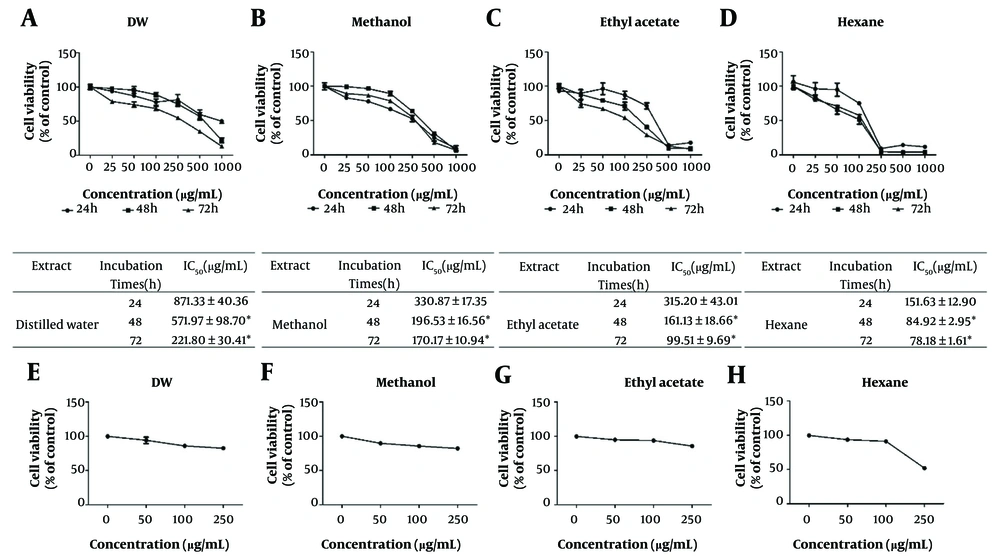
Figure 1.
Effects of the extracts on A549 proliferation. A - D, A549 cells were treated with extracts (0 - 1000 µg/mL, 24 - 72 hours), and viability was assessed by SRB assay; E - H, NHDF cells were treated with extracts (0 - 250 µg/mL, 24 hours) and analyzed by MTT assay. Data are presented as mean ± SEM (n = 3); * P < 0.05 vs control.
4.2. Suppression of Long-Term Proliferation and Migration
Beyond acute cytotoxicity, the extracts effectively compromised the reproductive integrity of A549 cells, as demonstrated by dose-dependent inhibition in the colony formation assay (Figure 2). The ethyl acetate fraction emerged as the strongest inhibitor of long-term proliferation. Furthermore, the wound-healing assay revealed a potent antimigratory effect (Figure 3). Although nonpolar fractions were highly cytotoxic, the distilled water and methanol extracts showed superior efficacy in slowing wound closure. This indicates that the phytochemical constituents of X. cambodiana may interfere with cytoskeletal dynamics or signaling pathways essential for cancer cell metastasis, independent of their immediate cytotoxic potency.
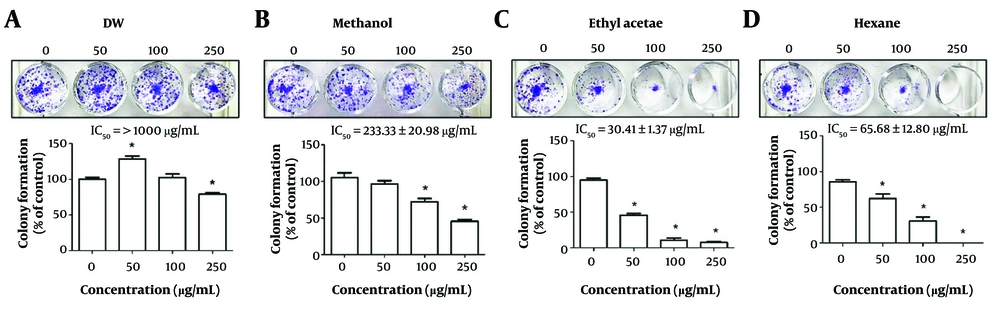
Figure 2.
Effects on colony formation. A – D, cells (250 cells/well) were treated with extracts (0 - 250 µg/mL, 24 hours) and cultured in fresh DMEM for 10 days. Colonies were stained and counted. Data are presented as mean ± SEM (n = 3); * P < 0.05 vs control.
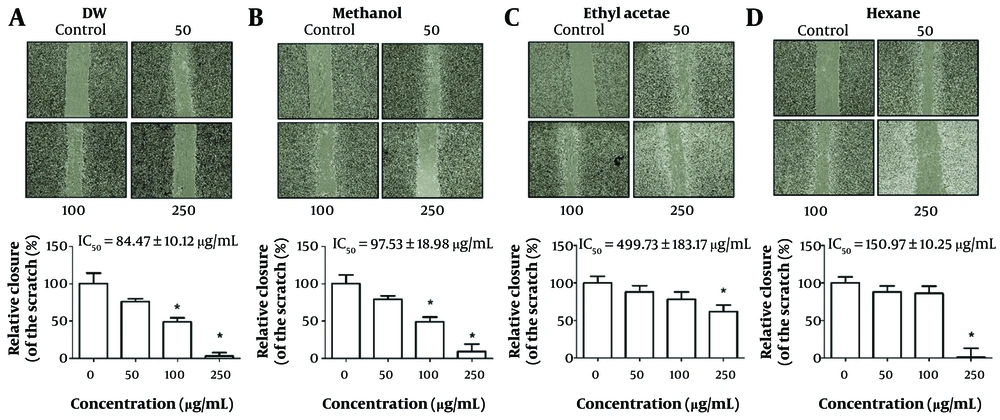
Figure 3.
Effects of the extracts on cell migration. A549 cells (2 × 10⁵ cells/well) were seeded in 6-well plates, wounded with a 0.2-mL pipette tip, and treated with extracts (0 - 250 µg/mL) for 24 hours. Images were captured at 0 and 24 hours, and relative wound closure was quantified versus control. Data are presented as mean ± SEM (n = 3); * P < 0.05 vs control.
4.3. Apoptosis Induction and Autophagy Modulation
The mode of cell death induced by X. cambodiana extracts was quantitatively characterized using flow cytometry. After 24 hours of treatment, distinct variation in the induction of PCD was observed among the different fractions (Figure 4A - D). The methanol extract induced the highest percentage of late apoptosis at 13.67 ± 1.25%, followed by ethyl acetate (10.50 ± 1.16%), hexane (6.77 ± 1.10%), and distilled water (5.70 ± 0.47%) fractions, respectively, compared with the untreated control. Interestingly, although the hexane extract exhibited the highest long-term cytotoxicity at 72 hours (Section 4.1), its apoptotic rate at the 24-hour mark was relatively lower than that of the methanol fraction. This observation suggests a temporal divergence in death signaling, where polar constituents in methanol may trigger a more rapid transition to late-stage apoptosis, whereas nonpolar compounds in hexane may exert more sustained growth arrest that manifests as higher cumulative cell death over 72 hours.

Figure 4.
Effects on apoptosis and autophagy. (A - D) Cells (2 × 10⁵ cells/well) were treated with extracts (0 - 250 µg/mL, 24 hours), and apoptosis was assessed by Annexin V-FITC/PI flow cytometry. (E - I) Autophagy was evaluated by AO staining and flow cytometry. Data are presented as mean ± SEM (n = 3); * P < 0.05 vs control.
In addition to apoptosis, the extracts significantly modulated autophagy, as evidenced by the increase in acidic vesicular organelles (Figure 4E - H). The ethyl acetate fraction emerged as the most potent inducer of autophagy, increasing the autophagic cell population to 77.27 ± 3.35%. Significant increases were also observed in cells treated with distilled water (42.37 ± 2.91%), methanol (19.53 ± 4.12%), and hexane (10.47 ± 1.27%), compared with the baseline control. These quantitative findings indicate that X. cambodiana triggers a complex interplay between apoptotic and autophagic pathways, suggesting that the extracts exert their anticancer effects through multiple PCD mechanisms.
4.4. Reactive Oxygen Species Generation and Mitochondrial Dysfunction as Mechanistic Drivers
To elucidate the underlying mechanism, intracellular ROS and ΔΨm were analyzed. All extracts induced a significant shift from baseline ROS levels, with the ethyl acetate fraction triggering the highest oxidative stress (16.87 ± 5.23%), followed by the hexane (15.37 ± 1.26%), distilled water (13.27 ± 3.31%), and methanol (3.97 ± 1.11%) fractions, respectively, compared with the untreated control (Figure 5A - E). This elevation in ROS directly correlated with marked dissipation of ΔΨm (Figure 5F - J). Specifically, the fraction with the highest ROS production also exhibited the most significant mitochondrial depolarization. This strong physiological correlation implies that the phytochemicals in X. cambodiana act as pro-oxidants, leading to mitochondrial membrane permeabilization. This cascade likely serves as the critical precursor for the intrinsic apoptotic pathway observed in A549 cells.
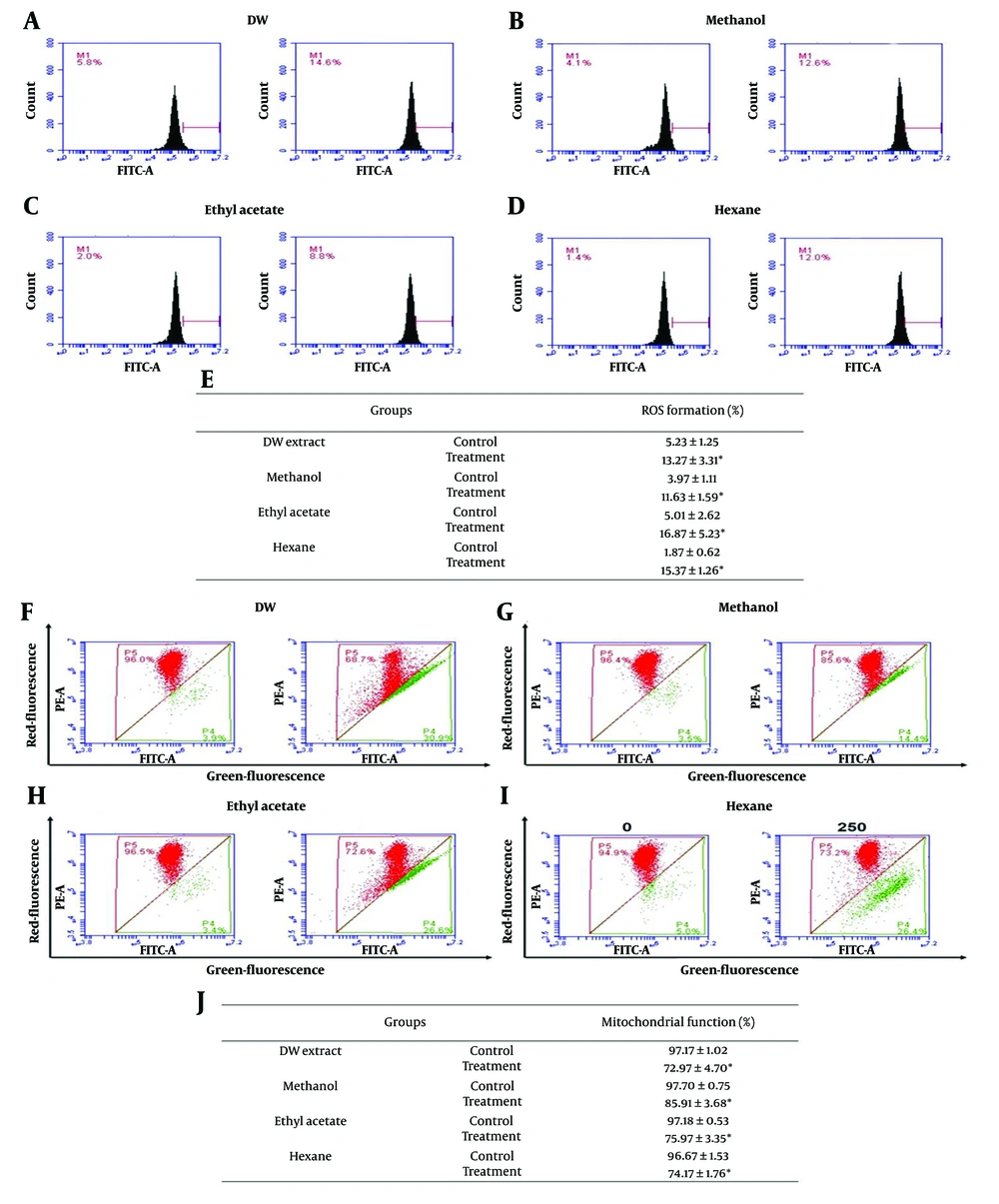
Figure 5.
Effects on ROS and mitochondrial function. Cells (2 × 10⁵ cells/well) were treated with extracts (0 - 250 µg/mL, 24 hours). Reactive oxygen species (ROS) were measured by DCF-DA, and mitochondrial membrane potential was assessed by JC-1 using flow cytometry. Data are presented as mean ± SEM (n = 3); * P < 0.05 vs control.
5. Discussion
Natural products remain a cornerstone in the discovery of bioactive compounds with potent anticancer properties. Xantolis cambodiana, despite its traditional use in Southeast Asian medicine for inflammatory conditions, has remained scientifically underexplored regarding its oncological applications. This study demonstrates that X. cambodiana extracts effectively suppress A549 lung cancer cell progression through a multifaceted mechanism involving growth inhibition, antimigratory activity, and induction of PCD through ROS-mediated mitochondrial pathways (17, 18).
A primary requirement for a viable anticancer candidate is selective cytotoxicity. Our results established a favorable therapeutic window, as the extracts targeted A549 cells at concentrations significantly lower than those affecting normal NHDF cells. Although normal cells were tested up to 250 µg/mL, their high viability, 2.5- to 3-fold higher than the IC₅₀ of the active fractions, provides evidence of selectivity. This suggests that X. cambodiana phytochemicals specifically exploit the unique metabolic vulnerabilities of cancer cells, such as their heightened sensitivity to oxidative stress, while sparing healthy fibroblastic cells within the effective pharmacological range (18).
A critical finding in our study was the kinetic divergence between short-term apoptotic induction at 24 hours and long-term cytotoxicity at 72 hours. Although the methanol extract was the most efficient at triggering late apoptosis within 24 hours, the hexane extract exhibited the highest cumulative potency at 72 hours. This “disconnect” is likely attributable to the distinct chemical nature of polar versus nonpolar constituents. Nonpolar compounds in the hexane fraction may induce a gradual, sustained cytotoxic effect involving cell cycle arrest or early-stage apoptosis that fully manifests as reduced cell mass over a longer duration. Conversely, polar compounds in the methanol extract appear to initiate a more rapid apoptotic cascade. This highlights that IC₅₀ values reflect a cumulative inhibitory impact, whereas flow cytometry provides specific temporal insights into the mode of cell death (19, 20).
The observed antimigratory activity, particularly in the distilled water and methanol extracts, suggests that X. cambodiana may interfere with the machinery of metastasis. Metastasis is a complex process in which malignant cells disseminate and establish secondary tumors (21). In lung cancer, this process is often facilitated by matrix metalloproteinases (MMPs), such as MMP-9, which degrade the extracellular matrix (22, 23). Similar to other Thai medicinal plants, such as Centella asiatica and Cratoxylum formosum, which inhibit migration by downregulating MMP expression (24, 25), extracts of X. cambodiana warrant further investigation to determine whether they specifically target the MMP-9 pathway or cytoskeletal remodeling.
The interplay between apoptosis and autophagy is pivotal in determining cancer cell fate. Our data showed that X. cambodiana induced late apoptosis and significantly enhanced autophagy, with the ethyl acetate fraction showing the most robust autophagic induction. Autophagy often involves the conversion of LC3-I to LC3-II and regulation of Beclin-1 (26, 27). Similar to curcumin and S-saponin, which trigger autophagy in A549 cells (28, 29), our extracts likely modulate these autophagic markers. Although the current study serves as a preliminary screening, the observed crosstalk between these PCD pathways is consistent with findings in other potent medicinal plants, such as Piper nigrum and Poria cocos, which engage both intrinsic and extrinsic apoptotic signaling (19, 25).
Finally, our results identify ROS-mediated mitochondrial dysfunction as a central mechanistic driver. The significant correlation between ROS accumulation and loss of mitochondrial membrane potential suggests that the extracts trigger the opening of mitochondrial permeability transition pores, leading to the release of proapoptotic factors into the cytosol (30). However, this study has certain limitations that should be addressed in future research. First, although the JC-1 assay clearly demonstrated a decrease in ΔΨm relative to the control, the absence of a standard positive control, such as carbonyl cyanide m-chlorophenyl hydrazone (CCCP), for mitochondrial depolarization is noted. Second, although the dose-dependent relationship between oxidative stress and mitochondrial damage strongly indicates a ROS-dependent mechanism, antioxidant rescue experiments, such as those using N-acetylcysteine, were not performed in this initial screening to confirm absolute causality (31, 32).
Furthermore, although our functional assays, including flow cytometry and staining, provide strong evidence for the induction of apoptosis and autophagy, the direct mechanistic links at the molecular level remain to be fully established. Key molecular markers, such as caspase activation, the Bax/Bcl-2 ratio, and the expression of LC3-II or Beclin-1, were not investigated by Western blot analysis in this preliminary study. Future research using specific ROS scavengers and protein-level quantification will be essential to definitively map the signaling pathways and molecular targets of X. cambodiana-induced cell death. Despite these limitations, the current findings provide an important foundation for the development of X. cambodiana as a promising plant-derived candidate for lung cancer treatment.
5.1. Conclusions
In conclusion, this study demonstrates the significant antitumor potential of X. cambodiana against A549 lung cancer cells, characterized by selective cytotoxicity that spares normal NHDF cells. Our findings establish that the extracts suppress cancer cell proliferation and migration through robust induction of ROS-mediated apoptosis and mitochondrial dysfunction. The observed kinetic differences in death signaling between polar and nonpolar fractions suggest that diverse phytochemicals in X. cambodiana contribute to its efficacy. These results identify X. cambodiana as a promising candidate for targeted lung cancer therapy and warrant further bioassay-guided isolation of active compounds and in vivo validation for preclinical development.