
1. Background
Obesity is a major global public health challenge that substantially increases the risk of chronic conditions, including type 2 diabetes, cardiovascular disease, and obstructive sleep apnea (1-4). Its prevalence has increased substantially over recent decades and continues to rise across regions (5, 6). In parallel, obesity imposes a considerable economic burden on health systems; in the United States, it is associated with increased annual per-person medical spending and high aggregate national costs (7). In addition, experimental studies have shown that obesity-related metabolic pathways may be modified through physiological and behavioral interventions, underscoring the complex biological mechanisms involved in weight regulation and responses to obesity treatment (8).
Lifestyle modification, including dietary changes and physical activity, remains first-line therapy; however, achieving and maintaining clinically meaningful weight loss is difficult for many patients. Pharmacotherapy may be appropriate for selected individuals, and bariatric surgery is effective for severe obesity; however, it is invasive, resource-intensive, and unacceptable or inaccessible for some eligible patients (9, 10). Recent regional evidence has further demonstrated the effectiveness of bariatric procedures, such as sleeve gastrectomy and single anastomosis sleeve ileal bypass surgery, in achieving short-term obesity-related outcomes, highlighting the ongoing need for less invasive alternative interventions for selected patients (11, 12). These limitations have accelerated interest in minimally invasive endoscopic approaches as adjuncts or alternatives for weight management (5, 9, 10).
Botulinum toxin type A (BTX-A) inhibits acetylcholine release at cholinergic nerve terminals, leading to reduced smooth muscle contractility (9, 13-18). When injected into the gastric wall, BTX-A is hypothesized to reduce gastric motility, particularly antral contractility, delay gastric emptying, and increase early satiety, thereby helping patients adhere to calorie restriction (9). Animal studies support potential effects on food intake and body weight (19-21), and subsequent clinical studies have evaluated intragastric BTX-A injection as a weight-loss intervention in humans (9, 22, 23).
However, results in humans have been inconsistent, likely reflecting heterogeneity in toxin dose, injection sites (fundus, antrum, or body), number of injection points, and the intensity of co-interventions, such as dietary counseling (23-25). Meta-analyses have also reached conflicting conclusions regarding the efficacy of gastric BTX-A for weight loss (26, 27). Importantly, most published studies have evaluated doses up to 500 U (23-25), leaving uncertainty as to whether a higher dose could enhance efficacy without compromising safety. Although higher total doses of BTX-A have been used in weight-loss interventions and other clinical contexts with acceptable safety profiles (28-34), evidence for higher-dose intragastric regimens remains limited.
2. Objectives
This prospective cohort study aimed to compare the efficacy and short-term safety of two intragastric BTX-A doses (1000 U vs 500 U), injected into the gastric body, for weight loss in adults with obesity.
3. Methods
3.1. Study Design and Setting
This prospective cohort study was conducted from March 2024 to January 2025 at Imam Hossein Educational Hospital, affiliated with Shahid Beheshti University of Medical Sciences, Tehran, Iran. The study protocol was approved by the Ethics Committee of the Deputy of Research and Technology, Shahid Beheshti University of Medical Sciences (IR.SBMU.RETECH.REC.1402.702). Participation was voluntary, and written informed consent was obtained from all participants before enrollment. The study was not registered on a clinical trial platform.
3.2. Participants
Adults aged 18 years or older with a BMI ≥ 30 kg/m2 who were candidates for intragastric injection of BTX-A as part of routine clinical care were enrolled. Patients were recruited using convenience sampling from eligible referrals to the endoscopy unit. Exclusion criteria were pregnancy or lactation, a history of diabetes mellitus or cardiovascular disease, a history of malignancy, gastric ulcer within the past 180 days, psychological disorders, thyroid or other hormonal disorders, known allergy to BTX-A, use of weight-loss supplements at study entry, and unwillingness to participate.
3.3. Exposure and Group Definition
Participants received intragastric BTX-A at 1 of 2 doses: 500 U (medium-dose group) or 1000 U (high-dose group). Dose selection was determined by the treating physician’s clinical decision among patients with a BMI ≥ 30 kg/m2. The research team had no role in treatment decision-making. There was no random allocation, and neither participants nor clinical staff were blinded to the administered dose.
3.4. Intragastric Botulinum Toxin Injection Procedure
All procedures were performed by a gastroenterologist using an endoscope (OLYMPUS GIF-H170). Patients fasted for 8 hours before the procedure. Sedation was administered under anesthesiologist supervision using a combination of midazolam, fentanyl, and propofol, according to routine practice. Diagnostic upper gastrointestinal endoscopy was performed immediately before injection. If a peptic ulcer, tumor, or food debris was detected during gastroscopy, the BTX-A injection was not performed.
The BTX-A product used was MASPORT® 500 U (Iran). The toxin was reconstituted with 0.9% sodium chloride to achieve a concentration of 50 U/mL. Accordingly, a total volume of 10 mL (500 U) or 20 mL (1000 U) of the prepared solution was injected using a 22-gauge sclerotherapy needle. Injections were administered circumferentially at 3 levels along the gastric body (7, 9, and 11 cm from the pylorus). At each level, 8 evenly distributed injections were performed to ensure complete circumferential coverage, resulting in a total of 24 injection points per procedure. The toxin was injected into the submucosal layer using an endoscopic injection needle. All procedures were performed by an experienced gastroenterologist under direct endoscopic visualization. After the procedure, patients were observed for 8 hours to monitor acute complications, such as bleeding, and were discharged if clinically stable.
3.5. Co-Intervention, Dietary Counseling, and Physical Activity Recommendations
All participants received dietary counseling and were advised to follow a 1200-kcal/day diet and perform daily physical activity, beginning 72 hours after injection, as recommended by a nutritionist. Dietary recommendations were reinforced at each follow-up visit. Adherence to dietary and physical activity recommendations was not formally assessed.
3.6. Data Collection and Measurements
Data were collected using a standardized, study-specific checklist and included demographic variables (age and sex) and clinical variables (weight, height, BMI, self-reported satiety/appetite, and adverse events). Anthropometric assessments included height (cm) and weight (kg). Weight was measured at each visit using a calibrated digital scale, and height was measured at baseline using a stadiometer, with BMI calculated as weight (kg)/height (m)2. The objectivity of weight and BMI measurements minimized the risk of detection bias, although assessors were not blinded to dose.
Satiety/fullness and appetite after meals were assessed via participant self-report at the first follow-up visit. Procedure-related and follow-up adverse events, such as abdominal pain and nausea/vomiting, were recorded based on participant reports and clinical assessment.
3.7. Follow-Up and Outcomes
Participants were followed for 16 weeks, with 5 scheduled visits: baseline (before BTX-A injection) and 1, 4, 8, and 16 weeks after injection. The primary outcomes were changes in body weight and BMI over the follow-up period. Secondary outcomes included self-reported satiety/appetite and procedure-related adverse events. Serious adverse events were defined as any event resulting in death, life-threatening conditions, hospitalization or prolongation of hospitalization, persistent or significant disability, or events requiring major surgical intervention.
3.8. Sample Size Estimation and Sampling
Sample size was estimated by assuming an average weight loss of 3 kg after 500 U BTX-A and 5 kg after 1000 U BTX-A at 16 weeks (32), with an assumed equal standard deviation of 2.5 kg, type I error α = 0.05, and 90% power. Allowing 20% attrition, the minimum required sample size was calculated as 44 participants per group (total n = 88). Participants were recruited using convenience sampling until the target sample size was achieved in both groups.
3.9. Statistical Analysis
Normality of quantitative variables was assessed visually using histograms. Quantitative variables were described as mean and standard deviation, and qualitative variables as frequency and percentage. The Mann-Whitney U test was used to compare differences in the means of quantitative variables between the 2 groups because the variables were not normally distributed. The chi-square test or Fisher exact test was used to assess differences in the distribution of grouped variables. A linear GEE regression model was used to examine trends in repeated quantitative variables over time. The correlation structure in the linear GEE model was set as exchangeable. Finally, multivariable GEE models with an exchangeable correlation structure were used to evaluate the effect of injected BTX-A dose on mean changes in weight and BMI, after adjustment for the baseline value of each outcome and probable confounding variables. The final model was fitted based on the minimum value of the quasi-likelihood under the independence model criterion. All analyses were performed at a significance level of less than 0.05 using Stata software version 17 (StataCorp LLC, College Station, TX, USA).
4. Results
4.1. Participants
Among 100 patients screened, 88 met the eligibility criteria and received intragastric BTX-A (500 U, n = 44; 1000 U, n = 44). In this study, 12 participants were excluded because of pregnancy (n = 1), ongoing pharmacological treatment for obesity (n = 3), nonadherence to the 1200-kcal/day diet and daily physical activity regimen (n = 5), and refusal to participate (n = 3).
4.2. Baseline Characteristics
The mean age of the participants was 40.13 ± 16.91 years, and 74 of 88 participants (84.09%) were female. Baseline age and sex distribution were similar between the groups. Baseline weight and height were higher in the 1000-U group (P < 0.05), whereas baseline BMI did not differ significantly (Table 1).
Table 1.
Basic and Anthropometric Assessment of Participants by BTX-A Dose a
| Variables | 500 unit (n = 44, 50%) | 1000 unit (n = 44, 50%) | Total (n = 88, 100%) | P Value |
|---|---|---|---|---|
| Age (y) | 39.81 ± 21.13 | 40.45 ± 11.49 | 40.13 ± 16.91 | 0.373 |
| Gender | 0.244 | |||
| Female | 39 (88.64) | 35 (79.55) | 74 (84.09) | |
| Male | 5 (11.36) | 9 (20.45) | 14 (15.91) | |
| Height (cm) | 162.97 ± 7.27 | 167.77 ± 11.24 | 165.37 ± 9.71 | 0.027 b |
| Weight (kg) | 87.59 ± 11.86 | 95.48 ± 16.81 | 91.53 ± 15.002 | 0.022 b |
| Body Mass Index (BMI, kg/m2) | 32.90 ± 2.82 | 33.76 ± 2.78 | 33.33 ± 2.82 | 0.160 |
| Weight loss in 16th week after injection | 0.002 b | |||
| < 5 kg | 17 (38.64) | 4 (9.09) | 21 (23.86) | |
| ≥ 5 kg | 27 (61.36) | 40 (90.91) | 67 (76.14) | |
| Feeling of fullness or satiety (7 days after injection) | 0.118 | |||
| No | 9 (20.45) | 3 (6.82) | 12 (13.64) | |
| Yes | 35 (79.55) | 41 (93.18) | 76 (86.36) | |
| Complication after injection | 0.616 | |||
| None | 43 (97.73) | 41 (93.18) | 84 (95.45) | |
| Abdominal pain | 1 (2.27) | 2 (4.55) | 3 (3.41) | |
| Nausea/vomiting | 0 (0.0) | 1 (2.27) | 1 (1.14) |
a Values are presented as mean ± standard deviation or frequency and percentage.
b Statistically significant, P value < 0.05.
4.3. Weight and BMI Changes Over Time
In the GEE models, both groups showed significant reductions in weight and BMI over the 16-week follow-up (time effect, P < 0.001). At week 16, the mean change in weight from baseline was −6.29 ± 4.57 kg (−7.18%) in the 500-U group and −9.75 ± 4.81 kg (−10.21%) in the 1000-U group (Table 2; Figure 1). The mean change in BMI at week 16 was −2.37 ± 1.55 kg/m2 (−7.20%) vs −3.42 ± 1.68 kg/m2 (−10.13%), respectively (Table 2; Figure 1). The group-by-time interaction was significant for both outcomes (P < 0.001), indicating different trajectories between the dose groups.
Table 2.
Time Trend Analysis of Weight and Body Mass Index in Participants by BTX-A Dose a
| Variables and BTX-A Units | Baseline (T0) | First Week (T1) | 4th Week (T2) | 8th Week (T3) | 16th Week (T4) | Mean Difference (Minimum, Maximum) | Mean Changes (%) | P-Value Time Effect | P-Value Time × Groups | P-Value Time Groups Comparison b, c |
|---|---|---|---|---|---|---|---|---|---|---|
| Weight (kg) | < 0.001 b | |||||||||
| 500 U | 87.59 ± 11.86 | 85.84 ± 11.38 | 83.75 ± 11.20 | 82.25 ± 10.87 | 81.29 ± 10.68 | −6.29 ± 4.57 (−17.0, 0) | −7.18 | < 0.001 b | T0/T1; T0/T2; T0/T3; T0/T4 | |
| 1000 U | 95.48 ± 16.81 | 93.11 ± 16.62 | 89.87 ± 15.98 | 87.71 ± 16.22 | 85.73 ± 16.52 | −9.75 ± 4.81 (−21.0, 0) | −10.21 | < 0.001 | T0/T1; T0/T2; T0/T3; T0/T4 | |
| BMI (kg/m2) | < 0.001 b | |||||||||
| 500 U | 32.90 ± 2.82 | 32.14 ± 2.80 | 31.39 ± 2.90 | 30.82 ± 2.90 | 30.53 ± 2.86 | −2.37 ± 1.55 (−5.94, 0) | −7.20 | < 0.001 b | T0/T1; T0/T2; T0/T3; T0/T4 | |
| 1000 U | 33.76 ± 2.78 | 32.97 ± 2.71 | 31.79 ± 2.72 | 31.03 ± 2.88 | 30.34 ± 3.27 | −3.42 ± 1.68 (−7.11, 0) | −10.13 | < 0.001 b | T0/T1; T0/T2; T0/T3; T0/T4 |
aValues are expressed as mean ± SD unless otherwise indicated. Abbreviation: BMI, Body Mass Index.
b Statistically significant, P value < 0.05, based on the linear generalized estimating equation method.
c Each time point was compared with baseline (T0); Mean difference = T4 - T0.
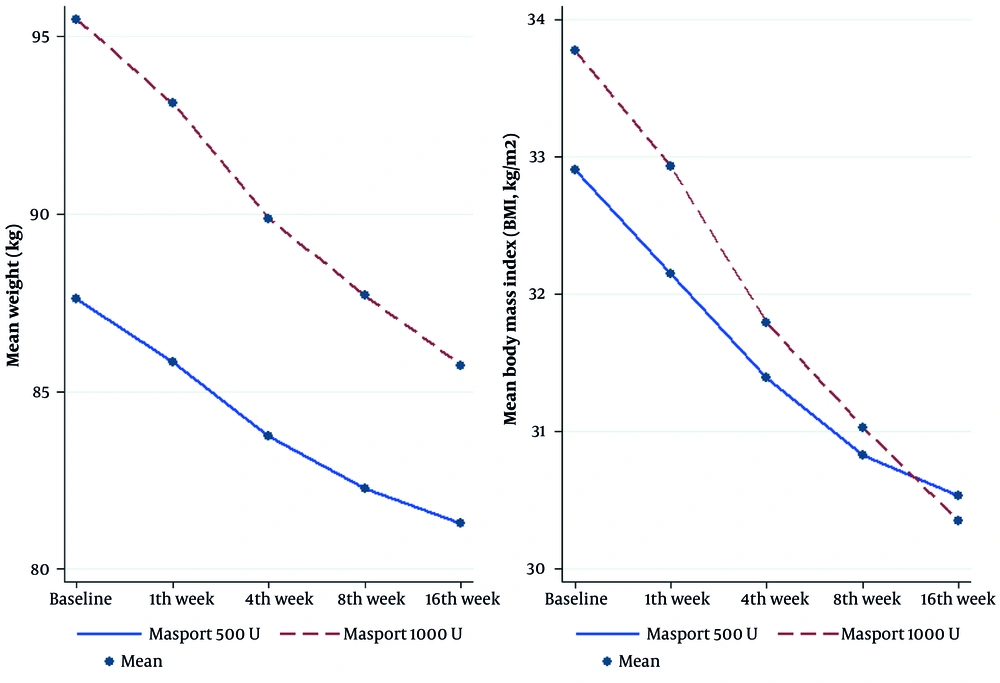
Figure 1.
Embedded flower image
4.4. Adjusted Association of Dose with Outcomes
In multivariable GEE models (model 2), after adjustment for the baseline value of each outcome and probable confounders, the 1000-U dose was associated with greater reductions in weight (β = −1.62 kg; 95% CI, −2.76 to −0.47; P = 0.006) and BMI (β = −0.53 kg/m2; 95% CI, −0.94 to −0.11; P = 0.013) than 500 U (Table 3).
Table 3.
Results of Linear Generalized Estimating Equation Analysis of the Effect of BTX-A on Mean Changes in Weight and BMI During the Study a
| Outcomes and BTX-A Units | Model 1 β (95% CI) b | P-Value c | Model 2 β (95% CI) b | P-Value c |
|---|---|---|---|---|
| Weight (kg) | 0.008 | 0.006 | ||
| 500 U | Reference | Reference | ||
| 1000 U | −1.54 (−2.68, −0.40) | −1.62 (−2.76, −0.47) | ||
| BMI (kg/m2) | 0.017 | 0.013 | ||
| 500 U | Reference | Reference | ||
| 1000 U | −0.51 (−0.93, −0.09) | −0.53 (−0.94, −0.11) |
a Abbreviation: BMI, Body Mass Index. Model 1: Initial value of weight or BMI and BTX-A units. Model 2 for mean changes in weight: Initial value of weight, BTX-A units, age, gender, and height. Model 2 for mean changes in BMI: Initial value of BMI, BTX-A units, age, and gender.
b Coefficient (β), 95% confidence interval.
c Statistically significant, P value < 0.05.
4.5. Categorical Response, Satiety, and Adverse Events
At week 16, 37 of 44 participants (84.09%) in the 500-U group and 42 of 44 participants (95.45%) in the 1000-U group had lost weight (P = 0.157). Weight loss of at least 5 kg occurred in 27 of 44 participants (61.36%) vs 40 of 44 participants (90.91%), respectively (P = 0.002) (Table 1). A sensation of satiety/fullness was reported by 35 of 44 participants (79.55%) vs 41 of 44 participants (93.18%) (P = 0.118). Adverse events were uncommon; abdominal pain occurred in 3 of 88 participants (3.41%), and nausea/vomiting occurred in 1 of 88 participants (1.14%). No serious adverse events were observed.
5. Discussion
In this prospective cohort study, intragastric BTX-A injection into the gastric body was associated with clinically meaningful short-term weight loss over 16 weeks in adults with obesity. By week 16, TBWL was greater in the 1000-U group than in the 500-U group (−10.21% vs −7.18%), accompanied by larger reductions in absolute weight (−9.75 ± 4.81 kg vs −6.29 ± 4.57 kg) and BMI (−3.42 ± 1.68 vs −2.37 ± 1.55 kg/m2). These trends were consistent with the follow-up findings. Importantly, even modest reductions in body weight may provide clinically meaningful benefits across obesity-associated comorbidities and patient-reported outcomes, as highlighted in a recent systematic review (35).
In adjusted longitudinal analyses, the higher dose remained associated with greater reductions in weight and BMI compared with 500 U (weight: β = −1.62 kg; 95% CI, −2.76 to −0.47; P = 0.006; BMI: β = −0.53 kg/m2; 95% CI, −0.94 to −0.11; P = 0.013). Nevertheless, causal inference is limited because dose selection was physician-directed rather than randomized, and baseline anthropometric differences between groups raise the possibility of residual confounding by indication.
The clinical literature on intragastric BTX-A for obesity has reported inconsistent outcomes, likely reflecting heterogeneity in toxin formulation and dose, injection location (fundus, antrum, or body), number of injection points, and the intensity of accompanying lifestyle interventions (23-27, 36-39). In our study, injections were administered into the gastric body in a circumferential distribution across 3 sites (7, 9, and 11 cm from the pylorus), with 8 evenly distributed injections per site (24 injection points in total). Differences in total dose, number of injection points, and injection distribution strategy likely contribute to variability in clinical outcomes reported across studies (23-25).
Recently, Bekin et al. (34) evaluated intragastric BTX-A injections using higher total doses in a retrospective cohort and reported significant weight reduction after 1000-U administration. Their findings suggest that higher doses may enhance short-term weight-loss outcomes, which is consistent with the greater TBWL observed in our 1000-U group (−10.21%) than in the 500-U group. However, unlike the retrospective design used by Bekin et al., our study was conducted prospectively with predefined follow-up visits and standardized data collection, which strengthens the temporal assessment of weight change and reduces the risk of recall and selection bias. The prospective nature of our design provides more robust evidence supporting the potential dose-related effect of intragastric BTX-A (34). Nevertheless, prior studies have demonstrated variable outcomes, underscoring the complexity of this intervention. For instance, Topazian et al. observed delayed gastric emptying after antral injections but no significant weight loss (23), suggesting that physiological modulation alone may be insufficient and that injection site, distribution strategy, and total dose likely interact to determine clinical efficacy.
BTX-A is hypothesized to reduce gastric contractility and promote earlier satiation, potentially facilitating adherence to calorie restriction (9, 13-18). In this cohort, satiety/fullness and appetite after meals were assessed via participant self-report and recorded accordingly. Although self-reported satiety was common, the between-group difference in the proportion reporting satiety was not statistically significant (93.18% vs 79.55%; P = 0.118) (Table 1). This finding may reflect the limited sensitivity of binary self-report measures, reporting bias, or the contribution of factors beyond perceived satiety, such as behavioral adherence or procedural factors, to the observed dose-related differences in weight loss. Because gastric emptying and appetite-related hormones were not measured, mechanistic interpretation should remain cautious (13, 15-18).
The procedure was generally well tolerated in our cohort, and no serious adverse events were observed during the 16-week follow-up (Table 1). Minor adverse events were uncommon in the study population (Table 1). Although our findings are reassuring in the short term, rare severe complications after intragastric BTX-A have been reported in the literature, underscoring the importance of standardized technique, careful patient selection, and systematic safety monitoring, particularly when higher doses are used (23, 40, 41).
5.1. Strengths and Limitations
The strengths of this study include prospective follow-up with predefined visits at baseline and weeks 1, 4, 8, and 16; repeated anthropometric measurements over time; and a head-to-head comparison of 2 dosing regimens within the same clinical setting. In addition, the use of a standardized injection protocol with 24 injection points distributed across 3 predefined gastric zones enhances procedural consistency and reproducibility.
The key limitations include the nonrandomized design, baseline anthropometric differences between dose groups, and the absence of a placebo or standard-care control group, which limit causal attribution of the observed weight loss to BTX-A alone. In addition, all participants received dietary counseling (1200 kcal/day) and activity recommendations, but adherence was not formally assessed and was recorded based on patient report. Finally, although our findings are reassuring in the short term, rare severe complications after intragastric BTX-A have been reported in the literature, underscoring the importance of standardized technique, careful patient selection, and systematic safety monitoring, particularly when higher doses are used. Therefore, longer-term durability and late adverse events cannot be determined.
5.2. Conclusions
In this prospective cohort study, intragastric BTX-A injection was associated with short-term reductions in body weight and BMI over a 16-week follow-up period. Patients receiving 1000 U demonstrated greater mean weight loss and BMI reduction than those receiving 500 U under identical dietary counseling and lifestyle recommendations.
However, given the nonrandomized design, physician-directed dose allocation, baseline differences between groups, and lack of a placebo or standard-care control group, causal inference regarding the independent effect of BTX-A and the presence of a true dose-response relationship cannot be established. In addition, the absence of formal dietary adherence assessment and the relatively short follow-up period further limit interpretation of the efficacy and durability of response.
Therefore, these findings should be considered exploratory and hypothesis-generating. The observed differences between doses require confirmation in adequately powered randomized controlled trials with appropriate control groups, standardized assessment of lifestyle adherence, and longer follow-up to evaluate both sustained efficacy and long-term safety.