
1. Background
Triple-negative breast cancer (TNBC) is the most clinically aggressive subtype of breast cancer and is characterized by the absence of estrogen receptor (ER), progesterone receptor (PR), and human epidermal growth factor receptor 2 (HER2) expression (1). The lack of these molecular targets precludes the use of endocrine or HER2-directed therapies, contributing to a high incidence of metastasis and reduced overall survival compared with receptor-positive subtypes (2, 3). Although the therapeutic landscape has expanded to include immune checkpoint inhibitors and antibody-drug conjugates, clinical outcomes remain suboptimal (4-6). Many patients exhibit intrinsic resistance, whereas others rapidly develop acquired multidrug resistance, highlighting the need for innovative, low-toxicity therapeutic strategies (6, 7).
In this context, drug repositioning has emerged as a promising strategy for identifying novel anticancer applications for established non-oncological agents (8). Among lipophilic statins, Lov has attracted substantial interest because it inhibits the mevalonate pathway by suppressing HMG-CoA reductase activity. This inhibition disrupts the post-translational prenylation of small GTPases, including Ras and Rho, which contribute to the proliferative and mesenchymal characteristics associated with TNBC (9). Beyond cholesterol regulation, Lov interferes with the mevalonate-isoprenoid axis, impairing the membrane localization and signaling activity of oncogenic GTP-binding proteins (10-12). Consequently, Lov may induce metabolic stress and sensitize TNBC cells to cytotoxic agents.
Arsenic trioxide (As2O3), widely recognized for its efficacy in hematological malignancies (13, 14), has also demonstrated pro-apoptotic activity in solid tumors through the induction of oxidative stress and mitochondrial dysfunction (15, 16). However, the clinical application of As2O3 in TNBC remains limited by concentration-dependent toxicity. We hypothesized that inhibition of the mevalonate pathway by Lov would create a metabolically vulnerable state that enhances the pro-oxidant and cytotoxic effects of As2O3. Such a synergistic interaction could allow concentration reduction while maintaining therapeutic efficacy and minimizing off-target toxicity.
2. Objectives
This study demonstrated that Lov enhances the antitumor activity of As2O3 in a TNBC cell model by synergistically inhibiting cell growth. These findings support the therapeutic potential of combining metabolic pathway inhibition with redox-targeting agents in TNBC. Further preclinical investigations using patient-derived models and molecular profiling approaches are warranted to evaluate the translational potential, scalability, and cost-effectiveness of this combinatorial strategy.
3. Methods
3.1. Cell Line and Maintenance
The TNBC cell line MDA-MB-231 was obtained from the National Genetic Resources Center of Iran. Cells were cultured in high-glucose Dulbecco's Modified Eagle Medium (DMEM; Gibco) supplemented with 10% (v/v) heat-inactivated fetal bovine serum, penicillin (100 U/mL), and streptomycin (100 µg/mL) (Biowest, England). Cells were maintained at 37°C in a humidified incubator containing 5% CO2 (17).
3.2. Evaluation of Lov-Induced Cytotoxicity by MTT Assay
The antiproliferative effects of Lov (Sigma-Aldrich, 98% purity) were evaluated using the MTT colorimetric assay, as previously described (18). MDA-MB-231 cells were seeded in 96-well plates at a density of 1 × 10⁴ cells/well and incubated for 24 hours to allow attachment. Cells were then treated with increasing concentrations of Lov (1 - 100 µM) for 48 hours; this exposure duration was selected based on previous studies demonstrating measurable antiproliferative responses of TNBC cells to statins and As2O3 within this interval (18, 20).
After treatment, 100 µL of MTT solution (5 mg/mL in PBS) was added to each well, and the plates were incubated for 4 hours at 37°C. Formazan crystals were dissolved in DMSO, and absorbance was measured at 570 nm with a reference wavelength of 630 nm using a microplate reader (BioTek, USA) (19). Cell viability was normalized to untreated controls.
3.3. Assessment of As2O3-Mediated Cytotoxicity and Cell Viability by MTT Assay
The cytotoxic effects of As2O3 (Sigma-Aldrich, 99.0% purity) on MDA-MB-231 cells were assessed using the MTT colorimetric assay. The As2O3 stock solution (10 mM) was prepared in 1.0 M NaOH and adjusted to pH 7.2 before use. MDA-MB-231 cells were seeded in 96-well plates at a density of 1 × 10⁴ cells/well and allowed to attach for 24 hours under standard culture conditions.
Cells were then exposed to increasing concentrations of As2O3 (1, 10, 25, 50, 75, and 100 µM) for 48 hours, whereas control cells received vehicle (PBS) alone. After treatment, 100 µL of MTT reagent (5 mg/mL in PBS) was added to each well, and the plates were incubated for 4 hours at 37°C. The culture medium was then removed, and the generated formazan crystals were solubilized in 100 µL of DMSO. Absorbance was measured at 570 nm with a reference wavelength of 630 nm using a BioTek microplate reader (20). Cell viability was expressed as a percentage relative to untreated control cells.
3.4. Combination Effects of Lov and As2O3 on Cell Viability of MDA-MB-231 Tumor Cells Evaluated by MTT Assay
To evaluate the cytotoxic effects of monotherapies and combination treatments, cells were seeded in 96-well plates at a density of 10,000 cells/well. After 24 hours of attachment, cells were treated with varying concentrations of As2O3, Lov, or their combinations for 48 hours. Cell viability was assessed using the MTT assay, and absorbance was measured at 570 nm using a microplate reader. Viability was expressed as a percentage of the untreated control group.
Synergy quantification and isobologram analysis were subsequently performed using these data. The nature of the interaction between As2O3 and Lov was quantified using the Chou-Talalay median-effect method with CompuSyn software (version 1.0; ComboSyn Inc., Paramus, NJ). The CI was calculated to define the interaction: CI < 1 indicates synergism, CI = 1 indicates an additive effect, and CI > 1 represents antagonism. An isobologram was generated to visually assess the synergistic potential of the combination at specific effect levels (21).
3.5. Morphological Assessment of Cellular Structure
To assess the cytotoxic effects of Lov and As2O3 on MDA-MB-231 cells, cells were seeded in 96-well culture plates at a density of 10,000 cells/well. After an initial 48-hour attachment period, the medium was replaced with treatment media containing various concentrations of Lov and As2O3, administered as individual agents and in synergistic combinations (22).
3.6. Clonogenic Survival Assay
To assess long-term proliferative capacity, MDA-MB-231 cells were harvested and seeded at low density (1000 cells/well) in 6-well plates. After a 24-hour attachment period, cells were exposed to vehicle (PBS/DMSO), Lov at concentrations lower than the IC50 (0.25, 0.5, and 1.0 µM), As2O3 at concentrations lower than the IC50 (0.95, 1.9, 3.8, and 5.4 µM), or their combination for 48 hours. The treatment medium was subsequently replaced with fresh, drug-free complete DMEM, and the cells were cultured for 14 days under standard conditions (37°C, 5% CO2) (23).
Colonies were fixed with 4% formaldehyde for 10 minutes and stained with 0.5% crystal violet for 30 minutes. A colony was defined as a cluster of at least 50 individual cells.
The plating efficiency (PE) was calculated as follows:
PE = (colonies counted / cells seeded) × 100%
The surviving fraction (SF) was determined as follows:
SF = colonies in treatment / (cells seeded × PE_control).
Images were captured using a high-resolution scanner and analyzed using ImageJ (NIH, Bethesda, MD) software with the Colony Area plugin to ensure unbiased quantification (24).
3.7. Statistical Analysis
Data are expressed as the mean ± standard deviation (SD) of three independent biological replicates (n = 3). Data were analyzed using GraphPad Prism version 9.0. Statistical significance was assessed using one-way analysis of variance followed by the Tukey post hoc test (25).
4. Results
4.1. Lovastatin Exerts Potent Concentration-Dependent Cytotoxicity in MDA-MB-231 Cells
To determine the sensitivity of TNBC cells to statin-mediated metabolic disruption, we performed a 48-hour Lov concentration-escalation study. Lov treatment elicited a robust, concentration-dependent reduction in the metabolic activity of MDA-MB-231 cells compared with untreated controls (Figure 1). The calculated IC50 for Lov at 48 hours was approximately 2 µM, indicating that MDA-MB-231 cells are sensitive to HMG-CoA reductase inhibition as a single-agent therapy.
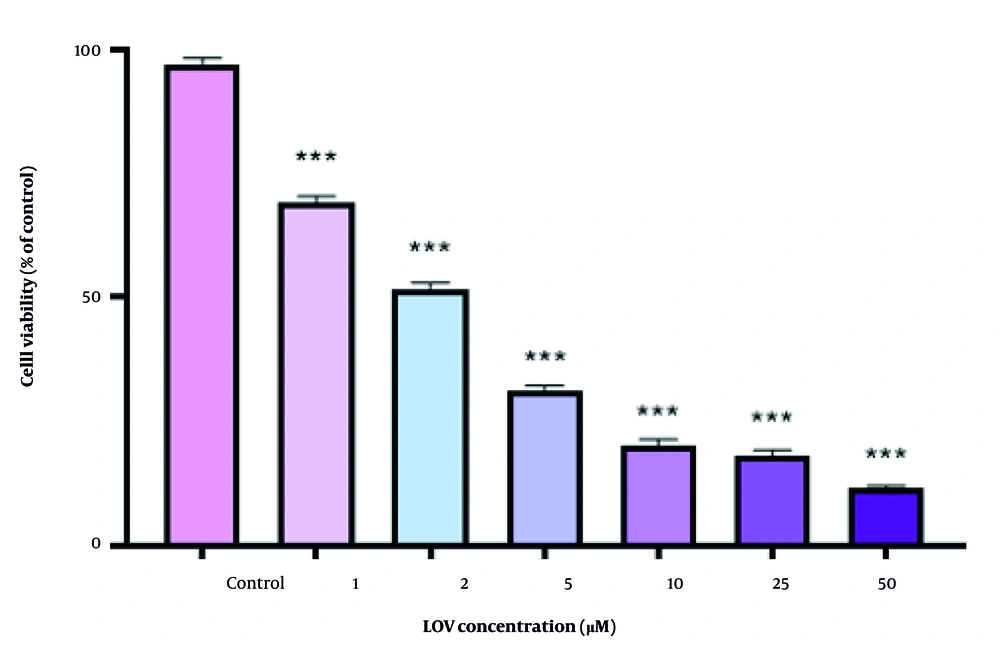
Figure 1.
Concentration-response analysis of Lov in MDA-MB-231 triple-negative breast cancer cells.
Cells were treated with increasing concentrations of Lov (0 - 50 µM) for 48 hours, and cell viability was assessed using the MTT assay (absorbance at 570 nm). Data are presented as mean ± SD from three independent biological experiments performed in triplicate. Statistical comparisons between treated and control groups were performed using one-way analysis of variance followed by a Tukey post hoc test (***P < 0.001 versus control).
4.2. As2O3 Induces Significant Concentration-Dependent Cytotoxicity in MDA-MB-231 Cells
Treatment with As2O3 resulted in a concentration-dependent reduction in MDA-MB-231 cell viability (Figure 2). A modest reduction in viability was observed at lower concentrations, whereas higher concentrations produced substantially greater cytotoxicity. The estimated IC50 value of As2O3 after 48 hours of exposure was approximately 7.5 µM. At concentrations above 25 µM, cell viability reached a plateau, with only minor additional reductions observed, suggesting saturation of the cytotoxic response under these experimental conditions (20).
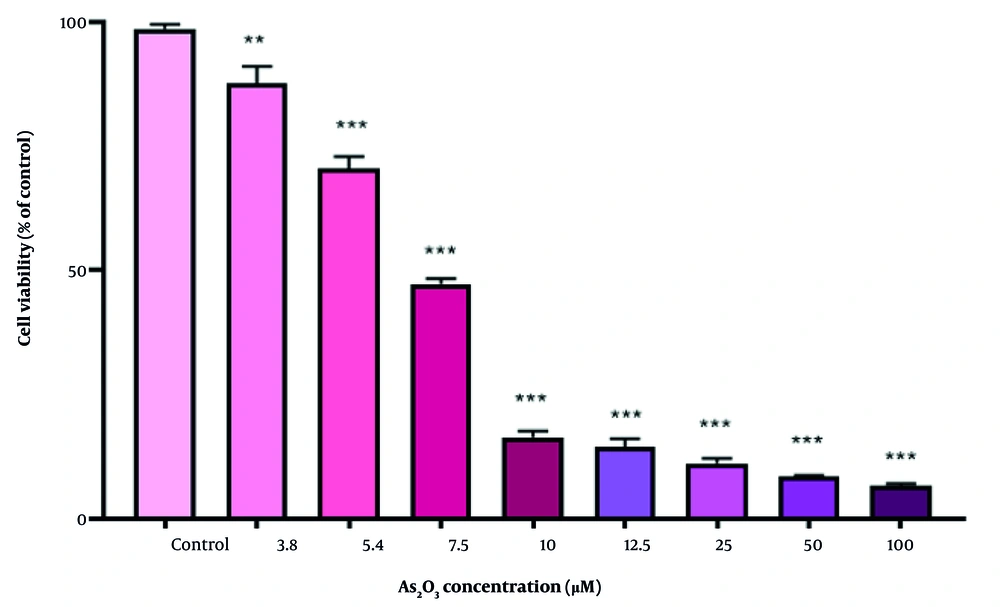
Figure 2.
Concentration-response analysis of As2O3 in MDA-MB-231 triple-negative breast cancer cells.
Cells were treated with increasing concentrations of As2O3 (0 - 100 µM) for 48 hours, and cell viability was assessed using the MTT assay (absorbance at 570 nm). Data are presented as mean ± SD from three independent biological experiments performed in triplicate. Statistical comparisons between treated and control groups were performed using one-way analysis of variance followed by a Tukey post hoc test (*P < 0.05; **P < 0.01; ***P < 0.001 versus control).
4.3. Cytotoxic Effects of Lov and As2O3 Co-Treatment in MDA-MB-231 Cells
Combined treatment with Lov and As2O3 produced greater inhibition of MDA-MB-231 cell viability than either monotherapy alone (Figure 3A). The nature of the interaction between As2O3 and Lov was quantified using the Chou-Talalay median-effect method with CompuSyn software. The CI was calculated to define the interaction: CI < 1 indicates synergism, CI = 1 indicates an additive effect, and CI > 1 represents antagonism (Figure 3B). Notably, Lov concentrations ranging from 0.5 to 2 µM enhanced the cytotoxic effects of sub-IC50 concentrations of As2O3 (1.9 - 5.4 µM). Isobologram analysis further confirmed synergism, as combination data points were positioned below the line of additivity (Figure 3C). These findings suggest that combined treatment may achieve enhanced cytotoxic activity at lower concentrations than single-agent exposure.
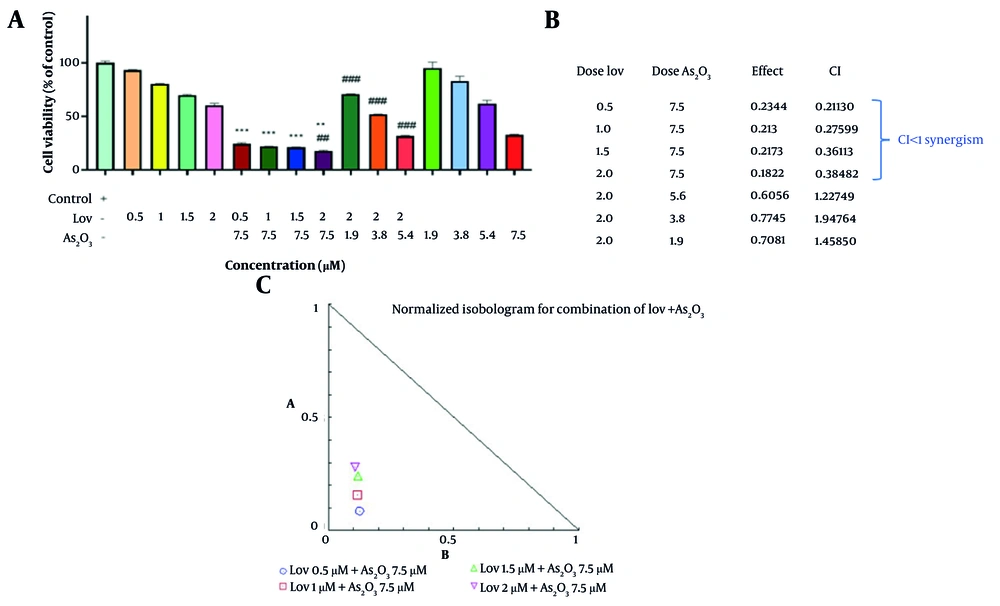
Figure 3.
Evaluation of the combinatorial effects of Lov and As2O3 on cell viability in MDA-MB-231 cells.(A) Cells were exposed to fixed-ratio combinations of Lov and As2O3 for 48 hours, followed by an MTT assay to determine relative cell viability. (B) CI values were calculated using the Chou-Talalay method with CompuSyn software. CI values < 1 indicate synergy, CI = 1 indicates an additive effect, and CI > 1 indicates antagonism. (C) Isobologram analysis of the Lov and As2O3 combination in MDA-MB-231 cells was constructed based on IC50 values derived from single-agent treatments and lower IC50 values. The line of additivity connects the IC50 values of each drug administered alone. Data points falling below the line indicate a synergistic interaction. Combination analysis was performed using the Chou-Talalay method. Data represent mean ± SD from three independent experiments. Statistical analysis was performed using one-way analysis of variance with a Tukey post hoc test for multiple comparisons
4.4. Evaluation of Morphological Alterations After Exposure to Lov and As2O3
Administration of Lov and As2O3 to the MDA-MB-231 breast cancer cell line induced significant, concentration-dependent morphological transformations (Figure 4). In the untreated control group, cells maintained their characteristic spindle-shaped architecture, exhibited high proliferative capacity, and formed a cohesive, confluent monolayer. At single-agent concentrations (Lov 2 µM and As2O3 3.8 and 5.4 µM), a slight decline in cell density was observed, accompanied by subtle structural alterations. These initial modifications represent early indicators of Lov- and As2O3-induced cytotoxicity.
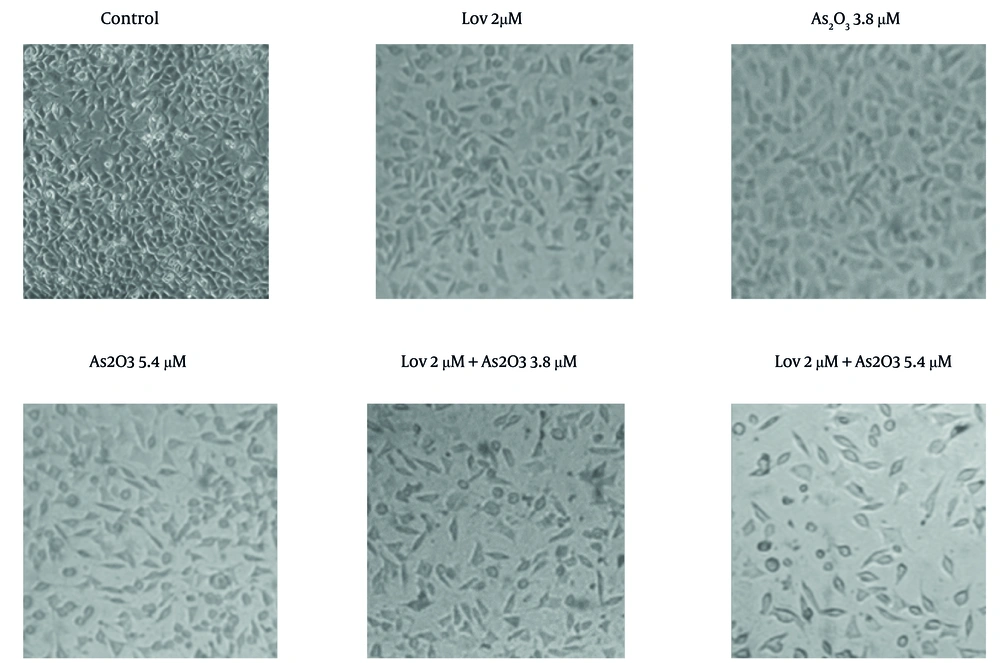
Figure 4.
Morphological changes in untreated MDA-MB-231 cells and Lov- and As2O3-treated MDA-MB-231 breast cancer cells treated with single and combination concentrations for 48 hours using an Olympus IX53 microscope.
Combination treatment induced pronounced morphological alterations, including reduced cell density, cellular rounding, cytoplasmic shrinkage, and loss of spindle-shaped morphology, compared with untreated controls and single-agent treatment groups. Although morphological alterations were observed after single-agent treatment with Lov and As2O3, concurrent treatment with both agents resulted in markedly more pronounced changes.
4.5. Synergistic Effect on Long-Term Colony Formation
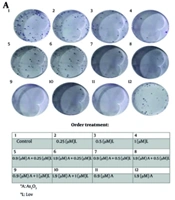
Although short-term viability assays suggested moderate single-agent activity, the clonogenic assay revealed a profound loss of reproductive integrity in MDA-MB-231 cells after combination therapy (Figure 5). Control wells demonstrated large, dense colonies characteristic of the aggressive mesenchymal phenotype of TNBC. In contrast, although single-agent Lov and As2O3 reduced colony counts, combination treatment essentially abolished colony formation (Figure 5A). We tested higher concentrations of As2O3 (3.8, 5.4, and 7.5 µM) and Lov (2 µM). However, after 14 days, all cells were dead, and no colonies were obtained (data not shown). Therefore, As2O3 at 0.9 and 1.9 µM and Lov at 0.25, 0.5, and 1 µM were used for combination treatment in the colony formation assay. These findings demonstrated a significant reduction in colony formation potential compared with single-agent treatment. Quantitative analysis of colony formation was expressed as a percentage relative to the untreated control to show the percentage of colony formation in treatment groups compared with the untreated or control group (Figure 5B).
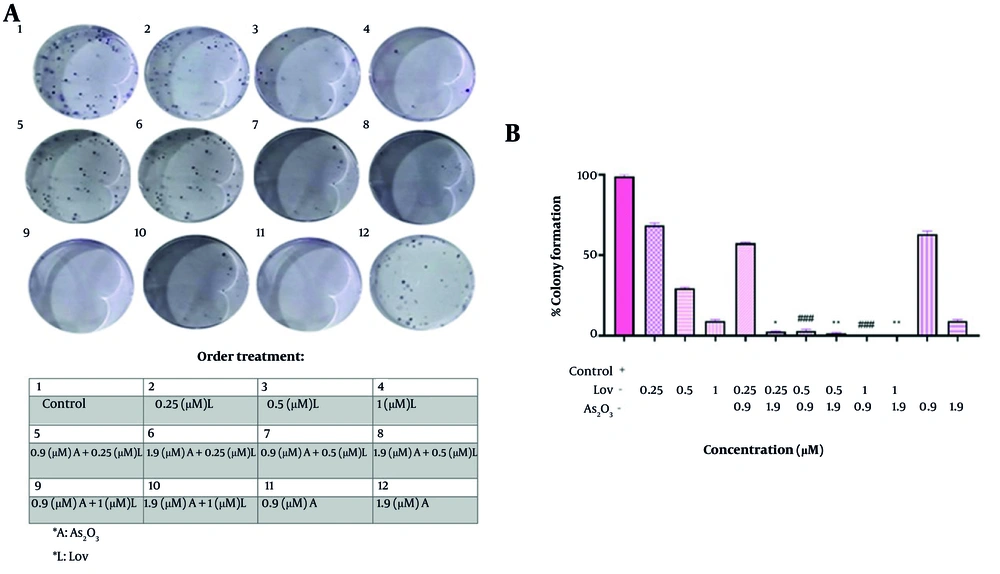
Figure 5.
Effect of Lov and As2O3, alone and in combination, on long-term clonogenic survival of MDA-MB-231 cells.(A) Representative images of colonies formed after 14 days following treatment. Cells were treated for 48 hours, washed, and allowed to grow in drug-free medium. Colonies were fixed with 4% formaldehyde and stained with crystal violet. (B) Quantitative analysis of colony formation expressed as a percentage relative to the untreated control. Data are presented as mean ± SEM from three independent experiments performed in triplicate. Statistical significance was assessed using one-way analysis of variance followed by a Tukey post hoc test (*P < 0.05, **P < 0.01 versus 1.9 µM As2O3 alone; ###P < 0.001 versus 0.9 µM As2O3 single agent).
5. Discussion
The therapeutic landscape for TNBC remains a major clinical challenge, primarily because of the lack of established targeted therapies, such as hormone receptor-directed treatments, and the high propensity for chemoresistance. This study investigated a novel drug-repositioning strategy by evaluating the synergistic antitumor effects of combining the lipophilic statin Lov with As2O3 in the MDA-MB-231 TNBC cell line.
Our primary and most compelling finding was the enhanced cytotoxic effect of Lov on TNBC cells when used in conjunction with As2O3. As monotherapies, both agents exhibited concentration-dependent cytotoxicity, with estimated IC50 values of 2 µM for Lov and 7.5 µM for As2O3. However, their simultaneous administration resulted in a marked, synergistic enhancement of growth inhibition. This synergy was rigorously quantified by the CI, with values consistently below 1 across multiple concentration levels, specifically with 0.5 - 2 µM Lov in combination with 7.5 µM As2O3, strongly suggesting a potent synergistic interaction. Isobologram analysis further substantiated these findings by demonstrating responses below the line of additivity (CI = 1), confirming a potent synergistic interaction in MDA-MB-231 cells. These results suggest that therapeutic efficacy can be achieved using substantially lower concentrations of each agent when administered together, which is a critical advantage for potential clinical translation, particularly for As2O3. The ability of the combination to reduce the required As2O3 concentration while maintaining or enhancing efficacy could translate into improved therapeutic outcomes and a reduced risk of treatment-related side effects and relapse in patients. These findings are consistent with published reports on drug combinations and synergy in TNBC, which highlight the potential of multiagent approaches to overcome resistance mechanisms (26).
Beyond immediate cytotoxicity, the clonogenic assay provided crucial insights into the long-term implications of this combined therapy. The results demonstrated that the Lov-As2O3 combination effectively abolished the long-term survival capacity of MDA-MB-231 cells, a hallmark of aggressive TNBC phenotypes. In TNBC models, the clonogenic assay serves as a functional indicator of sustained proliferative and survival capacity rather than short-term metabolic activity, making it particularly relevant for evaluating therapeutic responses. Although short-term viability assays, such as MTT, showed no significant toxic effects, the long-term clonogenic assay demonstrated notable potentiation of toxicity at lower single and combined concentrations. This suggests that combination treatment effectively reduced the concentration required to inhibit long-term survival and colony formation, a phenomenon not apparent in shorter proliferation assays. This finding highlights the potential of the combination to disrupt persistent, therapy-resistant cell populations that are often responsible for tumor recurrence and is integrated with findings from studies on statins and stemness/epithelial-mesenchymal transition (EMT), demonstrating that statins can inhibit cancer stem cell properties and EMT, which are crucial processes for TNBC recurrence and metastasis (27, 28).
Our results align with recent literature highlighting the mevalonate pathway as a metabolic vulnerability in TNBC and are consistent with the induction of cell death reported in recent studies of As2O3-treated TNBC models (20, 29). The observation that Lov and As2O3 enhance cytotoxicity mirrors findings by other researchers reporting that As2O3 enhances antineoplastic effects through mitochondrial dysfunction (30). Similarly, our focus on the mevalonate pathway as a sensitizing mechanism is supported by investigators who identified the mevalonate-YAP/TAZ axis as a key driver of TNBC growth (31).
Additional evidence supporting pathway-targeted therapeutic strategies in TNBC has been reported in studies demonstrating that modulation of AKT/mTOR/β-catenin signaling suppresses proliferation and survival in MDA-MB-231 cells (36). Comparative morphological assessment revealed that coadministration of Lov and As2O3 elicited markedly more severe structural alterations in MDA-MB-231 TNBC cells than either monotherapy. These phenotypic shifts align with prior observations in breast cancer models, reinforcing the established capacity of statins to remodel the cytoarchitecture of malignant breast epithelial cells (32, 33). Similar modulation of oncogenic signaling pathways has also been observed in studies evaluating natural compounds that alter epidermal growth factor receptor expression in MDA-MB-231 breast cancer cells (37).
Although numerous studies have explored statins as monotherapies or in combination with conventional chemotherapeutics, our research provides a distinct perspective by demonstrating synergy with a heavy-metal-based agent such as As2O3. These findings are compatible with reports on statin combinations with conventional chemotherapies, and they extend this evidence by showing potent synergy with the heavy-metal agent As2O3. The observed transition of surviving colonies to a paraclone-like morphology in our combination group further supports the findings of Zheng et al, who reported that Lov can inhibit EMT and stemness in TNBC, processes intrinsically linked to aggressive phenotypes and therapeutic resistance (34). Consistent with this concept, previous studies have demonstrated that modulation of EMT-associated regulators, including ZEB1, ZEB2, and E-cadherin, can alter the aggressive phenotype of triple-negative breast cancer cells (38).
Despite the robust synergy and promising mechanistic insights generated by this study, several limitations warrant careful consideration and will guide future research. First, the current findings were derived exclusively from experiments conducted in the MDA-MB-231 cell line. Although this cell line is a widely used and accepted model for TNBC, the inherent heterogeneity of the disease necessitates validation across a broader spectrum of TNBC subtypes. Future studies should incorporate additional TNBC cell lines, including those with different molecular profiles and varying degrees of chemoresistance, as well as patient-derived xenograft models. This will be crucial to ensure the generalizability of our findings and to confirm that the observed synergistic effects are not cell line-specific, as supported by an article on drug repositioning for TNBC (35).
Although isobologram analysis indicated that synergistic interactions between Lov and As2O3 may allow effective growth inhibition at reduced concentrations, the present study did not assess systemic toxicity, pharmacokinetics, or in vivo therapeutic response. Consequently, any potential safety advantage associated with concentration reduction remains preliminary. Further in vivo investigations are required to characterize the pharmacological interactions, tolerability, and therapeutic index of this combinatorial strategy.
Although significant findings were obtained with simultaneous treatment with Lov and As2O3 in the MDA-MB-231 cell line, a notable limitation of this study is the absence of concurrent exposure evaluation in healthy cell lines and other breast cancer subtypes. Future research should broaden the scope by investigating synergistic effects across a more diverse cellular landscape, including normal cells and other breast cancer models, to fully ascertain the specificity and potential clinical applicability of this therapeutic strategy. Addressing these limitations is a priority for future work by the research team, and this study will be pivotal in bridging the gap between preclinical efficacy and potential clinical application.
5.1. Conclusions
This study demonstrates that combined treatment with Lov and As2O3 exerts synergistic antiproliferative effects in the MDA-MB-231 TNBC cell line. Combination treatment significantly reduced cell viability and impaired long-term clonogenic survival compared with single-agent exposure. These findings support further investigation of metabolic pathway-targeted combination strategies in TNBC. However, additional studies involving mechanistic validation, multiple TNBC models, normal epithelial controls, and in vivo systems are necessary before translational relevance can be established. This graphical abstract provides a concise visual summary of the study design, experimental groups, and key analytical outcomes (Figure 6).
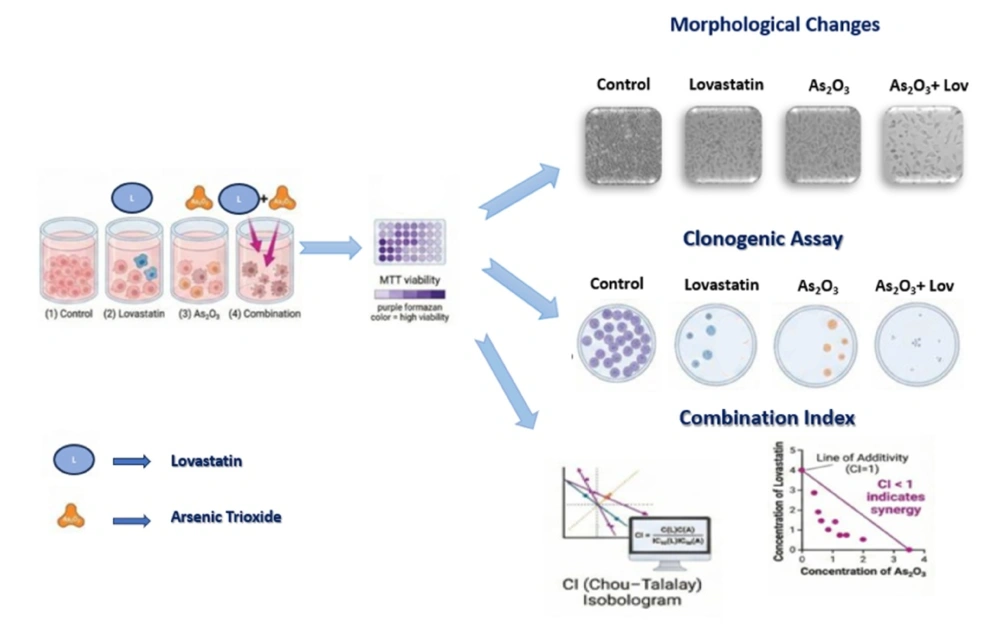
Figure 6.
Schematic representation of the experimental design, treatment groups, and main analytical approaches used to evaluate the biological effects and outcomes of the study.