
1. Background
Antimicrobial resistance is one of the most important public health challenges worldwide, substantially limiting the effectiveness of existing antibiotic treatments and increasing mortality, morbidity, and healthcare costs. Estimates indicate that, if effective interventions are not implemented, antibiotic resistance could cause approximately 10 million deaths per year and more than $100 trillion in global economic losses by 2050 (1). Despite this serious threat, the development of new antibiotics has progressed very slowly, and few new compounds have entered clinical use (2). Therefore, alternative strategies, such as antibiotic adjuvants, have gained considerable attention as a cost-effective approach to enhance the effectiveness of existing antibiotics and combat bacterial resistance (3).
Melatonin (N-acetyl-5-methoxytryptamine) is an endogenous neurohormone primarily recognized for its role in regulating circadian rhythms (4). However, increasing evidence indicates that this molecule has a wide range of biological activities, including antioxidant, anti-inflammatory, and immunomodulatory properties (2, 5). In addition to the pineal gland, melatonin is produced in various extrapineal tissues, as well as in plants and some microorganisms (6, 7). Notably, melatonin has low toxicity and a favorable safety profile, making it a suitable candidate for therapeutic applications (8).
Recent studies have shown that melatonin has antimicrobial activity and may act as an antibiotic adjuvant (9). For example, Liu et al. have shown that melatonin can reverse MCR-mediated resistance to colistin in Gram-negative bacteria through mechanisms such as increased membrane permeability, induction of oxidative stress, and inhibition of efflux pumps (8).
It has also been reported that melatonin can enhance bacterial clearance in infection models by enhancing the host immune response and increasing the bactericidal activity of neutrophils (10-12). Furthermore, emerging evidence suggests that melatonin can exert synergistic effects when combined with certain antibiotics, such as tigecycline, thereby restoring their efficacy against resistant pathogens (13).
Despite these promising findings, most previous studies have focused on the immunomodulatory role of melatonin or its effects in combination with a limited number of antibiotics. Consequently, limited information is available regarding the synergistic effects of melatonin in combination with antibiotics that target distinct bacterial structures and pathways, including cell wall synthesis inhibitors (e.g., ampicillin), protein synthesis inhibitors (e.g., streptomycin), and membrane-targeting antibiotics (e.g., colistin).
2. Objectives
Therefore, this study aimed to investigate the synergistic effects of melatonin in combination with colistin, streptomycin, and ampicillin against Escherichia coli ATCC 25922.
3. Methods
3.1. Minimum Inhibitory Concentration
The minimum inhibitory concentration (MIC) was defined as the lowest concentration of an antimicrobial agent that inhibited visible bacterial growth after incubation for 18 - 24 h at 35 ± 2 °C. In the present study, MIC values were determined using the broth microdilution method according to the Clinical and Laboratory Standards Institute (CLSI) guidelines.
Briefly, bacterial suspensions adjusted to 5 × 10⁵ CFU/mL were inoculated into 96-well microplates containing melatonin (≥ 98% purity, soluble in ethanol) or the antibiotics colistin (≥ 19,000 IU/mg, soluble in sterile distilled water), ampicillin (845 - 988 μg/mg, soluble in sterile distilled water), and streptomycin (≥ 720 IU/mg, soluble in sterile distilled water), all purchased from Sigma-Aldrich (St. Louis, MO, USA). Melatonin and all antibiotics were prepared as 2-fold serial dilutions in Mueller–Hinton broth (MHB) (Merck, Darmstadt, Germany). Final concentrations ranged from 0.12 to 8 mg/mL for melatonin and from 0.5 to 32 μg/mL for colistin, streptomycin, and ampicillin.
Each assay included a positive control consisting of bacterial suspension in Mueller–Hinton broth without antimicrobial agents and a negative control containing only culture medium without bacterial inoculation.
3.2. Checkerboard Assays
The synergistic effects of melatonin in combination with colistin, streptomycin, and ampicillin against the standard strain Escherichia coli ATCC 25922 were evaluated using the checkerboard microdilution method in a 96-well microplate with an 8 × 8 matrix of 2-fold serial dilutions. A bacterial suspension equivalent to 5 × 10⁵ CFU/mL was prepared in Mueller–Hinton broth. Two-fold serial dilutions of melatonin (0.12 - 8 mg/mL) and the antibiotics colistin, streptomycin, and ampicillin (0.5 - 32 μg/mL) were prepared separately. Each antibiotic was evaluated independently in combination with melatonin using a separate checkerboard assay. Subsequently, 40 µL of each antimicrobial agent was added to the appropriate wells, followed by the addition of 80 µL of the bacterial suspension to each well. After incubation at 37 °C for 18 - 24 h, bacterial growth was assessed by measuring the optical density at 600 nm using a microplate reader (14). Wells showing no detectable bacterial growth based on OD600 measurements were subsequently subcultured onto Mueller–Hinton agar (MHA) (Merck, Darmstadt, Germany) plates to confirm the absence of viable bacteria. The absence of colony formation after incubation was considered confirmation of complete bacterial growth inhibition.
All checkerboard assays were performed in three independent experiments to ensure reproducibility. The reported FICI values were calculated using the mean MIC values obtained from these independent experiments according to the following equation. The interaction patterns were consistent across all replicates:
where MICa and MICb represent the minimum inhibitory concentrations of compounds A and B when used alone, respectively, whereas MICab and MICba indicate the MIC values of compounds A and B in combination. In the present study, compound A refers to the tested antibiotic (colistin, streptomycin, or ampicillin), whereas compound B refers to melatonin.
Interactions between melatonin and antimicrobial agents were interpreted according to the FICI values as follows: synergistic (≤ 0.5), additive (> 0.5 - 1.0), indifferent (> 1.0 - 2.0), and antagonistic (> 2.0).
4. Results
4.1. Antibacterial Activity and Synergism of Melatonin with Antibiotics
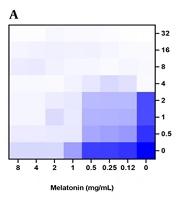
The antibacterial activity of melatonin and the antibiotics colistin (a membrane-disrupting agent), streptomycin (a protein synthesis inhibitor), and ampicillin (a cell wall synthesis inhibitor) was evaluated in vitro, both individually and in combination (melatonin with each antibiotic), using the broth microdilution method and checkerboard assay against the standard Escherichia coli strain (Figure 1A-C).
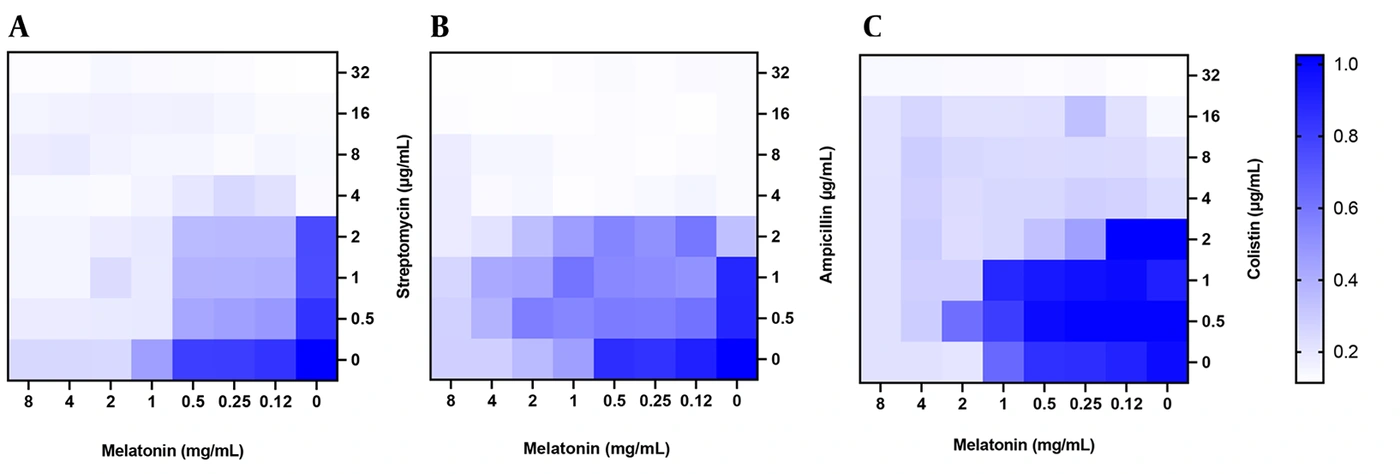
Figure 1.
Checkerboard broth microdilution assays showing the interactions between melatonin and (A) streptomycin, (B) ampicillin, and (C) colistin against Escherichia coli ATCC 25922. Darker blue colors indicate higher bacterial growth (OD600). Quantitative MIC, FICI, and potentiation values are presented in Table 1.
Bacterial growth inhibition was assessed by measuring optical density at 600 nm (OD600). Wells showing no detectable growth were further subcultured on MHA plates to confirm the absence of viable bacteria, indicating complete growth inhibition.
The MICs of melatonin, colistin, streptomycin, and ampicillin were 1 mg/mL, 4 µg/mL, 4 µg/mL, and 2 µg/mL, respectively (Table 1).
Table 1.
Synergistic Effect of Melatonin in Combination with Antibiotics Against E. coli ATCC 25922 a
| Antibiotic | MICa (μg/mL) | MIC of Melatonin Alone (mg/mL) | FICI | MIC in Combination with Melatonin (μg/mL) | Potency (fold) |
|---|---|---|---|---|---|
| Colistin | 4.0 ± 0.0 | 1 | 0.750 | 2.0 | 2 |
| Streptomycin | 4.0 ± 0.0 | 1 | 0.245 | 0.5 | 8 |
| Ampicillin | 2.0 ± 0.0 | 1 | 0.370 | 0.5 | 4 |
a Values are expressed as mean ± SD.
The fractional inhibitory concentration (FIC) index was calculated as the sum of the individual FIC values (ΣFIC), and synergy was defined as FICI ≤ 0.5. The results showed that melatonin exhibited synergistic interactions with streptomycin and ampicillin, whereas an additive interaction was observed with colistin, based on the FICI values. In combination with melatonin, the activity of colistin, ampicillin, and streptomycin increased 2-fold, 4-fold, and 8-fold, respectively.
5. Discussion
The present study investigated the antibacterial potential of melatonin in combination with colistin, streptomycin, and ampicillin against the standard strain Escherichia coli ATCC 25922. The checkerboard assay demonstrated that melatonin enhanced the antibacterial activity of all three antibiotics tested; however, the type of interaction varied among the antibiotics. Based on the FICI, synergistic effects were observed with streptomycin and ampicillin, whereas a primarily additive effect was observed with colistin. These findings are consistent with previous studies using similar methodologies to evaluate antibiotic–adjuvant interactions (15). The results showed that the degree of synergism varied by antibiotic class, with the strongest effect observed with streptomycin, followed by ampicillin, and the weakest effect observed with colistin. This variation suggests that the adjuvant effect of melatonin is influenced by the primary cellular target and mechanism of action of each antibiotic.
Streptomycin, an aminoglycoside that inhibits protein synthesis through ribosomal binding, demonstrated the greatest enhancement, suggesting that melatonin may more effectively interfere with processes related to translational stress, oxidative imbalance, or ribosomal fidelity (16). Aminoglycosides are known to induce mRNA misreading and promote oxidative damage, which can contribute to bacterial cell death (17). In this context, melatonin may enhance antibiotic efficacy by amplifying oxidative stress-associated pathways and disrupting bacterial stress responses. This observation is partially supported by the findings of Liu et al. and Wang et al., who reported that melatonin significantly potentiated the activity of doxycycline and tigecycline, respectively, both of which, like streptomycin, inhibit bacterial protein synthesis. Wang et al. further demonstrated that melatonin enhanced tigecycline activity by disrupting the bacterial proton motive force (PMF), inhibiting efflux pump function, and increasing intracellular antibiotic accumulation (8, 13). Although these mechanisms were not investigated in the present study, they may also contribute to the pronounced synergistic effect observed with streptomycin.
Ampicillin, a β-lactam antibiotic targeting cell wall synthesis, showed a moderate synergistic effect. β-lactam antibiotics disrupt peptidoglycan biosynthesis and activate cell wall stress responses, ultimately leading to bacterial lysis (18, 19). The enhancement observed with melatonin may be associated with increased susceptibility of cell wall biosynthetic pathways to oxidative or metabolic perturbations, thereby facilitating antibiotic-induced inhibition of peptidoglycan assembly. Interestingly, Liu et al. found little or no potentiating effect of melatonin when combined with the cell wall-targeting antibiotics ampicillin and meropenem (8), whereas a moderate synergistic interaction was observed with ampicillin in the present study. This discrepancy may reflect differences in bacterial strains, susceptibility profiles, and experimental conditions, suggesting that the adjuvant activity of melatonin may vary according to both the antibiotic target and the physiological characteristics of the bacterial strain.
In contrast, colistin exhibited the lowest degree of synergy with melatonin. Colistin primarily acts by disrupting the outer membrane through interaction with lipopolysaccharide (LPS), resulting in rapid membrane destabilization and bacterial death (8). The comparatively limited enhancement observed in this study may reflect the already highly efficient membrane-targeting mechanism of colistin, which may reduce the potential for further adjuvant-mediated potentiation under the tested conditions. This finding differs from that of Liu et al., who reported a markedly stronger synergistic interaction between melatonin and colistin against mcr-positive Gram-negative pathogens (8). This discrepancy is likely attributable to differences in the bacterial strains used, as Liu et al. primarily investigated multidrug-resistant clinical isolates carrying mcr genes, whereas the present study employed the susceptible reference strain E. coli ATCC 25922. Furthermore, Liu et al. demonstrated that melatonin enhanced colistin activity through multiple mechanisms, including increased membrane permeability, inhibition of efflux pumps, disruption of the PMF, and enhanced intracellular antibiotic accumulation. As these mechanisms were not directly examined in the present study, their contribution to the observed additive interaction remains to be determined.
The different degrees of synergy observed are likely related to the distinct mechanisms of action of the antibiotics. The strongest synergy was observed with streptomycin, consistent with previous studies showing that melatonin enhances the activity of protein synthesis inhibitors by disrupting the PMF, inhibiting efflux pumps, and increasing intracellular antibiotic accumulation. In contrast, the weaker synergy observed with ampicillin and the additive effect with colistin may be attributable to their different cellular targets and to the use of the susceptible E. coli ATCC 25922 strain rather than the resistant strains evaluated in previous studies (8, 18).
Overall, the findings of the present study demonstrate that melatonin enhanced the in vitro antibacterial activity of the tested antibiotics, with the magnitude of interaction varying according to antibiotic class. These findings provide preliminary evidence supporting the potential of melatonin as an antibiotic adjuvant and suggest that its potentiating effects may depend on the primary cellular targets and mechanisms of action of individual antibiotics.
5.1. Study Limitations
This study has several limitations. All experiments were conducted exclusively under in vitro conditions using a single laboratory reference strain, and the melatonin concentration used (1 mg/mL) exceeds the plasma levels achievable following conventional clinical administration, limiting the direct clinical translation of these findings. Furthermore, no resistant clinical isolates, animal infection models, pharmacokinetic evaluations, or safety assessments were included, and the precise molecular mechanisms underlying the observed synergistic effects were not directly investigated. Therefore, these findings should be considered preliminary and hypothesis-generating. Further studies involving resistant clinical isolates, in vivo models, pharmacokinetic evaluations, and mechanistic investigations are required to validate these observations and to determine the potential clinical relevance of melatonin as an antibiotic adjuvant.
5.2. Conclusions
The results of this study, together with emerging evidence, indicate that melatonin is not only an antioxidant molecule and circadian rhythm regulator, but may also function as an antibiotic adjuvant by enhancing bacterial susceptibility through multi-target effects on the cell wall, membrane, and protein synthesis pathways. This property supports its potential application in the development of novel strategies to combat antibiotic resistance.