
1. Background
Chemotherapy-induced nausea and vomiting (CINV) remain among the most common and distressing adverse effects of systemic cancer therapy, particularly in women with breast cancer. Despite substantial advances in antiemetic prophylaxis, a considerable proportion of patients continue to experience clinically significant nausea and/or vomiting, especially during the delayed phase after chemotherapy administration (1, 2). Recent guideline updates from the Multinational Association of Supportive Care in Cancer/European Society for Medical Oncology (MASCC/ESMO) and the American Society of Clinical Oncology (ASCO) emphasize that CINV continues to impair quality of life, nutritional status, and treatment adherence, even when guideline-based antiemetic regimens are used (1-3).
Prospective studies in breast cancer cohorts confirm that CINV remains frequent under routine clinical practice conditions (4). Bibliometric analyses further demonstrate sustained research interest in CINV, highlighting both the clinical burden and the need for improved preventive strategies (3).
Given the multifactorial nature of CINV, interest has grown in complementary and integrative strategies that can be combined with standard antiemetic regimens. Aromatherapy and herbal medicines are among the most widely studied approaches because of their relative safety, low cost, and high patient acceptability (5). In particular, peppermint (Mentha piperita) has been investigated for its potential antiemetic and antispasmodic effects (5-8).
2. Objectives
Integrating modern pharmacological evidence with traditional knowledge suggests that pomegranate–mint syrup could serve as an effective adjunct to standard antiemetic therapy in patients with breast cancer undergoing chemotherapy. This study aimed to evaluate the effect of this syrup, in addition to standard antiemetic treatment, on the incidence and severity of CINV in these patients.
3. Methods
3.1. Study Design and Setting
This randomized, double-blind, placebo-controlled clinical trial was conducted in the outpatient department of the Chemotherapy Center at Imam Khomeini Hospital, Iran, and at the Touba Specialty and Subspecialty Clinic, affiliated with Mazandaran University of Medical Sciences, Iran, from May to November 2018. Participants were women with a definitive diagnosis of breast cancer who had been treated only with chemotherapy and whose nausea and vomiting were not controlled by routine medications.
3.2. Ethical Considerations
The study received ethical approval from the Ethics Committee of Mazandaran University of Medical Sciences (REC NO: IR.MAZUMS.REC.1396.10465). The trial was registered in the Iranian Registry of Clinical Trials (IRCT20171118037516N1). Written informed consent was obtained from all participants, and all study procedures were conducted in accordance with the Declaration of Helsinki.
3.3. Preparation of the Material
The investigational syrup and placebo were prepared by the Department of Pharmaceutics, Faculty of Pharmacy, Mazandaran University of Medical Sciences. Fresh Punica granatum L. fruits were collected from KhalilShahr, Mazandaran Province, Iran, and Mentha spicata L. leaves were collected from Galugah, Mazandaran Province, Iran. Botanical identification was performed and confirmed by a professor of pharmacognosy. Voucher specimens were deposited in the herbarium under accession numbers E1 - 227311 for P. granatum and E1 - 23551618 for M. spicata.
The required volume of the combined sour and sweet pomegranate juice extract was prepared by mixing equal volumes of prefiltered sour and sweet pomegranate juice (125 mL each; total, 250 mL). This mixture was boiled until the volume was reduced by half to 125 mL and then strained again.
To prepare the spearmint extract for the investigational syrup, 30 g of dried mint leaves were soaked in 75 mL of deionized water for 12 hours. The leaves were then thoroughly compressed, and the resulting extract was filtered through filter paper. To prepare 250 mL of syrup, 125 mL of the concentrated and filtered sour and sweet pomegranate mixture (50% of the total volume), 62.5 mL of the dried mint leaf extract (25% of the total volume), and 62.5 g of white sugar (25% of the total volume) were mixed and stirred until completely dissolved. The mixture was then passed through filter paper, and sodium benzoate (0.1% w/v; 1 g/L of syrup) was added as a preservative to ensure microbiological stability and extend shelf life.
The final product was clear and free of sediment. The entire preparation process was conducted under aseptic laboratory conditions. The syrup was stored in labeled, dark containers.
Before administration, the investigational product underwent routine physicochemical quality control and microbial testing at the Faculty of Pharmacy, Mazandaran University of Medical Sciences, to verify its quality and microbiological safety.
An extract-free syrup was used as the placebo. For this purpose, 62.5 mL of liquid white sugar was added to deionized water and dissolved until the total volume reached 250 mL. A sufficient quantity of placebo for 8 days was prepared by adding 5 drops of edible red color solution (manufactured by Freer Knowledge Company, Isfahan, Iran) and preservatives. To maintain blinding, a trace amount of mint extract was applied only to the inner surface of the bottle caps of both the placebo and investigational syrup bottles so that a similar mint odor was perceived upon opening. The mint extract was not added to the placebo syrup itself and, therefore, was not part of the placebo formulation. Similar containers were used for both syrups to ensure a comparable appearance.
3.4. Standardization of the Herbal Formulation
To standardize the herbal formulation, the total phenolic content (TPC) of both extracts and the final syrup was determined using the Folin–Ciocalteu colorimetric method, with tannic acid as the reference standard. Measurements were performed using a spectrophotometer.
The TPC of the mint extract, pomegranate extract, and final syrup was 1533.06 ± 7.28, 1711.93 ± 19.67, and 1715.28 ± 8.82 μg/mL, respectively. Expressed as percentages (w/v), these values were 3.833 ± 0.018%, 4.279 ± 0.049%, and 4.288 ± 0.022%, respectively.
3.5. Investigational Syrup Dosage Form
For each participant in the investigational and placebo groups, 250 mL of syrup was prepared for an 8-day period. The daily dose was calculated based on the maximum permitted dose for administration 3 times daily (total dissolved solids), with 10 mL administered each time for 8 days. The dose and method of administration were identical in both groups.
3.6. Eligibility Criteria
3.6.1. Inclusion Criteria
1) Confirmed diagnosis of breast cancer by an oncologist and pathology report.
2) Age ≥ 18 years.
3) History of at least 1 previous chemotherapy cycle.
4) Outpatient chemotherapy regimen (single-day or continuous infusion).
5) History of nausea or vomiting during the previous cycle despite routine antiemetics.
6) At least 2 remaining chemotherapy sessions.
7) Provision of written informed consent.
3.6.2. Exclusion Criteria
1) Concurrent total or upper-abdominal radiotherapy.
2) Use of therapeutic-dose anticoagulants or a history of significant coagulation disorders.
3) Use of non-study antiemetic products or complementary treatments.
4) Known allergy to pomegranate or mint, or consumption of either within the previous week.
5) Presence of another active malignancy, including metastatic disease.
6) Medical conditions independently causing nausea, such as uncontrolled hypertension, hepatic or renal failure, or significant constipation.
7) Nonadherence to the study medication (≥ 2 consecutive or ≥ 3 intermittent missed doses).
8) Voluntary withdrawal or occurrence of adverse events requiring discontinuation.
3.7. Sample Size
Based on the findings of Tayarani-Najaran et al. (15), the sample size was estimated using the formula for comparing 2 independent means in G*Power software (version 3.1.9.2). The calculation was based on the mean and SD of vomiting scores reported for the intervention group (0.6 ± 0.3) and control group (1.1 ± 0.4), yielding a Cohen d effect size of 1.41. Assuming a 2-sided test, a 99% confidence level, 90% statistical power, and a 20% attrition rate, the final sample size was calculated as 42 participants (21 per group). However, to account for unforeseen dropouts and potential missing data and to further improve the reliability and precision of the findings, the research team enrolled 33 participants per group, for a total sample size of 66.
3.8. Randomization and Allocation
Randomization was performed by an independent statistical expert who generated a list of 4-digit allocation codes and assigned participants to either the Vomigramint syrup group or the placebo group using a concealed sequence. Based on these codes, the statistician prepared identical syrup containers for both groups, labeled only with the corresponding 4-digit codes, and provided them to the researcher while retaining the allocation key.
After written informed consent was obtained, the researcher assigned participants to groups by randomly selecting one of the coded containers and providing the syrup or placebo to the participant or an accompanying caregiver. All chemotherapy regimens proceeded according to standard protocols. All personnel involved in participant enrollment, data collection, and endpoint assessment remained blinded to group allocation throughout the study.
3.9. Study Intervention
All participants received the same standard antiemetic regimen according to the institutional protocol, including oral aprepitant (125 mg before chemotherapy, followed by 80 mg on days 2 and 3), oral ondansetron every 8 hours for 5 days, and intravenous dexamethasone (16 mg) plus ondansetron (4 mg) administered 30 minutes before chemotherapy.
Participants received 10 mL of the assigned syrup 3 times daily with approximately 150 mL of cold water, 30 minutes before each meal. The regimen began 3 days before the chemotherapy session and continued for 5 days afterward, except on the day of chemotherapy, to avoid potential interactions that could reduce the effectiveness of chemotherapy agents.
Each participant received an 8-day evaluation booklet and was instructed to record the severity and frequency of nausea and vomiting each night before bedtime. Nausea and vomiting were assessed using a structured 4-part self-report instrument:
1) Nausea severity: A 10-cm visual analog scale (VAS), on which participants selected a score from 0 to 10 (0 = no nausea; 1 - 3 = mild; 4 - 6 = moderate; 7 - 9 = severe; 10 = very severe).
2) Vomiting frequency: Participants recorded the total number of vomiting episodes experienced during the preceding 24 hours.
3) Adherence and concomitant treatments: Three questions assessed the frequency of missed doses and the use of any nonprotocol antiemetic medications during the intervention period.
In addition to verbal instructions, participants or accompanying caregivers received written educational materials detailing the administration schedule, completion of the evaluation sheets, and troubleshooting guidance. A dedicated contact number was provided for urgent questions, concerns, or adverse events throughout the intervention period.
Participants received detailed instructions regarding administration of the investigational product. Adherence to the intervention was monitored throughout the study via periodic telephone follow-up and participant self-report.
3.10. Study Endpoints
The primary endpoint was the severity of chemotherapy-induced nausea. Secondary endpoints included vomiting frequency and changes in nausea and vomiting across the anticipatory, acute, and delayed phases of CINV.
Acute CINV was defined as nausea and/or vomiting occurring within the first 24 hours after chemotherapy administration. Delayed CINV referred to symptoms beginning more than 24 hours after chemotherapy and persisting for up to 5 - 7 days. Anticipatory CINV was defined as nausea and vomiting occurring before chemotherapy administration, typically in patients who had experienced poor control of CINV during previous treatment cycles (16).
3.11. Statistical Analysis
All statistical analyses were performed using SPSS software (version 16). The normality of continuous variables was assessed using the Kolmogorov–Smirnov test. Because none of the continuous variables followed a normal distribution, nonparametric statistical methods were used throughout the analyses. Baseline demographic and clinical characteristics were compared using the chi-square test or Fisher exact test for categorical variables and the Mann–Whitney U test for continuous variables. Between-group comparisons of nausea severity and vomiting frequency at baseline and after the intervention were performed using the Mann–Whitney U test. Categorical variables, including the proportions of participants showing improvement, no change, or deterioration, were compared using the chi-square test.
Because of the statistically significant baseline imbalance in delayed nausea severity between the 2 groups and the nonnormal distribution of this variable, a nonparametric analysis of covariance (rank-transformed ANCOVA) was performed. Raw delayed nausea severity scores at baseline and after the intervention were converted to ranks. Effect sizes were reported as partial eta squared.
All statistical tests were 2-tailed, and P < 0.05 was considered statistically significant. To minimize potential bias resulting from participant attrition and protocol deviations, the primary statistical analysis was conducted according to the intention-to-treat principle, whereby participants were analyzed in the groups to which they were originally randomized, regardless of adherence to the assigned intervention or subsequent protocol deviations.
4. Results
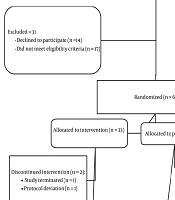
A total of 97 patients were screened for eligibility. Of these, 31 were excluded: 14 declined to complete the questionnaire or chose not to participate, and 17 were excluded for clinical reasons, including distant metastatic breast cancer (n = 6), concurrent radiotherapy (n = 2), uncontrolled hypertension (n = 4), use of therapeutic-dose anticoagulants (n = 3), and fewer than 2 remaining chemotherapy sessions (n = 2). Ultimately, 66 patients were enrolled and randomized (Figure 1).
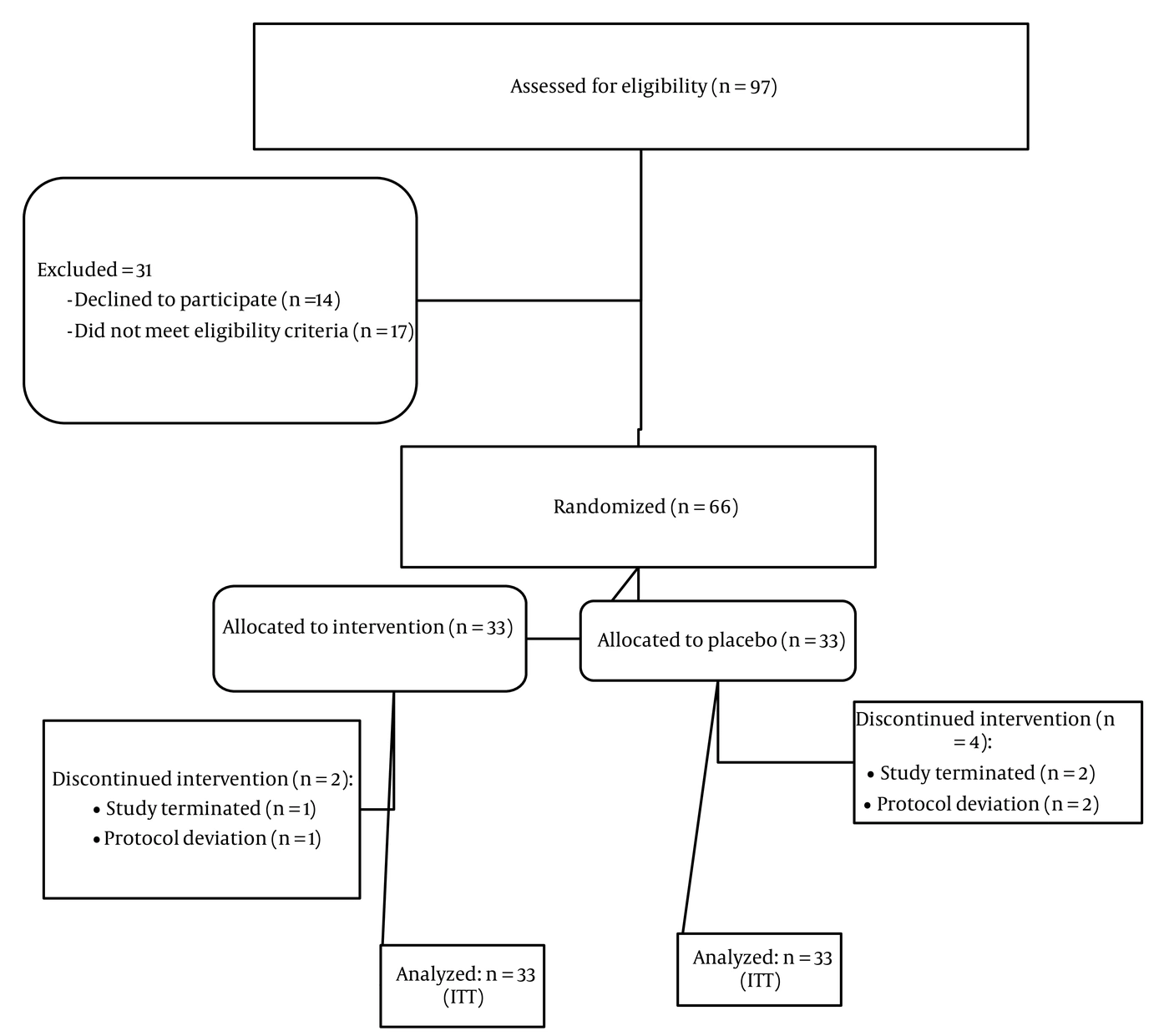
Figure 1.
CONSORT flow diagram of participant recruitment, randomization, and analysis
Baseline demographic and clinical characteristics were comparable between the Vomigramint and placebo groups, with no statistically significant differences (P > 0.05 for all variables) (Table 1).
Table 1.
Demographic Characteristics a
| Variables | Vomigramint Group | Placebo Group | P-Value |
|---|---|---|---|
| Age range (y) | 0.789 | ||
| 18 - 45 | 8 (24.2) | 16 (48.5) | |
| ≥ 45 | 25 (75.8) | 17 (51.5) | |
| Marital status | 0.492 | ||
| Single | 1 (3) | 0 (0) | |
| Married | 31 (94) | 33 (100) | |
| Divorced | 1 (3) | 0 (0) | |
| Smoking | 0.796 | ||
| Yes | 11 (33.3) | 12 (36.4) | |
| No | 22 (66.7) | 21 (63.6) | |
| History of hyperemesis gravidarum | 0.990 | ||
| Yes | 19 (57.6) | 19 (57.6) | |
| No | 14 (42.4) | 14 (42.4) | |
| Education level | 0.523 | ||
| Below high school diploma | 26 (78.8) | 28 (84.8) | |
| High school diploma or higher | 7 (21.2) | 5 (15.2) | |
| Family history of breast malignancy | 0.428 | ||
| Yes | 9 (27.3) | 12 (36.4) | |
| No | 24 (72.7) | 21 (63.6) |
a Values are expressed as No. (%).
Data on nausea severity and vomiting frequency during the anticipatory, acute, and delayed phases of CINV were collected and analyzed after unblinding the group codes. Vomiting episodes ranged from 0 to 10, and nausea severity was scored on a 0 - 10 scale. Endpoints were compared between groups relative to baseline measurements during the intervention period (Table 2).
Table 2.
Comparison of Nausea Severity and Vomiting Frequency Scores Between the Vomigramint and Placebo Groups Across Different Phases
| Outcomes and Group | Mean ± SD | Median (IQR) | P-Value |
|---|---|---|---|
| Anticipatory nausea, baseline | |||
| Control | 1.85 ± 0.39 | 1.67 (0.67) | 0.493 |
| Case | 1.77 ± 0.49 | 1.67 (0.50) | 0.493 |
| Acute nausea, baseline | |||
| Control | 8.10 ± 0.68 | 8.00 (1.00) | 0.832 |
| Case | 8.03 ± 0.77 | 8.00 (1.00) | 0.832 |
| Delayed nausea, baseline | |||
| Control | 5.76 ± 0.62 | 5.75 (0.75) | 0.023 |
| Case | 5.41 ± 0.63 | 5.50 (0.63) | 0.023 |
| Anticipatory nausea, trial | |||
| Control | 1.94 ± 0.41 | 1.76 (0.67) | < 0.001 |
| Case | 1.28 ± 0.43 | 1.00 (0.67) | < 0.001 |
| Acute nausea, trial | |||
| Control | 8.36 ± 0.59 | 8.00 (1.00) | < 0.001 |
| Case | 6.71 ± 1.02 | 7.00 (1.36) | < 0.001 |
| Delayed nausea, trial | |||
| Control | 5.96 ± 0.77 | 6.25 (0.98) | < 0.001 |
| Case | 3.98 ± 0.75 | 4.25 (1.00) | < 0.001 |
| Anticipatory vomiting, baseline | |||
| Control | 0.71 ± 0.35 | 0.66 (0.67) | 0.251 |
| Case | 0.62 ± 0.36 | 0.66 (0.50) | 0.251 |
| Acute vomiting, baseline | |||
| Control | 5.10 ± 0.77 | 5.00 (1.50) | 0.749 |
| Case | 5.18 ± 0.88 | 5.00 (1.50) | 0.749 |
| Delayed vomiting, baseline | |||
| Control | 3.14 ± 0.36 | 3.00 (0.50) | 0.774 |
| Case | 3.10 ± 0.44 | 3.00 (0.75) | 0.774 |
| Anticipatory vomiting, trial | |||
| Control | 0.88 ± 0.41 | 0.67 (0.61) | < 0.001 |
| Case | 0.32 ± 0.23 | 0.33 (0.44) | < 0.001 |
| Acute vomiting, trial | |||
| Control | 5.30 ± 0.87 | 5.00 (1.10) | < 0.001 |
| Case | 3.80 ± 0.97 | 4.00 (1.00) | < 0.001 |
| Delayed vomiting, trial | |||
| Control | 3.27 ± 0.65 | 3.25 (0.62) | < 0.001 |
| Case | 1.79 ± 0.58 | 1.75 (0.75) | < 0.001 |
According to the Mann–Whitney U test, a significant between-group difference was observed in baseline delayed nausea severity. After the intervention, significant differences were observed in anticipatory, acute, and delayed nausea severity and in vomiting frequency, with lower mean values in the Vomigramint group than in the placebo group. To adjust for the baseline imbalance in delayed nausea severity, rank-transformed ANCOVA was performed. After controlling for baseline rank scores, delayed nausea severity differed significantly between the intervention and control groups (P < 0.001; partial eta squared = 0.673). The intervention accounted for 67.3% of the variance in postintervention nausea severity ranks, indicating a substantial treatment effect.
As shown in Table 3, participants were categorized as improved, unchanged, or deteriorated according to whether their nausea score or vomiting frequency decreased, remained unchanged, or increased relative to baseline, respectively. The Vomigramint group had a higher proportion of participants showing improvement in nausea and vomiting across all phases of CINV, particularly during the delayed phase.
Table 3.
Distribution of Participants According to Improvement, No Change, or Deterioration in Nausea and Vomiting in the Case and Control Groups a
| Group/Status | Nausea | Vomiting | ||||
|---|---|---|---|---|---|---|
| Acute | Delayed | Anticipatory | Acute | Delayed | Anticipatory | |
| Control group | ||||||
| Improvement | 4 (12.1) | 7 (21.2) | 10 (30.3) | 8 (24.2) | 10 (30.3) | 11 (33.3) |
| No change | 14 (42.4) | 3 (9.1) | 8 (24.2) | 10 (30.3) | 5 (15.1) | 3 (9.1) |
| Deterioration | 15 (45.5) | 23 (69.7) | 15 (45.5) | 15 (45.5) | 18 (54.5) | 19 (57.6) |
| Case group | ||||||
| Improvement | 28 (84.8) | 32 (97) | 25 (75.8) | 29 (87.9) | 32 (97) | 25 (75.8) |
| No change | 4 (12.1) | 0 | 5 (15.1) | 3 (9.1) | 0 | 5 (15.2) |
| Deterioration | 1 (3.1) | 1 (3) | 3 (9.1) | 1 (3) | 1 (3) | 3 (9.1) |
a Values are expressed as No. (%).
4.1. Adverse Effects
Participants were routinely monitored for treatment tolerability and adverse events by the treating physician during scheduled clinical follow-up visits. Any adverse events reported by participants or observed during follow-up were documented and managed according to standard clinical practice. No serious adverse events occurred in either group.
5. Discussion
This randomized, double-blind, placebo-controlled clinical trial suggests that Vomigramint syrup may reduce nausea severity and vomiting frequency in patients with breast cancer undergoing chemotherapy.
Beyond statistical significance, the observed reductions in nausea severity and vomiting frequency may also be clinically relevant. Improved control of CINV has the potential to enhance patients’ tolerance of chemotherapy, reduce symptom burden, and improve overall well-being during treatment. Nevertheless, because this study was not designed to evaluate minimal clinically important differences or patient-reported quality-of-life changes as primary endpoints, the clinical significance of these findings should be interpreted with caution. Larger randomized clinical trials incorporating patient-centered endpoint measures are warranted to further establish the clinical benefits of this herbal formulation.
A clinical trial by Abdolhosseini et al. found significant improvement in pregnancy-related nausea and vomiting, with greater symptom reduction in the active-treatment group (14). These findings support the potential antiemetic activity of this herbal combination across different clinical contexts.
The antiemetic effects of Mentha spicata and Mentha × piperita have also been demonstrated in a randomized, double-blind clinical trial in which both essential oils significantly reduced the median number of emetic events and the intensity of acute-phase nausea within the first 24 hours after chemotherapy (15). Vomigramint syrup showed effects across the acute, delayed, and anticipatory phases, suggesting that combining mint with another bioactive component, such as pomegranate, may improve outcomes beyond those observed with mint alone.
Other studies, however, have reported inconsistent results with mint-based therapies. For example, Pasha et al. reported that aromatherapy with Mentha piperita essential oil did not significantly reduce nausea or vomiting in pregnant women (17). In contrast, Vomigramint syrup was associated with consistent improvements in nausea severity and vomiting frequency across all phases of CINV in patients with breast cancer, suggesting that oral phytotherapeutic formulations may provide more reliable antiemetic effects than inhalational preparations.
The mechanisms underlying the observed clinical effects of Vomigramint syrup were not investigated in this study. However, previous studies have suggested that pomegranate is rich in tannins and ellagitannins, which have antioxidant and anti-inflammatory properties, may modulate gastrointestinal motility, and may reduce chemotherapy-induced mucosal irritation and serotonin release—factors implicated in both acute and delayed CINV (18). These proposed mechanisms may partly explain the beneficial effects observed in this study; however, no mechanistic evaluations were performed, and these hypotheses require further investigation.
Several other herbal therapies have also shown promise. Nazari et al. demonstrated that Persumac, a combination of cumin and sumac, significantly reduced delayed-phase nausea and both acute and delayed vomiting in patients with breast cancer (19). Although those findings are consistent with ours, Vomigramint syrup also significantly improved acute-phase nausea, suggesting a broader antiemetic profile. Similarly, Sanaati et al. showed that ginger and chamomile capsules reduced vomiting frequency in patients with breast cancer, although neither improved nausea severity (20). In contrast, Vomigramint syrup improved both key components of CINV across all phases, suggesting that combination formulations may offer more comprehensive symptom control than single-herb preparations.
In a study by Lua et al., inhaled ginger essential oil reduced acute-phase nausea but did not significantly affect vomiting episodes in women with breast cancer undergoing chemotherapy (21). Compared with this limited effect, Vomigramint syrup improved both nausea and vomiting across the acute, delayed, and anticipatory phases. This distinction suggests that oral phytotherapeutic combinations may exert broader effects through integrated gastrointestinal, antispasmodic, and antioxidant pathways.
Taken together, these findings suggest that the pomegranate–mint formulation may provide broader antiemetic effects than single-herb or inhalational interventions. Its dual-action phytochemical profile offers a plausible mechanistic explanation for the findings observed in this study.
No treatment-related serious adverse events were reported or observed during the intervention period, suggesting that the investigational herbal formulation was generally well tolerated under the conditions of this trial. Nevertheless, the possibility of herb–drug interactions cannot be completely excluded, particularly in patients receiving multiple concomitant medications during chemotherapy. Further pharmacokinetic and clinical studies are therefore warranted to comprehensively evaluate the safety profile and potential interactions of this herbal formulation when used as an adjunct to chemotherapy.
5.1. Study Limitations
Although the total phenolic content of the extracts and final syrup was determined as a preliminary standardization parameter, comprehensive phytochemical profiling and quantitative determination of individual bioactive marker compounds were not performed. Future clinical studies should incorporate comprehensive phytochemical profiling and batch-to-batch standardization of both the raw materials and the final formulation before clinical evaluation to ensure reproducibility and facilitate regulatory acceptance.
5.2. Conclusions
The findings of this randomized clinical trial suggest that Vomigramint syrup may reduce nausea severity and vomiting frequency across different phases of CINV in patients with breast cancer when used as an adjunct to standard antiemetic therapy. Although these results are encouraging, larger, well-designed randomized clinical trials are warranted to confirm the efficacy and reproducibility of these findings.