
1. Background
Obesity is defined as the excessive accumulation of body fat associated with an increased risk of metabolic and cardiovascular diseases. It is a complex disease with a multifactorial etiology and is considered the second most common preventable cause of death after smoking. The management of obesity requires multiple therapeutic strategies and may necessitate lifelong treatment. Even a 5% - 10% weight loss can improve health, enhance quality of life, and reduce healthcare costs for individuals and healthcare systems (1-4). The World Health Organization has warned that approximately 167 million people, including children and adults, may face serious health problems associated with excess body weight.
Alfalfa (Medicago sativa) is a nutrient-rich plant widely studied for its antioxidant, anti-inflammatory, and metabolic effects. It contains proteins and bioactive compounds, such as saponins and flavonoids, and has been used medicinally for conditions including inflammation, metabolic and cardiovascular disorders, and immune support (5, 6). Previous studies have shown that alfalfa contains high levels of bioactive compounds, including proteins, carbohydrates, saponins, phenolic compounds, flavonoids, carotenoids, and phytoestrogens. Owing to the anti-inflammatory, antioxidant, hypoglycemic, and neuroprotective activities of these bioactive compounds, alfalfa is an important nutritional and medicinal resource for both humans and animals (5).
Recent studies suggest that alfalfa may have beneficial effects on weight reduction and obesity management (7). Alfalfa consumption has been reported to regulate glucose and lipid metabolism and reduce cholesterol and triglyceride levels. Its antioxidant and anti-inflammatory properties may reduce oxidative stress and obesity-related inflammation, thereby improving cellular health and decreasing fat accumulation (8). Animal models, particularly rats, are widely used to study obesity and dietary interventions because of their physiological relevance to human metabolic research.
2. Objectives
This study investigated the effects of alfalfa on high-fat diet-induced obesity in rats and evaluated its potential role in obesity management.
3. Methods
3.1. Animals and Housing
A total of 48 male Wistar rats weighing 130 - 180 g were obtained from the Laboratory Animal Center of Ahvaz Jundishapur University of Medical Sciences and used in this experimental study. The animals were allowed to acclimatize for 1 week in the animal facility of the School of Pharmacy. They were maintained at 23 ± 2 °C, with approximately 50% humidity and a 12-hour light/dark cycle. Standard chow and purified water were provided ad libitum. The cages were designed to prevent coprophagy. One hour before the experiments, the animals were transferred to the laboratory for acclimatization.
3.2. Experimental Design
After 1 week of adaptation, the rats were randomly divided into six groups of eight animals each:
1) Control group: Normal diet + 1 mL distilled water orally (9).
2) Negative-control group: HFD + 1 mL distilled water orally (9).
3) Positive-control group: HFD + orlistat (5 mg/kg) in 1 mL distilled water orally (9).
4) Alfalfa 200 mg/kg group: HFD + aqueous alfalfa extract (200 mg/kg) in 1 mL distilled water orally (10).
5) Alfalfa 400 mg/kg group: HFD + aqueous alfalfa extract (400 mg/kg) in 1 mL distilled water orally (10).
6) Alfalfa 600 mg/kg group: HFD + aqueous alfalfa extract (600 mg/kg) in 1 mL distilled water orally (10).
All treatments were administered for 8 weeks. Except for the control group, all animals received an HFD to induce obesity. The high-fat emulsion was prepared according to Mehrdoost et al. (11). The complete composition of the high-fat diet is presented in Table 1.
Table 1.
Composition and Caloric Content of the High-Fat Emulsion Diet
| Component | High-fat Emulsion |
|---|---|
| Corn oil (g) | 400 |
| Saccharose (g) | 150 |
| Total milk powder (g) | 80 |
| Cholesterol (g) | 100 |
| Sodium deoxycholate (g) | 10 |
| Tween 80 (g) | 36.4 |
| Propylene glycol (g) | 31.1 |
| Vitamin mixture (g) | 2.5 |
| Cooking salt (g) | 10 |
| Mineral mixture (g) | 1.5 |
| Distilled water (mL) | 300 |
| Total energy (kcal/L) | 4342 |
3.3. Preparation of Aqueous Alfalfa Extract
Alfalfa plants were purchased from an herbal market, authenticated by a pharmacognosy specialist, and assigned a herbarium code. The dried plants were ground into powder. The powder was macerated in distilled water. This extraction process was repeated three times, each for 1 hour. The extract was then filtered, concentrated using a rotary evaporator, and freeze-dried. The final powder was stored at 4°C until use (10).
3.4. Rationale for Dose Selection
The doses of 200, 400, and 600 mg/kg were selected based on previous studies by Farsani et al. (10) and Amraie et al. (12), which reported significant hypoglycemic and lipid-lowering effects of aqueous alfalfa extract in diabetic rat models at these concentrations. A dose-response evaluation was designed to identify the optimal therapeutic dose.
3.5. Anthropometric Measurements and Blood Sampling
At the beginning of the study, all rats were fasted for 14 hours and weighed. Body weight, body length from nose to anus, and waist circumference were measured. Body mass index was calculated as weight divided by the square of body length. These measurements were repeated during the study and again at the end under the same conditions (12).
At the end of the study, the animals were fasted for 14 hours before being anesthetized with ketamine (80 mg/kg) and xylazine (8 mg/kg). Blood samples were collected from the heart. The blood was centrifuged at 3000 rpm for 10 minutes to isolate the serum, which was then stored at -20°C for biochemical testing (11).
3.6. Biochemical Analysis
Fasting blood glucose was measured weekly using a glucometer. According to the manufacturers' protocols for Zellbio kits, total cholesterol, TG, HDL, and LDL levels were determined (13). Liver enzymes, including ALT and AST, were also measured using standard diagnostic kits (14).
Oxidative stress was assessed by measuring MDA, reduced GSH, and SOD activity using commercial kits according to the manufacturers' protocols (15).
3.7. Statistical Analysis
Data were analyzed using SPSS software. Results are presented as the mean ± standard deviation (SD). For body weight and FBS measured repeatedly over time, repeated-measures ANOVA was used to evaluate the effects of time, group, and their interaction. One-way ANOVA followed by Tukey post hoc testing was used for other parameters. A P value < 0.05 was considered statistically significant.
3.8. Ethical Approval
All procedures followed ethical guidelines for animal research and were approved by the Ethics Committee of Ahvaz Jundishapur University of Medical Sciences (IR.AJUMS.AEC.1404.036). The study was conducted to minimize animal stress and pain, and all data were used strictly for scientific purposes.
4. Results
4.1. Effect on Metabolic Parameters
The HFD induced significant alterations in the lipid profile. In the negative-control (NC) group, TG, total cholesterol, and LDL increased, whereas HDL decreased. In contrast, alfalfa extract at 400 mg/kg significantly reduced TG from 108.33 ± 25.24 to 59.83 ± 12.93 mg/dL, total cholesterol from 102.83 ± 16.19 to 55.33 ± 10.27 mg/dL, and LDL from 55.17 ± 20.24 to 27.67 ± 14.43 mg/dL, and increased HDL from 26.83 ± 23.43 to 27.83 ± 23.10 mg/dL (P < 0.05 for all vs the NC group). Fasting blood glucose increased in response to the HFD, whereas alfalfa treatment at 400 mg/kg significantly reduced glucose levels from 228.67 ± 35.56 to 121.00 ± 12.74 mg/dL (P < 0.0001) (Figure 1).
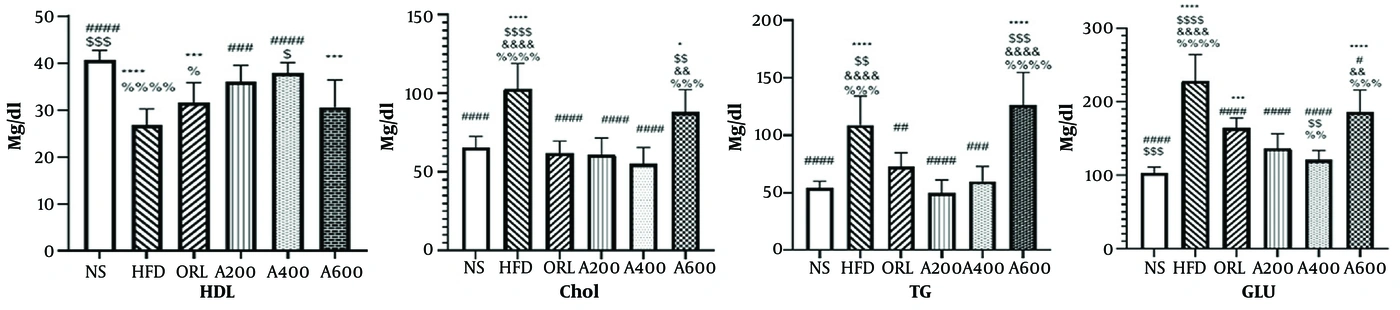
Figure 1.
Effect of aqueous alfalfa extract on the metabolic profile in high-fat diet-induced obese rats. This figure illustrates the effects of aqueous alfalfa extract on metabolic parameters in the control, negative-control (NC), positive-control, and alfalfa-treated groups. HDL (A), total cholesterol (B), TG (C), LDL (D), and fasting blood glucose (E) were assessed across groups. Data are presented as mean ± SD. All values are expressed in mg/dL. *P < 0.05, **P < 0.01, ***P < 0.001, and ****P < 0.0001 compared with the control group. #P < 0.05, ##P < 0.01, ###P < 0.001, and ####P < 0.0001 compared with the negative-control group. $P < 0.05, $$P < 0.01, $$$P < 0.001, and $$$$P < 0.0001 compared with the positive-control group. &P < 0.05, &&P < 0.01, &&&P < 0.001, and &&&&P < 0.0001 compared with the group receiving alfalfa extract at 200 mg/kg. %P < 0.05, %%P < 0.01, %%%P < 0.001, and %%%%P < 0.0001 compared with the group receiving alfalfa extract at 400 mg/kg.
4.2. Effect on Liver Enzymes
Compared with the control group, the NC group showed an increase in ALT from 25.33 ± 6.50 to 61.80 ± 8.38 U/L and a decrease in AST from 57.00 ± 7.95 to 14.66 ± 1.46 U/L. Administration of alfalfa extract at 400 mg/kg reduced ALT to 32.83 ± 3.54 U/L and AST to 4.62 ± 0.32 U/L compared with the NC group (P < 0.05) (Figure 2).
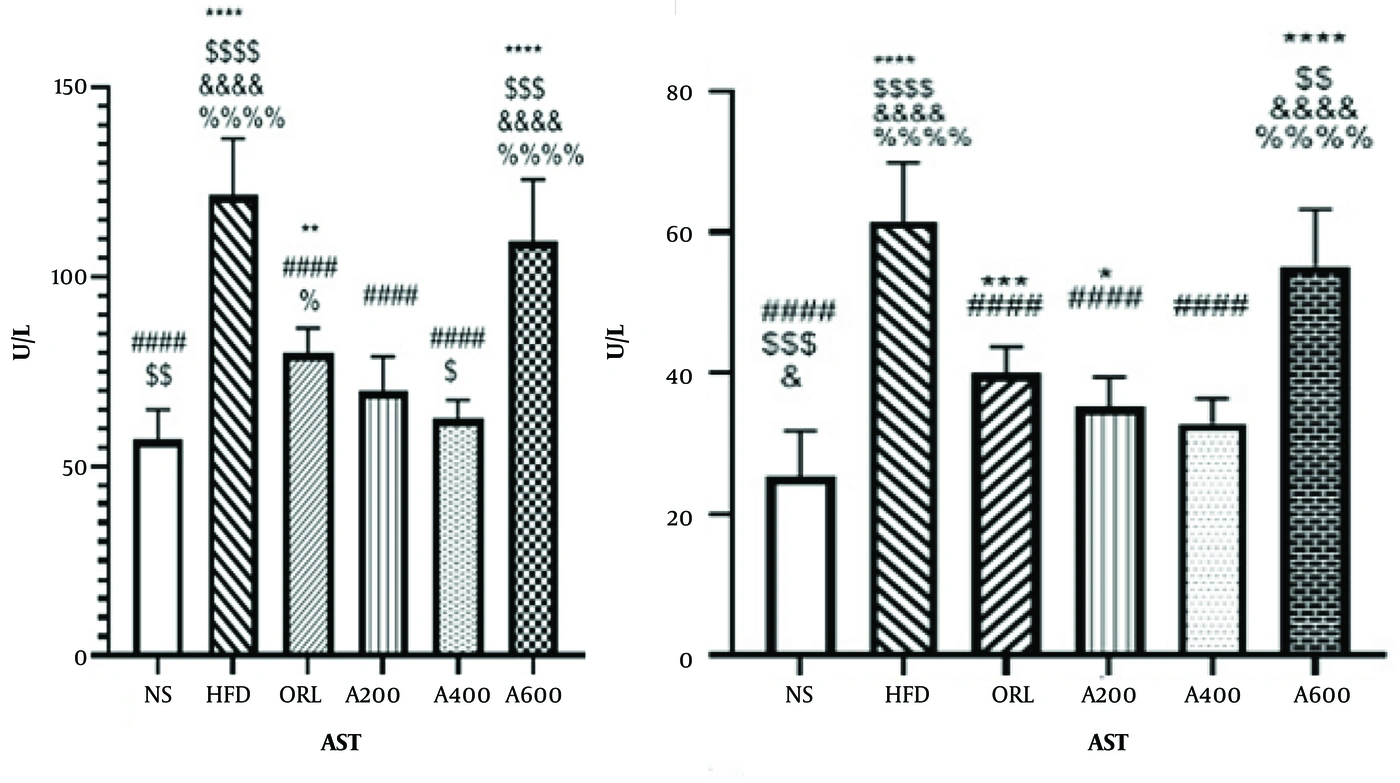
Figure 2.
Effect of aqueous alfalfa extract on liver enzymes in high-fat diet-induced obese rats. This figure shows the effects of aqueous alfalfa extract on serum liver enzymes in the control, negative-control (NC), positive-control, and alfalfa-treated groups. AST (A) and ALT (B) levels were evaluated. Data are presented as mean ± SD. All values are expressed in U/L. *P < 0.05, **P < 0.01, ***P < 0.001, and ****P < 0.0001 compared with the control group. #P < 0.05, ##P < 0.01, ###P < 0.001, and ####P < 0.0001 compared with the negative-control group. $P < 0.05, $$P < 0.01, $$$P < 0.001, and $$$$P < 0.0001 compared with the positive-control group. &P < 0.05, &&P < 0.01, &&&P < 0.001, and &&&&P < 0.0001 compared with the group receiving alfalfa extract at 200 mg/kg. %P < 0.05, %%P < 0.01, %%%P < 0.001, and %%%%P < 0.0001 compared with the group receiving alfalfa extract at 400 mg/kg.
4.3. Effect on Oxidative Stress Markers
The HFD increased oxidative stress, as indicated by decreased SOD activity and GSH levels and increased MDA levels in the NC group (MDA, 4.50 ± 0.40 nmol/mL; SOD, 18.00 ± 4.00 U/mL; GSH, 20.00 ± 3.00 µmol/L). Treatment with alfalfa extract at 400 mg/kg significantly improved these parameters by increasing SOD to 55.00 ± 7.00 U/mL and GSH to 45.00 ± 5.50 µmol/L and reducing MDA to 1.80 ± 0.25 nmol/mL compared with the NC group (P < 0.05 for all) (Figure 3).
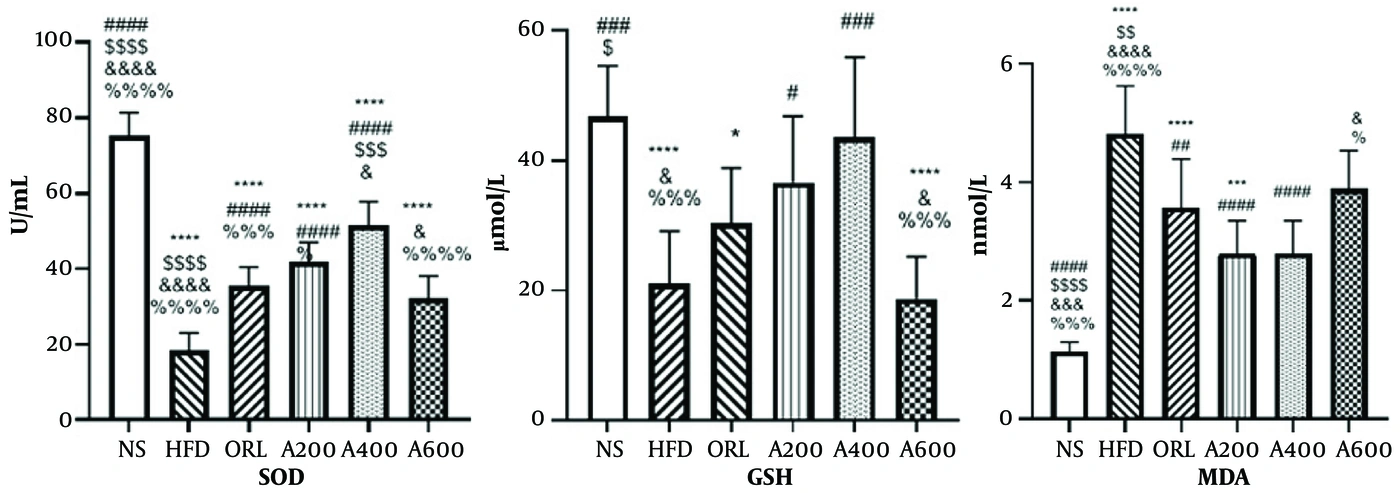
Figure 3.
Effect of aqueous alfalfa extract on oxidative stress markers in high-fat diet-induced obese rats. This figure shows the effect of aqueous alfalfa extract on oxidative stress markers in the control, negative-control (NC), positive-control, and alfalfa-treated groups. SOD activity (A), MDA (B), and GSH (C) were measured in all groups. Data are presented as mean ± SD. SOD is expressed in U/mL, MDA in nmol/mL, and GSH in µmol/L. *P < 0.05, **P < 0.01, ***P < 0.001, and ****P < 0.0001 compared with the control group. #P < 0.05, ##P < 0.01, ###P < 0.001, and ####P < 0.0001 compared with the negative-control group. $P < 0.05, $$P < 0.01, $$$P < 0.001, and $$$$P < 0.0001 compared with the positive-control group. &P < 0.05, &&P < 0.01, &&&P < 0.001, and &&&&P < 0.0001 compared with the group receiving alfalfa extract at 200 mg/kg. %P < 0.05, %%P < 0.01, %%%P < 0.001, and %%%%P < 0.0001 compared with the group receiving alfalfa extract at 400 mg/kg.
4.4. Histopathological Findings
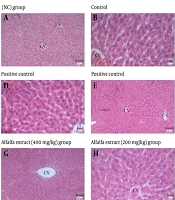
Microscopic evaluation of liver sections showed normal hepatic architecture in the control group. The NC group exhibited marked steatosis and inflammatory changes. In the positive-control group, these alterations were partially improved. The alfalfa-treated groups showed dose-dependent effects. The 200 and 400 mg/kg groups showed gradual improvement in liver structure, with the 400 mg/kg group demonstrating significantly fewer lipid vacuoles and better preservation of normal architecture. However, the 600 mg/kg group showed more severe liver damage, including persistent lipid vacuoles, inflammatory foci, and occasional hepatocyte necrosis with hemorrhage, comparable with the NC group (Figure 4K).
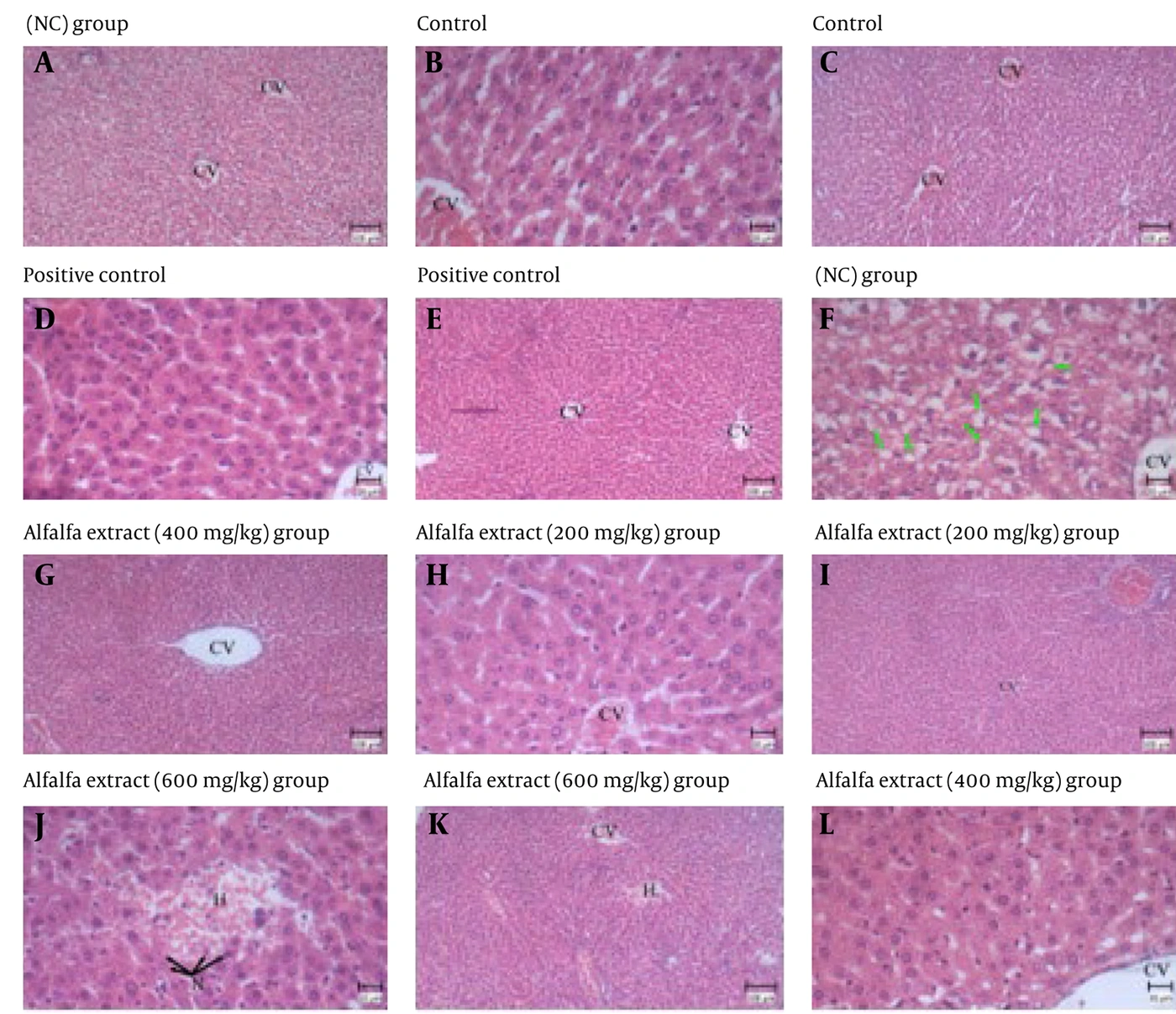
Figure 4.
Histopathological Findings of Rat Liver Sections (Hematoxylin and Eosin) in Different Experimental Groups. (A-B) Control group: The hepatic microstructure was completely normal. Hepatocytes were arranged in regular cords around the central vein (CV). The hepatocyte cytoplasm was homogeneous and free of lipid vacuoles. Nuclei were clearly visible and centrally located. Portal areas showed no inflammation or fibrosis.(C-D) Negative-control group: Fatty liver changes were observed. Many hepatocytes contained large, round lipid vacuoles that displaced the nucleus to the edge of the cell. Mild to moderate inflammatory-cell infiltration was also observed in the portal areas. (E-F) Positive-control group (HFD + orlistat 5 mg/kg): The severity of steatosis was reduced compared with the NC group, while mild inflammatory-cell infiltration remained present. (G-H) Alfalfa extract 200 mg/kg group: The severity of steatosis was reduced compared with the NC group but remained considerable. Some hepatocytes contained lipid vacuoles, and mild inflammatory-cell infiltration was still observed in the portal areas. (I-J) Alfalfa extract 400 mg/kg group: A significant improvement in liver tissue was observed. Only a few hepatocytes contained small lipid vacuoles. Mild, scattered inflammation was observed around the portal areas. (K) Alfalfa extract 600 mg/kg group: The liver structure was very similar to that of the NC group. In some areas, hepatocyte necrosis with hemorrhage was observed. Lipid vacuoles were also present in hepatocytes, and inflammatory cells were observed in portal areas and focally.
4.5. Body Weight
Body weight increased over the study period. Repeated-measures ANOVA showed significant overall differences among groups (P < 0.001), but the time × treatment interaction was not significant (P = 0.081), indicating no statistically significant differences in body-weight trajectories among treatment groups. The final body weights were 126.17 ± 12.96 g in the control group, 166.23 ± 20.93 g in the NC group, 192.67 ± 12.58 g in the positive-control group, 195.17 ± 22.93 g in the alfalfa 200 mg/kg group, 191.00 ± 16.12 g in the alfalfa 400 mg/kg group, and 176.60 ± 35.57 g in the alfalfa 600 mg/kg group. Thus, all three alfalfa-treated groups had higher final body weights than the NC group, although the 600 mg/kg group was numerically closer to the NC group than the 200 and 400 mg/kg groups (Figure 5).
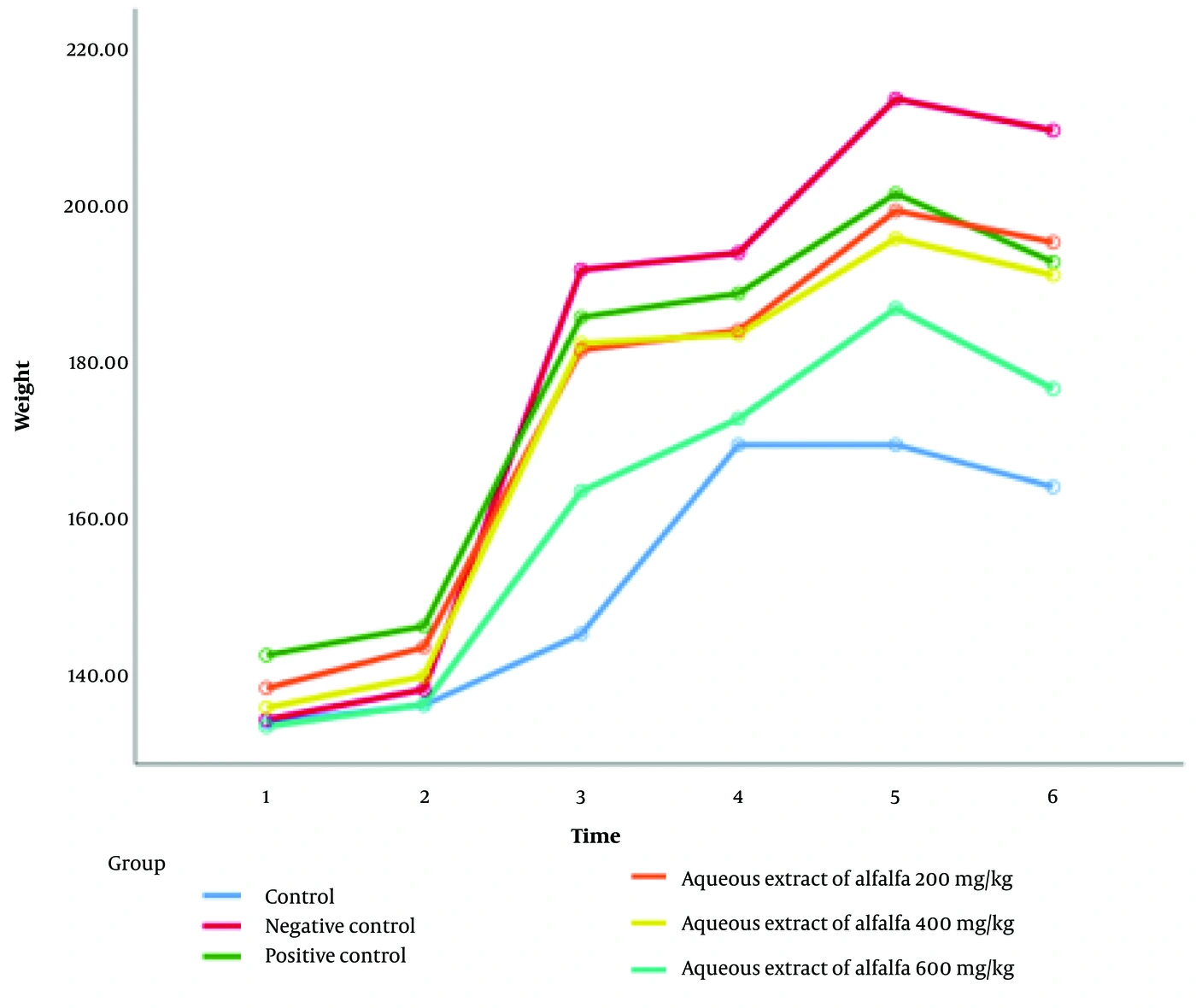
Figure 5.
Body Weight Changes in High-fat Diet-induced Obese Rats Over the Study Period
This figure shows body weight in grams measured at different time points across the experimental groups: control, negative control (NC), positive control, and alfalfa-treated groups at 200, 400, and 600 mg/kg. Data are presented as mean ± SD. Error bars represent SD. Although overall differences among groups were significant (P < 0.001), the time × treatment interaction was not statistically significant (P = 0.081), indicating that body-weight trends over time were relatively similar across groups.
5. Discussion
Alfalfa (Medicago sativa) is a well-known medicinal plant that has received considerable attention in pharmacological and nutritional research because of its diverse bioactive compounds. Al-Snafi et al. (5) conducted a comprehensive review highlighting the traditional use of alfalfa for a wide range of conditions, including arthritis, renal disorders, fever, and rheumatism, as well as its use as a diuretic, cardiac tonic, and menstrual regulator. Phytochemical analyses have shown that alfalfa contains proteins, carbohydrates, saponins, lignins, phenolic compounds, tannins, alkaloids, triterpenoid glycosides, carotenoids, sterols, phytoestrogens, flavones, and isoflavonoids. Pharmacological studies have demonstrated antioxidant, antidiabetic, anti-inflammatory, antimicrobial, hepatoprotective, cardioprotective, neuroprotective, and immunomodulatory properties (5).
Given these biological properties, recent research has increasingly focused on the effects of alfalfa on metabolic disorders, particularly obesity and oxidative stress. In the present study, an HFD induced substantial metabolic disturbances, including increased body weight, dyslipidemia, altered liver enzymes, and increased oxidative stress. These findings are consistent with those of previous studies; for example, Zhang et al. (16) reported metabolic and tissue-structure changes in HFD-induced obese mice, including mild to moderate inflammatory-cell infiltration in portal areas and hepatic steatosis.
In the present study, administration of alfalfa extract, particularly at 400 mg/kg, significantly improved the lipid profile by reducing TG, total cholesterol, and LDL while increasing HDL. These results are consistent with the findings of Farsani et al. (10) and Amraie et al. (12), who reported significant reductions in serum lipids and improved HDL levels in alloxan-induced diabetic rats treated with aqueous alfalfa extract. Furthermore, Li et al. (9) reported that alfalfa polysaccharides and their sulfated derivatives reduced blood lipid levels and improved metabolic indices in obesity models. These beneficial effects may be associated with bioactive compounds such as saponins, flavonoids, and polysaccharides, which may reduce TG, total cholesterol, and LDL by inhibiting intestinal cholesterol absorption, increasing bile-acid excretion, and modulating hepatic enzymes involved in lipid metabolism. Additionally, the antioxidant properties of alfalfa may help regulate lipid metabolism by reducing lipid peroxidation and supporting liver function (9).
Fasting blood glucose and serum glucose changed differently among groups over time. Alfalfa extracts lowered serum glucose at certain doses, consistent with the hypoglycemic effects reported by Farsani et al. (10) and Amraie et al. (12) in diabetic models. Zhang et al. (16) also reported that alfalfa saponins reduced blood glucose levels in obese mice. The observed decline in serum glucose may be related to functional components in alfalfa, including saponins and phenolic compounds, which may contribute to improved regulation of glucose metabolism by enhancing insulin responsiveness and modulating hepatic glucose output. Furthermore, the antioxidant capacity of alfalfa may help maintain normal insulin-related signaling and facilitate glucose utilization in peripheral tissues.
The liver-enzyme findings require cautious interpretation. Relative to the control group, the HFD increased ALT but decreased AST. In the 400 mg/kg alfalfa group, both ALT and AST were lower than those in the NC group. These biochemical changes occurred alongside histological improvement at 400 mg/kg. Raeeszadeh et al. (18) reported reduced liver enzyme levels and improvements in inflammatory and oxidative markers following treatment with alfalfa extract. Similarly, Li et al. (17) demonstrated that alfalfa polysaccharides reduced inflammatory gene expression and improved liver function.
Histopathological evaluation further demonstrated both the harmful effects of the HFD and the potential protective effects of alfalfa extract. In the NC group, marked hepatic steatosis, cytoplasmic lipid vacuolization, peripheral nuclear displacement, and inflammatory infiltration in portal areas were observed; these changes are characteristic of fatty-liver injury associated with oxidative stress and disrupted lipid metabolism (16). The effects of alfalfa observed in the present study may be related to its antioxidant and anti-inflammatory properties. In the 400 mg/kg group, clear improvements in liver histology were observed, including reduced lipid accumulation and better preservation of normal hepatic architecture. Raeeszadeh et al. (18) also reported that alfalfa extract improved histopathological damage in models of nicotine-induced liver injury. Farsani et al. (10) and Amraie et al. (12) similarly reported that alfalfa treatment improved liver and pancreatic tissue structure in diabetic animal models.
Importantly, the group receiving the higher dose of 600 mg/kg showed adverse histological findings compared with those of the 400 mg/kg group. Persistent lipid vacuoles, inflammatory foci, and occasional hepatocyte necrosis and hemorrhage were observed. These findings raise a potential safety signal for the highest dose, indicating a narrow therapeutic window. Unlike the 400 mg/kg dose, which showed more favorable histological findings, the 600 mg/kg dose did not provide additional benefit and was associated with adverse histological changes. This finding suggests that increasing the dose does not necessarily enhance the protective effects and that the biological response to alfalfa extract may be dose dependent. Therefore, identifying the optimal therapeutic dose is important for maximizing potential benefits while minimizing adverse outcomes, and further toxicological studies are warranted.
Regarding body weight, the reported final weights did not show lower body weight in the alfalfa-treated groups than in the NC group. In addition, the time × treatment interaction was not statistically significant (P = 0.081). Therefore, the present data do not demonstrate a definitive treatment-related reduction in body-weight trajectory. Previous studies have reported different findings: Zhang et al. (16) reported weight-reducing effects of alfalfa saponins, Li et al. (9) found decreased body weight and visceral fat with alfalfa polysaccharides, and Bobeck et al. (7) observed improved weight-related trends and gut-microbiota modulation with fat-soluble alfalfa extracts despite no significant change in body weight.
A key finding of this study was the improvement in oxidative stress markers in animals receiving alfalfa extract. In the HFD group, antioxidant markers such as SOD and GSH were significantly reduced, whereas MDA levels increased, indicating substantial oxidative stress. In contrast, alfalfa extract, especially at 400 mg/kg, increased SOD and GSH and reduced MDA, indicating improved antioxidant capacity. Raeeszadeh et al. (18) reported increased antioxidant-enzyme activity and reduced lipid peroxidation after alfalfa treatment. Zhang et al. (16) and Li et al. (9) also reported that alfalfa compounds enhanced antioxidant defenses and reduced oxidative-stress markers and reactive oxygen species production.
Recent research has also suggested a potential role for alfalfa in modulating the gut microbiota and reducing systemic inflammation. Pan et al. (19) found that alfalfa polysaccharides promoted the growth of beneficial gut bacteria, including Bifidobacterium, and improved metabolic parameters in obesity models. In addition, Li et al. (17) observed downregulation of inflammatory genes, including NF-κB and TNF-α, following treatment with alfalfa extracts. Although the gut microbiota was not evaluated in the present study, improvements in oxidative-stress and inflammatory parameters may partly involve similar mechanisms.
5.1. Conclusions
Aqueous alfalfa extract at 400 mg/kg improved metabolic parameters and reduced oxidative stress in an HFD-induced obesity model in rats. However, these findings are preliminary and limited to an animal model. The reported body-weight data did not demonstrate a definitive treatment-related reduction in weight trajectory. The adverse histopathological findings observed at the highest dose of 600 mg/kg, including persistent lipid vacuoles, inflammatory foci, and hepatocyte necrosis with hemorrhage, raise important safety concerns and emphasize that alfalfa extract should not be assumed to be broadly beneficial without qualification. Future studies should focus on dose optimization, toxicological assessment, and clinical trials to confirm both efficacy and safety before alfalfa can be recommended as a therapeutic agent for obesity-related complications.
5.2. Limitations of the Study
This study has several limitations. First, it was conducted in an animal model, and direct extrapolation to humans requires caution and further clinical studies. The controlled laboratory conditions may not fully reflect the complexity of human obesity. Second, some molecular mechanisms and signaling pathways involved in lipid metabolism and inflammatory processes were not investigated, which could have provided a deeper understanding of the mechanisms of action. Third, the gut microbiota was not evaluated, although it may have contributed to the observed effects.
5.3. Suggestions for Future Research
Future studies should investigate the effects of alfalfa extract at different doses and over longer periods to determine the stability and durability of its effects. Molecular studies focusing on gene expression related to lipid metabolism, antioxidant pathways, and inflammatory markers could help elucidate the mechanisms of action. Additionally, clinical trials in overweight and obese individuals could facilitate clinical evaluation and the development of alfalfa-based supplement products.