
1. Background
The most common cause of patients’ referral to emergency departments is aggravation of pain (1). According to the reports, pain has been the chief complaint for about 60% of patients admitted to the Emergency Department, 31% of the cases pain have been due to trauma (2). This shows that several studies have shown that more than 70% of patients with acute pain in the emergency departments do not get any pain- relieving medication. Several factors can cause a pain under-treatment (3). These factors include the lack of adequate knowledge in connection with the pain, defects in the initial assessment of the pain, and the defects in having a guideline of pain management (4). While the proper pain control can not only be a cause for an increase in patient satisfaction, but it also causes moving easier, faster recovery, and faster clearance of the patient from the hospital (5). One of the most important issues that the emergency physician is faced with is the choice of the type of suitable medication according to the terms of the patient and also the route of its prescription (6).
Ketamine as a N-methyl-D-aspartate (NMDA) receptor antagonist, is administered through different routes such as intravenously, intramuscularly, intra nasally, orally, and rectally. Ketamine is a water-soluble and fat where the property causes a broad distribution of the drug in the body and very quickly passes the blood-brain barrier (7). As in the intravenous injection, Ketamine reaches its receptor in less than a minute (8). This medication, at a lower dose, causes analgesia and sedation, while at a high dose, causes general anesthesia (9). Therefore, in patients with extremity fractures, Ketamine is also a safe and effective drug that has no side effects in lowering blood pressure and respiratory depression, which can be seen in consumption of opioids (10). Another drug that is being studied as a sedative drug is nitric oxide, although the drug is still not widely used by physicians and medical centers. However, studies have shown that patients taking painkillers are usually the ones that have received nitrous oxide 50%, do not need any additional drug, and sedative effects observed in them is much faster. In addition, the incidence of adverse events in these patients was very low (11). It seems that the mechanism of the analgesic effect of Nitrous oxide acts as an NMDA receptor antagonist (12).
Analgesics such as opioids are commonly used for pain control in emergency departments. Correlated respiratory side effects and central nervous system depression confine opioids application as analgesic medication. New pain control choices such as Nitric Oxide and Ketamine may be alternatives. This study evaluates efficacy of Nitric Oxide versus ketamine in purpose of pain reduction in limbs fractures.
2. Methods
2.1. Study Design
A controlled trial, which has been randomized, was designed for the purpose of the study. The inclusion criteria included all male patients complaining of limb fracture, who were referred to the Acute Medical Emergency Center. While the patients were younger than 18 years, patients with head trauma, patients with chronic airway disease, patients with chronic obstructive pulmonary disease, patients with a decreased level of consciousness, if the patient has a history of reactions to NO or ketamine, a known case of psychiatric disease, patients with otitis media, and those patients who received a sedative dose or liquid food up to 2 hours ago, were excluded. The Ethics Committee has granted an approval for study establishment. At first, the process of clinical trial was described to the patients and then they signed written informed consent forms.
2.2. Therapeutic Intervention
The male patients, who were enrolled, were randomly specified with the help of a computer random number generator to use one of the strategies of intravenous Ketamine (group I) or nitrous oxide/oxygen mixture (group II). First, patients’ vital signs were evaluated and recorded by the researcher who was a qualified Emergency Medicine Specialist, and patients of the first group were given Ketamine at an IV dose of 0.3 mg/kg in a dose for preventing the dissociative effect and impaired level of consciousness. We expect that the effect of the drug starts within 1 minute and lasts up to 15 minutes. The second group of patients, through giving set-mask, received 50% Nitrous Oxide/50% Oxygen mixture by self-administration to a maximum duration of time of 15 minutes. The mask was active until the pressure of the patient's breathing is higher than 5 cmH2O, therefore, by reducing the number of breathing, the mask itself is interrupted. For both groups, the amount of intensity of pain was recorded using the VAS Score at the minutes 0, 5, 10, 15 after arrival. For identifying of VAS Score, patients were asked for determining their pain level from 0 to 10 by considering its standards. For both groups, if the pain was not controlled after 15 minutes, intravenous morphine 0.1 mg/kg was administered as a rescue dose for the pain control.
2.3. Statistical Analysis
For purpose of power of 90%, type I error of 0.05, and a correlation of 0.25, the volume sample calculated at a minimum of 20/group. First, the data obtained were checked in terms of descriptive indicators; and then, given that our response were scores resulted of an ordinal scale and repeat due to follow-up, the generalized estimating equation (GEE) models or repeated measures were to analyze the results (to compare the reduction in pain at different times) and t- test, as well. The data were analyzed using SPSS 20. Using the confounding covariates in the model, their effect was controlled. A p-value less than 0.05 was considered as significant level.
3. Results
The number of patients enrolled in this study was 80. Five patients did meet the exclusion criteria and were excluded from the study (Figure 1). There were 43 and 42 patients who were assigned into the nitrous oxide and ketamine group, respectively. Comparison of the age of patients in both groups of nitrous oxide (Mean 34.94 ± 7.95) and Ketamine (Mean 32.77 ± 10.89) did not show a significant difference. Comparison of pain reduction between the 2 groups at all times of baseline, 5 minutes, 10 minutes, and 15 minutes revealed no significant differences. The amount of pain of 8.86 before starting treatment in patients receiving Ketamine reached 2.5 fifteen minutes after the treatment. This is while in the second group, the extent of the pain of 9.52 before starting treatment reached 5.05 15 minutes after the treatment. Reduction of the pain in the first group was 6.36 and in the second group, was 4.47 (Table 1 and Figure 2). In the Ketamine intervention group, 4 patient experienced nausea in the course of the study; in Nitrous Oxide administered patients, 2 patient experienced mild headache, 2 cases with dizziness, and 1 case with mild dyspnea, which were reported. None of the mentioned symptoms lead to discontinue of the study in the cases. Need for rescue analgesic treatment of morphine sulfate at 20 minutes after intervention were 2 and 26 cases for Ketamine and Nitrous Oxide group, respectively.
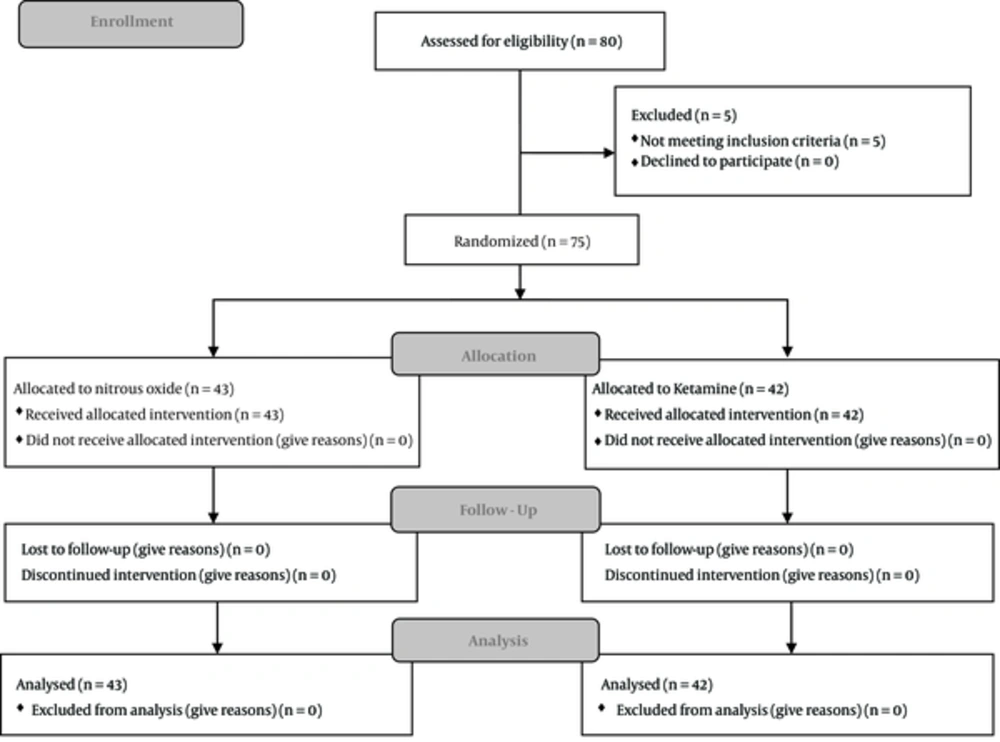
Figure 1.
Flow Chart
Table 1.
Comparison of Mean of VAS Score After Drug Administration and Evaluation of Pain Reduction Efficacy in Group A and B
| Variables | Time | Group 1 (Ketamine ) N = 42 | Group 2 ( Nitrous Oxide) N = 43 |
|---|---|---|---|
| Pain score | Before intervention | 8.86 | 9.52 |
| 5 min | 7 | 7.35 | |
| 10 min | 5.38 | 6.11 | |
| 15 min | 2.5 | 5.05 | |
| Need to Additional therapy (Morphine Sulfate) Number of Cases | 2 | 26 |
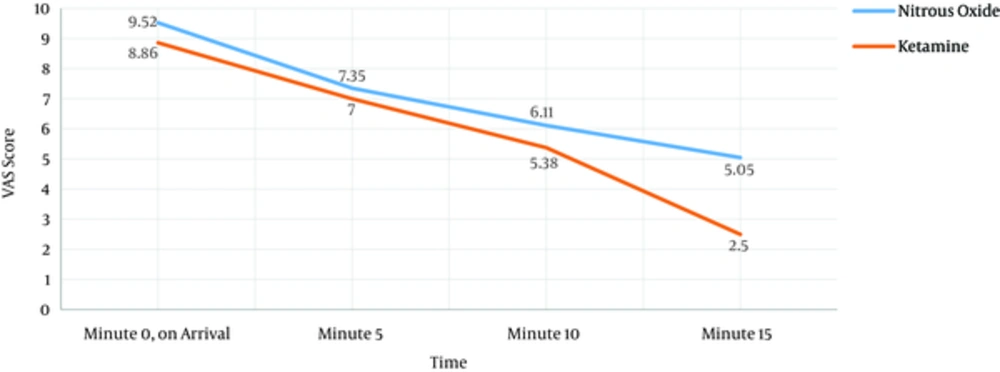
Figure 2.
The Results
4. Discussion
Pain management is adequately one of the global issues and needs of health care system.
Unlike the dramatic development, under treatment of pain can be seen in patients. Ineffective pain can lead to a noteworthy reduction in patients' satisfaction (5). Reduction of acute pain caused by the fracture of extremities in patients and resetting them is very important because it will be a risk factor in creating the next chronic pain. The use of anesthesia is common in emergency and it is done with repeated doses of morphine, fentanyl, and other opioids. In the process of management of traumatic patients, one of the most preferences is assessment of injury mechanism, hemodynamic parameters, and mental status. While opioids prescription interferes in properly evaluating the level of consciousness of patients, in these conditions, some patients require continuous monitoring (13). In addition, opioids are interfering with other drugs that are used in emergency service and should be cautiously used. This study aimed to find a way to limit the indiscriminate consumption, as well as reducing cardio-respiratory monitoring of patients treated with opioids in the emergency department. In the current study, the pain of patients in the group that received Ketamine and in group that received a mixture of 50% nitrous oxide / 50% Oxygen was controlled after intervention based on serial checking of pain score. The analgesic effect in the Ketamine group occurred earlier rather than the group of Nitrous Oxide, based on participant pain control satisfaction. Although a comparison of the decreased trends in the 2 groups of patients did not show a significant difference within 15 minutes. The same effect may be affected by the same mechanism of action (joint recipients) of the 2 drugs (7, 12).
Nitric oxide is an analgesic drug that is used in hospital wards. It has an analgesic effect without the loss of consciousness of the patient and is rapidly cleared from the blood through the lungs (11). Due to the low ratio, this drug starts its effect quickly (within 1 or 2 minutes) and its clearance is only 35 - 45 seconds (14). In a clinical trial, Kariman et al. evaluated the effect of 50% Nitrous Oxide/Oxygen compared with fentanyl in reducing the pain caused by bone fractures. The results of this study have shown that the effect of nitrous oxide is similar with Fentanyl and also the complications of these 2 medicines show a significant difference (15). Furthermore, in another clinical trial, Ducasse et al. evaluated the effect of nitrous oxide %50 in pain management of patients with trauma. The results of this study showed that 5 minutes after taking Nitrous oxide, a significant decrease was observed in the amount of pain (16). In additiInn, some previous studies evaluated analgesic effect of Ketamine. In a study on 41 patients with limb fractures and joint dislocation carried out, Jamal et al. showed that ketamine has the sedative effects similar to midazolam/fentanyl (17). Also, in another clinical trial, Motov et al. showed that intravenous administration of Ketamine has shown analgesic effects similar to intravenous morphine and is useful in the short-term treatment of acute pain in emergencies (18).
In our study, the analgesic effects of both ketamine and nitrous oxide 50% mixture have been showed. Ketamine and nitrous oxide may be a good alternative for short course pain control in acute pain in emergency departments. There are lower side effects and evidence for drug dependence rate in contrast with opioid such as morphine sulfate. Lower drug interaction, lower side effects, and lack of necessity for serious monitoring during drug administration are other advantages of nitrous oxide. The need for extra analgesic dose for the nitrous oxide trial group cases in contrast to the Ketamine group may be due to short drug half-life of nitrous oxide.
To conclude, these findings showed intravenous Ketamine and inhaled Nitrous Oxide mixture 50%, considerably reduced pain in patients with extremities’ bone fractures. The data showed both drugs analgesic effects is extremely fast, however, faster pain reduction results were recorded in the Ketamine group after initial drug administration. As a result, it can be suggested that Nitrous Oxide and Ketamine can be used as effective painkillers in the emergency department and can be alternative for common analgesics.