
1. Background
Trichomoniasis is one of the most common non-viral sexually transmitted diseases (STDs), whose causative agent is a flagellated protozoan living in the genitourinary system called Trichomonas vaginalis (T. vaginalis). It can cause trichomoniasis in both men and women (1, 2). Trichomoniasis infection is more common in women and is associated with several clinical problems and symptoms, including awful smell vaginal discharge, painful urination, genital excitability, disorders after sexual intercourse, premature rupture of membranes, preterm birth, low birth weight, and increased risk of infection with HIV (1, 3-5). The worldwide studies and statistics indicate that in developed countries, a significant percentage (more than 50%) of patients referring to STD clinics suffer from trichomoniasis, and the rate of infection is increasing (6, 7). Also, studies in our country have shown that Iran is the endemic focus of this infection (5, 8, 9).
Metronidazole has been known as the gold standard treatment for trichomoniasis, which has a significant effect on the treatment of this disease (10). However, side effects such as nausea, vomiting, bad taste, gastrointestinal disorders, exanthem, urticaria, angioedema, vertigo, peripheral neuropathy, and transient neutropenia are observed with the use of this drug, which reduces the willingness to use it by the patients (10-12). Additionally, in recent years, the evidence of drug resistance to metronidazole has been reported in some studies, which could be another reason for research on alternative trichomoniasis treatment (13).
The use of medicinal herbs has been common in many countries around the world for many years. Today, the tendency to use them is increasing due to the benefits including fewer side effects, better access, cost-effectiveness, and adaptability of the physiological function of the body to their therapeutic effects (14, 15). Studies on the anti-parasitic effects of plants, particularly against trichomoniasis, have been increasing in recent years, often accompanied by satisfactory results (16-18). For example, Yousefi et al. (19) conducted a study to investigate the effect of the hydroalcoholic extract of Peppermint and Salvia officinalis on T. vaginalis parasites, and found that the parasite did not grow at a concentration of 2 mg/mL of S. officinalis extract and 4 mg/mL of Peppermint extract (19). Also, Arefkhah et al. (20) conducted another study to investigate the effect of the hydroalcoholic extract of Scrophularia striata Boiss on T. vaginalis and concluded that this plant extract could completely inhibit the growth at a concentration of 4 mg/mL, and the inhibition rate of parasite growth was 99% at a concentration of 2 mg/mL (20). Besides, Sambucus spp., belonging to the Caprifoliaceae family, is known and used as an antiseptic, antiviral, antioxidant, anti-inflammatory, analgesic, and anti-proliferating agent due to the presence of eurosialic acid in its extract (21-23). Rahimi Esboei et al. (24) investigated the anti-parasitic effect of this plant against hydatid cyst protoscolex and Giardia lamblia cyst and observed an acceptable ability against this infection (24, 25).
2. Objectives
As there are no published documents on the anti-trichomoniasis effects of S. nigra, the present study was conducted to evaluate the in-vitro anti-trichomoniasis effects of S. nigra in laboratory conditions.
3. Methods
3.1. Plant Collection and Extraction
The plant was collected from different regions of Mazandaran Province and was registered at the Faculty of Health of Mazandaran University of Medical Sciences after confirmation of the scientific name and plant herbarium with registration no. 137-95. The fruits of the plant were shade-dried and crushed by electric grinding, and the powders were stored in dark containers. Then, 500 mL of methanol (Merck, Germany) was added to the plant powder and placed in the laboratory for 48 h. In the next step, the plant waste was separated and the solvent in the solution was evaporated under vacuum conditions by an evaporator. The dried powder was prepared at concentrations of 100, 200, 400, and 800 µg/mL, and used for anti-parasitic evaluation (24).
3.2. Preparation and Culture of Trichomonas vaginalis Parasite in Culture Medium
Vaginal samples were gathered by using sterile cotton swabs. Direct examinations were undertaken microscopically and then cultures were done in Dorset culture media. All test tubes were incubated at 37°C for eight days and microscopic observations were done every two days. The genus and species of the parasite were confirmed by morphological and morphometric methods. In this study, 5 × 10⁵ parasites were used for each reaction. Metronidazole as positive control and dimethyl sulfoxide (DMSO) as negative control were also used in this study (26).
3.3. Investigation of the Anti-Parasitic Effect of Sambucus nigra
This study was carried out by a 24-well cell culture plate. In this test, 5 × 10⁵ parasites of T. vaginalis were added to each well and 100 µL of different concentrations of herbal extracts were added, as well. The plate was placed in an incubator at 37°C, and the viability percentage of the parasite was evaluated at 12, 24, 48, and 72 h intervals using the microscopic method. Besides, 1% trypan blue was used for each concentration, as well as positive and negative control groups, and the growth inhibition was calculated using the following formula (27):
Finally, the number of parasites was counted at certain times using Neubauer slides and the minimum inhibitory concentration (IC50) was calculated.
3.4. Statistical Analysis
The experiments were conducted in triplicate. Finally, the obtained data were analyzed using SPSS software with the chi-square test.
4. Results
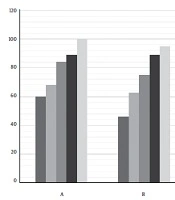
This study was carried out using the methanolic extract of the plant to evaluate its anti-trichomoniasis effects at concentrations of 100, 200, 400, and 800 µg/mL at exposure times of 12, 24, 48, and 72 h. The results are shown in Table 1 and Figure 1. As observed, the acceptable efficacy of plant extract against T. vaginalis was observed at concentrations of 400 and 800 µg/mL. It is also noticeable that the effect of the extract had a direct relationship with exposure time, implying that the inhibition of parasite growth enhanced with increasing exposure time. In addition, the best inhibitory effect on parasite growth was observed at an extract concentration of 800 µg/mL. At this concentration, the anti-trichomoniasis effect of the extract was equal to the anti-trichomoniasis effect of metronidazole (as an anti-trichomoniasis standard drug). The inhibition rate of parasite growth was not significant in a negative control environment (Table 2).
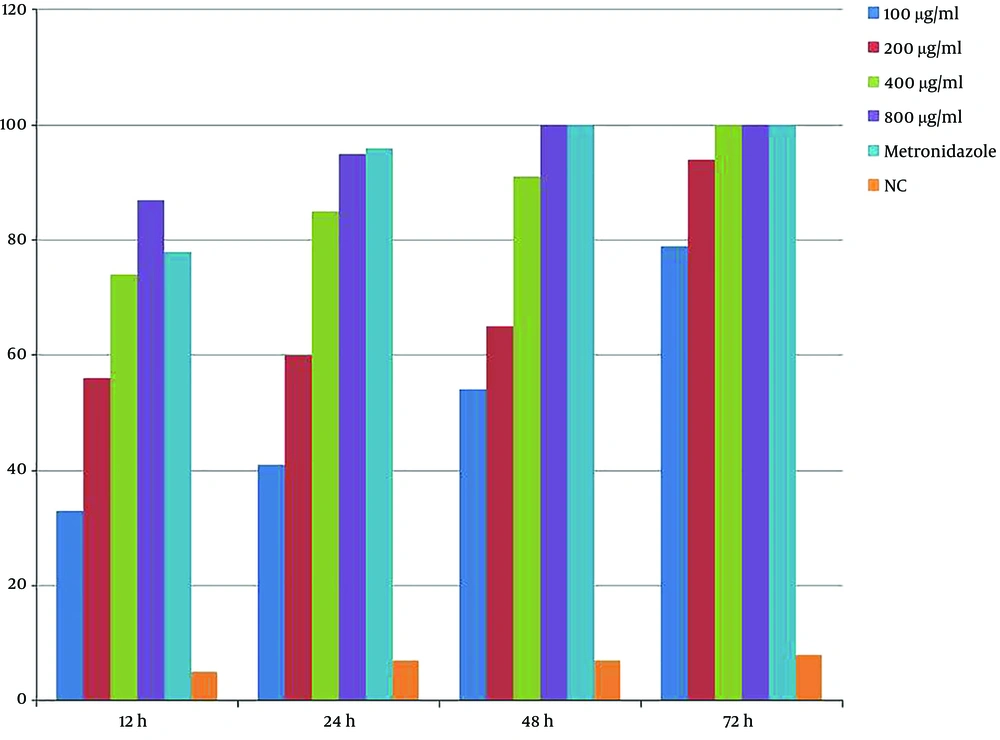
Figure 1.
Growth inhibitory effect of the methanolic extract of Sambucus nigra at concentrations of 100, 200, 400, and 800 μg/mL against Trichomonas vaginalis after 12, 24, 48, and 72 h compared to the positive control (metronidazole) and negative control (medium with DMSO).
Table 1.
Growth Inhibitory Effect of the Methanolic Extract of Sambucus nigra at Concentrations of 100, 200, 400, and 800 μg/mL Against Trichomonas vaginalis After 12, 24, 48, and 72 h Compared to the Positive Control (Metronidazole) and Negative Control (Medium with DMSO).
| Concentration | 100 µg/mL | 200 µg/mL | 400 µg/mL | 800 µg/mL | NC | Metronidazole | P value |
|---|---|---|---|---|---|---|---|
| 12 hours | 33 | 56 | 74 | 87 | 5 | 78 | 0.031 |
| 24 hours | 41 | 60 | 85 | 95 | 7 | 96 | 0.011 |
| 48 hours | 54 | 65 | 91 | 100 | 7 | 100 | 0.000 |
| 72 hours | 79 | 94 | 100 | 100 | 8 | 100 | 0.000 |
Abbreviatiom: NC, negative control (DMSO).
Table 2.
Minimum Inhibitory Concentration (IC50) of Methanolic Extract of Sambucus nigra at Concentrations of 100, 200, 400, and 800 μg/mL Against Trichomonas vaginalis After 12, 24, 48 and 72 h
| Time | Minimum Inhibitory Concentration (IC50), µg/mL |
|---|---|
| 12 hours | 151.15 |
| 24 hours | 121.95 |
| 48 hours | 92.59 |
| 72 hours | 63.29 |
5. Discussion
Based on the results, the methanolic extract of S. nigra significantly decreased the number of Trichomonas parasites at different times. The antiparasitic effect of the plant extract increased with its concentrations from 100 to 800 mg/L, and the best results were observed at 800 µg/mL, which was equal to the efficacy of metronidazole. Also, the time was effective on the effect of the plant extract on the parasite so that the highest efficacy was observed at the highest exposure time for each concentration.
Although there is an effective drug against this disease, consumers have complaints and are not satisfied, and drug resistance has led to conducting various studies for finding new drugs (15). Medicinal herbs have become one of the most attractive options in recent years to achieve effective drugs with lower side effects against all types of pathogens (17). Many studies are annually carried out in Iran and other parts of the world to investigate the ability of these types of plants against pathogenic agents (28). The use of herbal medicines and studies on the anti-parasitic properties of herbs against trichomoniasis have been also taken into consideration (17). Sambucus nigra is known as an antiseptic, antiviral, antioxidant, anti-inflammatory, analgesic, and antiproliferative agent due to the presence of eurosialic acid in its extract. Anthocyanins, especially cyanidin 3-sambubioside and cyanidin 3-glucoside, are polyphenolic compounds responsible for anti-oxidative effects (29), with antibacterial, antiviral, and anti-allergic effects, as well as immune-stimulating properties in humans (30-32).
Uncini Manganelli et al. showed the antiviral activity of S. nigra in the contradiction of the feline immunodeficiency virus using feline kidney Crandell cells. In another study, Razi Jalali et al. (33) used this plant to evaluate its anti-parasitic effect against hydatid cyst in an in vivo study and observed the acceptable ability of the plant against this infection. Their results indicated that in all infected groups, the number, size, and volume of cysts were significantly lower in the test groups than in the control group (P < 0.05) (33). Daryani et al. (23) reported that the fruit extract of S. nigra at concentrations of 5, 10, 25, and 50 mg/mL was effective against Toxoplasma gondii in an in vitro study. The concentrations used in this study were significantly lower than those in other work. In the current work, 100% efficacy was observed at a concentration of 400 µg/ml after 48 hours of incubation. Given the research done, as well as the presence of effective compounds such as anthocyanins and eurosialic acid, it is expected that more research is done on this plant (22).
In the current work, the methanolic extract of S. nigra was used to evaluate its anti-trichomonas activity and our results indicated that this plant was fully effective. Up to now, several plants have been used; but, there has not been any success in the production of medication. Ferula szowitsiana (34), Artemisia, Zataria, Myrtus (35), Freula assafoetida, Allium sativum (36), Taxus baccata (37), Saponaria officinalis (16), and many others plants have shown a variety of effects. Although many studies have been carried out and many plants have been studied, research on finding an effective plant remains ongoing. The comparison of our results with the results of the above-mentioned studies illustrates that the methanolic extract of S. nigra was very effective in removing T. vaginalis.
5.1. Conclusions
In our study, the exposure time for complete parasite removal was detected to be lower than in previous studies. Moreover, it was found that the methanolic extract of S. nigra was equal in effectiveness to metronidazole against T. vaginalis, which indicates the high potential of this plant to be examined as a drug candidate for the treatment of trichomoniasis. The results confirmed the potential of S. nigra against T. vaginalis and showed that, by supplementary studies on the effects of this plant, it can be considered a good alternative to metronidazole. It is suggested that animal and human models be used to study the effect of this plant on the growth and amplification of T. vaginalis.