
1. Background
In early December 2019, the new coronavirus-2019 (COVID-19) was first reported (1). On March 11, 2020, the World Health Organization (WHO) officially announced COVID-19 as a pandemic (2). COVID-19 directly affects the respiratory system, and the patients present with major symptoms such as fever, coughing, common fatigue, pneumonia, and abnormal chest CT-scan findings (3).
Public compliance with hygienic principles is considered to be an important preventive measure against COVID-19 and infection control (4). Currently, COVID-19 is a severe global health crisis, prompting communities, organizations, and countries to take initiative against its spread (5). According to the WHO (1998), self-care refers to behaviors that aim to protect the mental and physical health of individuals, meet their social and psychological needs, prevent diseases and adverse events, improve diseases and chronic conditions, and maintain health after a chronic disease or discharge from the hospital. Participation and staying accountable are key to self-care so that proper behaviors could control complications (6) or prevent disease.
In pandemics such as COVID-19, self-care encompasses the healthy behaviors recommended by the WHO, and everyone must comply with these principles as unhealthy behaviors adversely affect the health of the individual and the community; each person is responsible for their health and the health of others.
After the COVID-19 pandemic was confirmed, the WHO listed healthy behaviors such as frequent hand washing, wearing a face mask, physical distancing, and refraining from staying in indoor spaces for a long time. By adhering to these recommendations, individuals could protect themselves against the disease, while also preventing the spread of COVID-19 to others. However, people respond differently to a new phenomenon and often have difficulty accepting new principles and recommendations, with some resisting new requirements and rules. Therefore, governments and authorities must persuade the community to follow proper principles under such circumstances.
Persuasion or change of perception is a foundation of social support. Changing social life is not only affected by behaviors, but also by changes in the perspectives, beliefs, and attitudes of individuals and groups (7). Persuasion is a conscious attempt at changing the beliefs, attitudes, and behaviors of community members (8). Since the early 20th century, the concept of persuasion has been systematically explored in the field of social psychology (9).
Patrick et al. reported three components of experience, subject, and language to be influential in the persuasion of individuals to accept or reject a phenomenon (10). Various models have also been proposed for behavioral and attitude changes in individuals, and the shared features of these models are raising awareness and conveying the message. In this context, the message could change, promote, or reject one’s attitude, thereby leading to behavioral changes. Therefore, persuasion techniques play a pivotal role in conveying the message and changing attitudes on a large scale (11).
In the present study, we selected Hovland’s persuasion model as the framework. The model introduces the four main components of persuasive communication. The first component is the source of the message; in this regard, the term ‘source’ refers to all the individuals (real person, legal person, organization, social group, author, or anchor) who are involved in presenting and conveying the message. In addition, the source has five qualities of expertise, reliability, attraction, similarity, and power (12). According to the literature, community members often consider the words and claims of experts and knowledgeable individuals to be more reliable in regards to a specific issue (9, 13, 14). Positive disposition could also be attained by other variables such as using attractive sources, which facilitates persuasion along with the variable of credibility (9). Furthermore, the similarity of the message source with the audience to be another influential factor in the process of attitude change (15).
Message features are another important component in this regard, which include the understandability of the message, number of deductions, the partiality of the message, the conclusion of the message, mentioning the source at the beginning/end of the message, order of presenting the message, message repetition and its variations, speech principles, emotional tone, and framing of the message (16). Fear is an emotion commonly used in the process of persuasion, which is reported to be highly effective in this regard (17).
The third component is the means of conveying the message (tools). In research compared visual, auditory, and printed media with face-to-face communication, concluding that the latter is more effective in stimulating the audience and the findings indicated that simple messages could be conveyed to the audience more effectively through visual media compared to auditory and printed media. On the other hand, complex messages are conveyed more effectively through printed media (9). In another study, Keshavarz and Yazdkhosti reported that a pattern introduced through media is more effective in the attention and changing of beliefs, attitudes, and behaviors of the audience (18). According to the literature, properly written messages play a key role in changing health-related behaviors such as weight control (19), quitting smoking (20), and medication control (21).
Message recipients are the fourth component of persuasion. The persuasion of message recipients is influenced by several factors, such as their intelligence, education level, gender, self-esteem, elitism and purposive processing, age, engagement with the subject, personality traits, and belief systems (16). The audience population has wide-ranging and intricate characteristics, which could determine the considerations for the method of designing and codifying the message, representing the source, and ultimately choosing the proper media. Therefore, adequate knowledge of audience characteristics enhances the effectiveness of persuasive communication (15). A study in this regard indicated that under specific circumstances, personality traits may play a key role in targeting persuasive messages.
Gender is an important influential factor in persuasion (22), and message repetition is another significant parameter in this regard. Studies regarding memory and news processing in individuals have shown that transitory stimuli and concepts fail to affect the human cognitive system and often remain unlearned or will be forgotten shortly after they are conveyed (23). In this regard, Esmi et al. evaluated the level of watching commercials and compliance with safety measures, reporting that safety measures are observed better by the individuals who watch commercials more frequently (24). Furthermore, studies show that 96.1% of students choose the food items that they have come to know through commercials (25), while 82% of respondents in another study considered receiving three messages per day to be favorable regarding a specific service/product (12).
Communicable diseases such as COVID-19 have imposed substantial costs on the healthcare system of Iran and several other countries, while also causing undeniable human-related consequences and complications. For optimal results, preventive measures and increasing self-care skills are known to be more effective compared to other attempts (26). In the COVID-19 pandemic, specific and new attitudes must be adopted by individuals in terms of lifestyle and self-care in order to prevent the disease. As mentioned earlier, the WHO has published a list of healthy behaviors for the current pandemic, which must be promoted by governments to persuade each nation to comply with these rules.
In Iran and other countries, education on the prevention of COVID-19 has become increasingly important, with the mass media making the greatest endeavors in this regard. In the context of education and awareness, proper skills and techniques of persuasion could effectively correct and modify the behaviors of community members. By obtaining more information about the influential factors in this regard, the mass media could enhance the efficacy of their agenda. Therefore, the recognition of persuasion techniques could indirectly affect the prevention of COVID-19.
2. Objectives
The present study aimed to predict COVID-19 preventive behaviors based on persuasion techniques in five countries.
3. Methods
This descriptive, correlational study was conducted on the population aged more than 18 years in Iran, Australia, the United Kingdom, Sweden, and Canada. These countries were selected given their location in four different continents. In addition, the researchers were able to communicate with individuals who acted as liaisons between the authors and the participants. The inclusion criteria of the study were the age of more than 18 years and basic literacy. The participants were selected via convenience sampling.
Initially, electronic questionnaires were obtained from Parsal website, and a call was issued for enrollment in the mentioned countries via the internet in English and Persian. In total, 500 individuals volunteered via cyberspace.
Data were collected using an electronic questionnaire consisting of three sections, including demographics, a persuasion scale, and a scale of preventive behaviors for COVID-19. The tool was distributed online in English or Persian depending on the native language of the participants. They were assured of ethical terms and confidentiality regarding personal information, as well as the fact that the responses would not be published. In total, 498 respondents completed the questionnaire within one month online. The questionnaire was designed in a way that the respondent would only be able to answer the next question if the previous question had been answered; therefore, no incomplete questionnaires were returned.
After data collection and eliminating eight pieces of irrelevant data, data analysis was performed in SPSS version 21 using Pearson’s correlation-coefficient and multiple regression analysis in a stepwise manner.
3.1. Research Instruments
3.1.1. Demographic Data
The demographic section of the questionnaire consisted of data on the age, gender, place of residence, economic status, and education level of the participants. The items of this section were in a multiple-choice format.
3.1.2. Questionnaire of Healthy Behaviors for COVID-19
This scale was researcher-made and developed in 2020 in accordance with the health recommendations of the WHO (2020) to prevent the spread of COVID-19. The content validity of the designed questionnaire was confirmed by a panel of experts, and the scale was tested on some participants to confirm its reliability. The questionnaire consisted of eight items, which were scored based on a five-point Likert scale (score range: 8 - 40). The higher scores indicated more healthy behaviors, and the Cronbach’s alpha of the tool was estimated at 0.70.
3.1.3. Persuasion Scale
The persuasion scale used in the present study was a researcher-made questionnaire developed in 2020. The content validity of the scale was confirmed by a panel of experts, and the reliability was also confirmed by asking some subjects to complete the questionnaire. The persuasion scale consisted of 13 items, which were scored based on a five-point Likert scale (score range: 13 - 65). The higher scores indicated the higher effectiveness of persuasion techniques, and the Cronbach’s alpha of the scale was estimated at 0.62.
4. Results
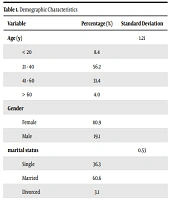
Among the participants, 403 were female (80.9%), and the remaining were male. The majority of the participants were aged 31 - 40 years (standard deviation [SD]: 1.21). In terms of education level, 38.2% of the participants had an MA (or higher), 43.6% had an associate degree or BA, 17.8% had high school education/high school diploma, and 0.4% had elementary education (SD: 0.73). Regarding the economic status, 14.9% of the participants had a poor economic status, 22.3% had a moderate-to-poor economic status, 36.1% had a moderate economic status, 14.3% had a moderate-to-favorable economic status, and 12.4% had a favorable economic status (SD: 0.20). The mean score of healthy behaviors in the subjects was 35.80 ± 4.01.
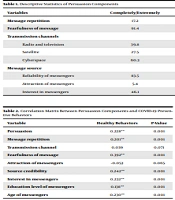
According to the information in Table 1, only 17.2% of the participants were exposed to frequent messages regarding COVID-19, and 91.4% considered the risk of the diseases to be severe (fear of contracting the infection). Among various methods of messaging, cyberspace was most frequently used by the participants to receive information about COVID-19. Among various features of messengers, reliability (messages published by experts) were considered more effective than the source of the messages (attraction and interest). In other words, the respondents trusted the messages about COVID-19 that were published by experts more than other sources. The lowest reliability level in this regard was reported with the attraction of messaging methods (eg, news spread by celebrities).
Table 1.
Descriptive Statistics of Persuasion Components
| Variables | Completely/Extremely | Sometimes/Seldom | None |
|---|---|---|---|
| Message repetition | 17.2 | 82.8 | |
| Fearfulness of message | 91.4 | 6.6 | 3 |
| Transmission channels | |||
| Radio and television | 39.8 | 59.6 | 0 |
| Satellite | 27.5 | 69.9 | 2 |
| Cyberspace | 60.3 | 38.5 | 1 |
| Message source | |||
| Reliability of messengers | 83.5 | 11.6 | 4 |
| Attraction of messengers | 5.4 | 88.1 | 6 |
| Interest in messengers | 46.1 | 47.0 | 10 |
According to the information in Table 2, the F-value of the regression model was estimated at 25.577, and 0.198 of the total variance of healthy behaviors could be predicted by the fearfulness of the message, interest in the messenger, repetition of the message, and credibility of the messaging method. Furthermore, the results of t-test indicated that the fearfulness of the message, interest in the messenger, repetition of the message, and credibility of the messenger were significantly correlated with COVID-19 preventive behaviors (P = 0.001) (Table 3).
Table 2.
Correlation Matrix Between Persuasion Components and COVID-19 Preventive Behaviors
| Variables | Healthy Behaviors | P-Value |
|---|---|---|
| Persuasion | 0.228** | 0.001 |
| Message repetition | 0.201** | 0.001 |
| Transmission channel | 0.039 | 0.071 |
| Fearfulness of message | 0.392** | 0.001 |
| Attraction of messengers | -0.053 | 0.065 |
| Source credibility | 0.242** | 0.001 |
| Interest in messengers | 0.232** | 0.001 |
| Education level of messengers | 0.138** | 0.001 |
| Age of messengers | 0.230** | 0.001 |
Table 3.
Multivariate Stepwise Regression of Persuasion Components and Healthy Behaviors
| References | R | R2 | R-Justified | F | P-Value | B | β | t |
|---|---|---|---|---|---|---|---|---|
| Fearfulness of message | 0.454 | 0.206 | 0.198 | 25.577 | 0.001 | 1.520 | 0.316 | 7.296 |
| Interest in messenger | 0.401 | 0.109 | 2.568 | |||||
| Message repetition | 0.388 | -0.105 | 2.516 | |||||
| Source credibility | 0.389 | 0.093 | 2.155 |
5. Discussion
Persuasion refers to any message that aims to form, promote, or change cognitive, emotional, and behavioral responses (27). In the present study, a significant correlation was observed between using persuasion techniques and increased preventive behaviors for COVID-19, which is consistent with the previous findings in this regard (9, 18-21). When individuals are exposed to a message, the main issue (ie, the key concept to realize the persuasion process) is the information that is processed by the recipients (immersion, interpretation, and evaluation) through the conveyed message. According to novel theories, individuals process encouraging messages in two distinct manners.
The potency of the intrinsic deductions within a specific message influences persuasion only in the case of systematic processing. On the other hand, factors such as the features of the messenger only affect persuasion in the case of assumptive processing. The most systematic processing engages individuals when they have high motivation and information processing capacity regarding the stimuli. Such processing occurs when individuals have adequate knowledge of the issue in question and allocate substantial time to the contemplation of the issue or in case the issue sounds critical. Conversely, the inability to process information more accurately or inadequate knowledge only leads to assumptions about the issue in question (28).
According to the results of the present study, the level of exposure to messages and message repetition had positive, significant effects on the healthy preventive behaviors of the participants, which is in line with the previous findings in this regard (23, 24).
The effects of television on people are often determined based on the stimulus-response model (conditioning); correspondingly, more exposure to television commercials (stimulus) increases the chances of the purchase and consumption of the advertised product/service by the viewer (response) (29). Furthermore, this finding could be explained within the framework of the central route to persuasion. Accordingly, message repetition is a contributing factor to the ability of information processing regarding a specific phenomenon. If not frustrating, message repetition could make the audience reflect upon the deductions within the conveyed message. Therefore, message repetition increases the possibility of exposure to the message, and its frequent broadcasting could largely contribute to persuasion (12).
According to Bandura’s theory, the learner needs a cognitive review course to be able to exhibit a behavior that corresponds to the observed behavioral pattern. As such, message repetition increases the attention span of viewers and listeners regarding all the aspects of the observed behavioral pattern, thereby resulting in the cognitive review of the pattern behavior and increasing the persistence of the targeted behavior (24). This hypothesis has been confirmed in several studies. For instance, Hosseini Anjadani stated that repeating messages regarding an economical lifestyle and saving water affected the behavior of children (30). Furthermore, Jabarlo Shabestary reported that repeating commercials regarding the optimal patterns of electricity use positively influenced the behavior of children and adolescents (31).
According to the current research, fear had a positive, significant correlation with healthy preventive behaviors for COVID-19, which is consistent with the previous findings in this regard (17). This correlation could also be explained by the protection-motivation theory, which states that fear ensures the necessary motivation for one’s protection. Moreover, the cognitive perception of an individual toward a threat affects the inductive agent of fear. In this regard, using fear (particularly mortal fear) can enhance the persuasiveness of a specific message if the audience is convinced of the fact that the described dangers are severe and likely and the suggested recommendations are effective; in other cases, the audience may be persuaded that they are able to comply with the proposed recommendations. As a result, the persuasive power of the message significantly increases (15). In the current research, the participants believed that they could easily decrease the risk of COVID-19 infection despite its invasive nature owing to the published preventive measures of the WHO and the recommendations of experts and other sources.
Credibility is an important feature of every message source, which refers to the scientific qualification (technical and specialized) of the source and the implicit intention to persuade the audience (16). Our findings indicated that the credibility and reliability of the message source were positively and significantly correlated with healthy preventive behaviors for COVID-19, which is in line with the previous studies in this regard (9, 13, 14). The results of the present study and previous findings regarding the credibility of the message source could imply that giving prominence to science and expertise in the eye of the audience could increase the effectiveness of persuasion, thereby increasing the possibility of changing perspectives and attitudes. In professional groups, elite members also have a more significant impact on decision-making. The audience tends to trust and accept the viewpoint of an expert regarding a related subject (32). While conveying expert messages (especially health messages), the public welcomes the viewpoint of an expert and remain impartial in most cases.
Conveying messages and presenting solid deductions are associated with better persuasion mostly because of the influence of the audience’s acceptance of the messenger. Individuals who are more confident in conveying their message are often more persuasive than those with a weaker predisposition (28). In addition, credibility and reliability are built upon the belief of the audience in the honesty and expertise of the message source, largely contributing to persuasion (33).
Our findings demonstrated that the attraction of the message source had no significant correlation with preventive behaviors for COVID-19, which is inconsistent with the previous studies in this regard (24). In messages about health and wellbeing, the reliability of the source seems to be more important to the audience compared to the attraction of the message source. On the other hand, we observed a positive significant correlation between interest in the message source and preventive behaviors for COVID-19. People are often influenced by those to whom they are attracted or are friends in the real and virtual world. A likable source makes communication more agreeable, and agreeability of communication is key to persuasion. Moreover, individuals tend to synchronize their emotions and cognitions with one another (9). Since friends often share similarities and similarity is an influential factor in persuasion, the audience empathizes with those with whom they share similarities. As a result, they tend to follow in their footsteps, feeling that they are the source of the message and have no intention of deception (15). Observational learning theories also confirm that individuals tend to follow behavioral patterns through observation (24).
According to the results of the present study, the age of the audience was a significant influential factor in persuasion, and increased age was associated with better self-care. Persuasion tends to diminish with age. Increased age is associated with the consolidation of defense mechanisms and cognitive structures, and the individual becomes less willing to change their views and perceptions. Conservatism is another consequence of aging. Undoubtedly, conservative individuals are less likely to acknowledge new ideas and views, while impressionability is higher in adolescents and youngsters (9).
Susceptibility to COVID-19 increases in the presence of underlying conditions such as diabetes, cardiovascular diseases, and age. Therefore, self-care seems more crucial to those with underlying diseases and weakened immune function associated with aging. This justifies the higher level of self-care behaviors in the aged population and their persuasion of healthy behaviors for COVID-19. Self-care needs in a healthy individual change in proportion to their growth level that determines their age (34).
In the current research, a positive significant correlation was observed between the education level of the participants and their preventive behaviors for COVID-19. Elitism and intellect are key components of communication with an audience. Intellectual individuals often have a vast knowledge of the subject in question, as well as its details and implications. According to the literature, the intellect of the audience largely influences their comprehension and information keeping (13).
5.1. Limitations of the Study
Since we used convenience, voluntary sampling, the majority of the respondents were incidentally women with academic education; this was a limitation of our study, which affects the generalizability of the results. Therefore, it is proposed that similar studies be conducted on sample populations including an equal number of male and female participants and different education levels.
5.2. Conclusions
In crises such as the outbreak of communicable diseases, the control and management of which require public participation and assistance, persuasion becomes a critical and sensitive concern of every government since such issues could only be controlled and resolved by adhering to the recommendations of experts. Given the differences in the views and perceptions of each individual in the community and difficulty in persuasion due to bias or distrust, authorities should adopt more effective persuasion policies depending on the community members.
According to our findings, the audience could be better persuaded by high credibility and interest in the messenger, along with an optimal degree of fear-mongering to emphasize the severity of the issue through the message. Therefore, it could be concluded that the media and authorities should have precise information on the influential factors in the success of persuasion techniques in order to enhance the efficacy of their agenda. The results of this study could also be beneficial for social psychiatrists.