
1. Background
The old age period is characterized by decreased efficacy, power, and independence. Society’s attitude to older adults and aging is associated with prejudice and stereotypes (1, 2). Ageism is beliefs (ugliness, disease, etc.) and attitudes (preferring youth and staying young even in old age) that can manifest in behaviors. Positive and negative attitudes are together when discussing ageism (3). "Ageism" or age discrimination is a systematic stereotype and prejudice against people due to getting old (4).
The term ageism was first used by Robert Butler (1969), who was the first director of the US National Institute on Aging. Gerontologist Robert Butler defines ageism as discrimination against older adults, which can lead the actions similar to racism and sexism (5).
Age discrimination is the ideas, attitudes, beliefs, and actions of people who are prejudiced toward older adults based on age (6). Age discrimination often leads to the belief that older adults are unproductive, depressed, and cognitively impaired due to aging (1, 2, 7). Given that individuals’ beliefs and attitudes shape society’s collective beliefs about various phenomena, understanding the general public’s perceptions and beliefs about aging can reveal society’s potential to address the aging challenges. In addition, aging challenges familiarize the relevant administrations with the truth of accepting and rejecting older adults in society and clarify the future for older adults. An accurate and reliable tool is essential for understanding people's attitudes and beliefs in society. Although various tools have been designed to measure ageism, some of which have been validated in Iran, there is still a need for a tool more tailored to the Iranian social context. Therefore, the ageism scale of Vefikuluçay Yilmaz and Terzioglu, developed in Turkey, maybe more culturally and socially relevant to Iran (8-10). This scale has 23 items, three subscales, and appropriate psychometric properties (11), used in different studies (12-17).
2. Objectives
This study was conducted to translate the psychometric properties of the Persian version of the Vefikuluçay Yilmaz and Terzioglu ageism scale in the Iranian population.
3. Methods
3.1. Design
This methodological study was conducted from November to December 2021. In stage one, experts reviewed the translations for clarity and linguistic appropriateness. In stage two, responses to the two language versions were compared by bilingual per. Ind in stage three, the translated Persian versions of the Ageism Scale (AS) were psychometrically analyzed among 13 to 63 years old Iranian people (Figure 1).
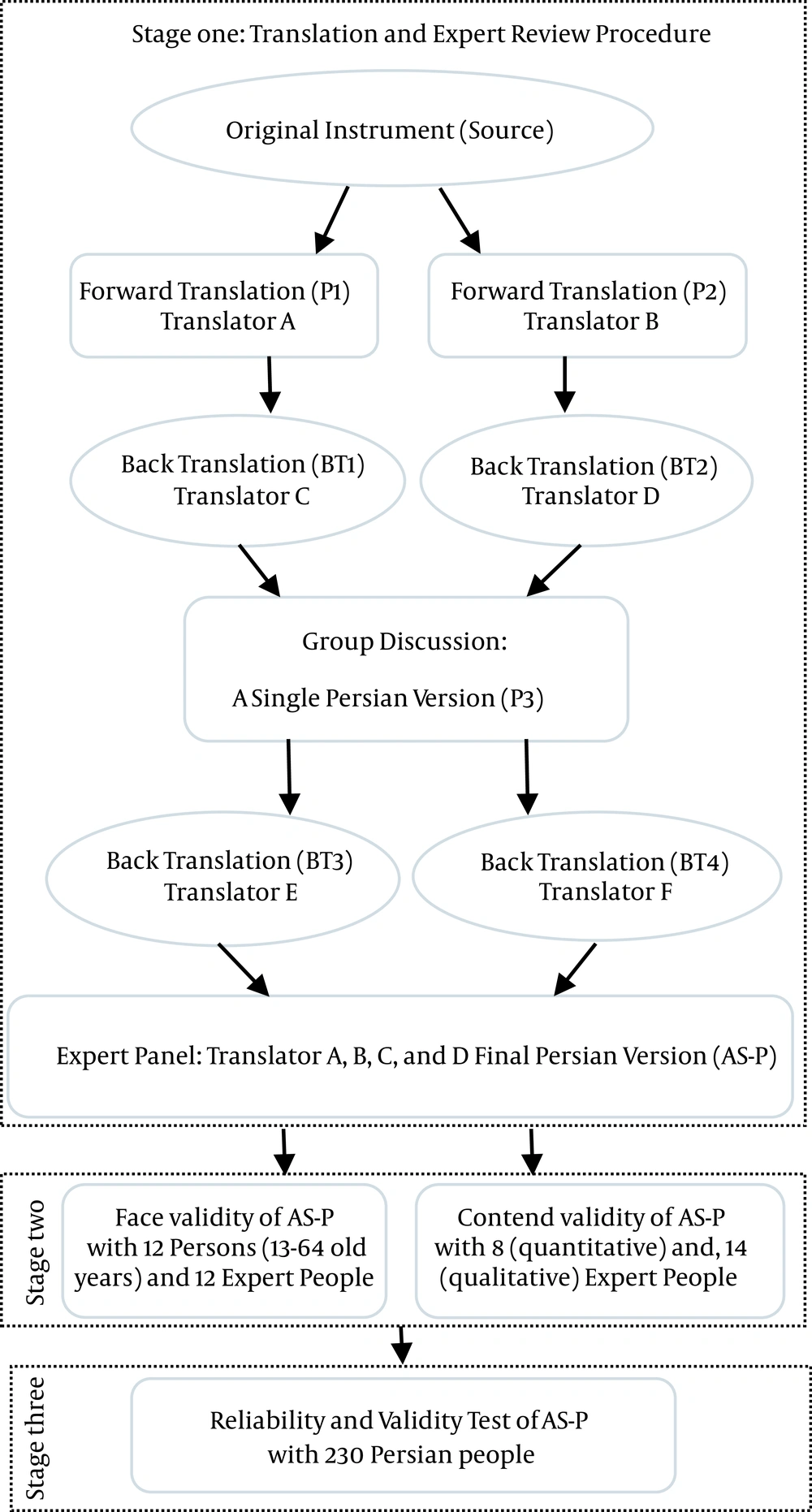
Figure 1.
Translation procedures, equivalence, and reliability and validity testing for each
3.2. Measure
Ageism Scale: Vefikuluçay Yilmaz and Terzioğlu developed the original version of the ageism scale. This scale comprises 23 items to measure three dimensions, including negative attitude towards aging (score range: 23 - 53), neutral attitude towards aging (score range: 54 - 84), and positive attitude towards aging (score range: 85 - 115). The items are scored on a 5-point Likert scale, with response options ranging from "completely agree" (scored as 5) to "completely disagree" (scored as 1). The Cronbach’s alpha coefficients for the positive, restricting, and negative attitudes sub-scales were 0.70, 0.70, and 0.67, respectively (11).
Demographic information: This checklist comprises information about various demographic factors, such as age, gender, ethnicity, religion, marital status, level of education, occupation, monthly income, and the presence of an older adult.
3.3. Participants, Procedures, and Translation
In this study, we followed the international quality of life assessment (IQOLA) principles (18) to translate the Ageism Scale from English to Persian. First, two translators performed a forward translation, and any discrepancies were resolved in a meeting. The unified translated version was then back-translated by two bilingual authors, and the backward translations were compared to the original English version. Two geriatricians reviewed the final Persian-translated version of the questionnaire and provided feedback to enhance its clarity (Figure 1, stage one).
Both qualitative and quantitative approaches were used to determine face validity. A total of 12 individuals from the target population and eight experts in relevant fields were invited to participate. Necessary modifications were made based on their feedback. The language and style of the text were revised by a professional scientific editor to enhance scientific rigor (Figure 1, stage two).
Two indicators, the content validity ratio (CVR) and the content validity index (CVI), were used for the quantitative content validity assessment. The CVR was used to assess the necessity of an item, and the CVI was used to assess the relevance of each item. A total of 14 social work, social welfare, sociology, and geriatrics experts were recruited to evaluate each item based on a three-part score ((1) not necessary; (2) useful but not necessary; (3) necessary). The CVR was calculated to determine the importance and priority of each item. This process ensured that the most essential and appropriate content was included in the questionnaire.
The language and style of the text were revised by a professional scientific editor with expertise in the relevant field to enhance the scientific rigor of the study (Figure 1, stage two).
The exploratory factor analysis (EFA) and confirmatory factor analysis (CFA) were conducted on a sample of 230 participants to assess the structural validity of the Persian version of the Ageism Scale. The participants were selected based on inclusion criteria and convenient sampling. The KMO measure and Bartlett’s test of sphericity were used for the EFA. The KMO measure shows the adequacy of the sample size for the analysis, with a range of zero to one, and a value of at least 0.5 is considered significant (19). Bartlett’s test was used to ensure the data suitability and a significance level of 0.05 was considered significant. A sample of 230 participants was also selected for the CFA based on inclusion criteria and convenient sampling. Multivariate techniques were used to examine the relationships between variables. Several indicators, including the squared multiple correlations (SMC), the squared SMC divided by degrees of freedom, the root-mean-square error of approximation (RMSEA), the goodness of fit (GIF) index, the normed fit (NFI) index, and the comparative fit index (CFI), which are commonly used in CFA were used to evaluate the model fit (10, 19). An exploratory factor analysis was conducted on 230 participants in the sample. The KMO measure was used to ensure the adequacy of the sample size, and Bartlett’s test of sphericity was used to confirm the suitability of the data. A sample of 230 participants was also included for the confirmatory factor analysis, and multivariate techniques were used to assess the relationships between variables. Several fit indicators were used to evaluate the model fit, including the SMC, squared SMC divided by degrees of freedom, RMSEA, GIF, NFI, and CFI. The adequacy of the sample size was confirmed by the KMO measure, which ranges from zero to one, with a value of at least 0.5 considered significant. Bartlett’s test was used to ensure the suitability of the data, and a significance level of 0.05 was considered significant. The fit indicators were used to examine the fit in the confirmatory factor analysis (10, 19) (Figure 1, stage three).
A test-retest method and intra-cluster correlation coefficient (ICC) were used on 40 participants who were asked to respond to the Persian version of the Ageism Scale at two different time points with a two-week interval to determine the reliability. The ICC test was considered the most acceptable for establishing the instrument’s stability. The internal consistency of the questionnaire was calculated using Cronbach’s alpha coefficient for the entire questionnaire and each item separately (10). Then, the reliability of the structure was calculated by examining the variance ratio of observed variables to latent variables in the confirmatory factor analysis. The stability of the factors, or the reliability of the structure, is an alternative to Cronbach’s alpha coefficient in the structural equation modeling analysis. This study considered the stability of over 0.7 acceptable (19). This study used SPSS version 23 (Armonk, NY: IBM Corp) and AMOS version 5 for data analysis. This study is part of a research project on ageism in Iran, which was approved by the Medical Ethics Committee of the Mashhad University of Medical Sciences under the code IR.MUMS.REC.1399.631.
This study followed the IQOLA principles (20) to translate the Ageism Scale from English to Persian. First, two expert translators performed a forward translation, and any discrepancies were resolved in a meeting. The unified translated version was then back-translated by two bilingual authors. The backward translations were compared to the original English version. Two geriatricians reviewed the final Persian-translated version of the questionnaire and provided feedback to enhance its clarity (Figure 1, stage one).
Both qualitative and quantitative approaches were used to determine face validity. A total of 12 individuals from the target population and eight experts in relevant fields were invited. Necessary modifications were made based on their feedback. A professional, scientific editor revised the language and style of the text to enhance scientific rigor (Figure 1, stage two).
The CVR and CVI were used to examine content validity. A total of 14 experts assessed each item based on a three-part score, and the CVR and CVI were calculated to determine the importance and relevance of each item. Exploratory and confirmatory factor analyses were conducted to assess structural validity, with several fit indicators to evaluate the model fit. The reliability was determined using a test-retest method and intra-cluster correlation coefficient, with Cronbach’s alpha coefficient used to calculate internal consistency. The Medical Ethics Committee of the Mashhad University of Medical Sciences approved the study, and the data were analyzed using SPSS version 23 and AMOS version 5 (Figure 1, stage three). This study is part of a research project on ageism in Iran.
4. Results
The mean and standard deviation of the 230 participants in the study was 36.30 ± 11.78, of whom 147 were female and 83 were male (Table 1).
Table 1.
Demographic Information of the Participants
| Variables | No. (%) |
|---|---|
| Age group | |
| 13 - 18 | 14 (6.1) |
| 19 - 29 | 54 (23.5) |
| 30 - 49 | 128 (55.7) |
| 50 - 64 | 34 (14.8) |
| Gender | |
| Female | 148 (64.3) |
| Male | 82 (35.7) |
| Marital status | |
| Single | 60 (26.1) |
| Married | 163 (70.9) |
| Separated | 6 (2.6) |
| Widow/widower | 1 (0.4) |
| Religion | |
| Islam | 226 (98.9) |
| Other | 4 (1.7) |
| Ethnicity | |
| Persian | 110 (47.8) |
| Azari | 30 (8.7) |
| Kurd | 29 (12.6) |
| Lor | 31 (13.5) |
| Lak | 2 (0.9) |
| Balooch | 2 (0.9) |
| Arab | 1 (0.4) |
| Gilak | 10 (4.3) |
| Sistani | 1 (0.4) |
| Bakhtiari | 3 (1.3) |
| Taleshi | 1 (0.4) |
| Ghasghaie | 2 (0.9) |
| Other | 18 (7.8) |
| Education | |
| Under diploma | 23 (10) |
| Diploma | 45 (19.6) |
| Student | 11 (4.8) |
| Associate | 14 (6.1) |
| Bachelor | 86 (37.4) |
| Master | 40 (17.4) |
| Doctorate and upper | 11 (4.8) |
| Job | |
| School student | 12 (5.2) |
| University student | 15 (6.5) |
| Employer | 22 (9.6) |
| Employed in the public sector | 90 (39.1) |
| Employed in the private sector | 24 (10.4) |
| Worker | 2 (0.9) |
| Retirement | 11 (4.8) |
| Workless | 13 (5.7) |
| Housekeeper | 41 (17.8) |
| Monthly income | |
| No income | 71 (30.9) |
| Under 1 mililons Toman | 29 (12.6) |
| Between 1 - 2.9 million Toman | 43 (18.7) |
| Between 3 - 5 million Toman | 69 (30.0) |
| Upper of 5 million Toman | 18 (7.8) |
| The presence of an older adult in the family | |
| Yes | 167 (72.6) |
| No | 54 (23.5) |
| Died | 9 (3.9) |
The translation of the scale into the Persian language in the translation and cultural adaptation phase received a high score, and there was no need for cultural adaptation of the items because the original scale was designed in Turkey, and the culture of Turkey is very similar to that of Iran.
In quantitative face validity, the effect scores of all items were equal to or higher than 1.5, and no items were excluded. Qualitative content validity was determined by consulting experts in gerontology, social work, social welfare, and sociology regarding clarity, simplicity, and grammar corrections. Quantitative content validity of the scale was obtained using the CVR for the scale (CVR = 0.72). The content validity index of the scale was brought based on the Waltz and Basel (21) and CVI = 0.64. In general, all the items of the tool were accepted, and none of the items were removed (Table 2).
Table 2.
Psychometric Characteristics of the Ageism Scale
| Subscale | No | Items | Number of Respondents | Frequency | Suitability | II-Score | Result | n-Essential | N/2 | CVR | CVI | Pc | K* | Evaluation |
|---|---|---|---|---|---|---|---|---|---|---|---|---|---|---|
| Restricting the life of elderly | 1 | The face of the elderly is ugly. | 12 | 0.8 | 3.333 | 2.667 | Good | 7 | 2 | 0.75 | 0.875 | 0.031 | 0.871 | Valid |
| 2 | Care of older adults should not be considered an economic burden by family members. | 12 | 1 | 4.500 | 4.500 | Good | 7 | 2 | 0.75 | 0.875 | 0.031 | 0.871 | Valid | |
| 3 | Older adults cannot carry bags and packages without help. | 12 | 0.9 | 4.000 | 3.600 | Good | 7 | 2 | 0.75 | 1 | 0.004 | 1.000 | Valid | |
| 4 | It is unnecessary for older adults to buy homes, cars, possessions, or clothes. | 12 | 0.7 | 3.500 | 2.450 | Good | 6 | 2 | 0.5 | 0.875 | 0.031 | 0.871 | Valid | |
| 5 | Older adults should live in nursing homes or residential care. | 12 | 0.6 | 3.000 | 1.800 | Good | 7 | 2 | 0.75 | 1 | 0.004 | 1.000 | Valid | |
| 6 | Older adults should not be present in the streets, shopping centers, and entertainment centers, and their life should be limited to their homes. | 12 | 0.6 | 3.083 | 1.850 | Good | 8 | 2 | 1 | 0.875 | 0.031 | 0.871 | Valid | |
| 7 | The elderly should work less than the young (their working hours should be less than the young). | 12 | 1.1 | 4.667 | 5.133 | Good | 6 | 2 | 0.5 | 0.875 | 0.031 | 0.871 | Valid | |
| 8 | Preference should be given to care for young people over the elderly in the hospital. | 12 | 0.6 | 2.917 | 1.750 | Good | 7 | 2 | 0.75 | 1 | 0.004 | 1.000 | Valid | |
| 9 | Older adults who lose their spouses should not remarry. | 12 | 0.7 | 3.417 | 2.392 | Good | 8 | 2 | 1 | 1 | 0.004 | 1.000 | Valid | |
| Positive ageism | 10 | Older adults are more tolerant than young people. | 12 | 0.7 | 3.833 | 2.683 | Good | 6 | 2 | 0.5 | 0.875 | 0.031 | 0.871 | Valid |
| 11 | Older adults are more compassionate. | 12 | 1.1 | 4.417 | 4.858 | Good | 6 | 2 | 0.5 | 0.875 | 0.031 | 0.871 | Valid | |
| 12 | When decisions are made in the family, the elders’ opinions should be considered. | 12 | 1.2 | 5.00 | 6.000 | Good | 8 | 2 | 1 | 1 | 0.004 | 1.000 | Valid | |
| 13 | Older adults should be shown importance by the family members with whom they live. | 12 | 1.2 | 4.917 | 5.900 | Good | 7 | 2 | 0.75 | 0.875 | 0.031 | 0.871 | Valid | |
| 14 | Older adults are more patient than young people. | 12 | 1.1 | 4.667 | 5.133 | Good | 7 | 2 | 0.75 | 1 | 0.004 | 1.000 | Valid | |
| 15 | Young people should learn from the experiences of older adults. | 12 | 1.2 | 4.833 | 5.800 | Good | 7 | 2 | 0.75 | 1 | 0.004 | 1.000 | Valid | |
| 16 | When the family budget is being developed, the opinions of older adults should be sought. | 12 | 1.2 | 4.750 | 5.700 | Good | 7 | 2 | 0.75 | 0.875 | 0.031 | 0.871 | Valid | |
| 17 | Preference should be given to the elderly in places where waiting in line is required. | 12 | 1.1 | 4.853 | 5.042 | Good | 7 | 2 | 0.75 | 0.875 | 0.031 | 0.871 | Valid | |
| Negative ageism | 18 | Preference should be given to young people for promotion sin work situations. | 12 | 0.9 | 4.333 | 3.900 | Good | 6 | 2 | 0.5 | 0.875 | 0.031 | 0.871 | Valid |
| 19 | Preference should be given to young people over the elderly for job hiring. | 12 | 1.1 | 4.500 | 4.650 | Good | 6 | 2 | 0.5 | 0.875 | 0.031 | 0.871 | Valid | |
| 20 | Older adults are not able to adapt to changes like young people. | 12 | 0.8 | 3.667 | 2.933 | Good | 7 | 2 | 0.75 | 1 | 0.004 | 1.000 | Valid | |
| 21 | Older adults are always ill. | 12 | 0.7 | 3.417 | 2.392 | Good | 7 | 2 | 0.75 | 1 | 0.004 | 1.000 | Valid | |
| 22 | Older adults should not go outside on their own. | 12 | 0.8 | 3.833 | 3.067 | Good | 7 | 2 | 0.75 | 1 | 0.004 | 1.000 | Valid | |
| 23 | The basic responsibility of the elderly should be to help their children with tasks such as housework and kitchen chores and care for their grandchildren. | 12 | 0.6 | 3.167 | 1.900 | Good | 8 | 2 | 1 | 1 | 0.004 | 1.000 | Valid |
Abbreviations: CVR, content validity ratio; CVI, content validity index.
Exploratory factor analysis was used to examine construct validity and extracted latent factors. The results of the KMO test about the adequacy of the sample size were 0.835, which was at an acceptable level, and the result of Bartlett’s test of sphericity was significant (df = 253, P < 0.001). In exploratory factor analysis, four factors, including "dignity of an elder in the family,” "restricting of the elder,” "social presence," and "characteristics of elder," were extracted using the maximum likelihood method and promax rotation and pebble chart. These three factors’ specific values were 4.28, 2.10, 1.84, and 1.55, respectively. These four factors explained 34.87% of the total variance of the ageism variables. The Turkish version of the scale included three factors, which were changed to four in the present study (Table 3).
Table 3.
Factors of the Persian Version of Ageism
| Factors | Items | Factor Loading | Percentage of Variance |
|---|---|---|---|
| The dignity of older adults in the family | Young people should learn from the experiences of older adults. | 0.608 | 14.93 |
| When decisions are made in the family, the elders’ opinions should be considered. | 0.534 | ||
| When the family budget is being developed, the opinions of older adults should be sought. | 0.402 | ||
| Care of older adults should not be considered an economic burden by family members. | 0.399 | ||
| Older adults should be shown importance by the family members with whom they live. | 0.395 | ||
| Restricting the older adults | Older adults cannot carry bags and packages without help. | 0.377 | 6.10 |
| Older adults are always ill. | 0.446 | ||
| Older adults cannot buy homes, cars, Possessions, or clothes. | 0.608 | ||
| Older adults who lose their spouses should not remarry. | 0.502 | ||
| The lives of the elderly should be limited to their homes. | 0.466 | ||
| The elderly should live in homes for older adults. | 0.475 | ||
| Social presence | Preference should be given to young people over the elderly for job hiring. | 0.773 | 5.78 |
| Preference should be given to care for young people over the elderly in the hospital. | 0.391 | ||
| Preference should be given to the elderly in places where waiting in line is required. | 0.583 | ||
| Preference should be given to young people for promotion sin work situations. | 0.373 | ||
| The basic responsibility of the elderly should help their children with tasks such as housework and kitchen. | 0.395 | ||
| Older adults should be paid less than young people in their work lives. | 0.344 | ||
| Characteristics of the older adults | Older adults are more tolerant than young people. | 0.753 | 3.76 |
| Older adults are more patient than young people. | 0.719 | ||
| Older adults are more compassionate. | 0.371 | ||
| The external appearance of the elderly is repulsive. | 0.302 | ||
| Older adults are not able to adapt to changes like young people. | 0.331 | ||
| Older adults are always ill. | 0.367 |
None of the items were removed in the exploratory factor analysis, and four subscales were obtained (Table 2). The confirmatory factor analysis results also had an average estimate based on the general indicators of the model’s fit (Table 4).
Table 4.
Fit Indicators in Confirmatory Factor Analysis Model of Ageism Scale
| Measures | Values |
|---|---|
| χ2 | 7163.3 |
| df | 230 |
| P-value | 0.000 |
| χ2/ df | 31.145 |
| RMSEA | 0.081 |
| GFI | 0.850 |
| NFI | 0.602 |
| CFI | 0.610 |
Abbreviations: RMSEA, root mean square error of approximation; GFI, goodness of fit; NFI, normed fit index; CFI, comparative fit index.
As shown in Figure 2, the assessed indicators exhibited the most significant variability across four factors, and the decreasing trend at this point became nearly smooth.
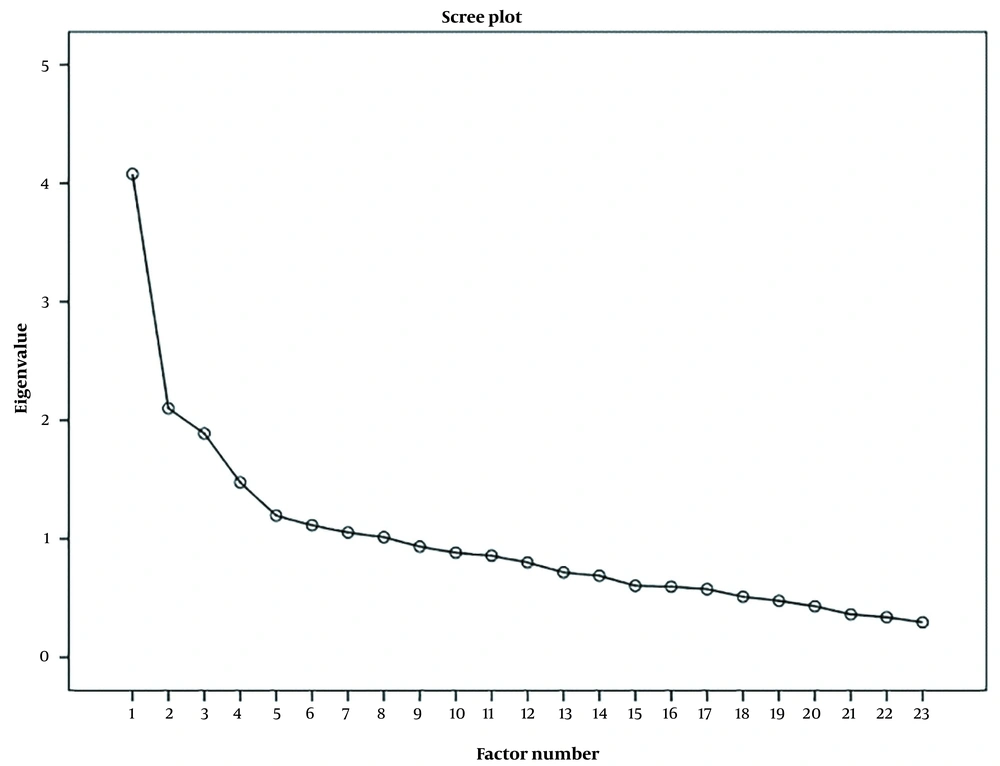
Figure 2.
Pebble chart
According to the final factor structure model of ageism, the variables highly correlated with their relevant factors (Figure 3).
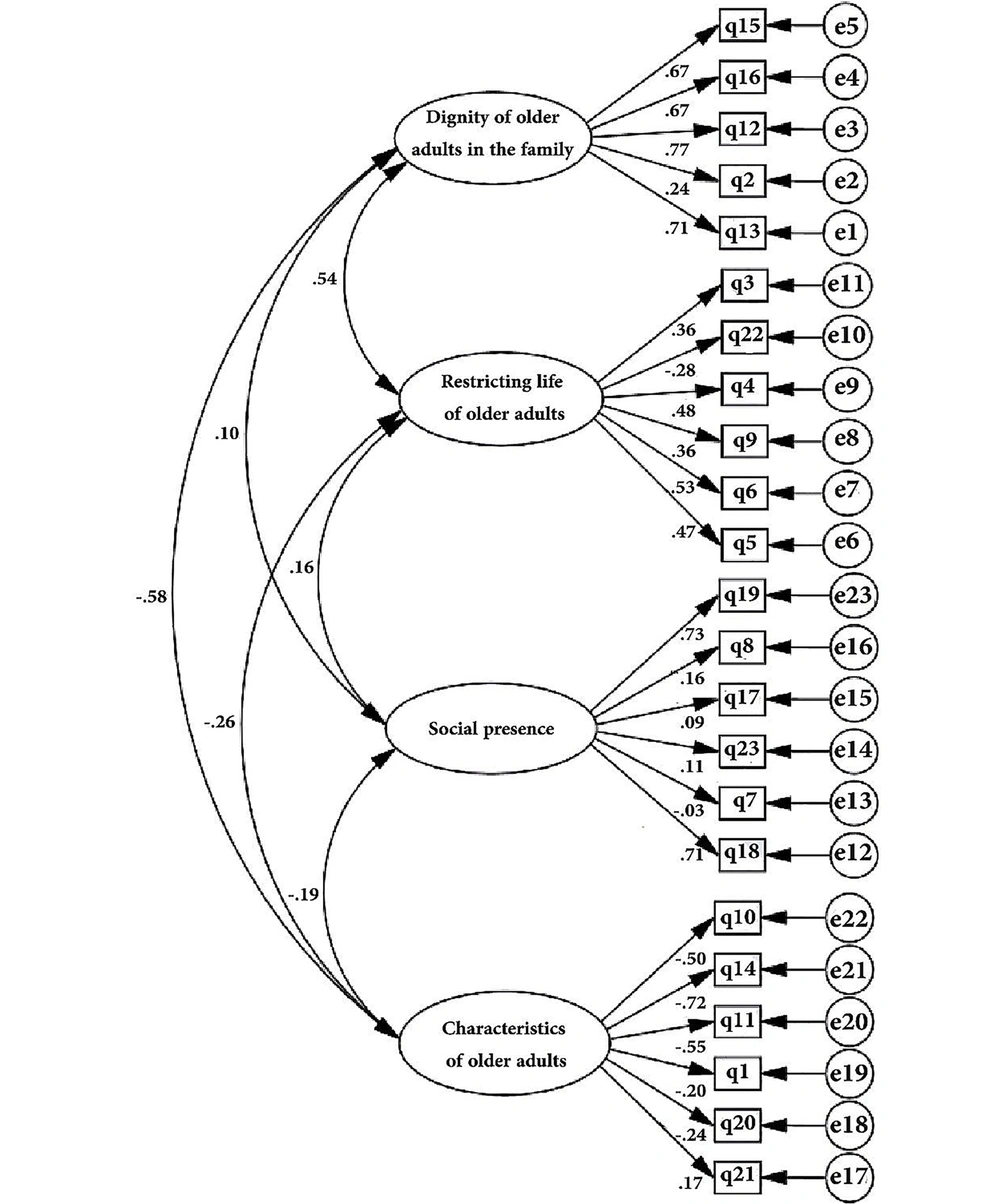
Figure 3.
The final structure model of the ageism scale
The retest results showed that the intra-cluster correlation coefficient of the subscales varies from 0.69 to 0.97 (Table 4). The test-retest results of the ageism scale indicated that the intra-class correlation of the components of this scale is optimal with a confidence interval of 95%. Cronbach’s alpha of the subscales was obtained from 0.709 to 0.786, which is acceptable (Table 5).
Table 5.
Reliability of the Ageism Scale
| Dimensions | Number of Items | Cornbrash’s Alpha | Test-Retest Correlation Coefficients | Intra-class Correlation Coefficient | P Value | ||
|---|---|---|---|---|---|---|---|
| Pearson Correlation | P-Value | Intracluster Correlation | 95% Confidence Interval | ||||
| The dignity of older adults in the family | 5 | 0.740 | 0.694 | 0.000 | 0.971 | 0.965 - 0.975 | < 0.001 |
| Restricting the older adults | 6 | 0.712 | 0.654 | 0.000 | 0.691 | 0.008 - 0.877 | < 0.001 |
| Social presence | 6 | 0.709 | 0.703 | 0.000 | 0.734 | 0.055 - 0.905 | < 0.001 |
| Characteristics of the older adults | 6 | 0.786 | 0.810 | 0.000 | 0.758 | 0.546 - 0.871 | < 0.001 |
| Total | 23 | 0.720 | 0.947 | 0.000 | 0.967 | 0.938 - 0.983 | < 0.001 |
5. Discussion
This study aimed to translate the Persian version of Vefikuluçay Yilmaz and Terzioglu’s ageism scale and assess its psychometric properties based on 23 items in three dimensions (11). However, the Persian scale version had 23 items in four subscales after translation and validation. The results indicated that the Persian version of the ageism scale has good validity and moderate reliability. The obtained Cronbach’s alphas for the subscales ranged from 0.709 to 0.786, which is acceptable and suggests good internal consistency and correlation between the questions. In Vefikuluçay Yilmaz and Terzioglu’s study, Cronbach’s alphas ranged from 0.67 to 0.70 (20).
The original Vefikuluçay Yilmaz and Terzioglu scale has three subscales that assess limitations in older adults’ lives with positive and negative age discrimination. The Persian version of the scale identified four factors through exploratory factor analysis. These factors were identified as the dignity of the older adults in the family, restriction of the older adults, social presence, and characteristics of old age. The first factor, "dignity of the older adults in the family," reflected the position of the older adults in family decision-making, the importance of their experiences, and the level of respect they receive within the family. This dimension is more closely related to age discrimination’s cultural and social aspects, similar to Marchetti et al.’s definition of ageism (22).
The second factor, “restriction on older adults," referred to the beliefs that interactions with older adults should be limited. This belief can lead to misunderstandings about the capabilities of older adults and reinforce stereotypes about their physical and mental limitations. The restriction factor is related to people’s beliefs about older adults, whether those beliefs are accurate or not (11).
The third factor, "social presence," expressed medium-range discrimination within social networks and was consistent with previous studies by Nelson (23), Iversen et al. (24), which highlighted other-directed age discrimination (23-25). This factor also aligns with the positive and negative subscales identified in Vefikuluçay Yilmaz and Terzioglu’s study (13), as well as with findings from Pekince et al. (26), Ayalon and Tesch-Römer (27), Sao Jose et al. (28), and Iversen et al. (24), which emphasized the benevolent behavior of others towards older adults (26-29). The fourth factor, "characteristics of the older adults,” refers to certain features such as illness caregiving, patience, and difficulty adapting to new situations. This factor aligns with the positive and negative subscales identified in Vefikuluçay Yilmaz and Terzioglu’s study (11).
In this study, the model fit was evaluated as moderate, and all factor loadings were above 0.30, which showed the minimum acceptable level of factor loading. The confirmatory factor analysis also provided a relatively good estimate based on the general indicators of the model fit. This is the first translation into another language, so comparing the results with those of other studies is impossible.
5.1. Conclusions
The Persian version of Vefikuluçay Yilmaz and Terzioglu’s ageism scale demonstrated acceptable validity and reliability within the Iranian population and held scientific values for assessing people’s attitudes to the aging process. The items are not overly complex, and the small number of items encourages individuals to complete the questionnaire. As people’s attitudes significantly influence behaviors, this scale can serve as a valuable tool for understanding and addressing ageism within society.
The Vefikuluçay Yilmaz and Terzioglu ageism scale can provide valuable information for policymakers in elderly care. Policymakers can utilize this questionnaire to assess people's attitudes toward aging and develop appropriate strategies to reduce societal ageism. Additionally, this questionnaire can be used to formulate family-oriented policies for elderly care and facilitate improvements in the quality of care for this population group.