
1. Context
Toxoplasma gondii remains a global concern, especially in developing countries. It is a zoonotic disease between humans and animals (1). The definitive host (feline) causes environmental pollution by releasing oocysts. High-risk groups, including pregnant women and immunocompromised people. Humans are infected with this parasite through the consumption of half-cooked meat, unpasteurized milk, direct or indirect contact with environmental oocysts, vertical transmission during pregnancy, blood transfusion, and organ transplantation (2).
The global prevalence of T. gondii varies (1% - 100%) (3, 4) under the influence of climatic conditions, host susceptibility and soil humidity, health conditions, eating habits, and general awareness level. The prevalence of contamination in the Middle East is approximately 30% to 50% (5), 27.8 % in Saudi Arabia (1), and 58.3 % in Turkiye (6).
This parasite is very important in women of reproductive age because it can cross the placental barrier during pregnancy, this infection in the first and second trimester of pregnancy can cause consequences such as low birth weight, hydrocephalus, intracranial calcifications, and vertinochoroiditis in newborns (7). T Specifically, 15% of premature abortions and 66% of late miscarriages are attributed to infections, considering the importance of having children and the youth of the population, this issue is very important (1).
2. Objectives
Considering the important role of T. gondii infection in neonatal complications as well as miscarriage (8), the present study was conducted to determine the serum prevalence of acute and chronic T. gondii infection in women of reproductive age in Iran.
3. Methods
This study, a systematic review and meta-analysis across Iran, was designed and implemented to evaluate the prevalence of serum antibiotics in women of reproductive age. This meta-analysis study was conducted according to the guidelines and protocol of meta-analysis (PRISMA) (9), and its protocol was registered in PROSPERO.
3.1. Search Strategy
The systematic search process was carried out from January 2010 to July 2024 through four English databases (PubMed, Scopus, Web of Science, and Science Direct) and two Persian databases (Magiran and SID) as well as Google Scholar as a specialized search engine for the article. using the following keywords: ("Toxoplasma" OR "Toxoplasma gondii" OR "T. gondii" OR "toxoplasmosis") and ("prevalence" OR "seroprevalence" OR "epidemiology") and ("Reproductive age " OR " Women " OR "Students" OR, childbearing Age " "or "Newly Married") and ("Iran" or "Islamic Republic of Iran").
3.2. Eligibility Criteria, Study Selection, and Data Extraction
After collecting the documents and articles, their specifications and abstracts were entered into the reference writing software, and duplicates were removed by using this software as well as re-reading the titles. In the next step, by reviewing the titles and abstracts, studies unrelated to the purpose of this research were excluded, and then from among the remaining studies, referring to the full text of the article, it was ensured that it was related to the purpose of the present study, and irrelevant items were removed. the reference list of specified studies was examined to find more related studies. In addition, to access the articles whose full text was not available through the databases, contact was made with the corresponding authors via e-mail to receive the full text of the articles. Inclusion criteria include: (1) Studies published in English or Farsi from January 2010 to July 2024; (2) all primary studies (cross-sectional-analytical and case-control) on the prevalence of T. gondii in women; (3) original articles with a full bibliography English and Farsi languages; (4) studies whose information (sample size and number of positive cases; (5) studies conducted only on humans.
3.3. Meta-Analysis
Meta-analysis analysis was performed using random effects model (10). The random effects model was used to estimate the prevalence and 95% confidence intervals. The weight of each study was calculated and the heterogeneity of studies was checked using Cochran's test (with a significance level less than 0.1) and its combination using the I2 statistic (with a significance level greater than 50%) (11). Egger and Begg's test was also used to evaluate the publication bias (12).
3.4. Quality Assessment
Study quality was assessed using the Newcastle-Ottawa scale (13).
4. Results
As shown in Figure 1, we identified 869 retrieved records in the database search, and after removing duplicates and irrelevant items, 28 studies were finally included in the meta-analysis (Figure 1). Table 1 shows the characteristics of the studies reported in the systematic review and meta-analysis.
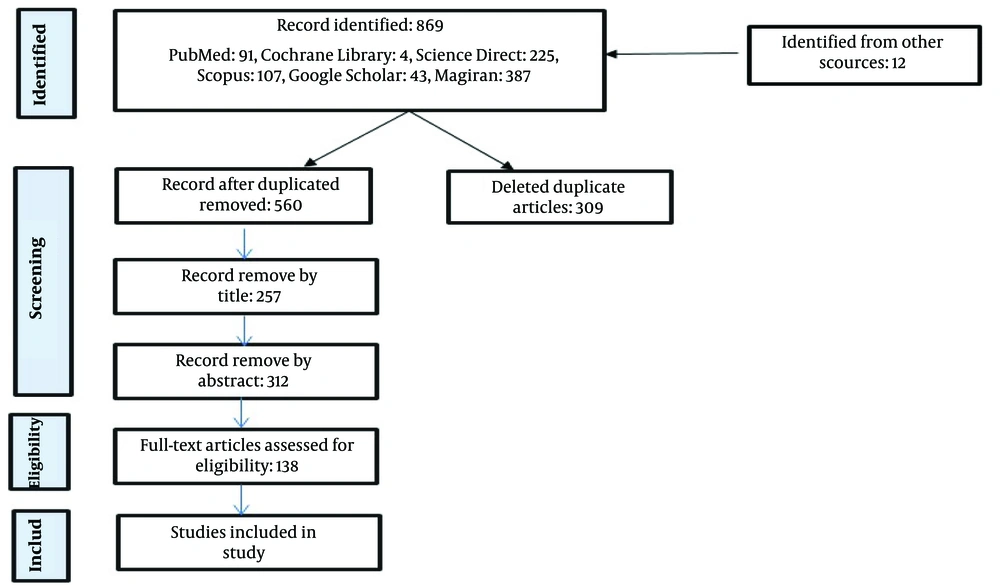
Figure 1.
PRISMA graph of data retrieved from various databases based on inclusion and exclusion criteria
Table 1.
Characteristics of the Selected Studies
| Study | Year | Place of Study | Group | Method | Type of Study | N | Positive IgG | Positive IgM |
|---|---|---|---|---|---|---|---|---|
| Salehi et al. (14) | 2022 | Mashhad | Reproductive age | ELISA | Cross-sectional | 417 | 80 | 8 |
| Zeinali et al. (15) | 2023 | Northwest of Iran | Aborted | ELISA | Cross-sectional | 215 | 70 | 3 |
| Elyasi and Souizi (16) | 2023 | Razavi Khorasan | Newly married | ELISA | Cross-sectional | 85 | 16 | - |
| Nabizadeh et al. (17) | 2022 | Tabriz | Reproductive age | ELISA | Cross-sectional | 2726 | 722 | 10 |
| Saki et al. (18) | 2021 | Khuzestan | Aborted | ELISA | Cross-sectional | 480 | 123 | 24 |
| Rahimi‑Esboei et al. (19) | 2021 | Mazandaran | Reproductive age | ELISA | Cross-sectional | 500 | 133 | 21 |
| Kalantari et al. (20) | 2020 | Fars | Students | ELISA | Cross-sectional | 504 | 58 | 5 |
| Naeini et al. (21) | 2019 | Chaharmahal and Bakhtiari | - | ELISA | Cross-sectional | 20 | 13 | 1 |
| Soltani et al. (22) | 2018 | Southwest of Iran | - | ELISA | Cross-sectional | 253 | 139 | 18 |
| Matin et al. (23) | 2017 | Ardabil | Aborted | ELISA | Cross-sectional | 200 | 107 | 10 |
| Sharif et al. (24) | 2016 | Mazandaran | ELISA | Cross-sectional | 1178 | 662 | ||
| Tavakoli Kareshk et al. (25) | 2016 | Kerman | Childbearing age | ELISA | Cross-sectional | 300 | 38 | 6 |
| Mojadadi et al. (26) | 2016 | Sabzevar | Students | ELISA | Cross-sectional | 137 | 18 | 0 |
| Kamran et al. (27) | 2015 | Ilam | High school girls | ELISA | Cross-sectional | 260 | 55 | |
| Saki et al. (28) | 2015 | Ahvaz | Aborted | ELISA | Cross-sectional | 130 | 34 | 1 |
| Hooshyar et al. (29) | 2015 | Kashan | - | ELISA | Cross-sectional | 434 | 123 | 7 |
| Davami et al. (30) | 2014 | Jahrom | Newly married | ELISA | Cross-sectional | 403 | 52 | 8 |
| Fallah et al. (31) | 2014 | Ajabshir | High school | ELISA | Cross-sectional | 402 | 88 | 66 |
| Rajaii et al. (32) | 2013 | Northwest Iran | childbearing women | ELISA | Cross-sectional | 1659 | 898 | - |
| Davami et al. (30) | 2013 | Jahrom | Young women | ELISA | Cross-sectional | 403 | 52 | 13 |
| Maraghi et al. (33) | 2013 | Abadan | Students | ELISA | Cross-sectional | 240 | 28 | 29 |
| Mostafavi et al. (34) | 2012 | Isfahan | Childbearing age | ELISA | Cross-sectional | 217 | 103 | - |
| Heidari et al. (35) | 2011 | Gonabad | High school | ELISA | Cross-sectional | 240 | 34 | 0 |
| Mostafavi et al. (36) | 2011 | Isfahan | - | ELISA | Cross-sectional | 300 | 109 | - |
| Khazaei et al. (37) | 2011 | Zahedan | Before marriage | ELISA | Cross-sectional | 280 | - | 15 |
| Hashemi and Saraei (38) | 2010 | Qazvin | Before marriage | ELISA | Cross-sectional | 400 | 136 | - |
| Fouladvand et al. (39) | 2010 | Bushehr | High school | ELISA | Cross-sectional | 491 | 114 | 7 |
| Fouladvand (40) | 2010 | Bushehr | Before marriage | ELISA | Cross-sectional | 303 | 71 | 10 |
The results of the study showed that the prevalence of IgG and IgM antibody serum in women is 0.29 (95% CI: 0.23 - 0.34) (Figure 2A) and 0.04 (95% CI: 0.03 - 0.05) respectively (Figure 2B). Egger's test results (P = 0.001) showed publication bias. A funnel plot for detecting publication bias is shown in Figure 3.
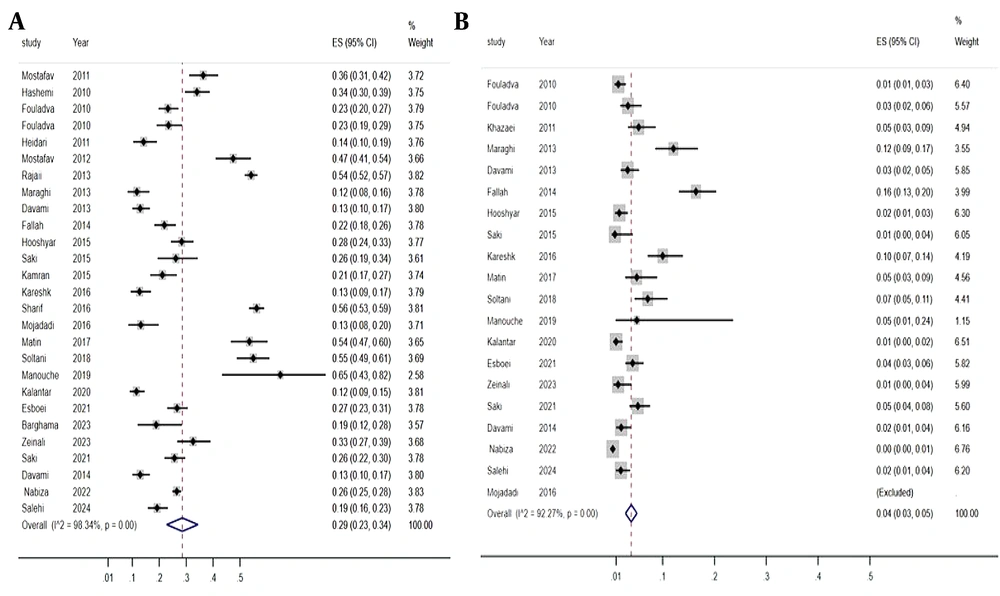
Figure 2.
Forest plot of meta-analysis showing Toxoplasma gondii seroprevalence in women of reproductive age A, IgG; B, IgM.
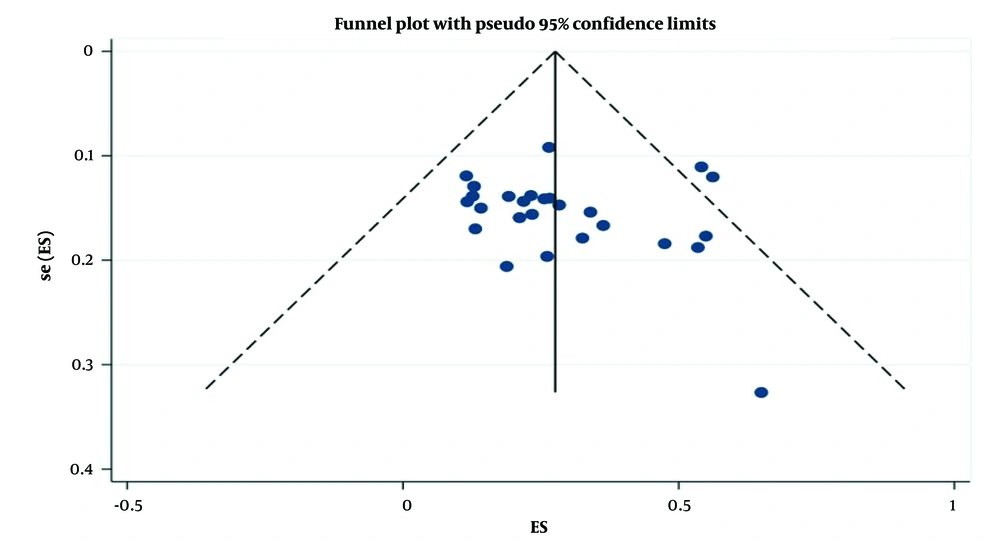
Figure 3.
Funnel plot to detect publication bias
5. Discussion
One of the important challenges of T. gondii infection is fetal and neonatal complications, and there is a need for strategies to reduce this infection in women of reproductive age (41). Therefore, it is very important to investigate the contamination of women of reproductive age. Therefore, this current systematic review and meta-analysis was conducted to estimate the prevalence of T. gondii infection in women of reproductive age in Iran.
The present meta-analysis was performed using 28 published serological studies, with a sample size of 13,177 people. In this study, the serum prevalence of IgG T. gondii in reproductive age women is 29% (95% CI = 23% - 34%), which is consistent with the meta-analysis study conducted in Saudi Arabia 27.8% (95% CI = 20.6% - 36.3%) (1). But compared to other countries around Iran, Iraq 52.6% (1), Turkey 58.3% (6), and a study conducted in Iran by Mizani 43% between 1994 - 2017 (42), it is lower this could be due to increased awareness and preventive measures against this parasite.
The seroprevalence of IgM in this study was 4% (95% CI = 3% - 5%), which is higher than the meta-analysis study conducted in Turkey (1%) (6), blood donors in Iran (1.4%) (43). IgM indicates the acute form of T. gondii infection (instantaneous prevalence) in a way that it increases in the first week after exposure and then decreases (44) while IgG indicates a chronic infection (lifelong prevalence). What is important for preventing the problems and complications of T. gondii is the prevalence of the acute form of the disease. Governments should seek to reduce its prevalence in women of childbearing age (45).
5.1. Strengths and Weaknesses
This study is the first meta-analysis that investigates the prevalence of acute and chronic T. gondii infection in women of reproductive age in Iran.
The most important limitations of this study: In this meta-analysis, the prevalence of T. gondii seroprevalence was only done in 18 provinces, and there were few studies in other provinces. Also, gray literature was not examined in this meta-analysis, the non-reporting of risk factors in many studies that did not allow meta-analysis of risk factors and the fact that in this study we only examined women of reproductive age and pregnant women were excluded from the study.
5.2. Suggestions
It is recommended that a comprehensive systematic review meta-analysis study be conducted in the entire Iranian general population to obtain a comprehensive estimate of the overall prevalence in the general population and to compare the prevalence rates in different population subgroups.
5.3. Conclusions
The results of this study showed that the prevalence of chronic (IgG) and acute infection (IgM) T. gondii in women of reproductive age in Iran is relatively high. However, considering the young population in Iran and the increased chance of fetal loss in pregnant women with the acute form of this infection, there is an urgent need for education about the complications of this infection, the ways of transmission and its prevention to increase women's awareness.