


1. Background
Fluoxetine is an antidepressant in the selective serotonin reuptake inhibitor class, generally used to treat depression and anxiety disorders (1). Research has demonstrated its toxic effects on the differentiation of embryonic stem cells (2). Moreover, fluoxetine (FLX) is known to traverse the human placental barrier (3) and is excreted in breast milk (4), inhibiting the activity of multidrug transporters like milk phosphoglycoprotein (5). Studies have also suggested that FLX increases cell proliferation and cancer risk (6). Chronic administration of FLX in male rats has been found to inhibit sexual behavior, leading to long-term delayed ejaculation (7).
Grape seed extract (GSE), is a natural extract of Vitis vinifera seeds, exhibits antioxidant activity and the ability to inhibit free radicals. The GSE contains a potent group of plant flavonoids, proanthocyanidin oligomers, known for their strong antioxidant properties and various health benefits (8).
2. Objectives
Recent research has highlighted GSE's role in inhibiting oxidative damage by modulating the expression of antioxidant enzyme systems (9). The GSE has also shown promise in ameliorating hepatic ischemia-reperfusion injury and reducing infarct size in cardiac ischemia in mice (10). Its extract contributes to improving oxidative stress both in vitro and in vivo (11). Previous studies have revealed that GSE protects liver damage caused by cisplatin in rabbits (12). This study aimed to evaluate the protective effects of GSE on in vitro fertilization and embryo development in adult mice treated with FLX.
3. Methods
3.1. Preparation of Grape Seed Extract
The grapes were sourced from the areas surrounding Urmia, a city in northwestern Iran. Following the collection, the grapes were washed, dried, and ground, and the nuclei were isolated. To the resulting 75 grams of grape powder, 200 mL of 70% ethanol (consisting of 70% ethanol and 30% distilled water) was added. The mixture was centrifuged at 3000 rpm for 20 minutes, and the supernatant was filtered. The solvent was evaporated using a rotary evaporator, and the resulting dried extract was collected.
3.2. Animal Model
In this study 32 adult male Balb/c mice (6 - 8 WK) weighing 30 ± 2 g were obtained from the animal house of Uremia Veterinary Faculty. They were housed under standard conditions, including a temperature of 25 ± 2°C, and a 12 h light/12 h dark cycle. Animals had access to standard diet and water. Mice were randomly divided into 4 groups: Control (received distilled water), FLX (received 40 mg/kg B.W Fluoxetine), GSE (received 150 mg/kg B.W GSE), FLX + GSE (received 40 mg/kg B.W Fluoxetine and 150 mg/kg B.W GSE). All mice were administered orally via gavage needle. Treatment continued for 42 days.
3.3. Sperm Collection
After completing the treatment period, each mouse was anesthetized using 20 mg/kg of xylazine and 50 mg/kg of ketamine. Euthanasia was performed by cervical dislocation. Sperm were harvested from the caudal epididymis at 20x magnification using a stereo zoom microscope. The caudal epididymides were carefully removed from each mouse and finely minced in 1 mL of pre-warmed (37°C) human tubal fluid (HTF) medium. After incubating the mixture for 60 minutes at 37°C in a 5% CO2 environment, the sperm were separated from the epididymis tissue.
3.4. Aniline Blue Staining
A sperm smear was prepared, and after drying, it was fixed using a 3% glutaraldehyde solution for 30 minutes. The smears were stained with 5% aniline blue (AB) solution (dissolved in 4% acetic acid) for 5 to 8 minutes. The proportion of mature sperm (with colorless heads) and immature sperm (with blue heads) was examined under a light microscope. For each mouse, five slides were prepared, and 100 sperm per slide were counted using the light microscope.
3.5. Acridine Orange Staining
To evaluate sperm DNA integrity, smears were made from each sample on glass slides and allowed to air dry. The smears were subsequently fixed in Carnoy’s solution (75 mL methanol and 25 mL acid acetic). Once dried, the slides were immersed in a tampon solution (80 mmol/L citric acid and 15 mmol/L Na₂HPO₄, pH 2.5) and incubated at 75°C for 5 minutes.
The slides were then stained with acridine orange (AO) (0.19 mg/mL) and rinsed with water to eliminate any excess stain. The stained slides were covered with coverslips and examined with a fluorescence microscope. Sperm with normal DNA show green fluorescence and sperm with abnormal DNA show fluorescence from yellow-green to red. Five slides were prepared for each mouse, and 100 sperm per slide were counted under the fluorescence microscope.
3.6. Collection of Ovulated Oocytes and In Vitro Fertilization
Ovulation was induced in 6 - 7-week-old female mice through an intraperitoneal injection of 10 IU of Pregnant Mare Serum Gonadotropin (PMSG, Sigma G4877). In female mice aged 6 - 7 weeks, ovulation was induced by an injection of 10 IU of PMSG (Pregnant Mare Serum Gonadotropin). After 48 hours, the mice received an injection of 10 IU of human chorionic gonadotropin (HCG). About 12 - 14 hours after the HCG injection, the mice were anesthetized using xylazine and ketamine, and subsequently, euthanasia was carried out by cervical dislocation in all the animals.
The oviducts were carefully removed and the ampoule part of the oviducts was removed and placed in a plastic container containing HTF with 4 mg/mL bovine serum albumin (BSA). After dissection, the oocytes were extracted from the ampulla of the oviduct and transferred to HTF medium containing 4 mg/mL BSA. Fertilized sperm micro drops were prepared in HTF medium with 4 mg/mL BSA, and 8 - 12 oocytes were placed in each micro drop. The culture medium was incubated for 4 - 6 hours to allow fertilization. Subsequently, fertilized oocytes were transferred to fresh drops of the same medium. All drops, including the fertilized oocytes, were covered with mineral oil. Fertilization was confirmed by observing the pronuclei under an inverted microscope at 200x magnification. After fertilization, the fertilized zygotes were washed three times and transferred to fresh culture medium. They were then incubated for 5 days. The development rate of the embryos was assessed 24 hours post-fertilization under laboratory conditions and monitored daily until day 5 using a phase-contrast microscope.
3.7. Statistical Analysis
The data obtained from the study were analyzed using one-way ANOVA, followed by Bonferroni post hoc tests, with SPSS software (version 19). Results are presented as mean ± SE, and a P-value of less than 0.05 was considered statistically significant.
4. Results
4.1. DNA Damage of Sperm
In the FLX-treated group, AO staining revealed a significantly higher percentage of sperm with DNA damage compared to the control and GSE groups after 42 days(P = 0.03). In contrast, the FLX + GSE group showed a important reduction in sperm DNA damage compared to the FLX-only group (P = 0.04), (Table 1 and Figure 1).
Table 1.Average Percentage of Sperm DNA Damage, Immature Sperm, Fertilized Oocyte, Percentage of Two-Cell, Blastocysts and Hatched Embryos a
| Groups | Sperms DNA Damage (%) | Immature Sperm (%) | Zygote (%) | 2-Cell Embryos (%) | Blastocysts (%) | Hatched Embryos (%) |
|---|---|---|---|---|---|---|
| Control | 4.46 ± 0.57 | 7.50 ± 0.26 | 90.3 ± 2.9 | 89.90 ± 0.55 | 88.79 ± 0.62 | 79.50 ± 0.53 |
| GSE | 4.54 ± 0.44 | 8.00 ± 0.25 | 89.80 ± 0.8 | 90.50 ± 0.54 | 89.1 ± 0.63 | 79.90 ± 0.73 |
| FLX | 5.30 ± 0.80 b | 8.60 ± 0.22 b | 79.77 ± 0.6 b | 88.4 ± 1.49 | 86.2 ± 0.31 b | 76.30 ± 0.76 b |
| FLX + GSE | 4.50 ± 0.71 c | 7.61 ± 0.22 c | 83.78 ± 1.11 c | 89.50 ± 7.1 | 89.27 ± 0.82 c | 79.30 ± 0.71 b |
| P-value | 0.045 | 0.021 | 0.47 | 0.251 | 0.016 | 0.037 |
Abbreviation: FLX, fluoxetine; GSE, grape seed extract.
a Values are expressed as mean ± SE.
b Significant differences were observed compared to the control.
c Significant differences were observed compared to the FLX group.
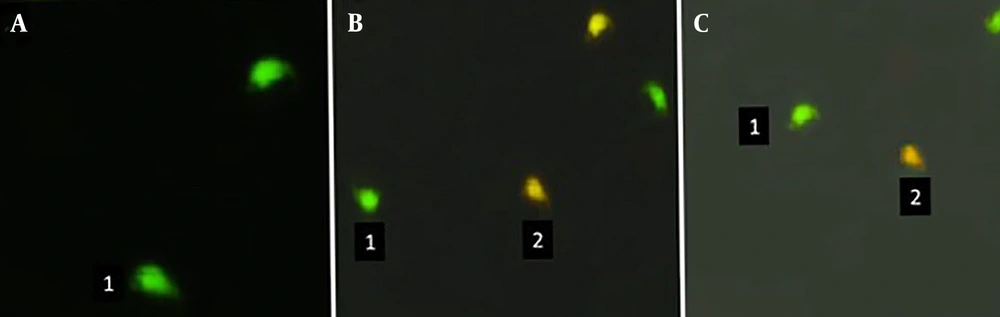
Figure 1.
A, Control; B, fluoxetine (FLX); and C, FLX + GSX: (1) Sperm with normal DNA (green nucleus), (2) sperm with DNA damaged (orange nucleus) (acridine orange, ×1000)
4.2. Immature Sperm
In the FLX-treated group, AB staining revealed a significant increase in the percentage of immature sperm compared to the control and GSE groups after 42 days (P = 0.02). Additionally, there was an important reduction in the percentage of immature sperm in the FLX + GSE group when compared with the FLX-only group (P = 0.04), (Table 1).
4.3. Early Embryo Assay
In the FLX-treated group, in vitro fertilization results revealed a significant reduction in the zygote percentage compared to the control and GSE groups (P = 0.00). Conversely, the FLX + GSE group demonstrated a significant increase in the average zygote percentage at day 42 compared to the FLX group alone (P = 0.04), (Table 1 and Figure 2).
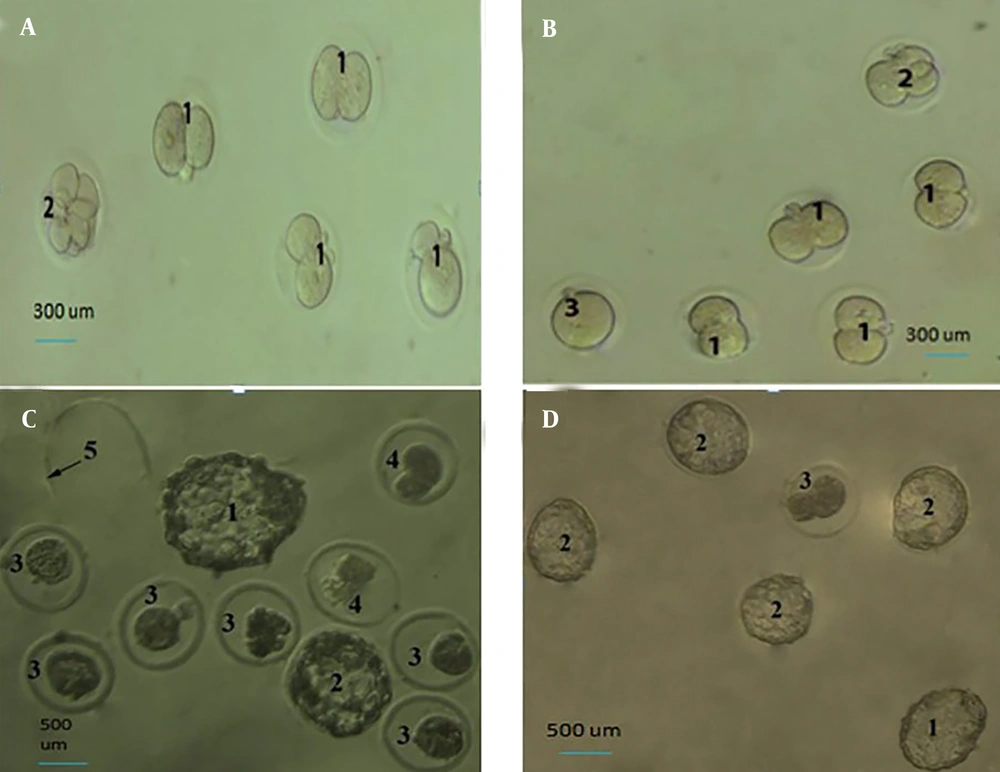
Figure 2.
A, Control; and B, GSX: (1) Two cell stage, (2) one embryo with three cell, (3) Unfertilized oocytes; C, fluoxetine (FLX); and D, FLX + GSX: (1) Hatched embryo, (2) blastocyst stage, (3) unfertilized oocytes, (4) arrested embryo, (5) zonapellucida
The comparison of the average percentage of two-cell embryos across different groups revealed no significant differences after 42 days (P = 0.25), (Table 1 and Figure 2).
In the FLX-treated group, the percentage of embryos reaching the blastocyst stage was significantly lower than in both the control and GSE groups (P = 0.02). Moreover, the FLX + GSE group showed a significant increase in the percentage of blastocyst-stage embryos compared to just the FLX group. (P = 0.01), (Table 1 and Figure 2).
5. Discussion
This study found that FLX significantly increased the percentage of immature sperms and sperms with damaged DNA compared to the control and GSE treated groups. A reduction in immature sperms and sperms with damaged DNA was observed in the (FLX + GSE) group compared with the FLX group alone. Many researchers believe that disruptions in DNA packaging can cause damage to the two strands of sperm DNA, potentially leading to sperm apoptosis (13). Physiological changes and transition may mitigate the detrimental effects of oxidative stress (14). Some of these physiological processes include the protamination of sperm. Protamines also appear to play a role in silencing sperm DNA and reprogramming the imprinting patterns of sperm cells (15). Therefore, it can be inferred that the use of FLX may damage the packaging of sperm DNA. The potent antioxidant properties of GSE could potentially mitigate the effects of FLX.
The results of this study revealed a distinguished decrease in the percentages of zygote cells, blastocysts, and hatched embryos in the FLX group compared to the control. It is postulated that FLX prompts the generation of reactive oxygen species (ROS), thereby inducing damage to the sperm membrane through lipid peroxidation.
This damage impedes fatty acid double bonds from participating in membrane penetration reactions, thus preventing damaged sperm from effectively interacting with ovules (16), consequently leading to diminished sperm binding to the ovules, reduced fertilization rates, and fewer zygote cells (17). These findings are supported by a previous study which demonstrated that FLX exacerbates toxicity in embryonic stem cells and inhibits the growth of embryonic mesoderm (2). Similarly, Sanchez et al. reported that antidepressants such as FLX during pregnancy cause craniofacial defects due to serotonin-mediated deregulation of stem/progenitor cells (18). Grapes are renowned for their significant anti-cancer and antioxidant properties (19). Due to the presence of potent antioxidant agents such as phenolic compounds and proanthocyanidins, GSE is considered a bioactive substance that modulates physiological and cellular activities, potentially offering health benefits (20). The current study demonstrated that co-administration of FLX with GSE markedly increased the percentage of zygote cells, blastocysts, and hatched embryos compared to FLX treatment alone. The antioxidants present in GSE likely counteract the free radicals generated by FLX, thus alleviating oxidative stress in testicular tissue. This reduction in oxidative stress decreases the toxicity of FLX on spermatogenic cells and promotes sperm production. Consequently, this enhances sperm's fertilization capacity with ovules, ultimately improving fertility in mice. Consistent with the present findings, Hajizadeh et al. reported that black GSE mitigates FLX-induced oxidative stress in the mice testis (21).
The use of FLX alone causes disturbances in sperm parameters and decreases fertility in mice. However, the use of GSE along with FLX improves sperm parameters and fertility.

