


1. Background
Adolescents constitute a critical demographic within any societal structure (1). The developmental period of adolescence is marked by a confluence of physiological, psychological, academic, and social transformations, alongside evolving family dynamics, collectively contributing to a transition from childhood characterized by heightened stress and psychological vulnerability (2, 3). Adolescents actively explore new domains through risk-taking and experiential learning, pursue evolving academic interests, and cultivate relationships that promote autonomous development (4). Moreover, the exploration and formation of identity is widely recognized as a central characteristic of this developmental phase (5).
Identity is commonly understood as a social construct, incorporating roles, norms, and modes of self-expression that align with gendered presentations (6). Within this conceptualization, gender identity represents a substantial facet of an individual’s comprehensive identity (7). The diagnostic category within the DSM-5 pertaining to sexual and gender identity disorders is structured into three distinct classifications: Sexual function disorders, gender dysphoria, and paraphilias (8). Notably, the term 'gender dysphoria' has superseded the previous diagnostic nomenclature of 'gender identity disorder' (9).
Gender dysphoria is characterized by distress arising from a marked incongruence between one’s experienced/expressed gender and assigned gender, often accompanied by a strong desire to alter one's gender (10, 11). In this condition, while an individual’s physical and sexual appearance, internal sexual organs, hormonal, and chromosomal systems are physiologically intact, they mentally and emotionally deny the validity of their assigned gender (12). Mousavi et al. (13), in their study on individuals with gender dysphoria, demonstrated that rumination has a direct and significant effect on suicidal ideation. Human gender identity is modulated by both inherent and acquired factors. Sex constitutes an inherent dimension, encompassing the physical, biological, and chromosomal attributes that delineate male and female distinctions (14). Conversely, sexuality operates as an acquired construct, differentiating males and females within a socio-cultural framework, and is predicated upon attributes commonly associated with each respective gender (15).
An inherent contributor to pathologies related to gender identity, potentially including gender dysphoria, is the individual’s brain-behavioral systems (10). Brain-behavioral systems, as conceptualized by Gray’s reinforcement sensitivity theory, refer to fundamental neural circuits in the brain that underlie individual differences in responses to environmental stimuli, particularly those signaling reward and punishment. Varied neural structures, responding to diverse experiential inputs, elicit distinct motivational mechanisms within individuals. A significant theoretical framework elucidating these motivational mechanisms and the psychopathology of behavioral disorders is reinforcement sensitivity theory. This theory, grounded in the concept of brain-behavioral systems, emphasizes the behavioral activation system (BAS) and the behavioral inhibition system in response to salient stimuli (16). The activation of each system precipitates unique emotional responses, thereby influencing an individual’s behavioral engagement with events (17). Empirical evidence supports the inextricable link between personality and brain-behavioral systems (18). Notably, the biopsychological paradigm has witnessed a substantial proliferation in its explanatory capacity for physical, developmental, and evolutionary disorders in recent years (19).
Brain-behavioral systems delineate an individual’s susceptibility to environmental cues associated with either punishment or reward, thereby offering a neurobiological and genetic framework for understanding personality traits (20). These systems are significantly involved in the genesis of negative perceptions and affective states. Augmentation of the BAS fosters experiences of pleasure and joy, thereby contributing to enhanced psychological well-being (21). Conversely, the experience of frustration or failure within the BAS precipitates negative affect and distress, whereas its hyperactivity can manifest as impulsive behavior. Activation of the behavioral inhibition system engenders feelings of anxiety, apprehension, rumination, and fear, sensitizing the individual to potential threat cues, which may exert detrimental effects on identity constructs, including gender identity (22). Alizadeh et al. (23) reported that deficits in emotion regulation mediated the relationship between the behavioral activation-inhibition system and impulsivity in predicting risky behavior.
Rumination is contemporarily understood as a pattern of persistent and repetitive negative cognition, which perpetuates psychological distress by amplifying emotional dysregulation, intensifying negative affect, cultivating avoidance-oriented negative states, and compromising cognitive performance (24). Functioning as a maladaptive cognitive strategy, rumination is implicated in a spectrum of psychopathological conditions, increasing the vulnerability to psychopathological symptom onset and exacerbating or precipitating affective disorders. It is conceptualized as a form of recurrent negative ideation and is recognized as a metacognitive process that transcends various psychological pathologies (25). Notably, Saleh et al. (26) demonstrated rumination’s mediating role in the development of depressive symptomatology. It is important to acknowledge that cultural factors, such as societal norms and expectations surrounding gender expression, can significantly influence both the experience of gender dysphoria and the propensity for rumination. In a society like Iran, where traditional gender roles may be strongly emphasized, adolescents experiencing gender dysphoria might face unique stressors, including social stigma and limited acceptance, which could exacerbate rumination. These cultural influences should be considered when interpreting the generalizability of research findings. In light of the escalating prevalence of gender dysphoria, investigating the mediating influence of rumination offers valuable insights into the etiology and facilitates the development of more efficacious therapeutic interventions for adolescents experiencing gender dysphoria.
2. Objectives
Consequently, the present study aimed to explore the mediating influence of rumination in the relationship linking brain-behavioral systems to gender dysphoria within a cohort of adolescent females.
3. Methods
This study utilized a descriptive correlational design, employing structural equation modeling (SEM) for data analysis. The target population comprised all female adolescents aged 13 to 18 years, residing within the city of Ahvaz, Iran, during the year 2024. The exclusive focus on female adolescents in this study was driven by the need to examine the specific interplay of brain-behavioral systems, rumination, and gender dysphoria within a relatively homogeneous group, allowing for a more nuanced understanding of these relationships. It also acknowledges potential gender-specific manifestations and experiences of gender dysphoria during adolescence. A sample of 316 female adolescents was obtained through a multi-stage cluster random sampling procedure. Specifically, two educational districts within Ahvaz were selected, and from each district, one secondary school was randomly chosen. Subsequently, four classrooms were randomly selected from each participating school. Prior to the administration of questionnaires, informed consent was obtained from both the participants and their parents/legal guardians, ensuring ethical compliance due to the participants’ minor status. Questionnaires were then administered to all students present in the selected classrooms who provided informed consent and fulfilled the inclusion criteria. Inclusion criteria included the absence of diagnosed psychological or sensory-motor disorders and consistent school attendance. Exclusion criteria encompassed a refusal to complete the questionnaires and the submission of incomplete or invalid questionnaire data.
3.1. Instruments
To assess gender identity/gender dysphoria in adolescents, the questionnaire developed by Deogracias et al. (27) was utilized. This questionnaire comprises 27 items, each scored on a five-point Likert scale ranging from 'always' (1) to 'never' (5). The questionnaire consists of four subscales: Gender identity doubt and physical change (16 items), social pressure (5 items), behavioral manifestations (3 items), and Subjective Index of Dissatisfaction (3 items). In the study by Soltanizadeh et al. (28), the face, content, and construct validity of the questionnaire were examined and confirmed. The reliability was evaluated using Cronbach’s alpha coefficient in the current sample, yielding the following results: Gender identity doubt and physical change subscale: 0.94, social pressure subscale: 0.73, behavioral manifestations subscale: 0.75, Subjective Index of Dissatisfaction subscale: 0.72, and the overall gender dysphoria score: 0.92.
This instrument, developed by Carver and White (29) and grounded in Gray’s reinforcement sensitivity theory, comprises 24 items. Specifically, 7 items assess the behavioral inhibition system, which measures an individual's sensitivity to punishment and the experience of anxiety in response to threat-related stimuli. The BAS Scale, consisting of 13 items, quantifies sensitivity to reward and is further divided into three subscales: Behavioral activation system-drive (4 items), BAS-fun seeking (4 items), and BAS-reward responsiveness (5 items). Four additional items are included as filler items and are not utilized in the scoring or interpretation of the scales. Each item is rated on a four-point Likert scale, ranging from 'strongly agree' (4) to 'strongly disagree' (1). Higher aggregate scores on each respective behavioral inhibition system or BAS Scale signify heightened sensitivity within that specific system. In the current sample, the reliability was evaluated using Cronbach’s alpha coefficient, yielding the following results: Behavioral inhibition system: 0.78, BAS-drive: 0.81, BAS-fun seeking: 0.74, BAS-reward responsiveness: 0.79, and the overall BAS Scale: 0.85. The reported reliability coefficients for the brain-behavioral systems scales in the original study range from 0.65 to 0.86 (29).
To assess rumination styles in response to negative affect, participants completed the 22-item RRS (30). This self-report measure utilizes a four-point Likert scale, evaluating responses across three subscales: Reflection (5 items), brooding (5 items), and depression (12 items). While prior research has indicated high internal consistency (Cronbach’s alpha = 0.90) (31), the present study found the following Cronbach’s alpha coefficients for the current sample: Reflection: 0.79, brooding: 0.82, depression: 0.85, and overall RRS: 0.81, demonstrating acceptable reliability within this sample.
3.2. Statistical Analyses
Data analysis involved both descriptive and inferential statistical methods. Descriptive statistics (means ± standard deviations) were calculated to summarize variable distributions. Pearson’s correlation coefficients were used to examine bivariate relationships. The SEM was employed to test the hypothesized model. Initial data exploration was conducted using SPSS version 27.0, while SEM analyses were performed using AMOS version 24.0.
4. Results
In the present study, 316 adolescent girls participated, with a mean age of 15.97 years and a standard deviation of 1.74 years. Among the participants, 100 individuals (31.6%) were enrolled in the first cycle of secondary education, and 216 individuals (68.4%) were enrolled in the second cycle of secondary education. Table 1 presents the means, standard deviations, and correlation coefficients among brain-behavioral systems, rumination, and gender dysphoria. The correlation coefficients presented in Table 1 demonstrated statistically significant relationships among the research variables. Additionally, the skewness and kurtosis values for all variables, as shown in Table 1, fell within the acceptable range of ± 2. This observation confirms that the assumption of normality for data distribution was satisfied.
Table 1.Means, Standard Deviations, Skewness, Kurtosis, and Correlation Coefficients of Research Variables
| Variables | 1 | 2 | 3 | 4 | 5 | 6 | 7 | 8 | 9 | 10 | 11 |
|---|---|---|---|---|---|---|---|---|---|---|---|
| Behavioral inhibition | 1 | - | - | - | - | - | - | - | - | - | - |
| Behavioral activation-drive | -0.07 | 1 | - | - | - | - | - | - | - | - | - |
| Behavioral activation-fun seeking | -0.12 a | 0.61 b | 1 | - | - | - | - | - | - | - | - |
| Behavioral activation-reward responsiveness | -0.15 a | 0.56 b | 0.52 b | 1 | - | - | - | - | - | - | - |
| Rumination-expression | 0.19 b | -0.44 b | -0.36 b | -0.57 b | 1 | - | - | - | - | - | - |
| Rumination-brooding | 0.13 a | -0.34 b | -0.23 b | -0.45 b | 0.54 b | 1 | - | - | - | - | - |
| Rumination-depression | 0.23 b | -0.36 b | -0.31 b | -0.48 b | 0.57 b | 0.61 b | 1 | - | - | - | - |
| Gender dysphoria-gender identity doubt | 0.25 b | -0.22 b | -0.39 b | -0.33 b | 0.43 b | 0.49 b | 0.31 b | 1 | - | - | - |
| Gender dysphoria-social pressure | 0.23 b | -0.29 b | -0.33 b | -0.39 b | 0.50 b | 0.46 b | 0.27 b | 0.64 b | 1 | - | - |
| Gender dysphoria-behavioral manifestations | 0.21 b | -0.33 b | -0.35 b | -0.27 b | 0.39 b | 0.46 b | 0.30 b | 0.61 b | 0.58 b | 1 | - |
| Gender dysphoria-Subjective Index of Dissatisfaction | 0.26 b | -0.18 b | -0.37 b | -0.30 b | 0.27 b | 0.51 b | 0.36 b | 0.55 b | 0.63 b | 0.67 b | 1 |
| Mean ± SD | 17.21 ± 3.79 | 11.16 ± 3.02 | 10.28 ± 2.98 | 13.32 ± 3.39 | 12.49 ± 2.82 | 11.98 ± 2.64 | 25.79 ± 5.48 | 21.19 ± 5.58 | 8.20 ± 2.03 | 5.60 ± 1.94 | 6.28 ± 2.40 |
| Skewness | -0.86 | -0.35 | -1.07 | 0.39 | -0.26 | 0.18 | 0.79 | -0.21 | -0.44 | -0.53 | -0.13 |
| Kurtosis | -0.37 | -0.79 | 0.28 | 0.17 | 0.98 | -0.52 | 0.67 | -0.19 | -0.10 | -1.03 | -0.19 |
a A P ≤ 0.05 is considered statistically significant.
b A P ≤ 0.01 is considered statistically significant.
Table 2 presents the goodness-of-fit indices for the hypothesized structural model, which were used to evaluate the model’s capacity to accurately reproduce the observed covariance matrix. The chi-square statistic (χ2) was 46.03 with 32 degrees of freedom, resulting in a χ2/df ratio of 1.44. This value falls within the acceptable range of 1 to 3, suggesting a good fit. Furthermore, the Goodness-of-Fit Index (GFI) and the Adjusted Goodness-of-Fit Index (AGFI) were 0.97 and 0.95, respectively, both exceeding the recommended threshold of 0.95 for a strong model fit. Similarly, the Comparative Fit Index (CFI) was 0.99, surpassing the recommended value of 0.95 and further supporting the model's adequacy. Finally, the Root Mean Square Error of Approximation (RMSEA) was 0.03, falling below the cutoff value of 0.08, indicating a close approximation of the model to the population covariance matrix.
Table 2.Fit Indicators of the Research Model
| Fit Indicators | χ2 | df | (χ2/df) | GFI | AGFI | CFI | RMSEA |
|---|---|---|---|---|---|---|---|
| Model | 46.03 | 32 | 1.44 | 0.97 | 0.95 | 0.99 | 0.03 |
| Acceptable range | - | - | 1 to 3 | > 0.90 | > 0.90 | > 0.90 | < 0.08 |
Abbreviations: GFI, Goodness-of-Fit Index; AGFI, Adjusted Goodness-of-Fit Index; CFI, Comparative Fit Index; RMSEA, Root Mean Square Error of Approximation.
Table 3 presents the standardized path coefficients, both direct and indirect, derived from the structural equation model. This model examined the interrelationships between behavioral inhibition, behavioral activation, rumination, and gender dysphoria in a sample of adolescent girls. The analysis revealed several significant direct effects. Behavioral inhibition was positively associated with rumination (β = 0.25, P < 0.001), while behavioral activation was negatively associated with rumination (β = -0.62, P < 0.001). Furthermore, rumination exhibited a significant positive direct effect on gender dysphoria (β = 0.53, P < 0.001). Direct effects were also observed between behavioral inhibition and gender dysphoria (β = 0.15, P < 0.001), and between behavioral activation and gender dysphoria (β = -0.38, P < 0.001). Critically, the model also revealed significant indirect effects. Rumination mediated the relationship between behavioral inhibition and gender dysphoria (β = 0.13, P < 0.001), as well as the relationship between behavioral activation and gender dysphoria (β = -0.33, P < 0.001). These findings underscore the significant role of rumination as a mediator in the pathways linking brain-behavioral systems to gender dysphoria among adolescent girls. Figure 1 shows the research model.
Table 3.Direct and Indirect Paths in the Research Model
| Paths | B | SE | β | P-Value |
|---|---|---|---|---|
| Behavioral inhibition → rumination | 0.22 | 0.05 | 0.25 | 0.001 |
| Behavioral activation → rumination | -0.95 | 0.11 | -0.62 | 0.001 |
| Rumination → gender dysphoria | 0.82 | 0.14 | 0.53 | 0.001 |
| Behavioral inhibition → gender dysphoria | 0.21 | 0.07 | 0.15 | 0.001 |
| Behavioral activation → gender dysphoria | -0.91 | 0.17 | -0.38 | 0.001 |
| Behavioral inhibition → gender dysphoria through rumination | 0.18 | 0.06 | 0.13 | 0.001 |
| Behavioral activation → gender dysphoria through rumination | -0.78 | 0.14 | -0.33 | 0.001 |
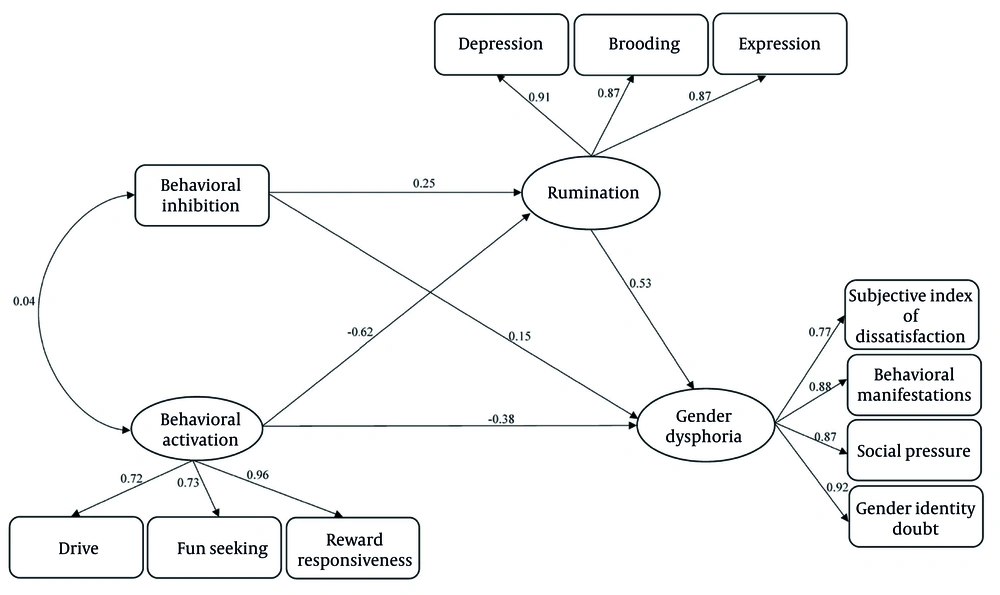
Figure 1.
The mediating role of rumination in the relationship between brain-behavioral systems and gender dysphoria
5. Discussion
This study examined the mediating role of rumination in the relationship between brain-behavioral systems and gender dysphoria among adolescent girls. Findings revealed a significant association between brain-behavioral systems and gender dysphoria. Specifically, the direct path coefficient from the behavioral inhibition system to gender dysphoria was positive and significant, indicating heightened sensitivity to punishment and anxiety in response to threat-related stimuli. Conversely, the direct path coefficient from the BAS to gender dysphoria was negative and significant, suggesting reduced reward sensitivity. These results align with prior research by Boucher and Chinnah (10) and Salmani Kalan and Kiamarsi (32).
Adolescence represents a critical developmental period marked by profound physical, psychological, and social transformations. Although abstract and formal cognitive abilities emerge during this phase, cognitive processing and impulse control remain underdeveloped, reflecting immaturity in brain-behavioral systems (1). The BAS drives reward-seeking, approach behaviors, and positive emotions such as pleasure and tranquility, while reduced BAS sensitivity may lead to diminished positive affect and increased depression risk (16). In this study, adolescents with gender dysphoria exhibited lower BAS sensitivity, potentially due to psychological distress from gender identity conflicts and social marginalization from non-conformity to gender norms (32). This reduced BAS sensitivity may exacerbate clinical symptoms of gender dysphoria. Furthermore, the observed association between low BAS sensitivity and gender dysphoria may be compounded by heightened emotional experiences, such as feelings of helplessness, social withdrawal, and difficulties with emotional expression. These emotional difficulties are consistent with previous research indicating that rumination can amplify negative thinking, impair goal-directed behavior, disrupt problem-solving abilities, and diminish social support, ultimately contributing to the development and maintenance of psychological distress (30).
Moreover, the results demonstrated that rumination significantly mediated the relationship between brain-behavioral systems and gender dysphoria. This finding aligns with previous research highlighting the mediating role of rumination in various psychological processes, including those related to gender dysphoria (13, 23).
The aforementioned findings can be further elucidated within the framework of the biological approach to gender dysphoria. This perspective posits that prenatal exposure to maternal stress can disrupt fetal neurological and endocrine development, potentially increasing the likelihood of subsequent gender identity difficulties. This vulnerability may be linked to the impact of testosterone on the sexual differentiation of the brain, particularly in regions such as the hypothalamus. Indeed, a growing body of research suggests that hormonal and neurological factors play a significant role in the etiology of gender dysphoria (27). Considering that these biologically influenced predispositions might interact with psychological processes like rumination is important. For instance, individuals with prenatal hormonal influences that contribute to gender dysphoria may experience increased distress and social challenges during adolescence. These challenges, in turn, could trigger or exacerbate ruminative thought patterns. Rumination, as a maladaptive coping mechanism, might then amplify the individual’s focus on their distress and perceived incongruence between their experienced gender identity and assigned sex, potentially intensifying gender dysphoria. Therefore, while biological factors may create a vulnerability, psychological factors like rumination can play a crucial role in shaping the individual’s subjective experience and the severity of gender dysphoria.
Gray’s reinforcement sensitivity theory provides a complementary framework for understanding these findings (33). According to this theory, both extreme high and low levels of activity within the brain-behavioral systems can contribute to psychopathology. Specifically, the behavioral inhibition system is responsible for mediating responses to aversive stimuli and resolving goal conflicts. Heightened behavioral inhibition system activity can increase the negative valence of stimuli, potentially leading to avoidance behaviors and rumination, a cognitive process characterized by repetitive negative thinking. Excessive rumination can disrupt cognitive function, amplify negative emotional states, and contribute to the development and maintenance of psychological distress, including gender dysphoria (34). Therefore, individual differences in brain-behavioral systems, particularly in the interplay between behavioral inhibition and activation, may influence vulnerability to gender dysphoria through their impact on cognitive and affective processes, such as rumination. This highlights the complex interplay between biological and psychological factors in the development of gender dysphoria.
This cross-sectional study, utilizing SEM, examined relationships among brain-behavioral systems, rumination, and gender dysphoria in female adolescents in Ahvaz, Iran. However, the design precludes definitive causal inferences or determination of directional associations. Although significant relationships were observed, whether one variable precedes another remains unclear. Additionally, the sampling, while intended to be representative, may not fully reflect the broader population’s diversity. The focus on female adolescents limits generalizability to males or other cultural contexts. To address these constraints, future research should adopt longitudinal designs to explore temporal dynamics and establish the sequence of variable changes. Such approaches would provide stronger evidence for causal pathways, enhancing the understanding of how brain-behavioral systems and rumination influence gender dysphoria.
5.1. Conclusions
This study elucidates the intricate relationships among brain-behavioral systems, rumination, and gender dysphoria in adolescent girls. The significant positive association between the behavioral inhibition system and gender dysphoria suggests that heightened sensitivity to punishment may exacerbate gender incongruence. Conversely, the negative association between the BAS and gender dysphoria indicates that reduced reward-seeking behaviors may intensify gender-related distress. Additionally, the strong positive correlation between rumination and gender dysphoria highlights the role of repetitive negative thinking in amplifying dysphoric feelings. Critically, rumination’s mediating effect reveals a key psychological pathway linking brain-behavioral systems to gender dysphoria. These findings suggest that interventions targeting rumination could mitigate the impact of the behavioral inhibition system and BAS on gender dysphoria. Future longitudinal research should examine these relationships over time and explore sociocultural moderators. Including male and non-binary youth in future studies would enhance understanding of gender identity’s influence on these dynamics, informing comprehensive, targeted clinical interventions.
