
J Kermanshah Univ Med Sci

Image Credit:J Kermanshah Univ Med Sci

Psychological Well-Being, Happiness, and Life Satisfaction Across Age Groups of Athletes and Non-athletes

Author(s):
Zabihollah KavehfarsaniZabihollah KavehfarsaniZabihollah Kavehfarsani ORCID1,*, Pouran RaeissiPouran RaeissiPouran Raeissi ORCID1
1Department of Counseling, Shahrekord University, Shahrekord, Iran

Journal of Kermanshah University of Medical Sciences:Vol. 29, issue 4; e165725
Published online:Nov 10, 2025
Article type:Research Article
Received:Aug 23, 2025
Accepted:Nov 08, 2025
How to Cite:Kavehfarsani Z, Raeissi P. Psychological Well-Being, Happiness, and Life Satisfaction Across Age Groups of Athletes and Non-athletes.J Kermanshah Univ Med Sci.2025;29(4):e165725.https://doi.org/10.5812/jkums-165725.

Abstract

Background and Objectives:

The present study examined psychological well-being, life satisfaction, and happiness among athletes and non-athletes across different age groups.

Methods:

A causal-comparative design was employed in 2022 - 2023 with 610 participants from Chaharmahal and Bakhtiari province. Participants were selected using proportional stratified cluster sampling. Psychological well-being, life satisfaction, and happiness were assessed using Ryff’s Psychological Well-Being Scale (PWS), Diener’s Satisfaction with Life Scale (SWLS), and Lyubomirsky and Lepper’s Subjective Happiness Scale (SHS). Data were analyzed using multivariate analysis of variance (MANOVA) in SPSS 26.

Results:

The findings revealed a significant difference between athletes and non-athletes in psychological well-being, happiness, and life satisfaction (P < 0.001).

Conclusions:

Regular sports participation is associated with higher psychological well-being, life satisfaction, and happiness. Policymakers should encourage physical activity through accessible programs to improve both mental and physical health.

1. Background

Regular physical activity plays a vital role in maintaining both physical and mental health, reducing stress and anxiety, and promoting psychological well-being and social connectedness (1-6). Psychological well-being — a multidimensional construct encompassing emotional, social, and cognitive functioning — is increasingly recognized as a key determinant of quality of life in the 21st century (7-10). Previous studies have shown that regular exercise enhances psychological well-being by strengthening resilience, improving social relationships, and increasing self-esteem (11-18).

Life satisfaction, another important indicator of mental health, refers to individuals’ cognitive evaluations of their overall quality of life (19-23). Participation in physical and sports activities has been shown to improve self-esteem and leisure satisfaction, which consequently enhance life satisfaction (24, 25). Athletes often report higher levels of life satisfaction due to positive social interactions, teamwork, and supportive networks developed through sports participation (20-26). Similarly, happiness — a subjective component of individual and social well-being — is strongly associated with exercise. Empirical evidence indicates that regular engagement in sports promotes physical health, facilitates socialization, and builds self-confidence, all of which contribute to higher levels of happiness (27-35).

Chaharmahal and Bakhtiari province, characterized by its diverse ethnic composition — including Bakhtiari, Qashqai Turk, and Fars groups — and an active lifestyle, offers a distinctive setting for studying the psychological effects of physical activity. Although numerous studies have explored the relationship between exercise and mental health, limited research has examined psychological well-being, life satisfaction, and happiness across different age groups of athletes and non-athletes in the Iranian cultural context.

2. Objectives

To address this gap, the present study aimed to compare these psychological indicators among athletes and non-athletes across various age groups in Chaharmahal and Bakhtiari province.

3. Methods

This study employed a causal-comparative design. The statistical population consisted of all men and women aged 18 to 75 years residing in Chaharmahal and Bakhtiari province during 2022 - 2023. According to the latest census, this population included approximately 600,446 individuals. Based on official data from the Provincial Department of Sports and Youth, about 35,000 individuals were registered as organized athletes. The minimum sample size was estimated using Cochran’s formula, indicating a requirement of at least 384 participants. Additionally, a power analysis was performed to ensure sufficient statistical power for between-group comparisons (athletes vs. non-athletes) using an independent samples t-test. Assuming a small effect size (Cohen’s d = 0.25), a significance level of α = 0.05, and a statistical power of 0.80, the required sample size was approximately 306 participants per group (total ≈ 612), calculated using the pwr package in R (36). To enhance representativeness, 620 questionnaires were distributed, and after excluding 10 with more than 20% missing responses, data from 610 participants were included in the final analyses.

A stratified proportional cluster sampling method was employed, with clusters corresponding to the six county centers of the province. Participants were recruited from sports clubs, public areas (e.g., parks, markets), mosques, and residential neighborhoods. Inclusion criteria were: (A) residency in Chaharmahal and Bakhtiari province; (B) willingness to participate; (C) sufficient literacy to complete the questionnaire; and (D) age of 18 years or older, as approved by the Provincial Sports and Youth Department’s Planning Council. Participants with more than 20% incomplete responses were excluded.

All ethical considerations were observed. Participants were informed about the study objectives and procedures, their right to withdraw at any time, and the confidentiality of their data. Questionnaires were administered only after obtaining written informed consent. Data analysis was conducted using multivariate analysis of variance (MANOVA) in SPSS version 26.

3.1. Instruments

3.1.1. Ryff’s Psychological Well-Being Scale

The 18-item Psychological Well-Being Scale (PWS, Ryff, 1989) assesses six dimensions of well-being — autonomy, environmental mastery, personal growth, positive relations, purpose in life, and self-acceptance — on a 6-point Likert scale. Total scores range from 18 to 108, with higher scores indicating greater psychological well-being. Reported reliability coefficients range from 0.81 to 0.93 (37). The Persian version validated by Khanjani et al. showed Cronbach’s α = 0.71 (38), and α = 0.73 in the present study.

3.1.2. Satisfaction with Life Scale

The Satisfaction with Life Scale (SWLS, Diener et al., 1985) includes five items rated on a 5-point Likert scale, yielding total scores between 5 and 25; higher scores reflect greater life satisfaction. Reported reliability exceeds 0.80 (39). The Persian adaptation by Bayani et al. demonstrated α = 0.83 (40), and α = 0.86 in this study.

3.1.3. Subjective Happiness Scale

The Subjective Happiness Scale (SHS, Lyubomirsky and Lepper, 1999) comprises four items rated on a 7-point scale, producing total scores from 4 to 28. Reported reliability ranges from 0.79 to 0.94 (41). The Persian version validated by Aghababaei and Farahani showed α = 0.76 (42), and α = 0.74 in this study.

3.1.4. Operational Definition of “Athlete”

Following Araujo and Scharhag, an athlete was defined as an individual who: (A) trains regularly to improve performance, (B) participates in official competitions, (C) is formally registered with a sports federation, and (D) devotes substantial daily time to training. Individuals engaging in physical activity solely for recreation or health purposes were classified as non-athletes (43).

4. Results

4.1. Participants’ Characteristics and Statistical Analysis

The final sample consisted of 610 participants, including 305 athletes and 305 non-athletes, with an equal gender distribution (50% female, 50% male). Age groups were distributed as follows: 20 - 30 years (31%), 30 - 40 years (26%), 40 - 50 years (19%), 50 - 60 years (14%), and 60 - 70 years (10%). Overall, 66.1% of participants were married, and 43.8% held a bachelor’s degree. The MANOVA was employed to compare psychological well-being, life satisfaction, and happiness across age groups.

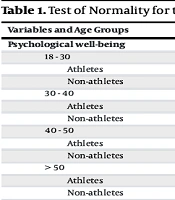
As shown in Table 1, all study variables exhibited a normal distribution across age groups and participant types (athletes and non-athletes), as indicated by the Jarque-Bera test (P > 0.05). Moreover, Levene’s test confirmed the homogeneity of error variances across groups (P > 0.05), and Box’s M test supported the assumption of homogeneity of covariance matrices (P > 0.05). Table 2 also presents the results of the MANOVA.

Table 1.Test of Normality for the Study Variables by Age Group (Athletes and Non-athletes)
Variables and Age GroupsMean ± SDχ2dfP-Value
Psychological well-being
18 - 303.3020.192
Athletes72.20 ± 9.27
Non-athletes67.75 ± 10.18
30 - 402.8220.240
Athletes72.75 ± 8.59
Non-athletes70.56 ± 9.93
40 - 502.1820.340
Athletes74.36 ± 10.23
Non-athletes70.30 ± 10.22
> 501.9720.370
Athletes68.61 ± 13.58
Non-athletes69.12 ± 9.78
Happiness
18 - 303.4220.180
Athletes18.11 ± 4.99
Non-athletes14.73 ± 4.87
30 - 402.6820.260
Athletes16.51 ± 5.49
Non-athletes14.74 ± 5.29
40 - 501.1120.570
Athletes18.52 ± 4.78
Non-athletes15.88 ± 5.83
> 503.9820.140
Athletes17.38 ± 4.70
Non-athletes14.70 ± 4.73
Life satisfaction
18 - 303.3620.190
Athletes23.29 ± 6.39
Non-athletes18.44 ± 7.34
30 - 403.0920.210
Athletes22.45 ± 7.81
Non-athletes19.89 ± 7.35
40 - 501.5120.470
Athletes23.94 ± 7.80
Non-athletes20.55 ± 7.56
> 502.5320.280
Athletes22.89 ± 6.85
Non-athletes19.32 ± 7.18
Table 2.Multivariate Tests
EffectTestsValueFdf Effectdf ErrorP-Value
GroupingWilks’ lambda0.27569.7453.000606.0000.001
Hotelling’s trace0.74369.7453.000606.0000.001
Pillai’s trace0.34569.7453.000606.0000.001
Roy’s largest root0.34569.74534.000606.0000.001

As shown in Table 2, the obtained F-value was 69.745, and Wilks’ Lambda was 0.743, which was statistically significant at P < 0.001. Therefore, the effect of the grouping factor was significant. In other words, it can be inferred that there is a significant difference between athletes and non-athletes in at least one of the dependent variables under study.

As shown in Table 3, the F-values for psychological well-being, happiness, and life satisfaction were 109.349, 141.941, and 127.641, respectively, all of which were significant at P < 0.001. These findings indicate that there are significant differences between athletes and non-athletes in terms of psychological well-being, happiness, and life satisfaction. Moreover, the calculated effect sizes (η2 = 0.152, 0.189, and 0.173, respectively) suggest that these differences are not only statistically significant but also large in magnitude, based on Cohen’s (1988) criteria.

Table 3.ANOVA Results for Dependent Variables
Source of VariationDependent VariablesSum of SquaresdfMean SquareFη2P-Value
GroupPsychological well-being10484.985110484.985109.3490.1520.000
Happiness3263.80513263.805141.9410.1890.000
Life satisfaction5862.10015862.100127.6410.1730.000

5. Discussion

This study demonstrates that athletes report higher psychological well-being, life satisfaction, and happiness compared with non-athletes. Although age-related differences were not statistically significant, the gap between athletes and non-athletes was more pronounced in younger adults (18 - 30 years), suggesting that early adulthood may be a period of greater psychological benefit from sports participation.

Higher psychological well-being among athletes aligns with prior findings (14-18). Sports participation fosters personal growth, resilience, self-awareness, social competence, self-esteem, and effective stress management. The structured and social nature of sports supports coping with everyday stressors, contributing to overall well-being.

Greater life satisfaction among athletes reflects improved physical health, social connectedness, self-esteem, and a sense of achievement and belonging (20-26). Similarly, higher happiness corroborates previous evidence linking sports participation to vitality, emotional balance, and social integration (32-35). Sports fulfill fundamental psychological needs for competence, relatedness, and autonomy, which underpin subjective well-being. Overall, these findings emphasize the importance of regular physical activity for mental health and highlight the value of promoting sports participation across populations.

5.1. Conclusions

Athletes demonstrated significantly higher psychological well-being, life satisfaction, and happiness than non-athletes across all age groups. Younger athletes appeared to derive the greatest psychological benefit. Future research should employ longitudinal or experimental designs to clarify causal relationships, investigate underlying mechanisms, and examine long-term effects. Policies and programs promoting inclusive and accessible sports participation may enhance population-level mental health and quality of life.

5.2. Limitations

The causal-comparative design limits causal inference. Reliance on self-reported measures may introduce bias. The regional sample restricts generalizability. Future studies should include multi-method assessments and broader, more diverse populations.
Acknowledgments

Footnotes

References

  • 1.
    Schuch FB, Vancampfort D. Physical activity, exercise, and mental disorders: it is time to move on. Trends Psychiatry Psychother. 2021;43(3):177-84. [PubMed ID: 33890431]. [PubMed Central ID: PMC8638711]. https://doi.org/10.47626/2237-6089-2021-0237.
  • 2.
    Holmes EA, O'Connor RC, Perry VH, Tracey I, Wessely S, Arseneault L, et al. Multidisciplinary research priorities for the COVID-19 pandemic: a call for action for mental health science. Lancet Psychiatry. 2020;7(6):547-60. [PubMed ID: 32304649]. [PubMed Central ID: PMC7159850]. https://doi.org/10.1016/S2215-0366(20)30168-1.
  • 3.
    Borrega-Mouquinho Y, Sanchez-Gomez J, Fuentes-Garcia JP, Collado-Mateo D, Villafaina S. Effects of High-Intensity Interval Training and Moderate-Intensity Training on Stress, Depression, Anxiety, and Resilience in Healthy Adults During Coronavirus Disease 2019 Confinement: A Randomized Controlled Trial. Front Psychol. 2021;12:643069. [PubMed ID: 33716913]. [PubMed Central ID: PMC7943442]. https://doi.org/10.3389/fpsyg.2021.643069.
  • 4.
    Martin-Rodriguez A, Gostian-Ropotin LA, Beltran-Velasco AI, Belando-Pedreno N, Simon JA, Lopez-Mora C, et al. Sporting Mind: The Interplay of Physical Activity and Psychological Health. Sports. 2024;12(1):37. [PubMed ID: 38275986]. [PubMed Central ID: PMC10819297]. https://doi.org/10.3390/sports12010037.
  • 5.
    Qiu J, Shen B, Zhao M, Wang Z, Xie B, Xu Y. A nationwide survey of psychological distress among Chinese people in the COVID-19 epidemic: implications and policy recommendations. Gen Psychiatr. 2020;33(2). e100213. [PubMed ID: 32215365]. [PubMed Central ID: PMC7061893]. https://doi.org/10.1136/gpsych-2020-100213.
  • 6.
    Srivastav AK, Sharma N, Samuel AJ. Impact of Coronavirus disease-19 (COVID-19) lockdown on physical activity and energy expenditure among physiotherapy professionals and students using web-based open E-survey sent through WhatsApp, Facebook and Instagram messengers. Clin Epidemiol Glob Health. 2021;9:78-84. [PubMed ID: 32838062]. [PubMed Central ID: PMC7358172]. https://doi.org/10.1016/j.cegh.2020.07.003.
  • 7.
    Muqodas I, Kartadinata S, Nurihsan J, Dahlan T, Yusuf S, Imaddudin A. Psychological well-being: A preliminary study of guidance and counseling services development of preservice teachers in Indonesia. International Conference on Educational Psychology and Pedagogy-" Diversity in Education"(ICEPP 2019). Bandung City, Indonesia. Atlantis Press; 2020. p. 56-60.
  • 8.
    Kubzansky LD, Kim ES, Boehm JK, Davidson RJ, Huffman JC, Loucks EB, et al. Interventions to Modify Psychological Well-Being: Progress, Promises, and an Agenda for Future Research. Affect Sci. 2023;4(1):174-84. [PubMed ID: 37064816]. [PubMed Central ID: PMC9982781]. https://doi.org/10.1007/s42761-022-00167-w.
  • 9.
    Gao J, McLellan R. Using Ryff's scales of psychological well-being in adolescents in mainland China. BMC Psychol. 2018;6(1):17. [PubMed ID: 29678202]. [PubMed Central ID: PMC5910620]. https://doi.org/10.1186/s40359-018-0231-6.
  • 10.
    Ryff CD. Entrepreneurship and Eudaimonic Well-Being: Five Venues for New Science. J Bus Ventur. 2019;34(4):646-63. [PubMed ID: 31105380]. [PubMed Central ID: PMC6516495]. https://doi.org/10.1016/j.jbusvent.2018.09.003.
  • 11.
    Park CL, Kubzansky LD, Chafouleas SM, Davidson RJ, Keltner D, Parsafar P, et al. Emotional Well-Being: What It Is and Why It Matters. Affect Sci. 2023;4(1):10-20. [PubMed ID: 37070009]. [PubMed Central ID: PMC10104995]. https://doi.org/10.1007/s42761-022-00163-0.
  • 12.
    Friedman EM, Ruini C, Foy CM, Jaros L, Love G, Ryff CD. Lighten UP! A Community-Based Group Intervention to Promote Eudaimonic Well-Being in Older Adults: A Multi-Site Replication with 6 Month Follow-Up. Clin Gerontol. 2019;42(4):387-97. [PubMed ID: 30767628]. [PubMed Central ID: PMC6715420]. https://doi.org/10.1080/07317115.2019.1574944.
  • 13.
    Diener E, Lucas RE, Oishi S. Advances and Open Questions in the Science of Subjective Well-Being. Collabra Psychol. 2018;4(1). [PubMed ID: 30637366]. [PubMed Central ID: PMC6329388]. https://doi.org/10.1525/collabra.115.
  • 14.
    Ghiami Z, Khalaghi K, Soh KG, Roslan S. Comparison of Mental Health Components among Athlete and Non-athlete Adolescents. Int J Kinesiol Sports Sci. 2015;3(3):33-7. https://doi.org/10.7575/aiac.ijkss.v.3n.3p.33.
  • 15.
    Gül Ö, Çağlayan HS, Akandere M. The Effect of Sports on the Psychological Well-being Levels of High School Students. J Educ Train Stud. 2017;5(5):72-80. https://doi.org/10.11114/jets.v5i5.2270.
  • 16.
    Alamdarloo GH, Shojaee S, Asadmanesh E, Sheikhani Shahin H, Rangani A, Negahdarifard S. A comparison of psychological well-being in athlete and non-athlete women. Balt J Health Phys Act. 2019;11(2):109-16. https://doi.org/10.29359/bjhpa.11.2.11.
  • 17.
    Kafkas ME, Açak M, Çoban B, Karademİr T. Investigation of the Relationship between Preservice Physical Education Teachers' Sense of Self-Efficacy and Professional Concerns. Inonu Univ J Faculty Educ. 2010;11(2).
  • 18.
    Woods D, Breslin G, Hassan D. A systematic review of the impact of sport-based interventions on the psychological well-being of people in prison. Ment Health Phys Act. 2017;12:50-61. https://doi.org/10.1016/j.mhpa.2017.02.003.
  • 19.
    Taş İ, İskender M. An Examination of Meaning in Life, Satisfaction with Life, Self-Concept and Locus of Control among Teachers. J Educ Train Stud. 2017;6(1):21-31. https://doi.org/10.11114/jets.v6i1.2773.
  • 20.
    Mutz M, Reimers AK, Demetriou Y. Leisure Time Sports Activities and Life Satisfaction: Deeper Insights Based on a Representative Survey from Germany. Appl Res Qual Life. 2020;16(5):2155-71. https://doi.org/10.1007/s11482-020-09866-7.
  • 21.
    Luo L. The key to life satisfaction in emerging adults: unlocking the secrets of self-efficacy and physical activity. Front Public Health. 2024;12:1431255. [PubMed ID: 39606087]. [PubMed Central ID: PMC11598934]. https://doi.org/10.3389/fpubh.2024.1431255.
  • 22.
    Sulandari S, Johnson J, Coats RO. Life satisfaction and its associated factors among young and older adults in the United Kingdom (UK). Aging Ment Health. 2025;29(4):687-95. [PubMed ID: 39611615]. https://doi.org/10.1080/13607863.2024.2432380.
  • 23.
    Rony MKK, Parvin MR, Wahiduzzaman M, Akter K, Ullah M, Zhang J. Challenges and Advancements in the Health-Related Quality of Life of Older People. Adv Public Health. 2024;2024:1-18. https://doi.org/10.1155/2024/8839631.
  • 24.
    Sirgy M, Uysal M, Kruger S. Towards a Benefits Theory of Leisure Well-Being. Appl Res Qual Life. 2016;12(1):205-28. https://doi.org/10.1007/s11482-016-9482-7.
  • 25.
    Schulz P, Schulte J, Raube S, Disouky H, Kandler C. The Role of Leisure Interest and Engagement for Subjective Well-Being. J Happiness Stud. 2017;19(4):1135-50. https://doi.org/10.1007/s10902-017-9863-0.
  • 26.
    Ivantchev N, Stoyanova S. Relationships in the Workplace and Occupational Attractiveness among Students, Teachers and Rangers-Sportsmen. Probl Psychol 21st Cent. 2016;10(1):22-30. https://doi.org/10.33225/ppc/16.10.22.
  • 27.
    Lozano M, Sole-Auro A. Happiness and life expectancy by main occupational position among older workers: Who will live longer and happy? SSM Popul Health. 2021;13:100735. [PubMed ID: 33511266]. [PubMed Central ID: PMC7815996]. https://doi.org/10.1016/j.ssmph.2021.100735.
  • 28.
    Bostani S, Rambod M, Irani PS, Torabizadeh C. Comparing the effect of progressive muscle relaxation exercise and support group therapy on the happiness of nursing students: A randomized clinical trial study. Int J Africa Nurs Sci. 2020;13:100218. https://doi.org/10.1016/j.ijans.2020.100218.
  • 29.
    Wen M, Ren Q, Korinek K, Trinh HN. Living in skipped generation households and happiness among middle-aged and older grandparents in China. Soc Sci Res. 2019;80:145-55. [PubMed ID: 30955552]. https://doi.org/10.1016/j.ssresearch.2019.01.004.
  • 30.
    Pandey KN. Happiness and Its Factors in Relation to Human Well-Being. Int J Indian Psychol. 2024;12(3).
  • 31.
    Shrivastava Y, Gupta PA. Happiness and Its Relation to Personality, Character Strengths, Emotional Intelligence and Mindfulness: A Review. Int J Indian Psychol. 2024;12(2):3472-87. https://doi.org/10.25215/1202.306.
  • 32.
    Blacklock RE, Rhodes RE, Brown SG. Relationship between regular walking, physical activity, and health-related quality of life. J Phys Act Health. 2007;4(2):138-52. [PubMed ID: 17570884]. https://doi.org/10.1123/jpah.4.2.138.
  • 33.
    Dolan P, Kavetsos G, Vlaev I. The Happiness Workout. Soc Indic Res. 2013;119(3):1363-77. https://doi.org/10.1007/s11205-013-0543-0.
  • 34.
    Huang H, Humphreys BR. Sports participation and happiness: Evidence from US microdata. J Econ Psychol. 2012;33(4):776-93. https://doi.org/10.1016/j.joep.2012.02.007.
  • 35.
    Akin U, Akin A, Ugur E. Mediating Role of Mindfulness on the Associations of Friendship Quality and Subjective Vitality. Psychol Rep. 2016;119(2):516-26. [PubMed ID: 27469364]. https://doi.org/10.1177/0033294116661273.
  • 36.
    Champely S, Ekstrom C, Dalgaard P, Gill J, Weibelzahl S, Anandkumar A, et al. pwr: Basic functions for power analysis. R package version 1.3-0. 2020. Available from: https://cran.r-project.org/web/packages/pwr/pwr.pdf.
  • 37.
    Ryff CD. Happiness is everything, or is it? Explorations on the meaning of psychological well-being. J Person Soc Psychol. 1989;57(6):1069-81. https://doi.org/10.1037/0022-3514.57.6.1069.
  • 38.
    Khanjani M, Shahidi S, Fathabadi J, Mazaheri MA, Shokri O. [Factor structure and psychometric properties of the Ryff’s scale of Psychological well-being, short form (18-item) among male and female students]. Thoughts Behav Clin Psychol. 2014;9(32):27-36. FA.
  • 39.
    Diener E, Emmons RA, Larsen RJ, Griffin S. The Satisfaction With Life Scale. J Pers Assess. 1985;49(1):71-5. [PubMed ID: 16367493]. https://doi.org/10.1207/s15327752jpa4901_13.
  • 40.
    Bayani AA, Koocheky AM, Goodarzi H. [The reliability and validity of the satisfaction with life scale]. J Iran Psychol. 2007;3(11):259-65. FA.
  • 41.
    Lyubomirsky S, Lepper HS. A Measure of Subjective Happiness: Preliminary Reliability and Construct Validation. Soc Indic Res. 1999;46(2):137-55. https://doi.org/10.1023/a:1006824100041.
  • 42.
    Aghababaei N, Farahani H. [The role of trait gratitude in predicting psychological and subjective well-being]. Development Psychol. 2011;8(29):75-85. FA.
  • 43.
    Araujo CG, Scharhag J. Athlete: a working definition for medical and health sciences research. Scand J Med Sci Sports. 2016;26(1):4-7. [PubMed ID: 26750158]. https://doi.org/10.1111/sms.12632.

Crossmark
Crossmark
Checking
Share on
Cited by
Metrics

Purchasing Reprints

  • Copyright Clearance Center (CCC) handles bulk orders for article reprints for Brieflands. To place an order for reprints, please click here (   https://www.copyright.com/landing/reprintsinquiryform/ ). Clicking this link will bring you to a CCC request form where you can provide the details of your order. Once complete, please click the ‘Submit Request’ button and CCC’s Reprints Services team will generate a quote for your review.
Search Relations

Author(s):

Related Articles